
I've been around pickups long enough to watch a guy fall in love with a wheel before he ever asked whether it would bolt onto his truck. Happens all the time. Somebody sees a deep-dish, milled-spoke beauty on a buddy's F-150, drops a chunk of money, and then learns the hard way that "looks great" and "fits right" are two very different things. The wheel sits in the garage, still in the box, while he eats the restocking fee.
So when somebody asks me how to choose the right truck rims, I tell them the same thing I tell everybody who rolls into the shop on Cherry Avenue: start with the numbers, end with the looks. A rim that fits your Silverado, your Ram, or your Tacoma — clears the brakes, sits at the right offset, wears the tire you want — is a rim you'll be happy with for years. A rim you picked because it was pretty might rub your fender at the first big bump. This guide walks you through every decision in the order that matters, so you spend your money once and get it right on your pickup.
Here's the thing folks miss. A truck wheel isn't jewelry. It's a structural part. It carries the weight of the truck and takes every pothole, curb, and washboard road you throw at it. A half-ton that mostly commutes and hits the trail on weekends has one set of needs. A mid-size like a Tacoma or Colorado built for the backcountry has another. And a daily-driven Ram that looks sharp in the office lot is a third. Same question — right rims — different answers.
That's why "the right rim" is never just about the style you like. It's about whether the wheel matches your truck's bolt pattern and hub, whether the offset keeps the tire where it belongs, whether the diameter and width play nice with the tire you want to run, and whether the build suits how you actually use the truck. Get those right and you've got a setup that's safe, drives clean, and lasts. Get them wrong and you're looking at rubbing, vibration, premature wear, or worse.
People always ask whether new rims are worth the trouble. They are, when you do it right. The wrong wheels can even cost you at the pump — bigger, heavier setups change how hard your engine works, and we get into exactly how rims can affect your gas mileage in another guide. For now, let's build the decision from the ground up.
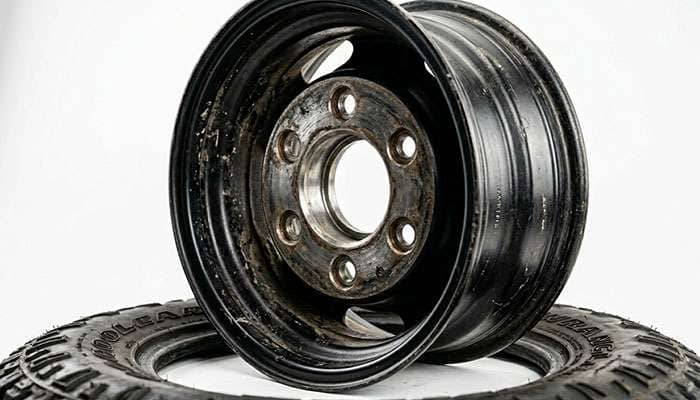
Before you even think about looks, you've got to know three numbers: your bolt pattern, your hub bore, and your lug type. These are the hard gates. If a wheel doesn't clear these, nothing else matters.
Bolt pattern is the count of lug holes and the diameter of the circle they sit on. On pickups you'll mostly see six-lug and eight-lug patterns. A whole lot of modern half-tons — the Chevy Silverado and GMC Sierra 1500, among plenty of others — run a 6x139.7 bolt pattern (that's 6x5.5 in inches). Heavy-duty pickups step up to eight lugs — patterns like 8x165.1 on the Ram 2500/3500 and GM HD trucks, or 8x170 on the Ford Super Duty. If you drive an HD pickup, our breakdown of 8-lug wheels is worth a read before you buy.
Hub bore — also called center bore — is the size of the hole in the middle of the wheel that sits over the hub. On most pickups, the hub carries the weight (that's a "hub-centric" setup), so the bore needs to match the hub or use a hub ring to fill the gap. Run a wheel with too big a bore and no ring, and you'll feel it as a vibration that no amount of balancing fixes. If your new wheels need them, we cover whether you need hub rings in a separate piece.
Lug type matters too. Conical (acorn), flat, and mag seats are not interchangeable. The wrong seat doesn't clamp the wheel properly, and that's a safety problem, plain and simple. When you buy, match the lug nuts to the wheel and the truck.
One more word on this: never guess your fitment off a forum post about "trucks like yours." Trim levels, model years, and factory packages change bolt patterns and hub bores more than people expect — a base half-ton and a loaded one can differ. If you're not certain, our specialists will pull your exact specs by year, make, model, and trim and tell you what bolts up. That's a five-minute phone call that saves a restocking fee.
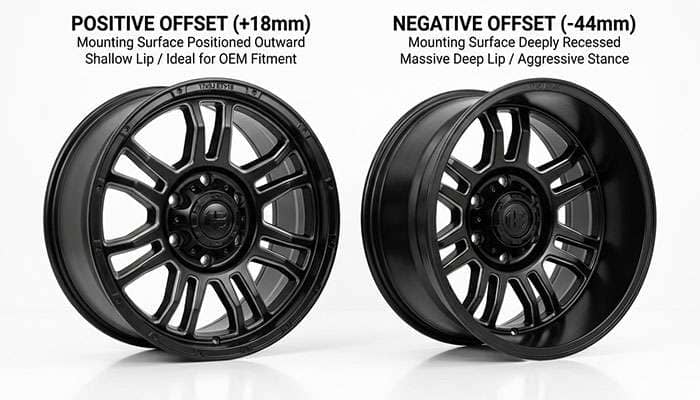
If fitment is the gate, offset is the gatekeeper that trips up the most people. Offset is the distance, in millimeters, between the wheel's mounting surface and its centerline. Positive offset tucks the wheel in toward the truck. Negative offset pushes it out — that's the aggressive "poke" look so many truck guys chase. Backspacing is the same idea measured the other way: the distance from the mounting surface to the back lip of the wheel, in inches.
Here's why it's make-or-break. Push the wheel out too far with too much negative offset, and the tire pokes past the fender — that throws mud and rocks, can rub at full lock, and in a lot of places it's not street-legal without flares. Tuck it in too far with too much positive offset, and the tire can rub the inner fender, the control arms, or the brake calipers. The factory picked your truck's offset for a reason, and every step away from it has a consequence.
For mild upgrades that keep it clean and rub-free, stay close to factory offset. For the wider, more aggressive stance, you're usually moving toward zero or negative offset — and that's when you start thinking about a leveling kit, a lift, or fender flares to make room. If you want the full mechanic's walkthrough, read up on what wheel offset actually does, and learn how to measure wheel offset so you can check a wheel before it ever ships.
My rule of thumb: if you're not lifting the truck, respect the factory offset within a few millimeters and you'll almost never have a problem. If you're going aggressive, plan the suspension and the fenders into the budget from day one. Don't buy the poke and figure out the rubbing later.
Now we get to the size question everybody loves: how big? Pickup wheels commonly run anywhere from 16 inches up to 24 and beyond, with 18-, 20-, and 22-inch sizes being the sweet spot for most owners today. But bigger isn't automatically better, and the right diameter depends on what you do with the truck.
Go bigger in diameter and the tire sidewall usually gets shorter to keep the overall height in check. Short sidewalls look sharp and sharpen steering response, but they give you less cushion against potholes and less air to air-down for off-road traction. That's why a guy who actually wheels his truck often runs a 17- or 18-inch wheel with a taller sidewall, while a guy who lives on pavement and wants the show-truck look reaches for a 22 or 24. Neither is wrong — they're built for different jobs. We dig into how rim size affects ride quality if you want the trade-offs laid out.
Width is just as important and gets less attention. Wheel width has to match the tire's approved rim-width range. Mount a wide tire on too narrow a wheel and the tread bulges and wears funny. Mount a narrow tire on too wide a wheel and you stretch the sidewall and lose protection. Both hurt handling and tire life. Match the wheel width to the tire you actually plan to run, not the other way around. Our guide to truck rim sizes breaks down which widths pair with which tires.
And remember the chain reaction: bumping diameter changes the tire, which changes your speedometer reading and can change clearance. Plan the whole package — wheel, tire, and any lift — together. That's exactly why so many folks buy them as a set, which we'll come back to at the end.
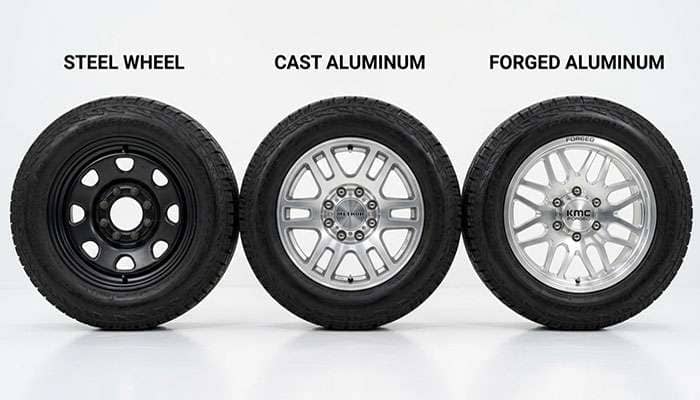
How a wheel is made tells you most of what you need to know about how strong it is, how heavy it is, and how much it costs. Here's the lineup, weakest-to-strongest in the dollars-per-pound sense.
Steel wheels are the old workhorse. They're cheap, they're tough, and when you bend one on a rock you can often beat it back into shape. They're heavy, though, and that weight hurts ride and fuel economy. For a winter set or a trail beater, steel still earns its keep — and we make the honest case for whether steel rims are worth it.
Cast aluminum is where most affordable aftermarket truck wheels live. Molten aluminum is poured into a mold, which keeps the price down and lets makers build wild styles. Plenty of strong, good-looking truck wheels are cast — but cast aluminum is the most porous of the aluminum methods, so it's the heaviest of the alloys for a given strength.
Flow-formed (also called flow-forged) wheels start as a cast center but get the barrel spun and stretched under heat and pressure, which packs the grain tighter. The payoff is a wheel that's lighter and stronger than a plain cast wheel without the price of a true forging. It's the smart middle ground a lot of pickup owners land on.
Forged is the top of the heap. A single billet of aluminum gets squeezed under enormous pressure into a wheel that's the strongest and lightest you can buy. That's why owners who want premium dependability reach for forged names like American Force. The catch is cost — forged wheels are the priciest option, no two ways about it. If you want the full science on how these methods differ, read our deep dive on cast, forged, and flow-formed wheels.
Feature |
Steel |
Cast Aluminum |
Flow-Formed |
Forged |
|---|---|---|---|---|
Weight |
Heaviest |
Moderate |
Light |
Lightest |
Strength |
Tough, bendable |
Good |
Very good |
Strongest |
Cost |
Lowest |
Affordable |
Mid-range |
Highest |
Best for |
Winter and trail bashing |
Daily and budget builds |
Street and trail all-rounders |
Premium and heavy-duty pickups |
Everybody checks the tire's load rating. Fewer folks check the wheel's — and if you use your pickup to tow a boat or haul a bed full of gear, it's worth a look.
Every wheel has a load rating, measured in pounds per wheel, that tells you the maximum weight it's engineered to support. For a pickup, you want a per-wheel rating that comfortably covers your truck's gross vehicle weight rating plus whatever you put in the bed or pull behind you. For a half-ton that mostly commutes, almost any quality truck wheel has you covered. But some flashy, deep-concave "style" wheels are rated for lighter SUVs and cars — so if you've got a three-quarter-ton that tows, take the extra minute to confirm the wheel is rated for your truck, not just built to look good on it.
If the rating isn't published, that's a red flag — ask, or move on. And if you run a dual-rear-wheel truck, the rules tighten up further; our dually buying guide covers what to watch for. When you're not sure what your pickup needs, this is another one for a quick call to our crew — we'd rather talk you into the right rated wheel than sell you a pretty one that's wrong for the job.
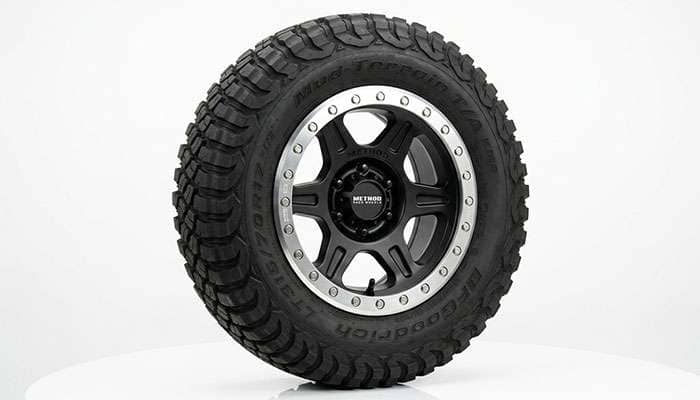
Here's where it all comes together. Once a wheel clears fitment, offset, size, and construction, the last question is the one I always ask first when somebody walks in: how do you actually drive your truck? Match the rim to the way you use it and you'll love it. Here's how I'd point you, with real wheels we carry.
Hard trail and rock work. If you actually air down and crawl, you want a beadlock or beadlock-style wheel that holds the tire to the rim at low pressure. Method builds some of the best in the business — the Method 101, 103, and 105 beadlocks are trail staples. Want to understand why they matter? We explain the real purpose of beadlock wheels in detail.
Aggressive off-road style. For the lifted look with serious attitude, Fuel wheels like the Ammo D700 and D790 and XD Series options like the Bomber XD870, R.O.F. XD869, and Colossus are built for it — deep, milled, and tough. Pairing these with a lift is common, and our roundup of the best wheels for lifted trucks is a great next stop.
Overlanding and daily duty. If you're running fire roads and highway in equal measure, Black Rhino nails the rugged-but-refined look — the Abrams, Alamo, and Arsenal are popular for a reason. Moto Metal's MO400 series and Helo designs hit that all-rounder note too.
Street and show. Living on pavement and chasing curb appeal? Big-diameter, deep-concave wheels from Cali Off-Road (the Busted, Americana, and Twisted) and Fittipaldi's truck line bring the stance. Just keep the load rating honest if you still tow now and then.
Towing and heavy-duty pickups. Eight-lug HD pickups that pull weight want strength first. ATX's AX181 Artillery in 8x170, forged American Force setups, and load-rated forged options are the move here. The strength and rating matter more than the milling.
Smart budget builds. You don't have to spend a fortune. Pro Comp (the Roughneck PA204 and Wraith PA205), Mayhem (Riot, Warrior, Chaos), Dirty Life, and Gear Off-Road all deliver real truck looks and solid construction without the forged price tag.
Still deciding between style families? Our overview of the types of truck rims compares the categories side by side.
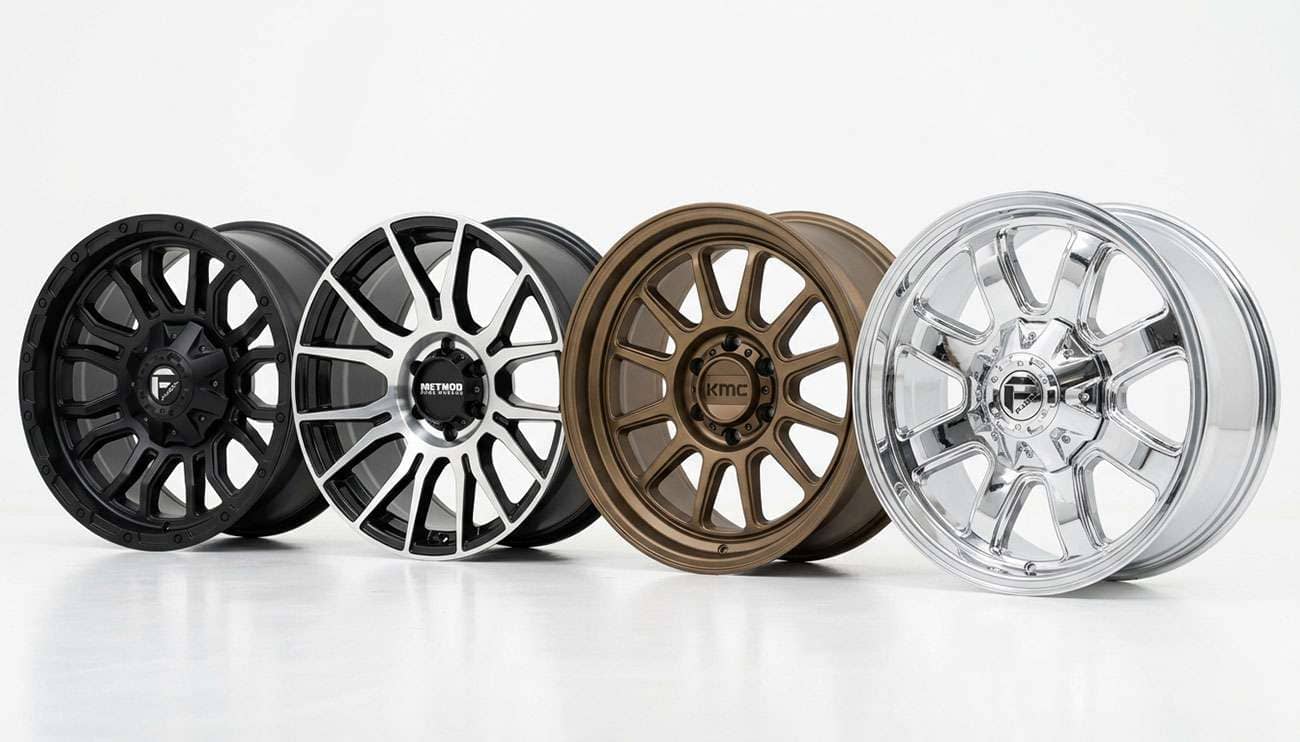
Now — and only now — we talk looks. Finish is the fun part, but it's also a maintenance decision. Matte and satin black hide brake dust and trail grime and have been the dominant truck look for years. Machined and milled faces add contrast and pop but want more cleaning. Chrome shines like nothing else but takes real upkeep to keep from pitting, especially where roads get salted. Bronze and gunmetal have taken off lately as the sharp middle ground. Pick a finish you'll actually keep up with, not just the one that looks best in the showroom lights.
On budget, set a realistic number that covers the whole package — wheels, the right tires, lugs, hub rings if needed, mounting and balancing, and any suspension work the new size demands. The wheels are only part of the bill. Going in with the full picture keeps you from buying gorgeous wheels and then skimping on the tires that actually touch the ground.
And here's my honest two cents on where to buy: buy the wheels and tires together from someone who'll verify your fitment before anything ships. That's the whole reason wheel-and-tire packages exist — you get matched components, mounted and balanced, with the offset and fitment checked against your actual pickup. Browse our full lineup of off-road wheels or the complete wheel catalog, and if you want a human to confirm it all bolts up right, that's exactly what we do at our shop at 3910 Cherry Ave in Long Beach. Call us, tell us your truck and how you drive it, and we'll get you into the right rims the first time.
Choosing the right truck rims isn't complicated once you take it in order. Start with the hard gates — bolt pattern, hub bore, and lugs — because a wheel that doesn't fit is a wheel you can't use. Nail your offset and backspacing so the tire sits where it should. Match diameter and width to the tire and the way you drive. Pick a construction that suits your truck, and check the load rating if you tow. Then, and only then, choose the style and finish you'll be proud of.
Do it in that order and you'll buy once, bolt them on, and never think about it again except to admire them. Do it backward — style first, numbers later — and you'll learn the expensive way. Forty-some years around trucks has taught me which one you'd rather be. When you're ready, we're here to make sure the set you fall for is the set that fits your pickup.
Count the lug holes and measure the diameter of the circle they form. Most modern half-tons run six-lug patterns like 6x139.7, while heavy-duty pickups use eight-lug patterns such as 8x165.1 or 8x170. If you're not certain, check your owner's manual or have a wheel specialist pull your exact specs by year, make, model, and trim.
Yes — it's one of the most important fitment numbers. Too much negative offset pushes the tire out past the fender and can rub at full lock; too much positive offset tucks it in and can rub the suspension or brakes. Stay close to factory offset for a clean, rub-free upgrade, or plan a level, lift, or flares if you go aggressive.
No. Larger diameters look sharp and sharpen steering, but the shorter sidewall gives up ride comfort and off-road cushion. Owners who actually wheel their trucks often run 17- or 18-inch wheels with taller sidewalls, while street and show builds favor 22s and 24s. The right size depends on how you drive the truck.
Cast wheels are poured into a mold — affordable but heavier. Flow-formed wheels start as a cast center with a spun barrel for added strength and lighter weight at a mid-range price. Forged wheels are pressed from a solid billet and are the strongest and lightest, but the most expensive — the go-to for premium and heavy-duty pickups.
If you tow or haul, yes. The load rating is the maximum weight each wheel is engineered to support, and across all your wheels it should comfortably cover your truck's gross weight plus your trailer and cargo. Most quality wheels suit a daily-driven half-ton, but some style-focused wheels are rated only for lighter vehicles, so confirm the rating fits your truck before buying.



