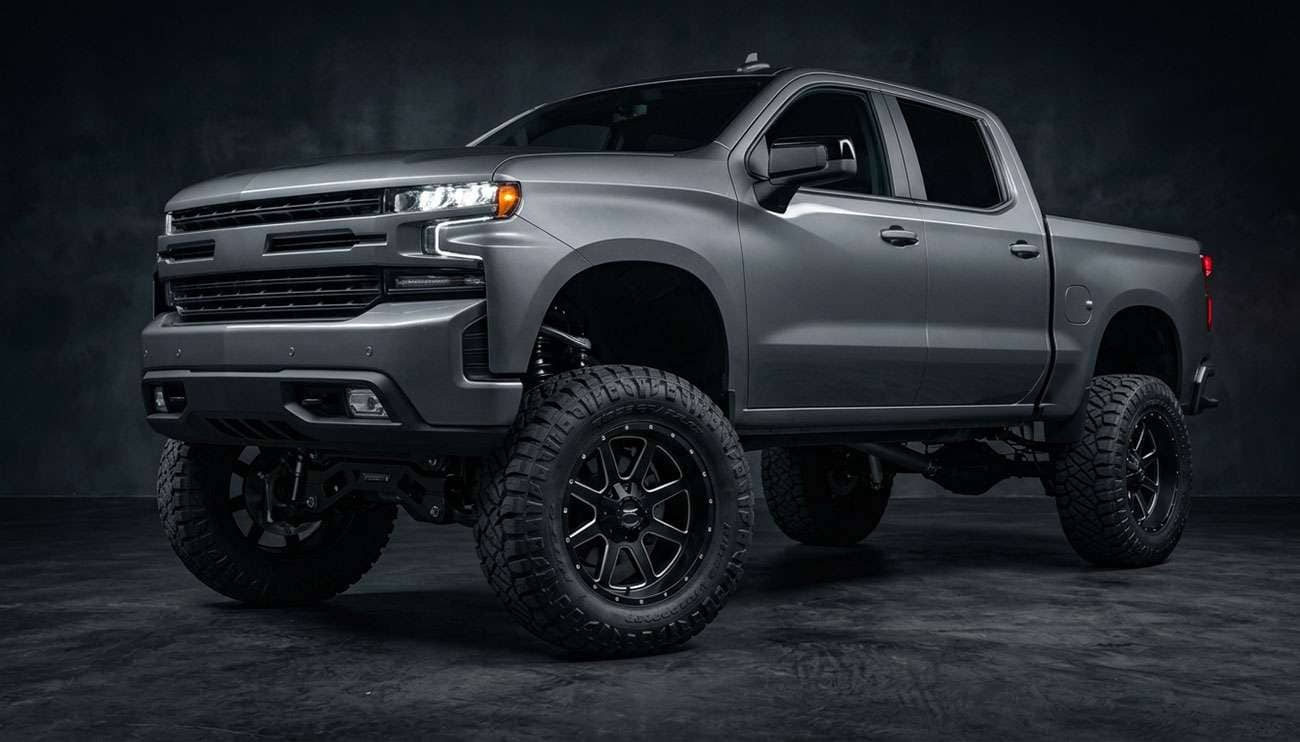
I've been bolting wheels onto lifted trucks since the original Skyjacker kits started showing up in the early 1980s, and I'll tell you something that hasn't changed in forty years: most lifted truck owners pick the wrong wheels for the wrong reasons. They see a wheel that looks aggressive on a stock-height truck in a magazine and assume it'll work on their six-inch lift kit. Then the truck comes back two weeks later with rubbing inside the fenders, tires that hit the upper control arms at full lock, and a wheel offset that puts the tire so far inside the wheel well that there's no way to clear 35-inch tires.
Lifted trucks need different wheel logic than stock trucks. The lift kit changes everything: how the suspension cycles, where the tire sits in the wheel well, what the upper control arm clears, and how much hub the wheel needs to cover. A wheel that fits perfectly on a stock F-150 will rub on a lifted F-150 at full compression. A wheel with the wrong backspacing will either tuck the tire so far inside that you can't run a wide tire, or it'll poke the tire so far out that you'll need fender flares to stay legal in most states.
Every wheel on this 2026 list works on lifted trucks specifically — proper offset ranges for 3-inch through 6-inch+ lift kits, hub coverage that clears typical lifted truck axle assemblies, and bolt patterns that match the popular lifted-truck platforms (Ford F-150, F-250, F-350, RAM 1500, RAM 2500, RAM 3500, Silverado/Sierra 1500, 2500, and 3500). Performance Plus Tire stocks all nine in 17-inch through 22-inch diameters with the bolt patterns and offsets that lifted trucks actually need. Click any wheel to verify fitment for your specific truck and lift configuration.
Five things change the moment you install a lift kit, and all five affect what wheel you need.
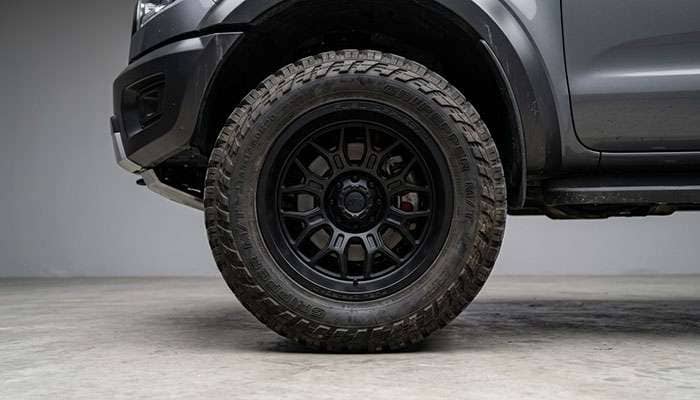
Tire clearance opens up vertically. A 3-inch lift gives you approximately 3 inches of additional vertical clearance in the wheel well, which lets you fit a taller tire without rubbing at full compression. A 6-inch lift opens up roughly 6 inches of vertical clearance, which lets you fit 37-inch or even 40-inch tires depending on the truck. The vertical clearance is the headline benefit of a lift kit, and it's what drives the tire size you can run.
Horizontal clearance also opens up — but less than vertical. Lift kits typically open up some horizontal clearance for wider tires, but not as much as the vertical clearance increase. A 4-inch lift might let you fit a 35-inch by 12.5-inch wide tire instead of the 33-inch by 11.5-inch tire that fit stock, but the wider tire still needs the right wheel offset to clear the upper control arm at full lock and the fender at full compression.
Upper control arm interference becomes the limiting factor. On most modern lifted trucks (F-150, RAM 1500, Silverado, Sierra, Tundra), the upper control arm sweeps through the wheel well at full lock and full compression. A wheel with too much backspacing (positive offset) will push the tire so far inboard that it hits the upper control arm. The wheel offset has to balance against this clearance — you need enough negative offset to clear the upper control arm while not so much negative offset that the tire pokes out beyond the fender.
Hub coverage becomes critical. Lifted trucks typically need wheels with adequate hub coverage to handle the loads that bigger tires create. A 35-inch or 37-inch tire weighs substantially more than a stock 31-inch tire, and the additional weight increases bearing loads, hub loads, and the structural demands on the wheel itself. Wheels designed for stock trucks may not have the hub coverage and structural integrity that lifted trucks demand.
Stance and visual proportions change dramatically. A stock-offset wheel on a lifted truck makes the truck look "tucked in" — the tires sit too far inboard relative to the fender flares, producing a visually awkward stance. The right lifted truck wheel uses negative offset (or low positive offset) that pushes the tire outboard, creating the aggressive stance that lifted trucks need to look intentional rather than awkward. The right offset isn't just about aesthetics — it's about making the lift kit visually work.
Wheel offset is the distance from the wheel's hub mounting surface to the centerline of the wheel. Positive offset (the hub sits inboard of centerline) pushes the tire inboard. Negative offset (the hub sits outboard of centerline) pushes the tire outboard. Zero offset puts the hub at centerline.
For lifted trucks, the offset range that works depends on lift height, tire width, and the specific truck platform. The general rules for half-ton trucks (F-150, RAM 1500, Silverado/Sierra 1500, Tundra):
Lift Height |
Typical Offset Range |
Backspacing |
Visual Stance |
|---|---|---|---|
Stock (no lift) |
+18 to +30mm |
5.5" to 6.5" |
Conservative |
2-3 inch leveling kit |
0 to +18mm |
4.75" to 5.25" |
Slightly aggressive |
4-6 inch lift |
-12 to 0mm |
4.5" to 4.75" |
Aggressive |
6-8 inch lift |
-24 to -12mm |
4.25" to 4.5" |
Very aggressive |
8+ inch lift |
-44 to -24mm |
4" to 4.25" |
Extreme |
Heavy-duty trucks (F-250, F-350, RAM 2500, RAM 3500, Silverado/Sierra 2500, Sierra 3500) generally need slightly more positive offset than half-ton trucks at the same lift height because their wider rear axles and different suspension geometry require more inboard tire placement. The exact range depends on the specific truck and tire combination.
The practical rule: more negative offset gives more aggressive stance but increases the risk of tire poke beyond the fender (which may not be street-legal in some states without fender flares). More positive offset gives more conservative stance but may not clear wider tires on lifted trucks. The right wheel for your specific lifted truck balances these trade-offs based on your tire choice, fender flare situation, and aesthetic priority. For deeper wheel sizing guidance, see our truck rim sizes guide.
Tire diameter is what most lifted truck buyers actually want to know about — what size tire works with what lift height. The rule of thumb that holds for most half-ton and three-quarter-ton truck applications:
Lift Height |
Max Tire Diameter |
Typical Wheel Diameter |
Tire Aspect Ratio Notes |
|---|---|---|---|
Stock (no lift) |
32-33 inches |
17-20 inches |
275/65R20 = 34" diameter, fits most stock half-tons |
2-3 inch leveling |
33-34 inches |
17-20 inches |
285/70R17 = 33.7" diameter, popular leveling combo |
3-4 inch lift |
34-35 inches |
17-20 inches |
33-35 inch fits without serious modifications |
4-6 inch lift |
35-37 inches |
17-20 inches |
35x12.5 most popular for daily-driven lifted trucks |
6-8 inch lift |
37-40 inches |
17-20 inches |
37x13.5 popular for heavy-duty lifted trucks |
8+ inch lift |
40+ inches |
17-22 inches |
Custom fender work typically required |
Smaller wheel diameters (17-inch and 18-inch) leave more sidewall for off-road capability, impact absorption, and the visual proportion that lifted trucks need. Larger wheel diameters (20-inch through 22-inch) reduce sidewall but provide the aggressive aesthetic that many lifted truck buyers want. For serious off-road use, 17-inch and 18-inch wheels are typically the right answer. For show truck applications with mild off-road duty, 20-inch and 22-inch wheels work fine. For deeper tire sizing analysis on the popular 31/33/35 inch options, see our 31 vs 33 vs 35 tire comparison.
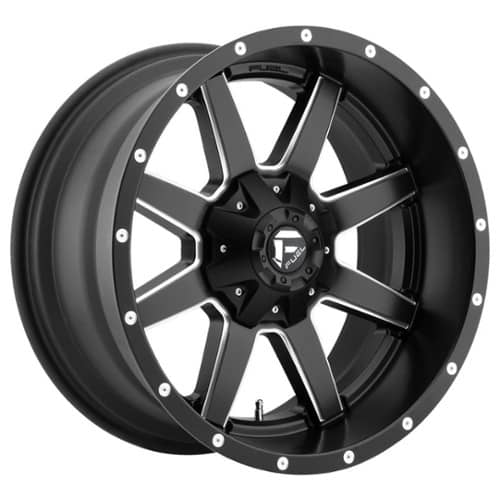
Best For: 3"–6" lift versatility benchmark • Sizes: 17" through 22" • Lift Compatibility: 2-3" leveling through 6" lifts
The Fuel Maverick D538 in Matte Black Milled is the lifted truck wheel I bolt onto more trucks than any other. The intricate multi-spoke design pairs aggressive aesthetics with offset ranges that work across the entire 2-inch leveling through 6-inch lift spectrum, and Fuel offers the wheel in offsets from +44mm (stock applications) all the way down to -44mm (extreme lift applications). For half-ton lifted trucks running 33-inch through 37-inch tires, the Maverick D538 covers virtually every popular configuration.
What separates the Maverick D538 from cheaper lifted truck wheel alternatives is the engineering investment. Fuel manufactures the wheel in their 36,000 square foot Los Angeles facility with rigorous quality control on each casting, machining, and finishing run. The Matte Black Milled finish hides rock damage and trail wear better than gloss alternatives, which matters because lifted trucks typically see more off-pavement duty than stock trucks. For Ford F-150, RAM 1500, Silverado, Sierra, Tundra applications with 3-inch through 6-inch lift kits, the Maverick D538 is consistently the right answer when the build philosophy emphasizes aggressive aftermarket aesthetics with proven engineering. Browse Fuel Maverick D538 sizes and offsets, or see the full Fuel Wheels lineup.
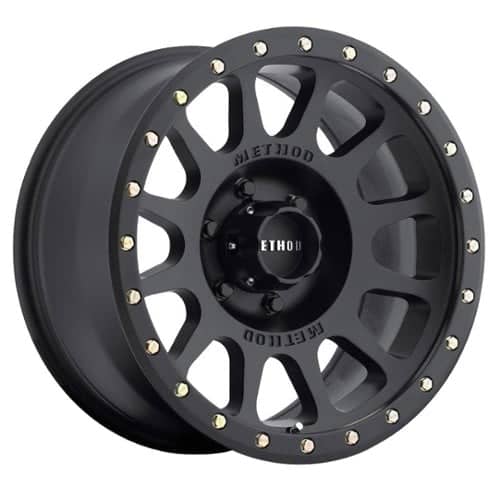
Best For: Daily-driven trail rigs (Raptor, ZR2, Rebel, Tremor) • Sizes: 17" and 18" primarily • Lift Compatibility: 2-3" leveling through 4" lifts
The Method 305 NV in Matte Black is the daily-driven trail rig benchmark for lifted trucks. Method Race Wheels was founded by Ultra4 racers who couldn't find wheels that survived competition off-road racing, so they engineered their own — and the 305 NV brings that race-derived engineering to street-driven lifted truck applications. The 12-window design produces aggressive aesthetics paired with patented bead-grip technology that lets the tire seat aggressively at low pressures (10-12 PSI for trail use) while remaining DOT-legal for highway driving.
For Ford F-150 Raptor, F-150 Tremor, Chevrolet Silverado ZR2, RAM 1500 Rebel, and similar factory-lifted trail-capable trucks, the Method 305 NV is typically the right answer when the build emphasizes daily-driving usability alongside serious off-road capability. The lifetime structural warranty (Fuel offers 1-year finish warranty) gives the Method 305 a meaningful engineering credibility advantage over premium cast alternatives. The 17-inch and 18-inch diameter range pairs perfectly with 33-inch through 35-inch tires that work well on modern factory-trail-capable trucks with mild aftermarket lift kits. For deeper Method analysis, see our Fuel vs Method head-to-head. Browse Method 305 NV sizes and offsets.
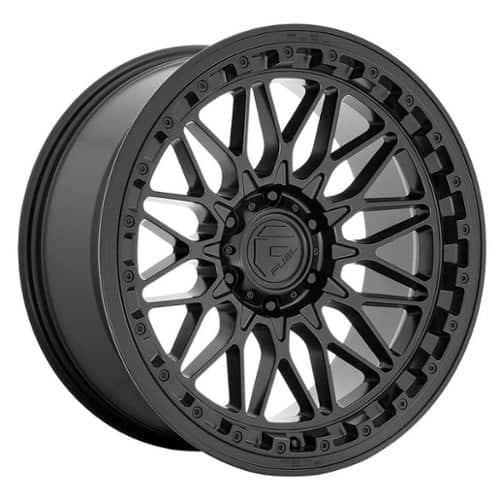
Best For: Premium aggressive 4"–6" lift • Sizes: 17" through 22" • Lift Compatibility: 4" through 6" lifts
The Fuel Trigger D757 in Matte Black brings Fuel's most intricate spoke design to lifted truck applications specifically engineered for 4-inch through 6-inch lift kits. The complex multi-spoke geometry creates dramatic visual depth that catches light at every angle — a wheel that reads as deliberately aggressive even from across a parking lot. The Matte Black finish maintains the aesthetic through years of trail damage and weather exposure better than chrome or gloss alternatives.
What gives the Trigger D757 its position is the offset specification — the wheel ships in offsets from -19mm to -44mm that work specifically with 4-inch through 6-inch lift kits on Ford F-150, RAM 1500, Silverado, Sierra, and Tundra. The negative offset pushes the tire outboard for the aggressive stance that 4-6 inch lifted trucks need to look proportional rather than tucked in. The structural design handles the additional loads that 35-inch and 37-inch tires create on the bearing and hub assemblies during impact events. For show truck builds and parking-lot-statement lifted truck applications where buyers want premium Fuel aesthetics paired with proper offset for moderate-to-aggressive lift kits, the Trigger D757 is consistently the right choice. Browse Fuel Trigger D757 sizes and offsets.

Best For: 4"–6" lift value with aggressive aesthetic • Sizes: 17" through 22" • Lift Compatibility: 4" through 6" lifts
The XD Series XD820 Grenade in Satin Black Milled brings KMC's hardcore truck wheel engineering to lifted truck applications at meaningfully better pricing than premium Fuel offerings. The Grenade design language has defined what aggressive 2010s and 2020s lifted truck aesthetics look like, and the XD820 variant remains one of the most popular wheels in the entire aftermarket truck wheel category. The Satin Black Milled finish produces dramatic visual contrast on lifted trucks where the milled accents catch light against the satin black base.
What gives the XD820 Grenade its position on this list is the value proposition combined with proper lifted-truck offset specifications. The wheel ships in offsets from +18mm down to -44mm covering the full range of stock through 8-inch+ lift applications on Ford F-150, RAM 1500, Silverado, Sierra, F-250, F-350, and HD truck platforms. The 8-lug versions specifically address the heavy-duty lifted truck market (RAM 2500, RAM 3500, Silverado/Sierra 2500/3500, F-250, F-350) where the bolt pattern and structural requirements differ from half-ton applications. Multiple finish variants (Satin Black, Satin Black Milled, Black Milled with Blue/Red tinted clear coats, Chrome, Gloss Black, Satin Black with Machined Face) give buyers extensive aesthetic options. Browse XD820 Grenade sizes and offsets.
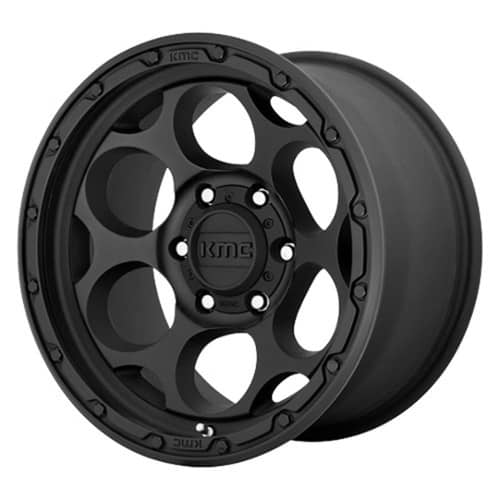
Best For: 6"+ lift hardcore trail rigs • Sizes: 17" through 20" • Lift Compatibility: 4" through 8" lifts
The KMC KM541 Dirty Harry in Textured Black is the wheel I see on the most serious lifted trucks that actually leave the pavement. KMC's Dirty Harry design language reads as deliberately purpose-built for hardcore off-road use — six aggressive spokes with intentional industrial detailing that signals the truck is built for serious trail capability rather than just parking lot show. The Textured Black finish has subtle surface variation that hides rock damage better than smooth Matte Black alternatives.
What gives the KM541 Dirty Harry its position on this list is the trail-proven engineering combined with offset specifications optimized for aggressive lift heights. The wheel ships in offsets from -18mm down to -44mm covering the 6-inch and 8-inch lift applications where most lifted truck wheels struggle. Available in multiple finishes (Textured Black, Matte Bronze with Black Lip, Satin Gray with Black Lip), the brand gives buyers options for different build aesthetic priorities. For Ford F-150, F-250, F-350, RAM 1500, RAM 2500, RAM 3500, Silverado, and Sierra applications with 4-inch through 8-inch lift kits running 35-inch through 37-inch tires, the KM541 Dirty Harry consistently delivers the right balance of aggressive aesthetics and trail-proven structure. Browse KMC KM541 Dirty Harry sizes and offsets.
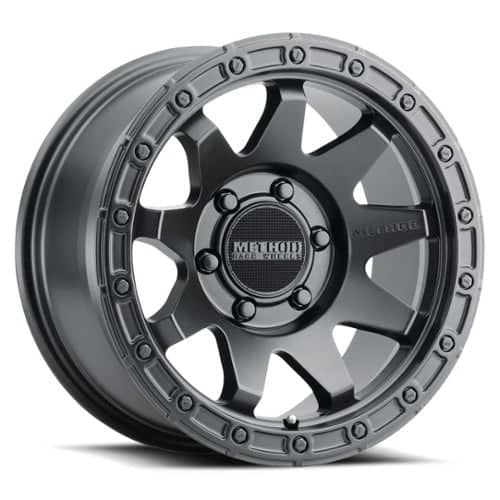
Best For: Full-size HD lifted (F-250, F-350, RAM 2500/3500, Silverado/Sierra 2500/3500) • Sizes: 17" through 20" • Lift Compatibility: 2-3" leveling through 6" lifts
The Method 317 in Matte Black is the heavy-duty lifted truck specialist on this list — engineered specifically for the F-250, F-350, RAM 2500, RAM 3500, Silverado 2500, Silverado 3500, Sierra 2500, and Sierra 3500 applications where the bolt patterns, structural loads, and lifted-truck offsets differ from half-ton requirements. The clean six-spoke design pairs aggressive aesthetics with proper structural engineering for the heavier loads that 37-inch and 40-inch tires create on heavy-duty trucks.
What separates the Method 317 from competitors is the combination of HD-truck-specific engineering and Method's lifetime structural warranty. The wheel ships in 8-lug bolt patterns (8x6.5, 8x180, 8x170) that match popular HD truck applications, with offset specifications optimized for the 4-inch through 6-inch lift kits that most lifted HD trucks run. For F-250 Tremor, F-350 Tremor, RAM 2500 Rebel, RAM 2500 Power Wagon, Silverado 2500 ZR2, and similar factory-trail-capable HD trucks with mild aftermarket lift kits, the Method 317 is consistently the right answer when the build emphasizes durability alongside aesthetics. The Titanium finish variant provides an alternative to Matte Black for builds wanting distinguished aesthetic. Browse Method 317 sizes and bolt patterns.
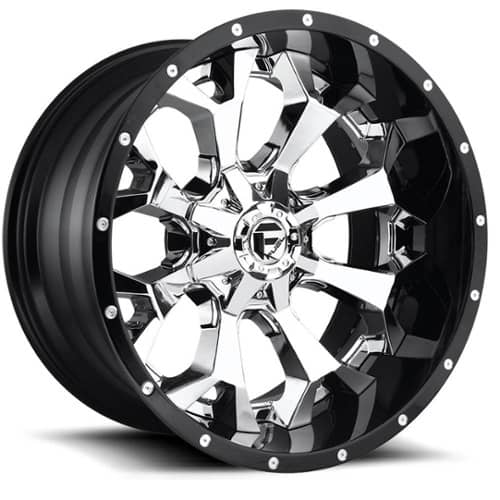
Best For: Show truck 4"–6" lift premium 2-piece • Sizes: 20" through 24" • Lift Compatibility: 4" through 8" lifts
The Fuel 2-Piece Assault D246 in Chrome Face with Gloss Black Lip is the show truck premium pick on this list. Two-piece construction means the wheel face and lip are manufactured separately and bolted together, which lets Fuel produce dramatic deep concave faces with chrome plating that single-piece manufacturing can't achieve. The Chrome Face produces high-shine visual statement contrasted against the Gloss Black Lip — a wheel that reads as deliberately premium even at first glance.
What gives the Assault D246 its position is the show-truck-specific engineering combined with offset specifications that work on lifted trucks. The wheel ships in offsets from -44mm to -76mm covering aggressive 4-inch through 8-inch lift applications where the deep concave face and Chrome aesthetic make sense on Ford F-150, RAM 1500, Silverado, Sierra, and Tundra builds. The 2-piece construction also produces a structural rigidity benefit versus comparable single-piece cast alternatives. For lifted show trucks, parking-lot statement builds, and social-media-focused builds where the wheels need to read as premium investment, the Assault D246 delivers the visual impact that premium Fuel alternatives can't match. Note: chrome finishes require more maintenance than matte black alternatives — they show water spots and brake dust more readily. Browse Fuel Assault D246 sizes and offsets.
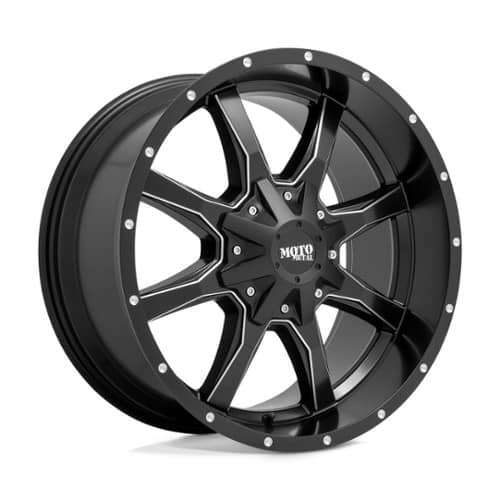
Best For: 3"–4" lift value statement • Sizes: 17" through 22" • Lift Compatibility: 2-3" leveling through 4" lifts
The Moto Metal MO970 in Semi Gloss Black Milled delivers Moto Metal's signature bold show-truck aesthetic at value pricing that beats comparable Fuel alternatives by 20-30%. The six aggressive spokes with milled accents on the spoke faces produce dramatic visual interest from any angle, and the Semi Gloss Black finish (between Matte and Gloss) gives a meaningful subtle sheen without the maintenance demands of full Gloss. For 2-3 inch leveling kits and 3-4 inch lift applications, the MO970 covers the popular lifted truck range that most buyers actually build.
What separates the MO970 from premium Fuel alternatives is the pricing — typically 20-30% lower at equivalent sizes while delivering acceptable structural construction for daily-driven lifted trucks. The wheel ships in offsets from +18mm down to -24mm covering the typical 2-3 inch leveling kit and 3-4 inch lift applications on Ford F-150, RAM 1500, Silverado, Sierra, and Tundra. Multiple finish variants (Semi Gloss Black Milled, Gloss Black, Gloss Black with Machined Face, Gloss Gray Center with Gloss Black Lip, Black Milled with Red Tint) give buyers extensive aesthetic options at the value tier. For first lifted truck builds and budget-conscious enthusiast builds, the MO970 delivers strong economics at acceptable construction quality. Browse Moto Metal MO970 sizes and offsets.
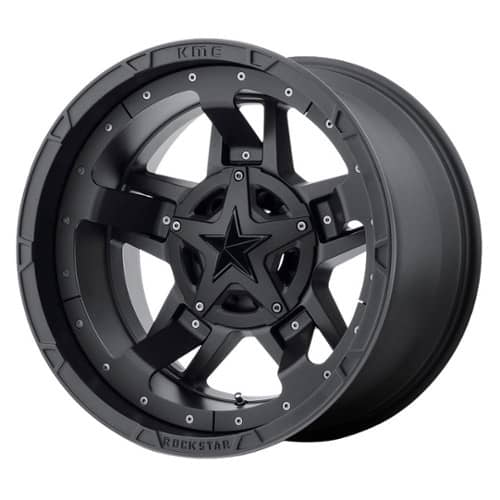
Best For: Classic Rockstar legacy 4"–6" lift • Sizes: 17" through 22" • Lift Compatibility: 4" through 6" lifts
The XD Series XD827 Rockstar III in Matte Black continues the Rockstar legacy that has defined aggressive lifted truck wheel aesthetics for over a decade. The multi-spoke geometric design with sharp angular detailing reads as deliberately aggressive — a wheel that signals the lifted truck is built for visual statement rather than just utility. The Rockstar III variant updates the earlier Rockstar II design with refined proportions and modern offset specifications that work better with current lifted truck applications.
What gives the XD827 Rockstar III its position on this list is the combination of brand recognition and lifted-truck-specific offset specifications. The wheel ships in offsets from -12mm down to -44mm covering the 4-inch through 6-inch lift application range on Ford F-150, RAM 1500, Silverado, Sierra, Tundra, and similar half-ton platforms. The Matte Black finish hides trail damage and brake dust better than alternatives — important for lifted trucks that see more off-pavement duty than stock applications. For lifted truck builds wanting the Rockstar brand recognition at meaningfully better pricing than premium Fuel offerings (typically 20-30% lower at equivalent sizes), the XD827 Rockstar III consistently delivers strong value. Browse XD827 Rockstar III sizes and offsets.
I see the same five mistakes in my shop more than any others when lifted truck owners pick the wrong wheels. Knowing what they are saves you the return trip.
1. Wrong offset for the lift height. The most common mistake — picking a stock-offset wheel for a lifted truck. A +18mm or +30mm positive offset wheel that fits a stock F-150 will tuck the tire so far inboard on a 6-inch lifted F-150 that the truck looks "tucked in" and you can't run a 35-inch tire without it rubbing the upper control arm. The correct offset for a 6-inch lifted half-ton truck is typically -12mm to -24mm, not the +18mm stock specification.
2. Wheel diameter too large for tire selection. Lifted truck owners frequently pick 22-inch and 24-inch wheels for 4-6 inch lifted trucks, then put 35-inch or 37-inch tires on them. The result is too little sidewall to absorb off-road impacts, which causes broken wheels, blown tires, and ride quality so harsh the truck becomes unpleasant to drive. For 4-6 inch lifted trucks running 35-inch or 37-inch tires, 17-inch and 18-inch wheels deliver the right tire/wheel proportion for actual use. Save 22-inch and 24-inch for show truck applications with less serious tire sizing.
3. Tire too wide for the wheel. Many lifted truck buyers run 35x12.5 tires on 9-inch wide wheels, which causes the tire to balloon outward (poor sidewall support) and produces handling instability. The 35x12.5 tire is designed for 8.5-inch to 11-inch wide wheels, with 9.5-10 inch widths producing optimal results. Verify tire width compatibility with wheel width before purchase.
4. Wrong bolt pattern for HD trucks. Half-ton trucks use 6-lug bolt patterns (6x135 Ford, 6x139.7 GM/RAM/Toyota), while heavy-duty trucks use 8-lug bolt patterns (8x180 Ford F-250/F-350, 8x6.5 GM 2500/3500, 8x170 Ford Super Duty). Running half-ton 6-lug wheels on a heavy-duty 8-lug truck isn't possible without adapter spacers (which add their own complications). Verify bolt pattern before ordering.
5. Ignoring hub coverage. Lifted trucks with bigger tires create higher loads on the wheel's hub interface. Wheels with inadequate hub coverage (the wheel hub bore doesn't fully cover the truck's hub) produce stress concentration that can crack wheels over time. Verify that the wheel hub bore matches your truck's hub diameter — most modern aftermarket truck wheels include this specification, and most aftermarket truck wheels for popular platforms have appropriate hub coverage by design.
Match the right wheel to your specific lift configuration.
Lift Configuration |
Primary Pick |
Alternative |
Why |
|---|---|---|---|
2-3 inch leveling kit |
Method 305 NV |
Moto Metal MO970 |
Offset range matches leveling kit clearance |
3-4 inch lift kit half-ton |
Fuel Maverick D538 |
Moto Metal MO970 |
Versatile offset range, broad finish options |
4-6 inch lift kit half-ton |
Fuel Trigger D757 |
XD820 Grenade or XD827 Rockstar III |
Aggressive offset matches moderate lift stance |
6-8 inch lift kit half-ton |
KMC KM541 Dirty Harry |
Fuel Trigger D757 (negative offset variants) |
Trail-proven structure for aggressive lift |
2-3 inch leveling kit HD |
Method 317 |
XD820 Grenade 8-lug |
HD bolt patterns with proper offset |
4-6 inch lift kit HD |
Method 317 |
KMC KM541 Dirty Harry 8-lug |
HD-rated structure for big tire loads |
Show truck premium build |
Fuel Assault D246 Chrome |
Fuel Trigger D757 large diameter |
2-piece construction, premium aesthetic |
Daily-driven trail rig |
Method 305 NV |
KMC KM541 Dirty Harry |
Race-derived engineering, lifetime warranty |
Budget first lifted truck |
Moto Metal MO970 |
XD820 Grenade entry variants |
Value pricing at acceptable construction |
The pattern that emerges: Fuel for premium aggressive aesthetics across the lift spectrum, Method for race-derived engineering with lifetime warranty (especially for daily-driven applications and HD trucks), KMC for hardcore trail use on aggressive lifts, XD Series for value at the aggressive design tier, Moto Metal for budget-friendly value pricing on lighter lifts. For broader truck wheel brand context, see our top 10 truck wheel brands 2026.
Rank |
Wheel |
Lift Range |
Best For |
|---|---|---|---|
1 |
Fuel Maverick D538 |
2-3" leveling through 6" |
Lifted truck versatility benchmark |
2 |
Method 305 NV |
2-3" leveling through 4" |
Daily-driven trail rigs (Raptor, ZR2, Rebel) |
3 |
Fuel Trigger D757 |
4" through 6" |
Premium aggressive moderate lift |
4 |
XD820 Grenade |
4" through 6" |
Value at aggressive design tier |
5 |
KMC KM541 Dirty Harry |
4" through 8" |
Hardcore trail rigs with aggressive lift |
6 |
Method 317 |
2-3" leveling through 6" |
Heavy-duty F-250/F-350/2500/3500 lifted |
7 |
Fuel Assault D246 |
4" through 8" |
Premium 2-piece show truck builds |
8 |
Moto Metal MO970 |
2-3" leveling through 4" |
Value statement at lighter lifts |
9 |
XD827 Rockstar III |
4" through 6" |
Rockstar legacy at value pricing |
For most half-ton lifted trucks (F-150, RAM 1500, Silverado 1500, Sierra 1500, Tundra) with a 6-inch lift kit, the optimal wheel offset range is -12mm to -24mm with 4.5-4.75 inches of backspacing. This offset range pushes the tire outboard enough to create the aggressive stance that 6-inch lifted trucks need to look proportional, while maintaining enough inboard placement to clear the upper control arm at full lock and the fender at full compression. For heavy-duty trucks (F-250, F-350, RAM 2500, RAM 3500), the offset range typically shifts toward slightly more positive numbers (-6mm to -18mm) because of the wider rear axle and different suspension geometry. The exact specification depends on your specific truck, tire width, and fender flare situation — Performance Plus Tire can verify proper offset for your specific lifted truck configuration.
A 4-inch lift kit typically allows 34-35 inch diameter tires on half-ton lifted trucks (F-150, RAM 1500, Silverado 1500, Sierra 1500, Tundra), with 35-inch tires being the most popular choice. Common 35-inch tire sizes include 285/70R17 (33.7" diameter, technically just under 35"), 285/75R17 (33.8"), 295/70R18 (34.3"), 305/70R17 (33.8"), 315/70R17 (34.4"), 33x12.5R17 (33"), and 35x12.5R17 or R18 (35"). For wider tires (12.5 inch tread width), wheel widths of 9-10 inches are typically needed. Going larger than 35-inch tires on a 4-inch lift typically requires fender trimming, upper control arm modifications, or fender flare additions to fit without rubbing.
Running 35-inch tires on a 3-inch leveling kit is possible but typically requires modifications. The 3-inch leveling kit opens up approximately 3 inches of vertical clearance, which is at the edge of what 35-inch tires need to clear at full compression. Most owners need to perform fender trimming, mud flap removal, or running smaller tire widths (35x11.5 instead of 35x12.5) to fit 35-inch tires on a 3-inch leveling kit without rubbing. For trouble-free 35-inch tire fitment, a 4-inch lift kit is typically the right answer. For 3-inch leveling kit applications, 33-34 inch tires fit more easily without modifications. The specific clearance available varies by truck model — Performance Plus Tire can verify fitment for your specific application.
22-inch wheels work fine on lifted trucks for show truck applications and street-focused builds with mild off-road duty. They become problematic for serious off-road use because the reduced sidewall (compared to 17-inch or 18-inch wheels with the same overall tire diameter) doesn't absorb impacts as well, increases the risk of wheel damage on rocks and trail obstacles, and produces harsher ride quality. For lifted trucks that see serious off-road use, 17-inch and 18-inch wheels deliver meaningfully better trail performance. For lifted show trucks, parking-lot statement builds, and primarily-highway applications, 22-inch wheels work well — they provide the aggressive aesthetic that show trucks need without compromising what those trucks are actually used for. Match the wheel diameter to your actual use case.
Negative offset means the wheel's hub mounting surface sits outboard of the wheel's centerline — which pushes the tire outboard relative to the truck. For lifted trucks specifically, negative offset is what creates the aggressive stance that lifted trucks need to look proportional rather than tucked in. A 6-inch lifted F-150 with a stock +18mm positive offset wheel looks awkward because the tire sits too far inboard for the lift kit. The same truck with a -24mm negative offset wheel looks intentional because the tire sits outboard, filling the wheel well properly. The trade-off: too much negative offset can push the tire beyond the fender (tire poke), which may require fender flares for legal compliance in some states. For most 4-6 inch lifted half-ton trucks, -12mm to -24mm offset produces optimal stance without excessive tire poke.
Beadlock wheels aren't required for typical lifted truck use, but they're useful for serious off-road applications where the truck operates at low tire pressures (10-15 PSI) for extended trail sections. Beadlock construction uses a separate clamping ring that mechanically locks the tire bead to the wheel, preventing the bead from unseating at low pressures. For daily-driven lifted trucks running 25-35 PSI on the street, beadlock wheels aren't necessary. For hardcore off-road builds, dedicated trail rigs, and trucks that regularly drive at very low pressures off-road, beadlock wheels prevent the tire failures that can occur when conventional bead-seat designs fail at low pressures. Method offers true beadlock variants (the 105 Beadlock series) and patented bead-grip technology that delivers some beadlock benefits in a DOT-legal package. For most lifted truck applications, conventional non-beadlock wheels are the right answer.
For a Ford F-250 with a 4-inch lift kit running 37-inch tires, the Method 317 in Matte Black is consistently the right answer. The wheel ships in 8x170 bolt pattern (matching F-250/F-350 Super Duty), offsets optimized for 4-inch lift applications, and Method's lifetime structural warranty addresses the higher loads that 37-inch tires create on heavy-duty truck applications. Alternative picks include the KMC KM541 Dirty Harry 8-lug variant (for hardcore trail-focused builds) and XD820 Grenade 8-lug variant (for aggressive aesthetic with value pricing). For HD truck applications specifically, verify the 8-lug bolt pattern matches your specific Ford F-250 year (older F-250s use 8x6.5, newer F-250s use 8x170) before ordering. Performance Plus Tire can verify proper fitment for your specific F-250 application.
Running lifted truck wheels (negative offset, aggressive aesthetic) on an unlifted truck creates two problems. First, the negative offset will push the tire outboard, which may produce tire poke beyond the fender — not street-legal in some states without fender flares. Second, the aggressive offset combined with stock-height suspension geometry creates excessive scrub radius, which produces harsh steering feedback, accelerated tire wear, and increased steering effort. Stock-offset wheels (typically +18mm to +30mm positive offset for most half-ton trucks) are the right answer for unlifted truck applications. If you want aggressive aftermarket truck wheel aesthetic on an unlifted truck, look for aftermarket wheels with stock-equivalent offsets — many of the brands on this list offer offset variants that work on both lifted and unlifted applications.