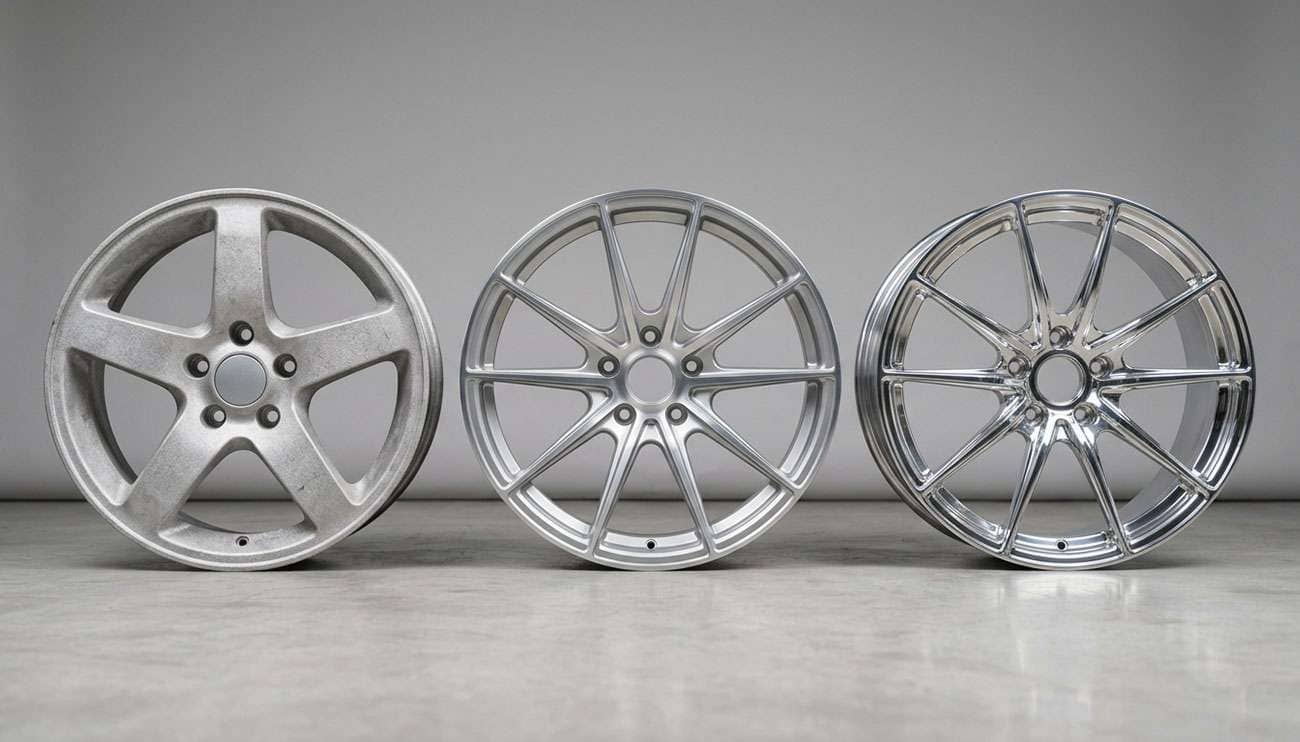
You've decided to upgrade your wheels. You've narrowed down the size, picked a finish you like, and now you're staring at three different price tiers for what looks like the same wheel. One says "cast." Another says "flow forged." The third just says "forged" — and costs three times as much.
So what's the difference? And more importantly, which one is actually worth your money?
After fitting thousands of wheel and tire packages at Performance Plus Tire, I can tell you that the manufacturing method behind your wheel affects everything — its weight, its strength, how it handles a pothole, and how long it lasts. Most buyers get this decision wrong because the wheel industry buries the real information behind marketing jargon. This guide cuts through all of it.
Every aluminum wheel starts as raw metal. But what happens to that metal during manufacturing determines whether you end up with a 28-pound wheel or an 18-pound wheel — and whether it bends on a pothole or shrugs it off.
There are three manufacturing methods you need to understand: casting, flow forming, and forging. Each one changes the internal grain structure of the aluminum differently, and that grain structure dictates strength, weight, and durability. Think of it like wood grain. Metal that's been compressed and aligned under pressure is harder to break than metal that cooled randomly in a mold — the same way straight-grained oak is stronger than knotty pine.
The differences aren't subtle. A forged wheel can use 30-35% less material than a cast wheel and still be stronger. That's not marketing — that's metallurgy.
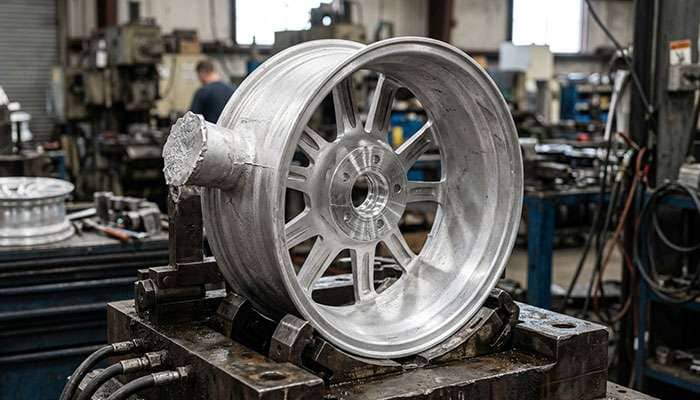
Cast wheels are made by pouring molten aluminum into a mold and letting it cool. Once solid, the wheel gets trimmed, drilled, and machined into its final shape. It's the simplest and cheapest way to make a wheel, and it accounts for about 90% of all aftermarket and OEM wheels on the road.
The process comes in two flavors. Gravity casting lets the metal settle into the mold under its own weight. Low-pressure casting pushes the molten aluminum into the mold with controlled air pressure, which produces a denser, more consistent wheel. If you're buying cast, look for low-pressure cast — it's noticeably better.
The trade-off is straightforward. As molten aluminum cools, tiny air pockets form inside the metal. These microscopic voids — called porosity — make the wheel weaker than it could be. To compensate, manufacturers add more material, which makes the wheel heavier. A typical 18-inch cast wheel weighs 25-30 pounds. That's a lot of unsprung weight working against your suspension, brakes, and fuel economy.
Cast wheels are right for you if: You're a daily driver who doesn't push hard, you want a specific design at a reasonable price, and you're not planning track days or heavy towing. They're reliable, widely available, and affordable — just don't expect them to survive a hard curb hit without cracking.
Price range: $80-$300 per wheel depending on size and brand. You can find quality cast wheels from brands like Vision, Motegi, and Ion in nearly every diameter and bolt pattern.
This is where things get interesting — and where the marketing confusion starts. Flow formed wheels (also called flow forged, rotary forged, spun forged, or hybrid forged depending on who's selling them) use a process that's genuinely different from standard casting.
Here's how it works: the manufacturer starts by casting a wheel blank that's intentionally narrower and thicker than the final product. That blank gets mounted on a machine, heated up, and spun at high speed while steel rollers press against the barrel — stretching and compressing the aluminum into its final width. The pressure aligns the metal's grain structure in the barrel area, making it denser and stronger than a standard cast wheel.
The result is a wheel with a cast face and spokes but a barrel that has properties closer to a forged wheel. You get about 15-25% less weight than a comparable cast wheel and significantly better impact resistance on the barrel — which is exactly where most pothole damage happens.
Flow formed wheels sit in a price sweet spot that makes them the smartest buy for most enthusiasts. You're getting real, measurable performance improvements over cast without the sticker shock of full forged. A typical 18-inch flow formed wheel weighs 20-24 pounds versus 25-30 for cast — and that 5-8 pound difference per corner adds up fast. That's 20-32 pounds of unsprung weight off your car.
Flow formed wheels are right for you if: You want lighter wheels that actually improve handling and braking, you do spirited driving or occasional track days, you're building a performance daily driver, or you tow and want reduced rotational mass without spending $4,000+ on a set of forged wheels.
Price range: $175-$500 per wheel. Brands like Konig, TSW, and Enkei offer excellent flow formed options across a wide range of fitments.
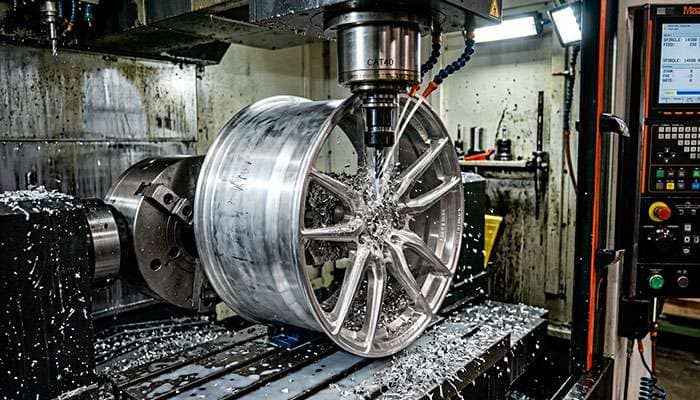
Forged wheels are the top of the food chain. They start as a solid block of aerospace-grade 6061-T6 aluminum billet — no molten metal, no molds, no air pockets. That billet gets heated to a controlled temperature, then smashed under 8,000 to 10,000 tons of hydraulic pressure into a rough wheel shape. From there, CNC machines carve the spoke pattern, bolt holes, and final profile with surgical precision.
The forging process fundamentally changes the aluminum. Instead of random grain structure (cast) or partially aligned grain (flow formed), forged aluminum has a dense, continuous grain that follows the contours of the wheel. Zero porosity. Maximum density. The result is a wheel that's 25-35% lighter than cast, dramatically stronger, and has a completely different failure mode.
That last point matters more than most people realize. When a cast or flow formed wheel hits something hard, the granular aluminum tends to crack or shatter — a catastrophic failure. A forged wheel bends. It deforms instead of breaking apart. Your tire stays on the rim, and you limp to a shop instead of losing control. For racing applications, that difference can save your life.
Forged wheels come in monoblock (one piece), two-piece, and three-piece configurations. Multi-piece forged wheels allow you to customize width, offset, and barrel depth independently — something that's impossible with a one-piece cast or flow formed design.
Forged wheels are right for you if: You run track days regularly, you drive a high-performance car where every pound matters, you're building a show car and want fully custom specs, or you simply want the lightest and strongest wheel money can buy.
Price range: $500-$2,500+ per wheel. Brands like Forgeline, HRE, BBS, and Schott deliver at this level. Yes, a set of four can cost more than some people's entire car. That's the price of the best engineering in the wheel industry.
Here's the comparison you actually need — real numbers, real trade-offs, no marketing spin. These figures represent typical 18×8 wheels in comparable designs:
Specification |
Cast |
Flow Formed |
Forged |
|---|---|---|---|
Typical Weight (18×8) |
25–30 lbs |
20–24 lbs |
17–21 lbs |
Tensile Strength (MPa) |
220–280 |
280–350 |
380–480 |
Price Per Wheel |
$80–$300 |
$175–$500 |
$500–$2,500+ |
Failure Mode |
Cracks/shatters |
Cracks (barrel may bend) |
Bends (non-catastrophic) |
Porosity |
High |
Moderate (barrel low) |
None |
Customization |
Pre-made designs only |
Pre-made designs only |
Fully custom specs available |
Best For |
Daily driving, budget builds |
Enthusiast daily, light track |
Racing, show, high performance |
Design Variety |
Widest selection |
Growing selection |
Limited but fully bespoke |
The weight column tells the most important story. Dropping 6-10 pounds per corner means 24-40 pounds less unsprung mass on your vehicle. Your suspension reacts faster, your tires stay planted better over bumps, your brakes work more efficiently, and your engine doesn't have to spin as much rotational mass. You feel it in the steering wheel the first time you take a corner.
Forget the specs for a second. Here's the decision framework I use when customers call in trying to figure out what to buy:
Go cast. You're driving to work, running errands, and parking in lots where someone might door-ding you. A quality low-pressure cast wheel from a reputable brand handles everything normal driving throws at it. Spend the savings on better tires — that's where you'll notice the biggest improvement in ride quality and safety. Check out our Custom Wheels Ultimate Guide for help narrowing down styles.
Flow formed is your move. You care about how your car drives, you push it on back roads, and maybe you hit an autocross or track day a few times a year. The weight reduction over cast is real and noticeable. Flow formed wheels give you 80% of the forged experience at 40% of the cost. It's the best value in the wheel market right now.
Cast or flow formed depending on wheel size. If you're running 17s or 18s, cast is plenty strong for most truck applications. Once you get into 20-inch and larger territory, flow formed becomes more appealing because the weight savings at bigger diameters is more significant. Make sure your wheel offset is correct before you buy — wrong offset on a truck creates problems fast.
Forged. Period. The combination of strength and weight savings isn't optional when you're running sticky tires at high speeds and subjecting wheels to repeated heavy loads. A cast wheel on a 3,800-pound Camaro running R-compound tires at a road course is a liability. Forged wheels bend under impact instead of shattering, and they resist the fatigue cycles that come from hard braking zones and high-speed curbing.
Forged, specifically multi-piece. Two-piece and three-piece forged wheels let you specify exact width, offset, barrel depth, and hub bore for your build. You can mix lip finishes with different center finishes. Nothing else gives you that level of control over the final look.
Let's clear something up because this costs people money every single day.
"Rotary forged" is not forged. It's flow formed. Different manufacturers call the same flow forming process by different proprietary names — TSW calls theirs "Rotary Forged," Konig says "Flow Formed," Enkei uses "MAT Technology," and Niche brands it as "Spin Forged." They're all describing the same manufacturing technique: a cast blank with a pressure-formed barrel.
This matters because some shoppers see "forged" in the name and assume they're getting a fully forged wheel. They're not. The face and spokes of a "rotary forged" wheel are still cast aluminum with the same porosity limitations as any other cast wheel. Only the barrel gets the flow forming treatment.
That doesn't make flow formed wheels bad — far from it. They're excellent wheels and a smart buy. But you shouldn't pay forged prices for them. If someone is charging you $800+ per wheel for a "rotary forged" wheel, you're either paying a brand premium or getting taken for a ride. True forged wheels start with a solid billet — no casting involved at any stage.
How to tell the difference: ask the manufacturer what alloy they use. Cast and flow formed wheels typically use A356 aluminum. Forged wheels use 6061-T6. That's your litmus test.
The right wheel construction depends on how you use your car, not how much you're willing to spend. Cast wheels do the job for millions of daily drivers. Flow formed wheels hit the performance-to-value sweet spot that makes them the smart upgrade for enthusiasts. And forged wheels deliver uncompromising strength and weight savings for people who need — or simply demand — the best.
Don't overthink it. Be honest about how you drive, set a realistic budget, and pick the construction method that matches. Then put the rest of your energy into getting the right wheel and tire package dialed in — because fitment matters just as much as how the wheel was made.
Need help figuring out the right setup for your vehicle? Call us at 888-926-2689 or browse our full custom wheel inventory. We'll walk you through every option.
For daily driving, forged wheels are overkill — you're paying for strength and weight savings you won't fully use. For track driving, racing, or high-performance builds where unsprung weight and impact resistance directly affect safety and lap times, forged wheels are absolutely worth it. Flow formed wheels offer the best middle ground for enthusiasts who want measurable performance improvements at a fraction of forged pricing.
Flow forged (flow formed) wheels start as a cast blank, then the barrel is heated and compressed under rollers to improve its grain structure. Only the barrel benefits from this process — the face and spokes remain cast. Fully forged wheels start from a solid billet of aluminum that's compressed under thousands of tons of pressure before being CNC machined. Every part of a forged wheel — face, spokes, and barrel — has a dense, aligned grain structure with zero porosity.
No. "Rotary forged" is a marketing term for flow formed wheels. The word "forged" in the name refers to the barrel-forming process, not the full wheel construction. The face and spokes of a rotary forged wheel are still cast. True forged wheels use a solid aluminum billet with no casting involved at any stage. You can confirm this by asking what alloy the wheel uses — A356 indicates cast or flow formed, while 6061-T6 indicates a fully forged wheel.
Forged wheels are typically 25-35% lighter than cast wheels of the same size and design. For a typical 18×8 wheel, that translates to roughly 7-10 pounds less per wheel, or 28-40 pounds less unsprung weight across all four corners. Flow formed wheels fall in between, running about 15-25% lighter than cast. These weight savings directly improve acceleration, braking, handling, and fuel efficiency.
Quality cast wheels can handle occasional track days on lighter vehicles with street tires. However, cast wheels are not recommended for regular track use — especially on heavier cars or with high-grip R-compound tires that increase the loads on the wheel. The repeated stress cycles of hard braking, high-speed cornering, and curb strikes can cause cast wheels to crack without warning. For consistent track use, flow formed or forged wheels are the safer and more durable choice.
Flow formed wheels are significantly more resistant to cracking than standard cast wheels, particularly in the barrel area where the flow forming process compresses and strengthens the aluminum. However, the face and spokes are still cast and can crack under severe impact. They're durable enough for spirited street driving and occasional track use but may not survive the repeated abuse that fully forged wheels can handle in competitive racing environments.