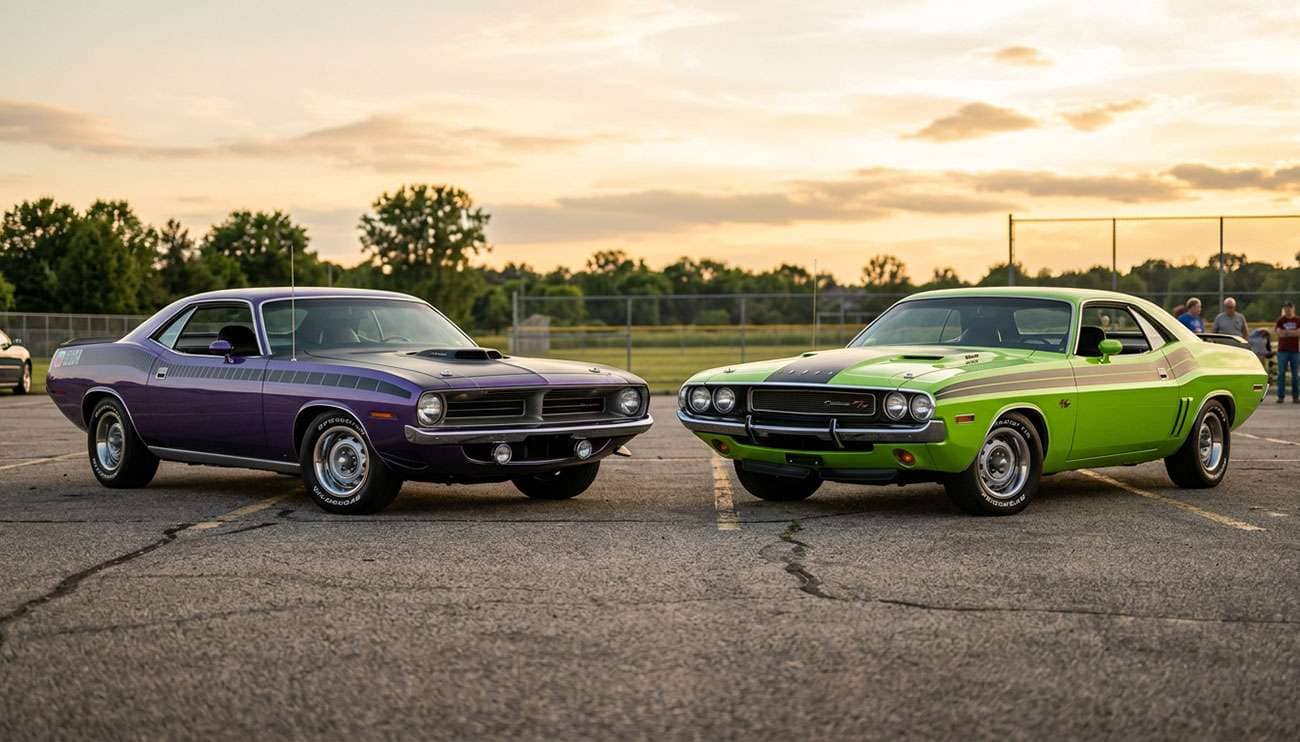
Every 1970-74 Dodge Challenger and Plymouth Barracuda, 'Cuda included, uses the 5x4.5 bolt pattern on 1/2-20 studs. On a stock body, a 15x8 with 4.5 inches of backspacing and a 275/60R15 is the safe rear, and a 17x9 at 5 inches with a 275/40R17 is the common modern one. Most charts stop at the bolt pattern. The part nobody puts in front of you is the rear axle. Owners measure E-body axles sitting up to an inch off center, so one rear tire, usually the passenger side, runs out of room first.
I opened the shop in 1971, the year after these cars came out, and they have been rolling through the door ever since. The tables below are what owners actually run on stock-body cars, then what Chrysler put on them.
These combinations assume stock springs in the stock location, stock quarters and a stock-width axle. They apply to both cars unless noted.
Setup |
Front Wheel and Backspacing |
Front Tire |
Rear Wheel and Backspacing |
Rear Tire |
Watch For |
|---|---|---|---|---|---|
15-inch, factory look |
15x7, 4.25 in. |
235/60R15 or 245/60R15 (26.1 to 26.6 in.) |
15x7 at 4.25 in. or 15x8 at 4.5 in. |
255/60R15 (27.0 in.) |
Fits nearly every car with room to spare |
15-inch, maximum |
15x8, 4.5 in. |
255/60R15 (27.0 in.) |
15x8, 4.5 in. |
275/60R15, or 295/50R15 on a centered axle |
Passenger-side quarter lip; front fender lip at full lock |
17-inch, common |
17x8, 4.5 in. |
245/45R17 (25.7 in.) |
17x9, 5 in. |
275/40R17 (25.7 in.) |
Wheels built for modern cars carry too much backspacing |
17-inch, conservative |
17x8, 4.5 in. |
235/45R17 (25.3 in.) |
17x9, 5 in. |
255/45R17 (26.0 in.) |
Best choice if you can't measure the car first |
The 17-inch rows come straight from owners. Several Challenger and 'Cuda owners report a 245/45R17 on a 17x8 at 4.5 inches up front and a 275/40R17 on a 17x9 at 5 inches out back with no rubbing, and one owner ran a 255 on the rear of the same setup specifically to leave margin. Height matters up front more than width does. Owners report that much over 27 inches, the height of a 255/60R15, starts catching the front fender lip.
Nearly every E-body left the plant on bias-ply or belted bias tires, and most of them on 14-inch wheels. The 15x7 was the big wheel of the day. Here is what the build records and Chrysler literature show for the common combinations.
Model |
Front Tire |
Rear Tire |
Factory Wheel |
|---|---|---|---|
1970 Barracuda and Challenger, six and small V8 |
E78-14 or 7.35-14 |
Same as front |
14-inch steel, hubcaps or optional covers |
1970 'Cuda (340, 383, 440) and Challenger R/T |
F70-14 raised white letter |
F70-14 raised white letter |
14-inch steel or Rallye, plus the Road wheel on the 'Cuda; 15x7 Rallye with E60-15 optional on the 'Cuda |
1970 Hemi 'Cuda |
F60-15 Goodyear Polyglas GT |
F60-15 Goodyear Polyglas GT |
15x7, the only standard 15-inch 'Cuda |
1970 Challenger T/A and AAR 'Cuda |
E60-15 |
G60-15 |
15x7; steel with trim rings standard on the T/A, Rallye standard on the AAR |
1971-74 performance models |
F70-14 raised white letter common |
Same as front |
14-inch Rallye or styled wheel; 15x7 Rallye on higher-performance cars |
The T/A and AAR are worth a second look. Chrysler put a smaller E60-15 up front and a taller, wider G60-15 out back, which made them some of the first American muscle cars to leave the factory on different front and rear tire sizes. If you want that stance with modern rubber, our muscle car staggered setup guide walks through keeping the diameters honest.
The factory tires stood about 25 to 26 inches tall. A G60-15, the biggest of the bunch, measures about 26.2 inches. That number still matters, because the wheel openings were drawn around it. You won't know exactly what your car came with without the build sheet or window sticker, and a spare is a poor clue because it was often a plain steel wheel on a different tire.
Two things: the leaf spring on the inside and the quarter-panel lip on the outside. The E-body squeezes the space between them more than most Mopars do.
Mopar's own axle charts put the E-body rear spring perches 46 inches apart. A 1968-70 B-body, the Charger, Road Runner and GTX, sits at 44 inches on an axle that's only slightly narrower. That puts the E-body's leaf spring right behind the inside of the tire. Too much backspacing and the tire rubs the spring. Too little and it rubs the lip. The window between them is what decides your tire, and it helps explain why an E-body's rear tire limit is tighter than the size of the car suggests.
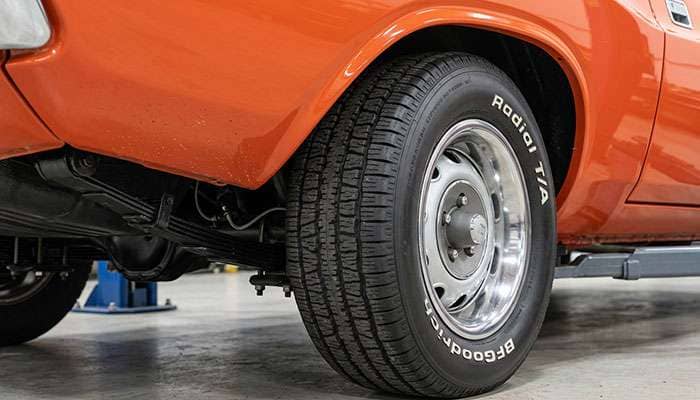
Then there's the axle itself. Owners on the E-body forums report the rear axle sitting as much as an inch off center on cars with factory quarters and a factory axle, and the tight side is usually the passenger side. One 1973 'Cuda owner had a 255 touch the passenger-side wheel well on 15x8 Rallyes at 4.5 inches of backspacing and fixed it with 5 inches of backspacing. Another owner ran a 235 front and 275 rear with no trouble anywhere except the rear passenger side.
What that adds up to:
The front is a different problem. Width is rarely what stops you. Height is. The factory tires were about 26 inches tall, and owners report that a front tire much past 27 inches starts touching the front fender lip at full lock or over a hard bump. That's why a 255/60R15 is the practical front ceiling at 15 inches, and why a 245/45R17 at 25.7 inches fits so easily. If you want more front grip, add width before you add height.
Backspacing is the distance from the wheel's mounting face to its inner edge, and on an E-body it is the number that decides everything above. If you have never measured one, our guide to measuring backspacing on classic car rims takes about five minutes to read.
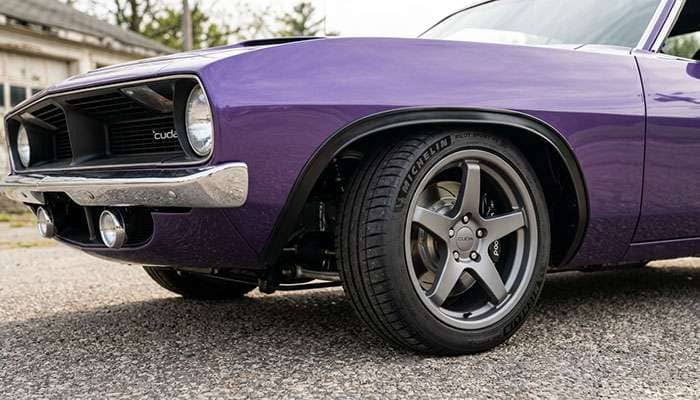
The trap is that 5x4.5 is the same pattern as 5x114.3, and most wheels drilled for it are built for modern cars. Across the market, the median 17x8 in 5x114.3 carries +35 mm of offset, which is close to 6 inches of backspacing, and only about 3 in 10 sit at 5 inches or less. At 18 inches it's worse: only about 1 in 7 18x8s comes in under 5 inches. A wheel that bolts on is not a wheel that fits, so check the backspacing on the spec sheet before you check the price. Our 5x4.5 wheels guide covers the rest of the pattern.
Not where it counts. The Challenger rides on a 110-inch wheelbase, two inches longer than the Barracuda's 108, and its body is roughly an inch and a half wider. Underneath, both cars share the same front and rear track, 59.7 inches front and 60.7 inches rear, the same suspension and the same rear spring spacing. The numbers in this guide apply to both, and owner reports from either car apply to the other.
What does change is the body that surrounds the tire, so check your own fender and quarter lips rather than trusting a photo of the other car. Fifty-plus years of bodywork, replacement quarters and sagging springs matter more on an individual car than the factory difference between the two badges.
Yes, and 1970 is the year that catches people. Chrysler used left-hand-thread studs on the driver's side of its cars for decades, and 1970 was the last year for it. On an E-body, that means the 1970 Challenger and Barracuda are the only years built with left-hand threads on the left side. Owners report that 1971 parts books show right-hand threads all around, though some early-built 1971 cars carried over the old studs. A left-hand stud has an L stamped on its end, so look before you put a wrench on it.
The stud size never changed. Every E-body uses 1/2-20 studs, front and rear, from 1970 through 1974. What did change is the front hub on 1973-74 cars, which use the later big-bearing disc spindle. Mopar owners running the 1973-and-later disc hubs report that some aftermarket wheels need their center bore opened up to clear them, so test-fit a wheel on the front before you mount tires.
When you switch to aftermarket wheels, use the lug nuts the wheel maker specifies. Many classic mag-style wheels take a shank-style nut, not the conical nut that came on your steel wheels, and the wrong seat will not hold torque. Our classic Mopar wheels and tires builder's guide covers the A-body and B-body patterns if you have more than one Mopar in the garage.
Not as a bolt-on. The 2008-2023 Challenger uses 5x115, not 5x4.5. The two circles differ by only 0.7 mm, which is close enough that the wheel will appear to go on, but the lug nuts can't all seat square. The usual fix is floating-seat lug nuts made for that conversion, never just forcing the wheel down with an impact gun.
The bigger problem is offset. Factory wheels on the new car run about +18 to +25 mm. On a 9-inch-wide wheel, that's roughly 5.7 to 6 inches of backspacing, well past the 5 inches an E-body rear wants. The modern car's tires are also built around 17- to 20-inch wheels and a much wider body. If you're shopping the modern car's wheels for the modern car, our guide to whether Charger wheels fit a Challenger is the one you want.
It comes down to the look you want and how much tire choice you need. Fifteens keep the period look and the white letters. Seventeens give you far more tires to choose from, but none of them have white letters.
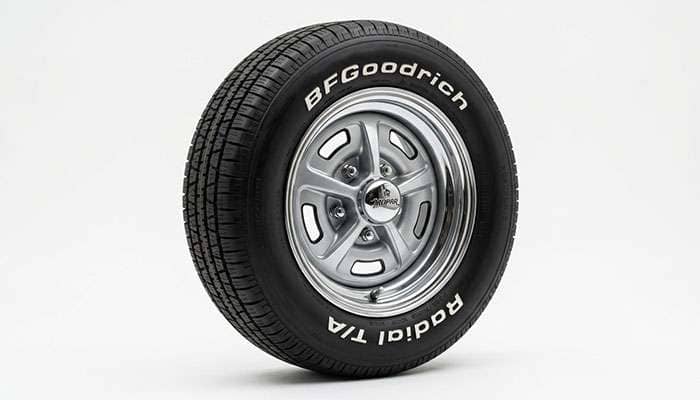
A 17-inch tire on these cars also ends up a little shorter than the 15. A 275/40R17 is about 25.7 inches tall against 28 inches for a 275/60R15, which lowers the rear of the car visually and changes the final drive. Many owners like that. Some want the taller 15 for the stance.
On a car this valuable, a wrong guess costs you in steps, and each one is more expensive than the last:
The fix is cheaper than any of it: measure first, then buy the wheel with the right backspacing and the tire that fits your tighter side.
When you have your numbers, search wheels and tires for your car on our 1970 Dodge Challenger page, then match the backspacing to your measurements before you buy.
Every 1970-74 Challenger and Barracuda shares the 5x4.5 pattern, 1/2-20 studs and the same track, so the same numbers work on both cars. The fit is decided at the rear, where the leaf spring and quarter lip leave a narrow window and the axle may not be centered in it. A 15x8 at 4.5 inches with a 275/60R15 or a 17x9 at 5 inches with a 275/40R17 is the dependable rear, and a 245-width tire under 27 inches tall is the dependable front. Measure both rear sides, watch the left-hand studs on a 1970 car, and skip modern 5x114.3 wheels with 6 inches of backspacing.
The 1970 Challenger uses 5x4.5, also written 5x114.3 mm, on 1/2-20 studs. 1970 cars were built with left-hand-thread studs on the driver's side, and 1971-74 cars use right-hand threads all around. The 1970-74 Barracuda and 'Cuda use the same pattern and studs.
Owners consistently fit a 275/60R15 on a 15x8 with 4.5 inches of backspacing, and some run a 295/50R15 on the same wheel when the axle is centered. Measure both sides first, because E-body axles can sit up to an inch off center. Wider tires need the springs moved inboard.
Owners commonly run a 17x8 with 4.5 inches of backspacing and a 245/45R17 up front, and a 17x9 with 5 inches of backspacing and a 275/40R17 out back. Most 5x114.3 wheels built for modern cars carry close to 6 inches of backspacing, which is too much for an E-body.
Not as a bolt-on. The modern Challenger uses 5x115, 0.7 mm larger than the 1970 car's 5x4.5, so it needs floating-seat lug nuts. Its factory offset of about +18 to +25 mm also gives too much backspacing for an E-body rear.
Yes. Both are 1970-74 E-bodies with the same 5x4.5 pattern, the same 1/2-20 studs and the same 59.7-inch front and 60.7-inch rear track. A wheel and tire that fits one fits the other, within the car-to-car variation in axle centering and body lips.
F60-15 Goodyear Polyglas GT raised white letter tires on 15x7 wheels. The Hemi was the only 1970 'Cuda with 15-inch wheels as standard; other 'Cudas came on F70-14s, with the 15-inch Rallye and E60-15 tires as an option.