
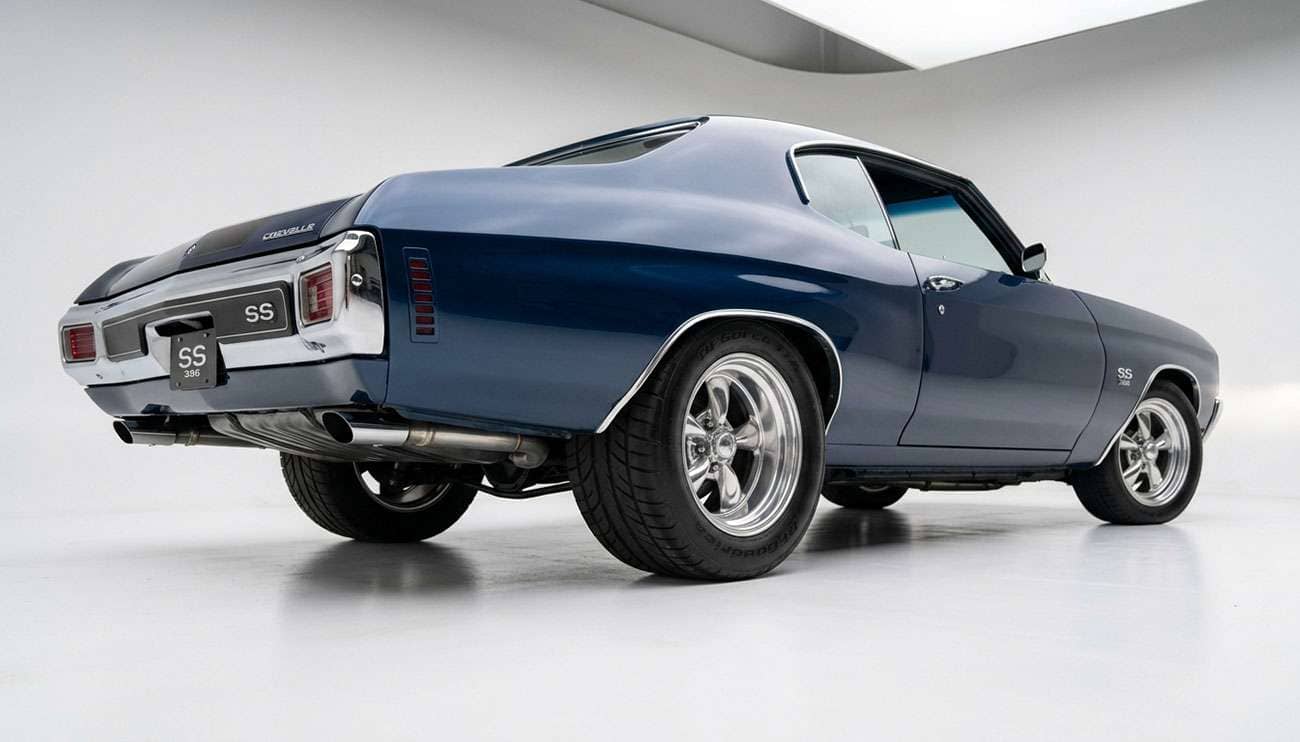
There's a reason every great muscle car photo you've ever seen shows wider rubber in the rear. It's not just style — although I'll be the first to admit that a Chevelle with fat meats poking out of the rear wells looks absolutely right in a way that a square setup never quite matches. The real reason muscle cars and staggered setups go together is physics. These are rear-wheel-drive cars with big engines and a lot of torque. More rubber on the drive wheels means more grip, harder launches, and that aggressive, nose-down stance that tells everyone this car means business.
I've been building staggered wheel and tire packages for muscle cars since before "pro-touring" was a word. The fundamentals haven't changed. What's changed is the quality of wheels and tires available — you can build a staggered setup today that looks period-correct and performs like a modern sports car. Let me show you exactly how to do it.
Every classic muscle car is rear-wheel drive. Every one. That means all the power — whether it's 300 horsepower from a small block or 500 from a big block — goes through the rear tires. The wider those rear tires are, the larger the contact patch, and the more of that power actually reaches the pavement instead of going up in tire smoke.
But it's more than just traction. When you accelerate hard in a muscle car, weight transfers to the rear. The nose lifts, the rear squats, and the back tires are suddenly carrying significantly more load than the fronts. Wider rear tires take advantage of that weight transfer by spreading the load across a bigger footprint. Meanwhile, narrower front tires keep the steering light and responsive — you're not dragging unnecessary rubber around corners where the front end needs to be quick.
Then there's the look. I can't overstate this. A 1969 Camaro with 235s all the way around looks fine. The same car with 235s in front and 275s in the rear looks like it's about to eat your lunch. That visual wedge — skinnier up front, wider out back — is the defining silhouette of American muscle. It's what separates a muscle car from a sedan with a big engine.
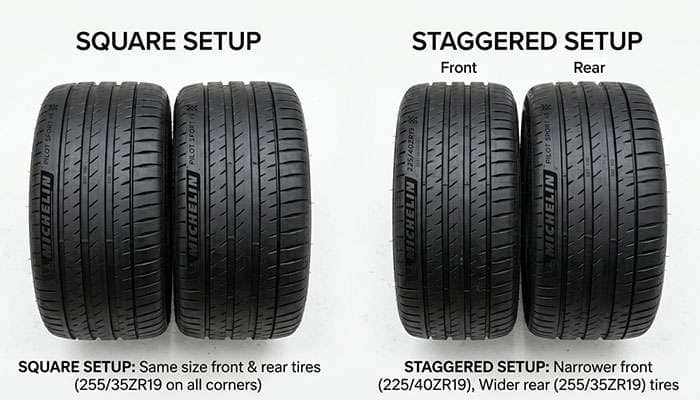
Staggered isn't always the answer. Here's when each setup makes sense on a muscle car:
You want maximum straight-line traction — drag strip launches, stoplight pulls, highway on-ramps. You want that classic muscle car stance with wider rubber filling the rear fenders. You're building a street cruiser, weekend warrior, or occasional drag strip car. You prioritize the look and acceleration feel that defines muscle car culture.
You're building a road course or autocross car where balanced cornering grip matters more than straight-line traction. You want the ability to rotate all four tires front-to-rear for even wear and longer total tread life. You're on a tight budget and want to buy four identical tires instead of two different sizes. You want more neutral handling characteristics with less tendency toward understeer.
For most classic muscle car owners? Staggered wins. These cars weren't designed to carve apexes at Laguna Seca — they were designed to go fast in a straight line and look intimidating doing it. A staggered setup honors that design intent while delivering real-world performance benefits on the street.
Getting the stagger right means balancing three variables: wheel width, tire width, and overall tire diameter. Here's how to think about each one:
A 1-inch width difference front to rear is the minimum for a visible stagger. Two inches is the sweet spot for most classic muscle cars — it gives you a meaningful visual difference and enough extra rear tire width to make a performance difference without requiring major fender modifications. Going beyond 2 inches of wheel width stagger starts pushing into fender rolling or tubbing territory on most stock-bodied cars.
Typical staggered wheel combos: 17×8 front / 17×9 rear. 17×8 front / 17×10 rear. 18×8 front / 18×9.5 rear. 15×7 front / 15×8 rear.
Match the tire width to the wheel width. The general rule is that each inch of wheel width supports roughly 30mm of additional tire width. So if your rear wheels are 1 inch wider, your rear tires should be about 30mm wider. Two inches wider? About 40-50mm more tire. Common muscle car pairings: 235mm front / 275mm rear. 245mm front / 295mm rear. 225mm front / 255mm rear.
This is where staggered setups get tricky and where I see the most mistakes. Your front and rear tires must have approximately the same overall diameter — within 3% of each other. If the rear tire has a significantly larger rolling diameter, your speedometer will be wrong, your ABS and traction control (if equipped) will malfunction, and the car will handle unpredictably.
When you go wider on the rear tire, you compensate with a shorter aspect ratio (sidewall height) to keep the overall diameter matched. For example: a 235/45R17 front tire has an overall diameter of about 25.3 inches. A 275/40R17 rear tire has an overall diameter of about 25.7 inches. That's about 1.5% difference — well within the acceptable range.
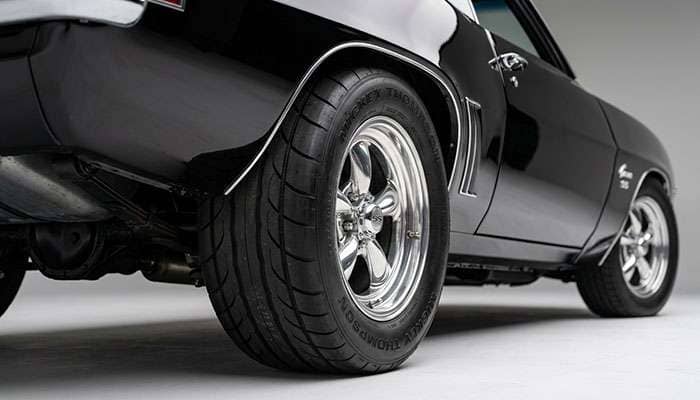
These are the combos I've built hundreds of times. They fit on stock or mildly modified fenders with no rubbing on most cars. If you've lowered the car significantly or have non-stock inner fenders, confirm clearance before ordering.
Platform |
Wheel Size |
Front Tire |
Rear Tire |
Notes |
|---|---|---|---|---|
GM A-Body (Chevelle, GTO, Cutlass) |
15×7 / 15×8 |
235/60R15 |
275/60R15 |
Classic look with BFGoodrich Radial T/A |
GM A-Body |
17×8 / 17×9 |
245/45R17 |
275/40R17 |
Most popular modern upgrade |
GM A-Body |
18×8 / 18×10 |
245/40R18 |
295/35R18 |
Pro-touring — may need fender rolling |
GM F-Body (Camaro, Firebird) |
15×7 / 15×8 |
225/60R15 |
255/60R15 |
Narrower body — conservative stagger |
GM F-Body |
17×8 / 17×9 |
235/45R17 |
275/40R17 |
Sweet spot for first-gen Camaro |
Ford Mustang (1964–1973) |
15×7 / 15×8 |
215/65R15 |
255/60R15 |
Period correct — narrowest body |
Ford Mustang |
17×8 / 17×9 |
225/45R17 |
255/45R17 |
Same aspect ratio keeps diameter close |
Mopar B-Body (Charger, Road Runner) |
15×7 / 15×8 |
235/60R15 |
275/60R15 |
Wide fenders handle big rubber easily |
Mopar B-Body |
17×8 / 17×10 |
245/45R17 |
295/40R17 |
Aggressive — Mopar fenders are forgiving |
Need exact offset and backspacing specs for your specific car? Call us at 888-926-2689. We build these packages every day and can confirm clearance before you order.
Here's where I see the most staggered setups go sideways — literally. Guys pick the right wheel diameter and width, the right tire sizes, and then get the backspacing wrong. On a staggered setup, the front and rear wheels almost always need different backspacing because the wider rear wheel sits differently in the fender well.
Too much backspacing on the rear and the tire tucks under the fender and hits the inner fender well or the frame. Too little backspacing and the tire pokes out past the fender lip — which looks wrong, throws road debris onto the body, and is illegal in some states.
For most classic muscle cars, rear backspacing on a staggered setup falls between 4.0 and 4.75 inches. Front backspacing is typically 4.25 to 5.0 inches. But these numbers vary significantly by make, model, and year — a '67 Camaro has different clearances than a '70 Chevelle, which has different clearances than a '69 Mustang. This is not a place to guess.
The safest approach is to buy from a source that specializes in muscle car fitment. At Performance Plus Tire, we've test-fit virtually every popular muscle car platform. When you order a staggered package from us, we confirm backspacing compatibility for your specific car before we ship it. That eliminates the most common — and most expensive — mistake in staggered builds.
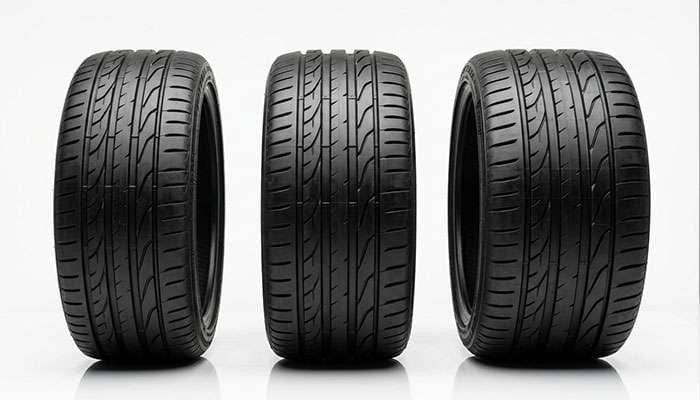
Not every tire is available in the wide range of sizes a staggered setup demands. You need a tire that comes in both your narrower front width and your wider rear width, ideally in the same tread pattern so the car looks cohesive. Here are the tires I reach for most often:
The BFGoodrich Radial T/A is still the king. Raised white letters, meaty sidewall, and available in the full range of 15-inch sizes from 215 through 275. It looks correct on any 1960s or 1970s muscle car and the tread pattern matches front to rear even at different widths. Nothing else touches it for an authentic period look on a staggered 15-inch setup.
The Nitto NT555 G2 is my first recommendation for a staggered street setup. It's available in sizes from 225 through 305 in 17 and 18 inch, the tread pattern is aggressive without being obnoxious, and the wet grip is genuinely excellent. The Mickey Thompson Street Comp is another strong choice — serious dry grip with a directional tread pattern that looks great at any width. And the Falken Azenis RT615K+ is the pick if you want a tire that can handle occasional autocross or track day duty on top of street driving.
If your muscle car sees the quarter mile, look at the Nitto NT555RII drag radial for the rear and a standard performance tire up front. Some guys run skinny front tires — 185 or 195 width — with 275 or 295 drag radials out back. That extreme stagger minimizes front rolling resistance and maximizes rear traction for the hardest possible launches. Just know that this kind of setup is strictly for drag use — it's not balanced enough for spirited street driving.
Browse our full selection of 17-inch and 18-inch wheels from brands like American Racing and Boyd Coddington — all available in staggered widths specifically designed for muscle car fitments.
Not front to rear — the different sizes prevent that. You can only rotate side to side (left rear to right rear, left front to right front), and only if the tires are non-directional. If you're running directional tread patterns, the tires would need to be dismounted, flipped, and remounted, which adds cost and complexity. This limitation means rear tires on a staggered setup typically wear faster and need replacement sooner than fronts. Budget for replacing rears at roughly 60-70% of the front tire's lifespan.
For most classic muscle cars, 30-50mm wider in the rear is the sweet spot. A common street setup is 235mm front and 275mm rear — that's a 40mm difference that provides a meaningful visual and traction advantage without requiring fender modifications on most stock-bodied cars. Going 60mm or more wider (like 235 front / 295 rear) creates a dramatic look but may require fender rolling, tubbing, or mini-tubs depending on your specific platform.
Only if the overall tire diameter differs significantly between front and rear. On a properly set up staggered package, you compensate for the wider rear tire by using a shorter sidewall (lower aspect ratio), which keeps the overall rolling diameter within 3% of the front. For example, a 235/45R17 front and 275/40R17 rear have nearly identical overall diameters. As long as you follow this principle, your speedometer will remain accurate and your drivetrain components won't be stressed by mismatched wheel speeds.
Backspacing requirements vary by make, model, and year — there is no universal number. As a rough guideline, most classic muscle cars use 4.25-5.0 inches of backspacing on the front and 4.0-4.75 inches on the rear in a staggered configuration. The wider rear wheel typically needs slightly less backspacing to keep the tire centered in the wheel well. Always confirm with a fitment specialist for your specific car, because even small differences in suspension components, brake caliper size, and exhaust routing can change what fits.
It depends on what "pro-touring" means to you. If your pro-touring build is primarily a fast street car with occasional drag strip runs, staggered is still the better choice — it maximizes rear traction and gives you the aggressive stance that pro-touring is known for. If you're building a car that will see serious road course or autocross time where balanced cornering grip is the priority, a square setup with equally wide tires all around provides more neutral handling and allows full tire rotation. Many competitive pro-touring cars actually run square setups for this reason.
You don't have to, but it's the safest and most cost-effective approach. Buying a staggered wheel and tire package from a specialist like Performance Plus Tire means we confirm that the wheel widths, tire sizes, backspacing, and bolt patterns are all compatible with your specific car before anything ships. We mount and balance the package so it arrives ready to bolt on. Piecing together wheels and tires from different sources increases the risk of fitment errors — wrong backspacing, incompatible tire width for the wheel width, or mismatched overall diameters — all of which cost time and money to fix.



