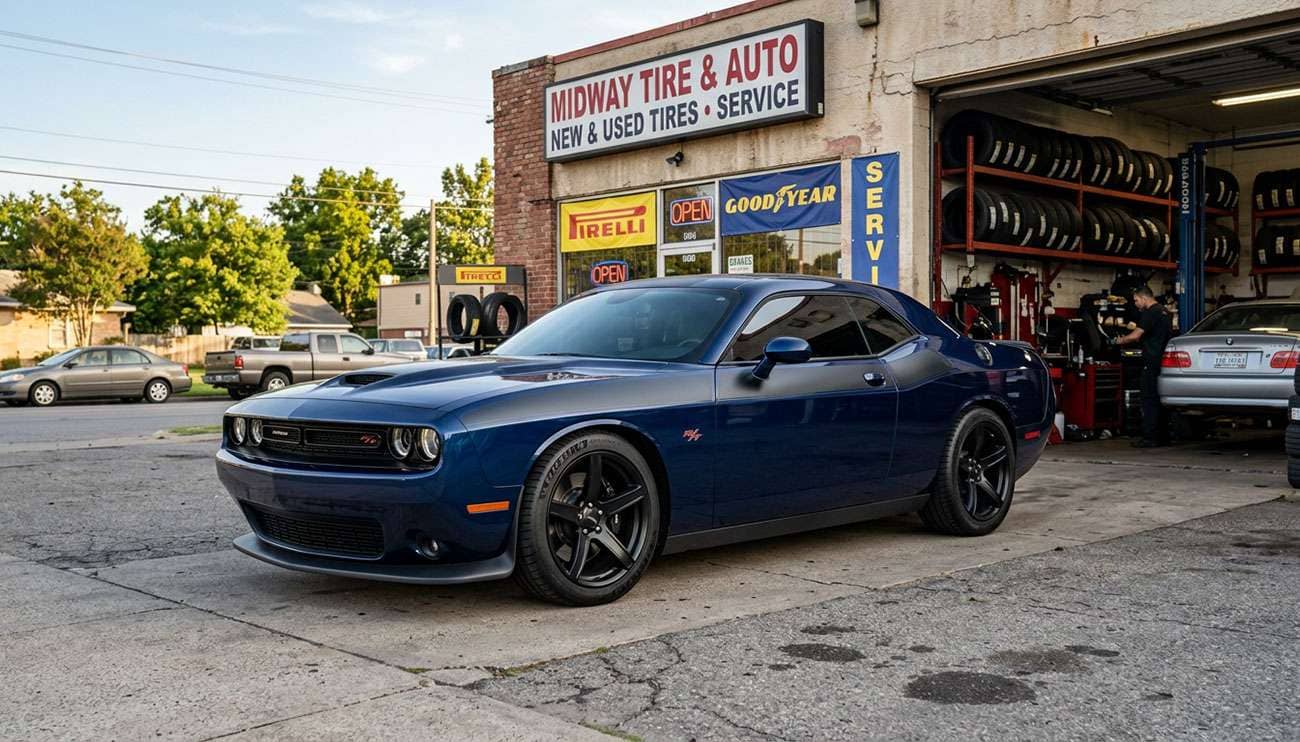
Yes, if the Charger is a 2006 to 2023 and the Challenger a 2008 to 2023, both are rear-wheel drive, and the Charger wheel is built to clear the Challenger's brakes. Every Charger and Challenger from those years shares the 5x115 bolt pattern, 71.5 mm hub bore, M14x1.5 studs and the same +18 to +25 mm offset family. Most answers stop at "same 5x115." What actually decides it is the brake package behind your Challenger's wheels, whether either car is AWD, and how wide the rear wheels are.
I have been bolting wheels onto Mopars at our shop in Long Beach since 1971, and this one comes in every month. A fellow finds a clean set of Charger take-offs, the bolt pattern checks out, and then the wheel will not spin past the caliper. Find your Challenger's front brake below first.
Challenger Front Brake |
Usually Found On |
Smallest Wheel That Clears |
Charger Wheels That Fit |
|---|---|---|---|
Non-Brembo single-piston calipers (about 320 mm, 12.6 in rotor on the SXT) |
SXT, GT and R/T models without a Brembo package |
17-inch |
Any RWD Charger wheel, 17-inch and up |
Brembo four-piston, 360 mm (14.2 in) rotor |
Scat Pack, 2008-2014 SRT8 |
20-inch for most wheels; only a few 18s built to clear |
Charger Scat Pack, SRT and Hellcat 20s; not SXT 17s or 18s |
Brembo six-piston, 390 to 400 mm (15.4 to 15.7 in) rotor |
SRT 392, Hellcat, Redeye, some later Scat Packs |
20-inch, except purpose-built drag front runners |
Charger SRT and Hellcat 20s; test-fit anything else |
Any brake, AWD car |
2017-2023 Challenger GT and SXT AWD |
Depends on brake, but offset must suit AWD |
AWD Charger wheels; RWD Charger wheels are listed as not fitting |
You can see which brake you have through the spokes. A Brembo caliper says so on its face and you can count the pistons by the bulges on the caliper body.
Because under the sheet metal they are the same car. The 2008 to 2023 Challenger was built on a shortened version of the platform under the 2006 to 2023 Charger, the Chrysler 300 and the old Magnum. All of them use a 5x115 bolt pattern and a 71.5 mm hub bore, and replacement stud sets are sold as M14x1.5 for every Charger from 2006 and every Challenger from 2008. Factory lug nuts interchange too.
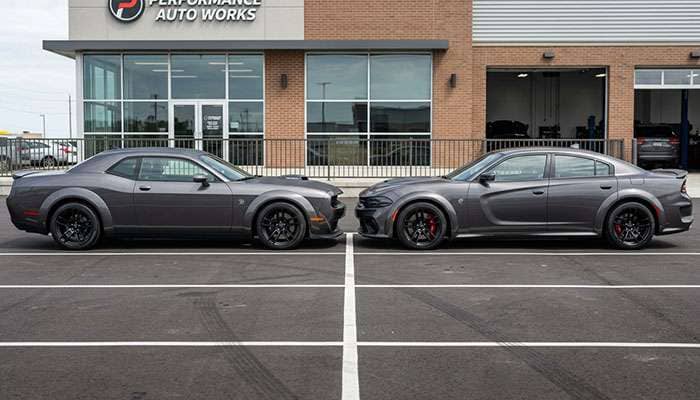
The offsets line up as well. Factory rear-drive Charger wheels run roughly +18 to +25 mm, the same family the Challenger uses. The Hellcat's five-spoke 20x9.5 sits around +18 mm on both cars. That is why replica wheel sellers list one Charger-style 20x9 for every 2008 to 2023 rear-drive Challenger except the Widebody.
Here is how the Charger wheels you are most likely to find line up on a Challenger:
Charger Wheel |
Typical Size |
Narrow-Body Challenger, Base Brakes |
Narrow-Body Challenger, Brembo |
Widebody Challenger |
|---|---|---|---|---|
SE and SXT |
17 or 18-inch |
Fits |
No; hits the caliper |
No; hits the caliper |
R/T and GT |
20x8 |
Fits |
Test-fit; spoke shape decides it |
Bolts on but sits tucked inside the flares |
Scat Pack |
20x9, about +18 to +20 mm |
Fits |
Fits four-piston cars; test-fit on six-piston cars |
Test-fit over the six-pistons; sits tucked inside the flares |
SRT 392 and Hellcat |
20x9.5, about +18 mm |
Fits |
Fits; built for six-piston Brembos |
Bolts on but sits tucked inside the flares |
Widebody Scat Pack and Hellcat |
20x11, about -2.5 mm |
No; pokes past the fenders |
No; pokes past the fenders |
Direct fit |
AWD Charger |
18 or 19-inch, higher offset |
Bolts on but sits further inboard on a RWD car |
Usually too small for the caliper |
No |
Only the ones built to. This is where most Charger-to-Challenger swaps die. A Charger SXT wheel was designed around a single-piston brake on a 12.6-inch rotor. A Challenger Scat Pack carries Brembo four-pistons on a 14.2-inch rotor, and an SRT 392 or Hellcat carries six-pistons on 15.4 to 15.7-inch rotors. The bolt pattern lines up fine. The inside of the wheel barrel and the back of the spokes run straight into the caliper.
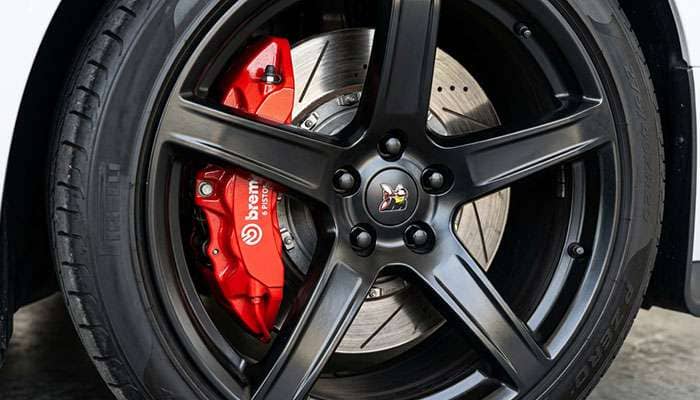
Two things have to clear, not one. The barrel has to be big enough in diameter to pass over the caliper body, and the back face of each spoke has to sit far enough out to clear the caliper face as the wheel turns. That second one is why diameter alone does not settle it. Dodge shipped the Challenger SRT Demon and the 2021 Super Stock on 18x11 wheels over a 14.2-inch Brembo, because those wheels were shaped for it. A wide street 18 with a flatter spoke will not follow them over the same caliper. Even some replica 20s are sold with a note that they do not fit Brembo-equipped cars.
Here is how we check it in the shop. Slide a bare wheel on with no tire, snug two lug nuts by hand, and turn the wheel a full revolution. At the tightest point between spoke and caliper, a folded business card should slide through. If it will not, that wheel is too close to run, no matter what the listing said.
My rule at the counter: if your Challenger has Brembos, the Charger wheels need to come off a Charger that had the same or bigger brakes. SRT 392 and Hellcat wheels pass that test on every narrow-body car, and Scat Pack wheels pass it on four-piston cars. Anything from an SXT, a GT or a base R/T gets a test-fit before money changes hands. Our guide to brake caliper wheel clearance shows how to check it with a single wheel, and our 18 vs. 20-inch muscle car package guide covers which 18s clear which brakes.
They bolt on, but they do not sit where a rear-drive wheel sits. The all-wheel-drive Chargers and Challengers run noticeably higher offset wheels. Aftermarket AWD fitments for these cars commonly land around +35 to +45 mm, against +18 to +25 mm for rear-drive cars, and one Chrysler 300 AWD wheel was stamped +55. Bolt that onto a rear-drive Challenger and the wheel pulls in toward the strut and control arms by roughly an inch.
It works worse the other way. Rear-drive Charger wheels on an AWD Challenger GT push out past where the car was designed to carry them, and most wheel sellers list their rear-drive Charger and Challenger wheels as not fitting AWD cars at all. If you have a 2017 to 2023 Challenger GT or SXT AWD, shop AWD Charger wheels or wheels sold specifically for the AWD Challenger.
The market makes this easy to get wrong. About four in ten 20x8.5 wheels drilled 5x115 run +35 mm or more. Those are built for AWD Chargers and for the front-drive GM sedans that share the 5x115 pattern, not for a rear-drive Challenger.
The fronts will. The rears are where you can come up short. Dodge built nearly every one of these cars on a square setup from the factory, same width at all four corners, so a staggered set is almost always aftermarket, and the Charger has a little more room in the rear wheel well than the Challenger. Owners who track this closely put the narrow-body Challenger's comfortable limit at a 275 front and a 305 rear on 20s. A Charger can carry a 315 in the rear right at the edge of the fender. That 315 on a Challenger will poke past the fender, rub inside it, or both, depending on offset.
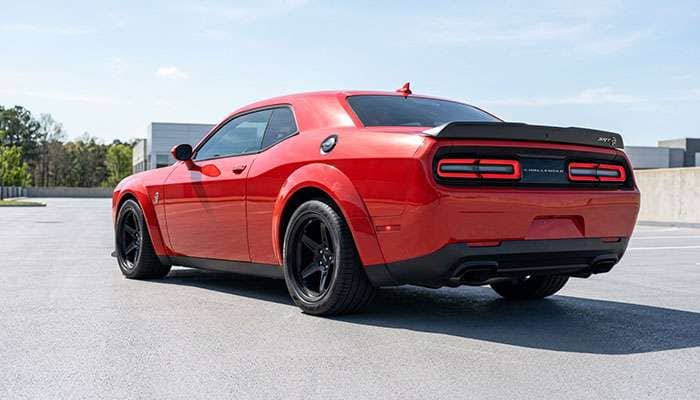
Rear offset matters as much as width. Owner-compiled fitment lists for the narrow-body Challenger show 20x10.5 rears working around +22 mm and 20x11 rears around +18 mm, while higher offsets on those widths start touching inside the wheel well. So a staggered Charger set built around 20x10.5 or 20x11 rears and 315 tires is the part of the deal most likely to need a different tire, a fender roll or a different offset on a Challenger.
Two more staggered notes. You cannot rotate a staggered set front to rear, so the rears wear on their own schedule. And on an AWD car, front and rear rolling diameters have to match even if the widths do not. Our guide to the muscle car staggered setup walks through sizing a set that keeps the diameters honest.
On a Widebody Challenger, yes. The Widebody Charger and Challenger share the 20x11 wheel and 305 tire package. On a narrow-body Challenger, no. A factory Widebody wheel sits around -2.5 mm against roughly +18 mm for a narrow-body Hellcat wheel, and it is an inch and a half wider. Add the wider 305 tire, and the outer shoulder lands somewhere around two inches further out than the narrow-body Challenger's fender was drawn to cover.
The reverse works mechanically. Narrow-body Hellcat 20s bolt onto a Widebody car and clear its six-piston brakes. Narrow-body Scat Pack wheels were drawn for four-pistons, so test-fit one on a Widebody Scat Pack, which carries six-pistons. Either way they sit tucked an inch or more inside those flares, and most owners do not like the look.
No to both. The 2024 and newer Charger, the Daytona EV and the gas Sixpack, moved to a new platform with a 5x127 bolt pattern, so its wheels will not bolt onto any Challenger. Our guide to Charger Daytona wheel fitment covers that car in detail.
Go back the other way and the classics are a different hub altogether. The 1966 to 1974 Charger and the 1970 to 1974 Challenger used a 5x4.5 pattern and inch-size studs, so neither one swaps with the modern cars. If you are wheeling a vintage B-body or E-body, our classic Mopar wheel and tire builder's guide is where to start. The 1980s front-drive Charger and the Mitsubishi-built Challenger of the late 1970s were four-lug cars and share nothing with either.
Not for factory Charger wheels. They take the same M14x1.5 factory lug nuts as your Challenger and center on the same 71.5 mm hub with no ring. Torque them to the factory spec in your owner's manual with a torque wrench, in a star pattern, and check them again after the first 50 to 100 miles.
Aftermarket wheels are a different story. Only about one in four aftermarket 5x115 wheels is bored at the Charger and Challenger's 71.5 mm. Most are bored bigger, at 72.6, 74.1 or 78.1 mm, so they can fit other 5x115 cars too, and they need a hub-centric ring on your Challenger or they will center on the lug nuts alone. Factory-style lug nuts are also sold with a warning that they are meant for factory wheels only, because aftermarket wheels often need a different nut. Our 5x115 bolt pattern guide lists every car on this pattern and what each one needs.
Two small things travel with the wheels. Move your tire pressure sensors over or buy the set with sensors in it, then drive the car and make sure the warning light clears. And center caps are matched to the wheel, not the car, so a Charger wheel keeps its Charger cap. If you want Challenger caps, check that they snap into that wheel's center bore before you order a set.
Factory Charger wheels, yes. The Charger is the bigger car, and Dodge rated it accordingly. Gross vehicle weight ratings run about 5,100 to 5,500 pounds on the Charger and 4,950 to 5,500 pounds on the Challenger, with the Hellcats at the top of both. A Charger Hellcat sits around 4,586 pounds at the curb against roughly 4,415 for a Challenger Hellcat. A wheel Dodge built for the Charger is carrying a Challenger's job with room to spare.
Aftermarket wheels are where I would slow down. The median 5x115 wheel is rated around 1,900 pounds, but about one in four is rated at 1,600 pounds or less. Many of those were built for lighter cars on the same pattern. On a 5,500-pound Hellcat, the average corner carries about 1,375 pounds at full load, and these cars carry more of their weight on the front. A 1,600-pound wheel leaves very little margin up there. Read the rating stamped on the back of the wheel, and pass on anything that is not comfortably above a quarter of your door-sticker GVWR.
If the Charger set does not fit your plan, you can compare widths, offsets and load ratings across our 5x115 bolt pattern wheels.
Charger wheels fit a Challenger more often than not, because from 2008 to 2023 the two cars share the same hub, studs, bore and offset family. The bolt pattern is never the problem. The brakes are. An SXT wheel will not clear a Scat Pack's or Hellcat's Brembos, AWD wheels do not belong on a rear-drive car, and a staggered Charger rear set built around 315s is a size too big for a narrow-body Challenger.
Check your caliper, your drivetrain and your rear tire width before you check the price. Do that, and a set of Charger take-offs is one of the best deals in the Mopar world.
Yes on 2006 to 2023 Chargers and 2008 to 2023 Challengers, which share the 5x115 bolt pattern, 71.5 mm hub bore and M14x1.5 studs, as long as both cars are rear-drive and the Charger wheel clears the Challenger's brakes. SXT wheels will not clear Brembo calipers, and wheels from the 2024 and newer Charger use a different 5x127 pattern.
Mechanically, the 2008 to 2023 cars share the same hub, studs and offset family, so rear-drive wheels interchange. What differs is trim: an SXT wheel was built for small single-piston brakes, a Hellcat wheel for six-piston Brembos, and a Widebody wheel for wider fenders. Match the wheel to a trim with the same brakes and body as your car.
Yes on a narrow-body Scat Pack. The Hellcat's 20x9.5 wheel sits around +18 mm, the same offset family as the Challenger's, and it was built to clear six-piston Brembos, so it clears the Scat Pack's four-pistons easily. On a Widebody Scat Pack it bolts on but sits tucked inside the flares.
Yes, under the same rules in reverse. Rear-drive 2008 to 2023 Challenger wheels fit 2006 to 2023 rear-drive Chargers if they clear the Charger's brakes. The Charger has a little more room in the rear wheel well, so a staggered Challenger set usually fits a Charger with room to spare.
They fit an AWD Challenger GT or SXT. On a rear-drive Challenger they bolt on, but their much higher offset pulls the wheel an inch or more closer to the suspension, and many are too small to clear Brembo brakes. Rear-drive Charger wheels are generally listed as not fitting AWD cars.
No. The 2024 and newer Charger Daytona and Sixpack ride on a new platform with a 5x127 bolt pattern, while every 2008 to 2023 Challenger uses 5x115. The lug holes will not line up.