
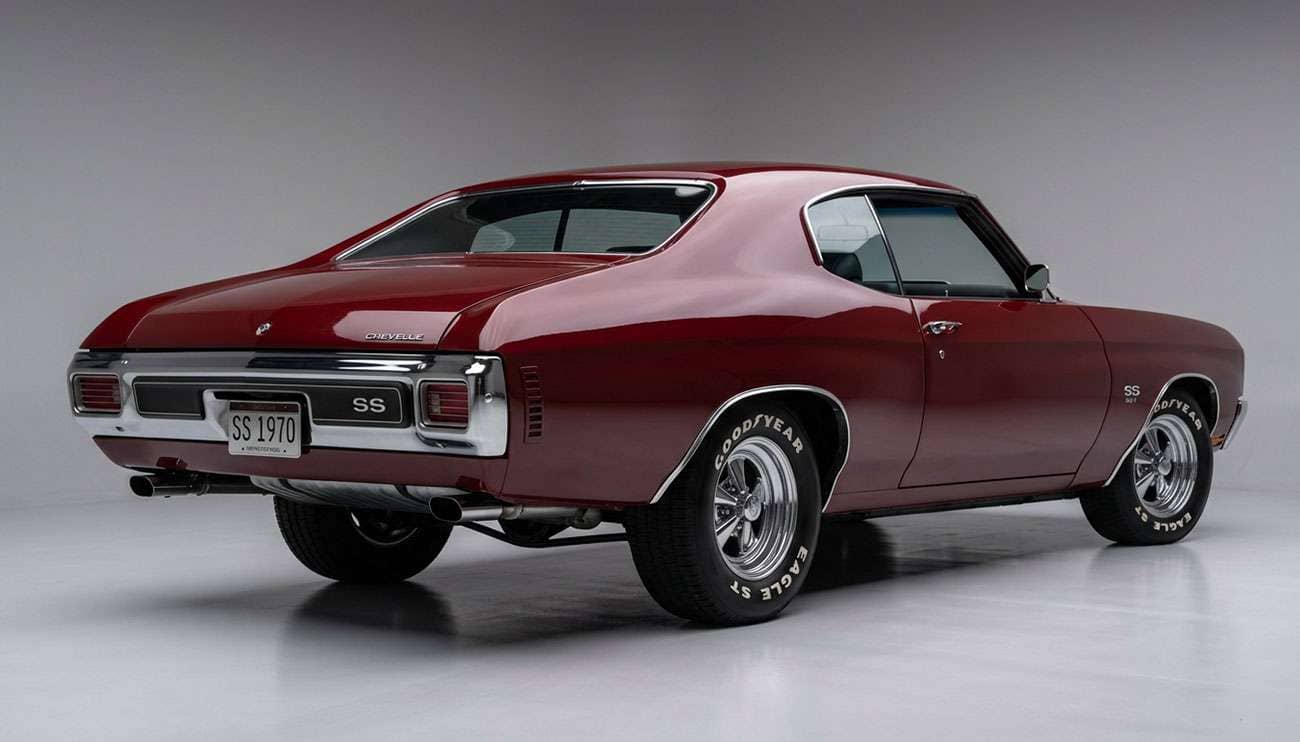
Walk into any cruise night this summer and stand near the muscle cars long enough, you'll hear the argument. Guy with a '72 Trans Am rolls up on a fresh set of BFGoodrich Radial T/As, and within about ninety seconds somebody will mention to him that his tires are installed backwards. Letters should face in, they'll say. Smoother sidewall to the outside, cleaner look, more period correct. The next guy over will push back. Letters always face out. That's what the factory did. That's why the letters are there in the first place. The Trans Am owner usually just stands there nodding while the two old-timers argue about his tires.
I've been mounting raised white letter tires for longer than some of those cruise night guys have been alive, and I'll tell you flat out: letters face out. That's the answer. That's been the answer since Firestone started putting raised white lettering on Wide Ovals in the late 1960s. That's how the factory installed them on Camaros, Mustangs, Chargers, and every other muscle car that left Detroit with raised letter rubber. But the debate exists for a reason, and there are specific situations where letters-in makes sense. Let me walk you through the whole picture.
A raised white letter tire — RWL for short — has the tire brand name and model designation molded into the sidewall as a raised relief, with white rubber filling the letter shapes. The lettering sits proud of the sidewall surface, typically about an eighth of an inch, and the white rubber is vulcanized into the tire during manufacturing. It's not paint that can rub off or a sticker that can peel. It's part of the tire.
Here's the part most drivers don't realize: nearly every raised white letter tire has two different sidewalls. One side has the bold white lettering — that's the "outside" or "display" side. The other side has either a plain blackwall or much smaller, recessed black lettering that's almost invisible from more than a few feet away. The tire is designed to give you a choice of which side faces the world.
This dual-sidewall construction goes back to the earliest days of RWL tires. Firestone and Goodyear both played with raised lettering on high-performance street tires during the mid-1960s, but the technology took off in 1970 when BFGoodrich introduced the Radial T/A — the tire that defined American performance rubber for the next thirty years. Every BFG Radial T/A, every Goodyear Wrangler RT/S, every Mickey Thompson Sportsman S/T, every Cooper Cobra, every Firestone Firehawk of that era shipped with a lettered side and a plain side. Mount the tire one way, letters show. Flip it around, you get a clean blackwall.
On a classic muscle car, a cruiser, a weekend driver, or any street-driven vehicle with RWL tires — the lettering faces out. Outward. Toward the curb. The side you can see when you walk around the car.
This isn't a judgment call. It's factory-correct. BFGoodrich, Goodyear, Firestone, Cooper, Mickey Thompson — every tire manufacturer that ever produced a raised white letter tire designed the letter side to be the visible side. The branding was the whole point. A '69 Camaro Z/28 rolled off the assembly line with Firestone Wide Oval RWLs installed letters-out, because Chevrolet wanted the people at the stoplight next to you to know you were running performance rubber. When restorers do a factory-correct build today, letters face out. Every time.
If you've ever seen a car magazine photo from the 1970s showing a Trans Am or a Road Runner in its factory setting, the tires have letters showing. That's not an accident. That's how they were supposed to look.
So where does the letters-in crowd come from? A few places.
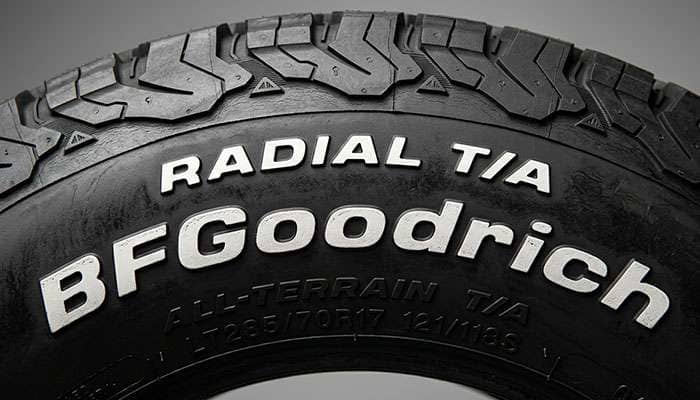
Concours restoration of specific cars. Some pre-1970 muscle cars didn't come with raised white letter tires from the factory. They came with pure blackwalls — no letters, no whitewalls, nothing. If you're doing a concours-level restoration of a 1965 GTO, putting letters-out on a modern BFG T/A isn't period correct for that specific car, even though T/As are great tires. Some restorers flip them around to present the blackwall side as a compromise.
Racing heritage. Serious drag racers and road racers traditionally ran tires with the brand name facing in, toward the car. Part of that was practical — smooth sidewall rubber resists tear damage slightly better than lettered rubber — and part of it was a cultural thing in racing circles. When guys who grew up watching Pro Stock and Trans-Am series cars in the '70s bring that mentality to the street, they flip the letters.
Personal preference. Some folks just think a blackwall tire looks cleaner and more aggressive than a lettered tire. That's a legitimate aesthetic choice. The car is yours, and the industry designed these tires to give you that option.
Bad advice from the internet. A handful of forum posts over the years have declared letters-in to be "more sophisticated" or "what real enthusiasts do." This is mostly nonsense. It's an opinion, not a fact, and it's usually coming from somebody who has never owned a car with factory RWL tires in the first place.
Confusion with whitewall etiquette. Whitewall tires — a totally different product — have very specific rules about which side faces out based on the style and era. See our deep dive on why whitewall tires are so expensive for the whitewall side of the world. Some folks get the two categories mixed up and apply whitewall logic to RWL tires. Don't do that. They're different animals.
Here are the reasons I give every customer who asks why letters-out is the right call for their street car.
1. Factory correctness. If you care about how your car looked when it left Detroit, or how the magazines photographed it in 1972, letters face out. That's documented history on every American muscle car from 1968 through the early 1980s.
2. The letters are the point. The whole reason manufacturers vulcanized white rubber into a tire sidewall was to make the branding visible. Facing them in defeats the purpose. You paid for the lettered option — you might as well display it.
3. Better visual proportions. Raised white letters break up the big black visual mass of a tire and add depth to the sidewall. On a car with correctly sized rubber and factory-correct ride height, lettered tires make the wheel-and-tire package look right. A solid blackwall on a classic muscle car can look plain, almost unfinished.
4. Show judges and cruise night culture. At any organized classic car event with a judging component, lettered tires installed letters-out will score higher for presentation than the same tires reversed. Not every event cares, but if you go to enough Goodguys shows and cruise nights, the consensus among the judges and the longtime enthusiasts is clear.
I'm not going to pretend letters-out is the only legitimate choice. There are specific scenarios where letters-in is the right call.
Dedicated race cars. If you're running a full-on road race car or a Pro Street dragster, where every aesthetic choice is subordinate to performance and the car is trailered to the track anyway, running letters-in is a legitimate choice. It's the old racing tradition. Nobody's going to judge you for it in the paddock.
Concours-correct blackwall restorations. If you're restoring a pre-RWL-era car — say a 1966 Pontiac GTO that originally shipped with Firestone Deluxe Champion blackwalls — and the only modern tire in your size that performs acceptably is a BFG T/A with raised letters, flipping them around is a legitimate compromise for authenticity.
Personal style on a build where you own the story. If you've built a restomod or a custom where you've intentionally moved away from period-correct and you just prefer the cleaner blackwall look, run letters-in. Your car, your call. Just know that you're making a deliberate choice against factory convention, not following some secret "proper" standard.
When the letters are badly faded and can't be cleaned. If you've got a set of aging RWL tires whose letters have yellowed or browned past the point of refresh, flipping them around buys you some extra service life while you save up for new rubber.
Here's the practical complication nobody mentions when they tell you letters face out: raised white letter tires rotate differently from plain tires.
On a normal set of tires, you can rotate front-to-back and side-to-side without worrying about appearance. On a set of RWL tires installed letters-out, a standard cross-rotation sends two of your tires to the other side of the car — which means two of your tires now have their letter sides facing inward. That's not good for the tire, but it's real bad for how the car looks parked.
Most RWL tires are non-directional — the tread pattern works equally well in either direction of rotation — so the tire itself doesn't care which side you mount it on. But the letters care. If you want letters to stay facing outward after a rotation, you have to either dismount and flip the tires on the wheels (adds cost, complicates the rotation), or use a rotation pattern that keeps tires on the same side of the car (typically just front-to-back on the same side).
Our detailed guide on the correct way to rotate tires covers the standard rotation patterns. For RWL tires, I recommend a same-side front-to-back rotation for street-driven classics — keeps the letters where they belong without requiring dismount work. Accept slightly less even wear than an X-pattern rotation would give you and move on with your life.
Some owners of high-dollar show cars skip rotation entirely and just buy new tires every few years when the originals wear out. For a car that sees 2,000 miles a year, that's not crazy.
A few names defined RWL culture.
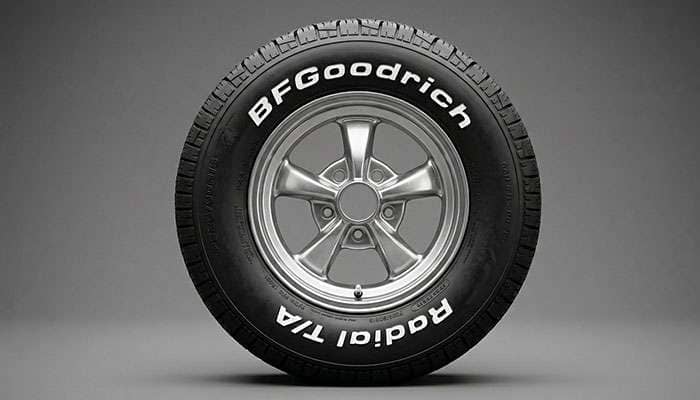
BFGoodrich Radial T/A. The king. Introduced in 1970, still in production today, more than fifty years on. The T/A put radial construction, performance handling, and bold raised white lettering on one tire for the first time, and it became the default performance tire for two generations of American car guys. If you picture "raised white letter tire" in your head, you're picturing a Radial T/A. BFG still makes them in classic muscle car sizes.
Goodyear Polyglas GT. The factory-installed performance tire on 1970s Mustangs, Camaros, Challengers, Chargers, and Trans Ams. Polyester/glass-belted bias-ply construction with raised white lettering and the iconic Goodyear wing and diamond logo. Long out of production but reproduced today by Coker Tire for concours restorations.
Firestone Wide Oval. The 1968–1972 factory tire on many muscle cars. Raised white letters on a wide, short-sidewall construction that helped define the muscle car visual vocabulary. Also available today in reproduction.
Mickey Thompson Sportsman S/T and Sportsman Pro. The street-legal drag and performance tire favored by hot rodders from the '80s onward. Big, aggressive white lettering on tall sidewalls. Still made in updated form for modern street machines and restomods.
Cooper Cobra Radial G/T. The affordable alternative to the BFG T/A through the '80s and '90s. Classic raised white lettering, solid handling, street-friendly tread compounds. Still available today in the Cooper Cobra Radial G/T family.
Goodyear Wrangler RT/S and HT. The truck and SUV version of the RWL formula. Made RWL tires a staple on pickup trucks, Broncos, Blazers, and other American 4x4s throughout the '70s, '80s, and '90s.
For the full context on how these tires fit into the broader muscle car tire landscape, see our article on what tires muscle cars use from street to strip.
Raised white letters attract dirt. They attract brake dust. They attract tire dressing overspray. And when they get dirty, they can make the cleanest-looking classic muscle car look neglected from twenty feet away. Here's the shop-tested process that actually works.
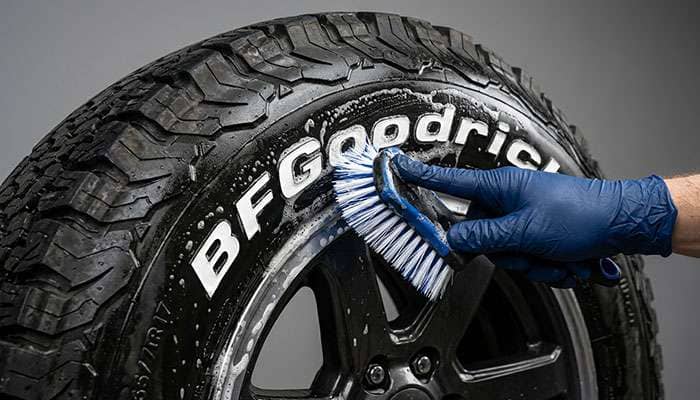
Step 1 — Rinse first. Hose off the tire with clean water. Loose dirt and road grime rubs into the white rubber during cleaning if you don't get it off first.
Step 2 — Soap and stiff brush. Use a quality tire cleaner or even plain dish soap in warm water, and a stiff-bristle scrub brush. Work the brush into the raised lettering in a back-and-forth motion. The letters will lighten visibly within thirty seconds. Don't use a wire brush — it'll damage the white rubber.
Step 3 — Bleach-based cleaner for stubborn stains. If soap alone isn't cutting through yellowed or browned letters, a 50/50 mix of household bleach and water applied with a brush will typically restore the white. Do not leave bleach on the tire for more than a few minutes, and rinse thoroughly afterward. Avoid contact with painted wheels — bleach will damage wheel finishes.
Step 4 — Whitewall cleaner as an alternative. Dedicated whitewall cleaners work on raised white letters. They're formulated for exactly this job. More expensive than dish soap but faster, especially on heavily soiled tires.
Step 5 — Rinse and inspect. Hose off the tire thoroughly. Any cleaning chemical left on the rubber can discolor or degrade the tire over time.
Step 6 — Skip tire shine on the letters. This is the part most people get wrong. Silicone-based tire dressings (the glossy stuff you spray on tires to make them shine) will yellow and darken raised white letters over time. If you want glossy sidewall rubber, apply the dressing only to the blackwall area and keep it away from the letters. For more on tire dressing options, see our guide on how to make tires shine.
Sometimes a cleaning isn't enough. The white rubber has oxidized, UV-damaged, or stained so deeply that nothing short of refresh work will bring the brightness back. A few options.
White tire marker pens. Dedicated tire paint pens (Tyre Pen, White Stripe Touch-Up, and similar products) apply a thin layer of white tire-compatible paint over the existing letters. Best for light touch-ups on letters that are mostly intact but showing age. Cheap, quick, usually lasts a season before needing refresh.
Plasti-Dip in white. A more durable option. Plasti-Dip's rubber-based spray coating can be carefully applied to the raised letter surface with a small brush. Holds up better than paint pens but requires more careful application to avoid drips and uneven coverage.
Professional sidewall restoration. Some specialty shops will chemically restore or refresh raised white letters. Not cheap, but produces the best-looking result if the tires are worth the investment.
Just replace the tires. If your RWL tires are more than seven or eight years old, the rubber itself is aging regardless of tread depth. Refreshing the letters on tires that should be replaced for safety reasons is not a good trade. Check the DOT date code before investing any money in cosmetic refresh work.
Raised white letter tires are still in production in 2026. The classic enthusiast market kept them alive, and several contemporary tires in the performance, truck, and classic segments still roll off the line with the old-school RWL option.
Tire |
Best For |
Classic RWL Pedigree |
|---|---|---|
Classic muscle cars, restomods, performance cruisers |
The original RWL radial. Continuously in production since 1970. Still the default RWL choice for classic American performance cars. |
|
Street/strip hot rods, classic trucks, dual-purpose muscle builds |
Bold raised white lettering on tall sidewall construction. Designed for hot rodders who want street legality plus drag strip capability. |
|
Budget-conscious classic muscle car owners, daily-driven classics |
Affordable RWL performance tire since the '80s. Classic lettering style, solid street performance, friendlier pricing than BFG. |
|
Classic trucks, Broncos, Blazers, SUV restomods |
The truck-world RWL. Most sizes offer a raised white letter sidewall option and a blackwall sidewall option on opposite sides of the same tire. |
The raised white letter debate isn't really a debate. It's a long-standing preference argument dressed up as a technical question. The answer is letters-out for any street-driven classic, muscle car, cruiser, or weekend car — that's how they left the factory, that's how the magazines photographed them, that's how the show judges expect to see them. Letters-in works for full race cars, concours-correct pre-RWL restorations, and personal-preference builds where the owner is making a deliberate choice against factory convention.
The bigger lesson in all of this is that classic tires come with culture attached. The folks arguing at the cruise night aren't really arguing about tires — they're arguing about what it means to build a car right, and that's a conversation with fifty years of muscle car history behind it. You can pick a side. Just know what side you're picking and why.
For raised white letter tires — classic and modern — come see us at Performance Plus Tire. We stock BFGoodrich Radial T/As, Mickey Thompson Sportsmans, Cooper Cobras, reproduction Goodyear Polyglas GTs, and the full lineup of vintage-style rubber in the sizes that fit classic muscle, hot rods, and restomods.
Raised white letter tires face out — the lettered side visible to the world — on any street-driven classic or muscle car. That's how they shipped from the factory, how they were photographed in period magazines, and how show judges expect to see them. Letters-in is a legitimate choice only for race cars, concours-correct pre-RWL restorations, or personal-preference builds.
Nearly all of them, yes. RWL tires are designed with two different sidewalls — one with bold raised white lettering, the other with a plain blackwall or much smaller recessed lettering. This was intentional from the start so owners could choose which side faced out. A handful of modern performance tires have lettering on both sides, but the traditional dual-sidewall design is the standard.
Use a same-side front-to-back rotation pattern. Cross-pattern rotations move tires from one side of the car to the other, which puts the lettered side facing inward on the tires that changed sides. Same-side rotation keeps every tire on the same side of the car, so letters stay facing out. Accept slightly less even wear than an X-pattern rotation would give for the sake of appearance.
Rinse first with clean water, then scrub with a stiff-bristle brush and warm soapy water (quality tire cleaner, whitewall cleaner, or dish soap all work). For stubborn yellowing, a 50/50 bleach-and-water mix applied briefly and rinsed thoroughly will restore brightness. Avoid silicone-based tire shine on the letters themselves — it causes yellowing and darkening over time.
Yes. Dedicated tire paint pens, white Plasti-Dip applied with a small brush, or professional sidewall restoration services can refresh faded or yellowed letters. Check the DOT date code on the tire before investing in cosmetic refresh work — if the rubber is older than six or seven years, replacement is a better investment than cosmetic refresh.
Yes. BFGoodrich Radial T/A, BFGoodrich All-Terrain T/A KO3, Mickey Thompson Sportsman, Cooper Cobra Radial G/T, and reproductions of iconic vintage tires like Goodyear Polyglas GT and Firestone Wide Oval are all in current production. Raised white lettering remains a staple of the American classic muscle car, restomod, and vintage truck tire market.



