
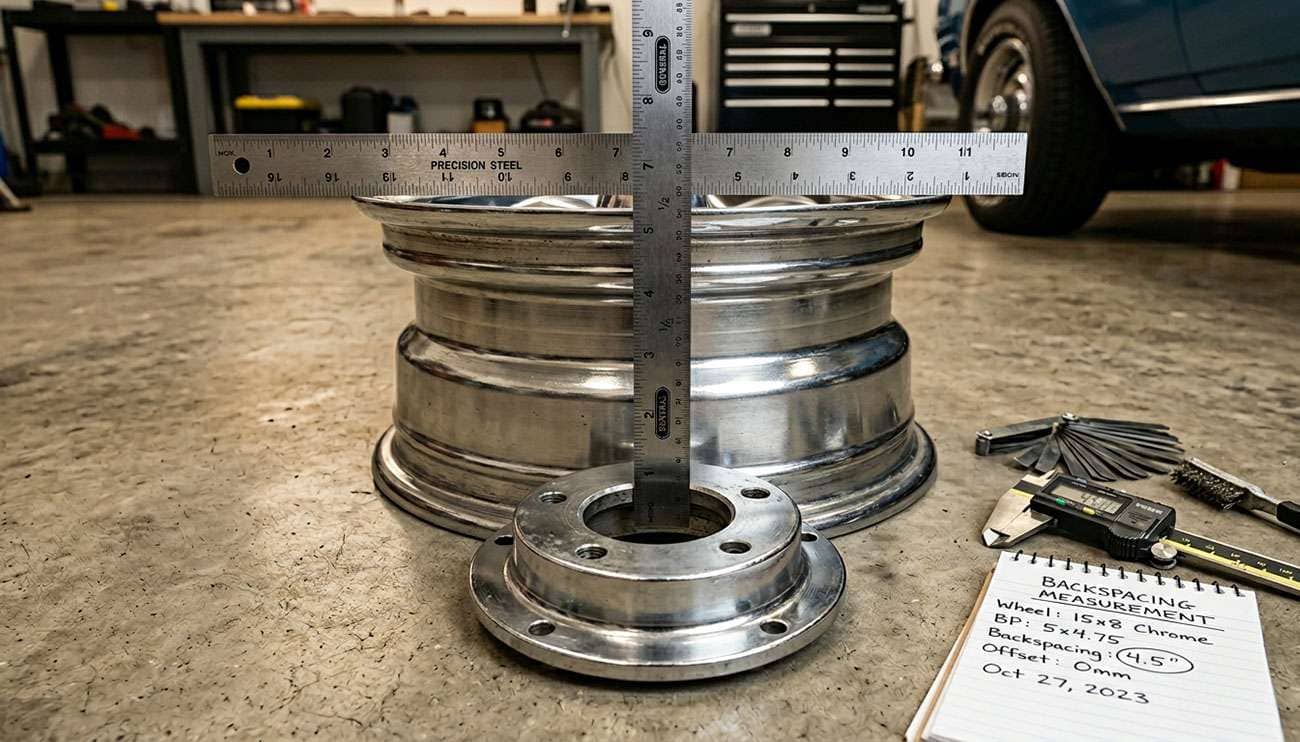
Order wheels for a classic car without nailing your backspacing, and you'll know it immediately — they'll rub the fender lip or vanish into the wheel well. That one number, measured in inches, controls everything about how your wheel sits relative to the suspension, the fender, and the road. It sounds straightforward until you're standing in a shop trying to remember whether more backspacing pushes in or out, and whether that's the same thing as offset or something different entirely. On pre-1980 American muscle cars and classics not designed around modern wheel geometry, the distinction matters enormously.
This guide gives you the exact process for measuring backspacing on classic car rims, explains how backspacing and offset relate to each other, and hands you the practical knowledge to buy wheels with total confidence. Whether you're restoring a 1969 Camaro to factory specs, widening the stance on a classic Mustang, or chasing a deep-dish look on a '72 Chevelle, these measurements are your foundation. Get them right and your wheels clear cleanly. Get them wrong and you're dealing with expensive spacers, trimmed inner fender wells, or return shipping on a set of wheels you can't use.
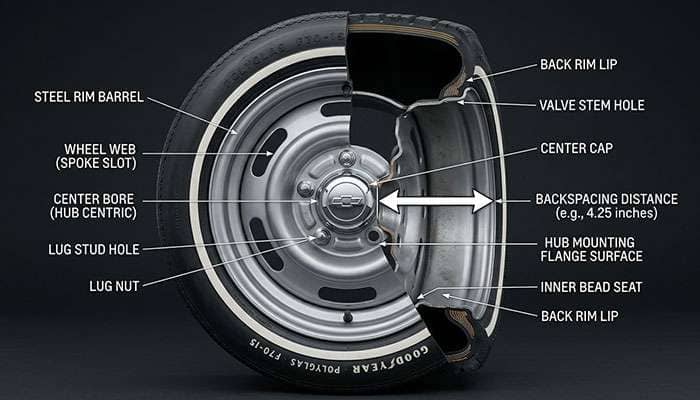
Backspacing is the distance — in inches — from the back edge of the wheel's mounting flange to the back lip of the rim. That single measurement tells you how far the wheel pushes toward the vehicle's center relative to its bolt-on point. More backspacing moves the wheel inward, toward your suspension and brake components. Less backspacing moves it outward, toward the fender. On classic cars — where brake calipers, leaf springs, and frame rails occupy very specific real estate — getting this number right separates a clean build from a constant headache.
Three numbers work together on every wheel: overall width, backspacing, and offset. You need to understand all three before you touch a ruler. Wheel width is measured inside bead seat to inside bead seat — not outer lip to outer lip. A wheel stamped "8 inches wide" measures 8 inches between the bead seats; the outer lips add roughly half an inch per side, bringing total rim width closer to 9 inches. Backspacing, as described above, is measured in inches and is the most practical spec for classic car builders — it's the easiest to physically verify with a straight edge and a tape measure. Offset is the metric counterpart, expressed in millimeters, describing how far the hub mounting face sits from the wheel's true centerline. Positive offset means the mounting face is toward the street side; negative offset means it's toward the vehicle's interior.
For the vast majority of pre-1975 American cars, factory backspacing ran between 3.5 and 4.5 inches on a standard 6-inch-wide wheel. Builders running wider 8- to 10-inch wheels on classic muscle cars typically target 4.5 to 5.5 inches of backspacing in the rear and 3.5 to 4.5 inches up front — enough to maintain proper suspension clearance while achieving an aggressive stance.
The single biggest mistake builders make is confusing backspacing with offset without converting between them. Wheel manufacturers increasingly quote offset in millimeters, while classic car builders have always worked in backspacing in inches. Give a vendor your backspacing spec when they're thinking in offset — or vice versa — and you'll get the wrong wheel every time. The second most common error is measuring the wrong surface. Backspacing runs from the back edge of the mounting flange to the back rim lip. Many people accidentally measure from the rear lip of the wheel instead, which gives you the total barrel depth — not backspacing. Those are different numbers. Third, builders frequently forget to account for brake caliper clearance, especially on cars converted to disc brakes. A wheel with 4 inches of backspacing might clear drum brakes without issue but make direct contact with a large aftermarket disc caliper mounted in the same location.
Here's the math in plain language. Take an 8-inch-wide wheel (bead seat to bead seat). Its true centerline sits at 4 inches. If backspacing measures 5 inches, the mounting flange is 1 inch behind center — positive offset territory, or +25.4mm in metric. If backspacing measures 3 inches, the flange is 1 inch in front of center — negative offset, or −25.4mm. The classic deep-dish look popular on 1960s and 1970s muscle cars uses negative offset wheels with backspacing in the 3 to 3.75 inch range on wide 8- or 9-inch rims. That throws the wheel face outward and creates the recessed center appearance you're after. Knowing this relationship lets you translate a build spec from one car to another, or convert a metric wheel catalog back to your inch-based measurements without guessing.
Knowing how to measure backspacing is only half the job. The other half is knowing which value is correct for your specific application. That depends on your vehicle's frame and suspension geometry, the wheel width you're fitting, any suspension or brake modifications you've made, and your aesthetic goals. There's no universal answer — and any chart claiming to give you a single backspacing number for "1969 Camaro" is glossing over critical variables like whether the car has been tubbed, whether it runs stock or aftermarket control arms, and what tire width you're mounting. Your build is specific. Your measurements need to be too.
Classic American cars fall into broad categories that give you a solid starting point. Full-size land yachts from the late 1950s and 1960s — Impala, Galaxie, Fury — typically ran narrow 5- to 6-inch wheels with backspacing around 3.5 to 4 inches. Pony cars like the Mustang, Camaro, Firebird, and Barracuda generally accept 7- to 8-inch-wide wheels with 4 to 5 inches of backspacing in the rear without any modification. Full-size muscle cars on B-body and A-body platforms — Chevelle, El Camino, Cutlass, Road Runner — can often accommodate 8- to 9-inch rear wheels with 4.5 to 5.5 inches of backspacing, depending on rear spring width. Classic pickups from the 1950s through 1970s are typically more restrictive up front due to steering linkage geometry, often requiring 3.75 to 4.25 inches even on a wider wheel. Always start by measuring your existing wheel before you order anything new — that baseline measurement is the most valuable number you have.
How you actually use the car should shape your backspacing decision. Building a weekend show car that never sees a track? You have more flexibility to run aggressive negative offset for visual impact, since you're not pushing suspension and tires to their limits. Driving hard — autocross, drag strips, open road — demands clearance margins that account for suspension travel, tire growth under load, and chassis flex. At speed, a tire that barely clears at rest can contact the inner fender or frame rail under hard cornering or a hard launch. For cars driven on real roads, build in at least a quarter inch of clearance beyond your minimum measurement. That's cheap insurance. For trailer queens, you can push closer to the envelope if the visual payoff justifies it.
Budget is always part of the conversation, but backspacing carries a specific financial trap: buying cheap wheels at the wrong spec and then spending money on spacers to compensate. A 1-inch wheel spacer effectively reduces your backspacing by 1 inch, which can work in a pinch — but it also shifts the wheel bearing load point outward, increases stress on your wheel studs, and can introduce vibration at highway speeds if the spacer isn't hub-centric. Spending an extra $50 to $100 per wheel to get the correct backspacing from the factory almost always costs less than dealing with spacer problems down the road. That said, quality reproductions of classic steel wheels in correct backspacing specs are widely available at very reasonable prices, particularly for popular platforms — you often don't have to choose between correct and affordable.
You understand the measurement. You know how to choose the right value. Now let's get specific. The recommendations below are organized by how the car is primarily used. The measurement process is identical across all categories — what changes is how you apply the numbers once you have them. You can browse the full selection of classic wheels at Performance Plus Tire to find options that match your measured specs, and if you're still selecting tires for your build, the classic car tires collection covers the sizes and profiles that pair best with the wheel widths and backspacing values discussed here.
Street-driven classic cars demand wheels that fit correctly within stock or mildly modified clearances — no trimming, no spacers, no compromises. For most pony and muscle cars used as daily or weekend drivers, target OEM backspacing within plus or minus a quarter inch, or step up to wheels 1 inch wider than stock while adding about a half inch of backspacing to keep the wheel centered in the well. A 7-inch-wide wheel with 4.25 inches of backspacing is an exceptionally safe, broadly compatible choice for most 1964–1972 pony and intermediate-size cars. Steel reproductions of factory rally wheels and styled steel wheels in this spec are widely available and consistently affordable. The payoff is simplicity: these combinations mount and go with zero clearance drama.
On the tire side, a 225/60R15 or 235/60R15 on that 7-inch wheel gives you a period-correct profile with enough sidewall to handle imperfect road surfaces confidently. If you're running the car year-round in a northern climate and need a tire that bridges all-season capability with classic aesthetics, modern radial options in classic sizing deliver both. Use the Antique/Classic Tire Size Conversion tool to translate old bias-ply sizes into modern radial equivalents — it cuts through the confusion when you're reading original factory spec sheets.
Performance-focused builds demand maximum tire width within your fender and suspension clearances, with backspacing chosen to center the tire in the wheel well for even wear and balanced geometry. Most serious street/strip classic builds run rear wheels in the 9- to 10-inch width range with 5 to 5.5 inches of backspacing, paired with a 275 to 295 series tire. Up front, a 7- to 8-inch wheel with 3.75 to 4.25 inches of backspacing keeps steering geometry intact while fitting a 245 or 255 series front tire. The wider stance significantly improves cornering stability and gives the car a properly purposeful look that matches its performance.
On these builds, caliper clearance is non-negotiable. If your car runs aftermarket disc brakes — and most performance-oriented classic builds do — physically test fit a wheel before ordering a full set. Hold the unmounted wheel against the hub with a lug nut or two and rotate it slowly to check clearance at every caliper position. That step takes ten minutes and can save you from returning a $1,200 set of wheels. Brands like BFGoodrich offer performance tire lines in sizes that work exceptionally well for classic performance builds, with compounds engineered for real driving — not just show use.
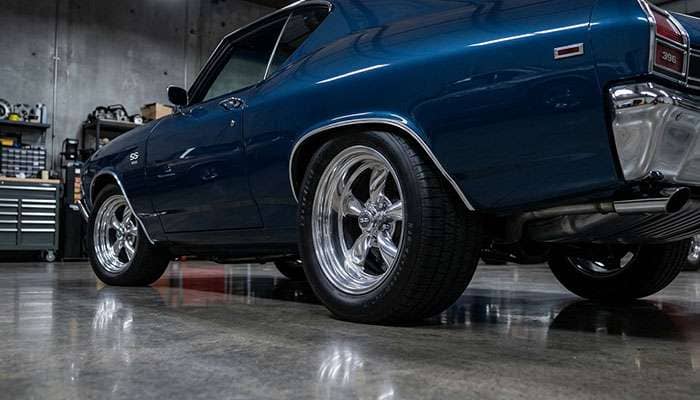
Correct backspacing doesn't require a big budget. For cost-conscious builds, reproduction steel wheels in factory backspacing specs are almost always your smartest move — inexpensive, correct, and easy to source for common platforms. If you want the look of aluminum without the cost of premium billet wheels, quality cast aluminum reproductions of classic designs — five-spoke Magnums, Torq Thrust styles, slotted mags — are available in correct backspacing specs for the most popular muscle car platforms for $100 to $175 per wheel. The critical rule on budget wheels: verify the backspacing spec before you buy, not after. Budget wheel listings sometimes carry errors or show a single spec that actually covers multiple offset variants. Confirm the spec in writing and keep that confirmation in hand if a return becomes necessary.
On the tire side, brands like Nexen deliver surprisingly strong performance per dollar in sizes commonly used on classic builds. Their radial construction gives you the handling and longevity of a modern tire without a premium price tag. Pair budget tires with correctly specced wheels rather than expensive tires on wrong-backspacing wheels — that combination produces a better-driving, better-looking car for less money overall.
Vehicle Platform |
Typical Wheel Width |
Recommended Backspacing (Rear) |
Recommended Backspacing (Front) |
Common Tire Size |
|---|---|---|---|---|
1964–1973 Pony Cars (Mustang, Camaro) |
7–8 in |
4.0–4.75 in |
3.75–4.25 in |
225–245/60R15 |
1964–1972 A-Body (Chevelle, GTO, Skylark) |
8–10 in |
4.5–5.5 in |
3.75–4.5 in |
245–275/60R15 |
1958–1970 Full-Size (Impala, Galaxie, Fury) |
6–8 in |
3.5–4.5 in |
3.5–4.0 in |
215–235/75R15 |
1947–1972 Classic Pickups |
7–8 in |
4.0–5.0 in |
3.75–4.25 in |
235–265/75R15 |
1970–1981 F-Body / B-Body (Trans Am, Road Runner) |
8–10 in |
4.75–5.5 in |
4.0–4.5 in |
255–295/50R15 |
For more detailed help matching wheel dimensions to your specific vehicle, the Tire Size Calculator at Performance Plus Tire is a useful starting point to verify that your chosen tire size works with the backspacing and wheel width you've measured.
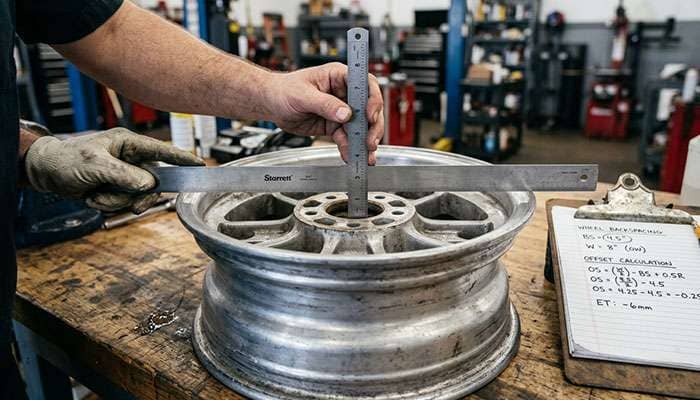
Measuring backspacing correctly is a skill that pays dividends on every classic car build you ever touch. The process takes five minutes with a straight edge and a ruler — but the number it produces, the exact inward depth from hub face to back rim lip, is the single most important spec you'll use when buying or evaluating wheels. Pair that with wheel width, and you have everything you need to calculate offset, verify clearances, and communicate precisely with any wheel vendor, whether they're quoting inches or millimeters.
The mistakes that cost classic car builders the most money — wheels that rub, wheels that tuck too far into the well, spacers that vibrate at speed — almost always trace back to a skipped measurement or a misread spec. Spending twenty minutes measuring your existing wheel, checking your clearances, and calculating your target backspacing range before you order is the cheapest insurance policy in the hobby. It also makes you a more confident buyer and a much harder person to sell the wrong product to.
When you're ready to shop with your numbers in hand, Performance Plus Tire carries an extensive selection of wheels and tires built for classic car applications at every budget level. Whether you need reproduction steel wheels in factory specs or premium cast aluminum in a custom backspacing, the team at Performance Plus Tire is ready to help you get the fit right the first time.
Here are the five most important things to remember from this guide.
• Backspacing is measured in inches, from hub face to back rim lip: Lay the wheel face-down on a flat surface, place a straight edge across the back lip, and measure straight down to the mounting flange — that's your backspacing number.
• Backspacing and offset are related but not the same: To convert backspacing to offset in millimeters, use the formula: Offset = (Backspacing − (Wheel Width ÷ 2 + 0.5)) × 25.4. Getting this conversion right prevents costly ordering mistakes when dealing with metric wheel specs.
• Classic American cars generally need 3.5–5.5 inches of backspacing: The exact number depends on wheel width, vehicle platform, and whether any suspension or brake modifications have been made — always measure your existing wheel first.
• More backspacing pushes the wheel inward; less backspacing pushes it outward: Deep-dish negative offset wheels for the classic low-and-wide look use less backspacing; wheels that need to clear large disc brake calipers often need more backspacing to keep the barrel away from the caliper body.
• Always physically verify caliper and suspension clearance before finalizing a wheel order: Hold the candidate wheel against the hub and check clearance at the caliper, inner fender, and frame rail — this ten-minute step can save you from returning an expensive set of wheels.
Backspacing is the distance in inches from the wheel's hub mounting flange to the back rim lip. It controls how far inward the wheel sits relative to where it bolts onto the hub. On classic cars, this measurement is critical because older suspension and brake designs have very specific clearance requirements — get the backspacing wrong and you risk the wheel contacting brake calipers, leaf springs, or inner fender panels.
Remove the wheel from the vehicle and lay it face-down on a flat surface. Place a straight edge — a ruler, a long level, or a piece of straight wood — across the back rim lip so it spans the full diameter. Then measure straight down from the bottom of the straight edge to the hub mounting flange (the flat surface where the lug holes are). That measurement in inches is your backspacing. This method works on any wheel regardless of width or style.
Backspacing is an American measurement in inches describing the distance from the hub face to the back rim lip. Offset is a metric measurement in millimeters describing how far the hub face sits from the wheel's true centerline — positive offset means the hub face is toward the street side, negative means it's toward the vehicle interior. To convert backspacing to offset: Offset (mm) = (Backspacing − (Wheel Width ÷ 2 + 0.5)) × 25.4. Classic car builders typically use backspacing; modern wheel manufacturers typically quote offset.
The deep-dish appearance comes from running negative offset wheels, which means low backspacing relative to wheel width. On a 9-inch-wide wheel, backspacing of 3 to 3.75 inches produces a notably deep dish with the wheel face recessed well behind the outer lip. The exact amount you can run depends on your car's inner fender and frame clearances — always verify that the back of the barrel clears your brake and suspension components before committing to a low-backspacing spec.
Wheel spacers can work as a short-term fix to reduce effective backspacing (push the wheel outward), but they're not ideal for long-term use on classic cars driven regularly. Spacers shift the wheel's load point away from the hub bearing, increasing stress on the studs and bearing. If you use spacers, use only hub-centric spacers — not lug-centric — and confirm the studs are long enough to maintain full thread engagement through both the spacer and the wheel. Whenever possible, order wheels with the correct backspacing from the start and skip the spacer altogether.



