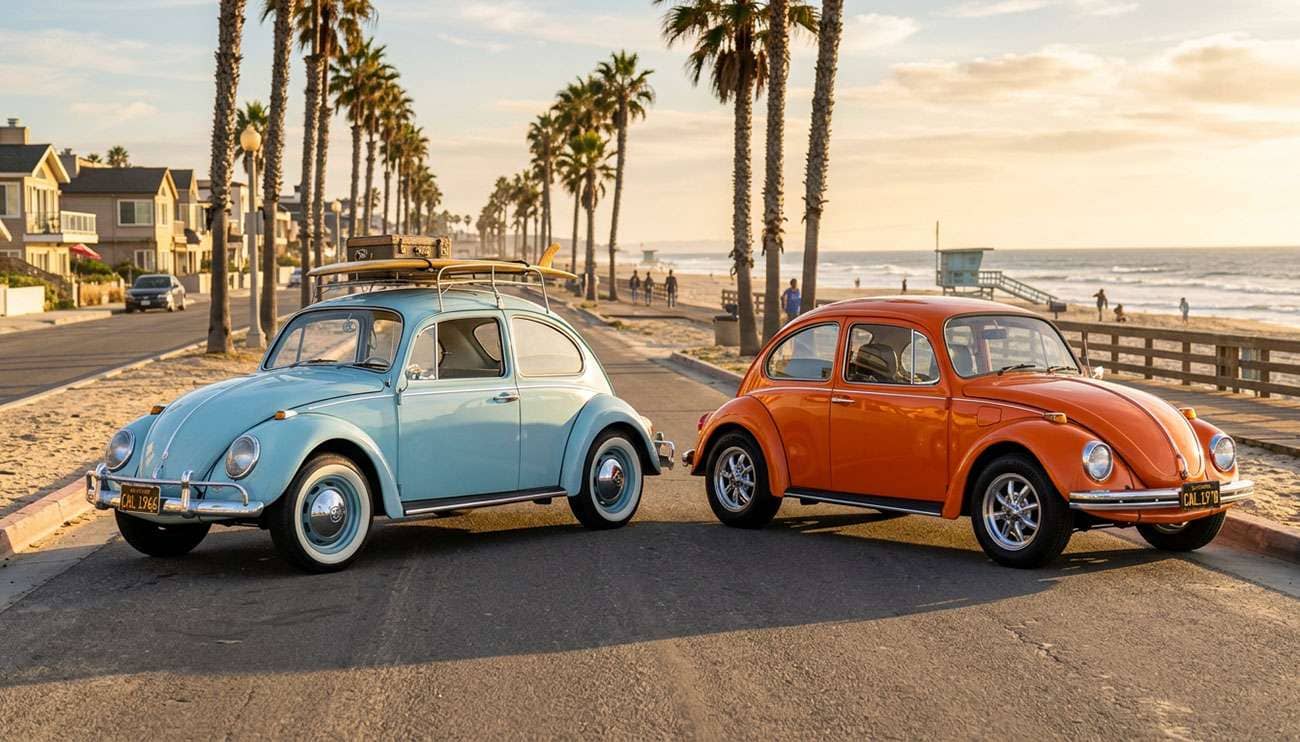
Count the lugs first. A US-market Beetle built through the 1967 model year runs the 5x205 "wide five" pattern. From 1968 on, it's 4x130. But the bolt pattern isn't the only thing that changed. The lug bolt went from 12 mm to 14 mm, and most aftermarket wheels want a 60-degree cone seat where Volkswagen used a ball. Two more things matter that most guides never mention. The speedometer runs off the left front tire, so front tire height changes your speedo. And the front tires carry only a small share of the car, which is why VW's own tire pressures were so different front to rear.
Find your car in this table first.
Model and Years |
Bolt Pattern |
Lug Bolt |
Factory Wheel |
Factory Tire |
|---|---|---|---|---|
Beetle 1954-67 (US) |
5x205 wide five |
M12x1.5, ball seat |
15x4 steel |
5.60-15 bias |
Beetle 1967 (European 1500 with front discs) |
4x130 |
M14x1.5, ball seat |
15-inch steel |
5.60-15 bias |
Beetle 1968-77 |
4x130 |
M14x1.5, ball seat |
15x4; 15x4.5 from about 1972-73 |
5.60-15 until March 1972, then 6.00-15; 155SR15 radial |
Super Beetle 1971-79 |
4x130 |
M14x1.5, ball seat |
15x4; 15x4.5 from about 1972-73 |
5.60-15 or 6.00-15; 155SR15 or 165SR15 radial |
Karmann Ghia 1956-66 |
5x205 wide five |
M12x1.5, ball seat |
15-inch steel |
5.60-15 bias |
Karmann Ghia 1967-74 |
4x130 |
M14x1.5, ball seat |
15-inch steel |
5.60-15, then 6.00-15 after March 1972 |
Southern California is Beetle country, and we've been mounting tires on them in Long Beach since 1971. The Cal Look grew up around here. So did Empi, out in Riverside. I've seen every kind of Bug come through the door, and the ones that give people trouble are almost never the stock ones. They're the cars where somebody swapped the front end, the brakes, or the wheels twenty years ago and nobody wrote it down.
Here's what owners run on stock-body Beetles, keyed to the look you're after. These are owner-reported combinations, so check your own car before you order. The steps are at the end.
Setup |
Front |
Rear |
Watch For |
|---|---|---|---|
Stock look |
15x4 or 15x4.5 with 165/80R15 (25.4 in.) or 155/80R15 (24.8 in.) |
Same as front |
Closest to factory height, so the speedometer stays honest |
Stock height, more rubber |
15x5 or 15x5.5 with 185/70R15 (25.2 in.) |
15x5.5 with 195/65R15 (25.0 in.) or 205/65R15 (25.5 in.) |
A 195/65 on a stock 4.5-inch rim can rub the fender or spring |
Cal Look (lowered front) |
15x4.5 or 15x5 with 135/80R15 (23.5 in.) or 145/80R15 (24.1 in.) |
15x5.5 with 205/60R15 (24.7 in.) or 205/65R15 |
Speedometer reads 5 to 8 percent fast; narrowed beams lose steering lock |
17-inch |
17x7 at about +35 to +42 mm with 205/40R17 (23.5 in.) |
Same, or wider where the fender allows |
Strut clearance on a Super Beetle; speedometer reads fast |
Fifteen inches is still where almost everything happens on these cars. The stock-height sizes, 155/80R15 and 165/80R15, come from a short list of classic-tire makers. The 65-series 15s, like 185/65R15 and 195/65R15, are everyday passenger sizes with dozens of brands to pick from. That's one reason so many owners land on a 195/65R15 or 205/65R15 in back: it's close to stock height, and it's easy to buy.
Baja Bugs are their own world. With cut or fiberglass fenders, owners run 15x8 to 15x10 rear wheels with deep negative offset. Everything in this guide about bolt patterns, lug bolts, and the speedometer still applies. The clearance numbers don't.
By the book, it splits on the 1968 model year. Volkswagen's 1968 Beetle came out in August 1967, and it moved from the 5x205 wide five to the 4x130 four-lug pattern. Every US-market Beetle through the 1967 model year is 5x205. Every Beetle and Super Beetle from 1968 on is 4x130.
There are two wrinkles. The 1967 European Beetle 1500 got front disc brakes and the four-lug pattern a year early. And the other air-cooled VWs switched on their own schedule:
Now the real world. These cars are 50 to 70 years old, and plenty of them have had front ends and brakes swapped. A 1966 might wear a later disc front end. A 1972 might have been converted to the Porsche 5x130 pattern. So count the lugs and measure before you trust the title.
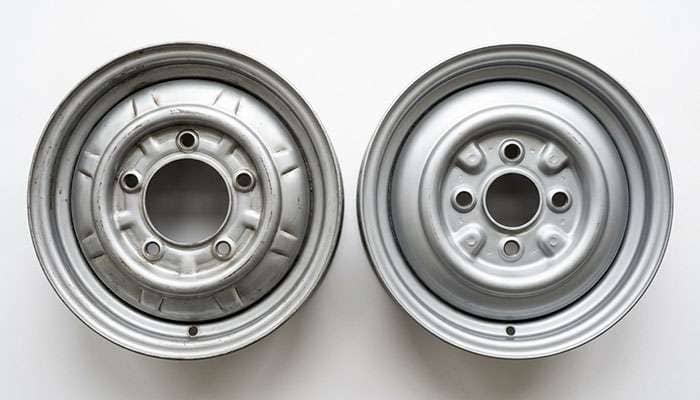
The wheels themselves are easy to tell apart. A wide-five wheel has a center hole big enough to put your foot through. A stock 4x130 steel wheel has small nubs stamped into the face to hold the hubcap. To measure 4x130, go from the center of one bolt hole to the center of the hole straight across. It should be 130 mm. On a wide five, the bolt holes are spread so far apart that 205 mm is hard to mistake for anything else.
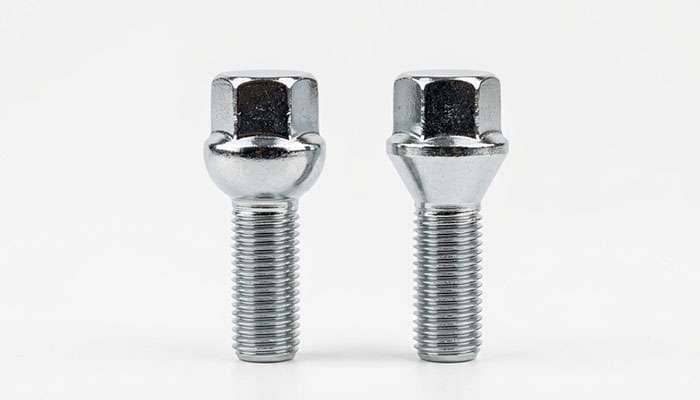
This is where I see the most mistakes, and it's the part nobody puts in front of you. Beetles use lug bolts, not studs and nuts, and two things changed with the bolt pattern.
Thread size. Stock 1967-and-earlier drums take M12x1.5 bolts. The 1968-and-later drums take M14x1.5. Aftermarket disc conversions can go either way, so check what's tapped into your hub before you order bolts.
Seat shape. Volkswagen's steel wheels use a ball, or radius, seat. Most aftermarket alloy wheels, including Empi's 8-spoke, GT-5, and Sprintstar lines, call for a 60-degree conical seat. Put a ball-seat bolt in a cone-seat wheel and it only touches on a thin ring. It feels tight, then it loosens. Our guide to lug nut seat types shows the difference side by side.
Length. Alloy wheels are thicker at the mounting pad than steel. The cone-seat bolts sold for them run about 24 mm of thread, against roughly 19 mm on a stock four-lug bolt. On drum brakes, check that a longer bolt doesn't reach the shoe hardware inside the drum before you torque it down.
Keep a set of stock ball-seat bolts in the trunk with your spare. If the spare is a factory steel wheel and your road wheels are aftermarket alloys, the bolts on the car won't seat it correctly.
The Beetle's original tire was the 5.60-15 bias-ply. The Bentley manual says every model built before March 1972, Karmann Ghias included, came on 5.60-15s, and cars built after that came on 6.00-15s. The radial option was a 155SR15, and later cars also saw the 165SR15. The wheels went from 4 inches wide to 4-1/2 inches around 1972-73. Sources disagree on the exact month.
Those old metric radial sizes don't carry an aspect ratio. A 165SR15 is really about an 80-series tire, so the modern match is a 165/80R15 at about 25.4 inches tall. A 155/80R15 is a hair shorter at 24.8 inches and sits closest to the original 5.60-15. Either one looks right on a stock Bug. Most owners go with the 165 because more makers build it.
If you're restoring to original, bias-ply 5.60-15s are still made. For a car you drive, a radial rides and grips better. Our article on radial vs. bias-ply tires for classic cars lays out the trade.
Whitewalls on a Beetle follow the same era rules as anything else. Wide bands of about 2-1/4 inches look right on 1950s cars, and narrower bands on later ones. In 165R15, whitewalls are made in both a 2-1/4-inch band and a 3/4-inch band, so you can match your year. Our whitewall width guide has the timeline. Lucas Classic Tires, which is part of our family now, has been putting period-correct rubber on Beetles for a long time.
Empi started in the 1950s at Joe Vittone's Volkswagen dealership in Riverside, California. The name stood for European Motor Products Inc. Empi built a lot of the parts that made Beetles go fast, and its wheels became part of the Cal Look. The Sprintstar was Empi's take on the optional Lemmerz wheel Volkswagen offered, and the originals were all steel. The BRM wheel came out of Empi's joint venture with Speedwell. Today's versions of both are cast aluminum.
Here's how the main Empi styles line up for a Beetle:
Most of Empi's street wheels for these cars are 15x5 or 15x5.5 with about 3-1/2 to 4-1/2 inches of backspacing. The GT-8 in 4x130 is a 15x5.5 at a 30 mm offset with 4-3/8 inches of backspacing. The GT-5 in 5x205 is a 15x5.5 at 20 mm with 4 inches. The BRM in 5x205 runs closer to 3-1/2 inches. Most of these wheels are rated to carry 1,180 pounds each, which is more than any corner of a Beetle will ever ask. Empi also makes 17x7 versions of the BRM and Raider in 5x205 at about +40 mm, for owners going big.
Two cautions on Empi wheels. Most of them take 60-degree conical-seat bolts, not your stock ball-seat bolts. And Empi itself warns that some of its 5x205 wheels, the Torque Star for one, may need spacers or caliper clearancing on disc-brake cars.
The Super Beetle (1971-79) swapped the standard Beetle's torsion-beam front end for MacPherson struts. That changes what limits the wheel. On a standard Bug, the outer fender lip and, on a narrowed beam, your steering lock are usually the limit. On a Super Beetle, the strut and spring sit close to the inside of the tire.
Here's what Super Beetle owners report:
The takeaway: on a Super Beetle, check the inside first. Measure from the tire to the strut and spring at full lock before you trust anyone's offset number, including mine.
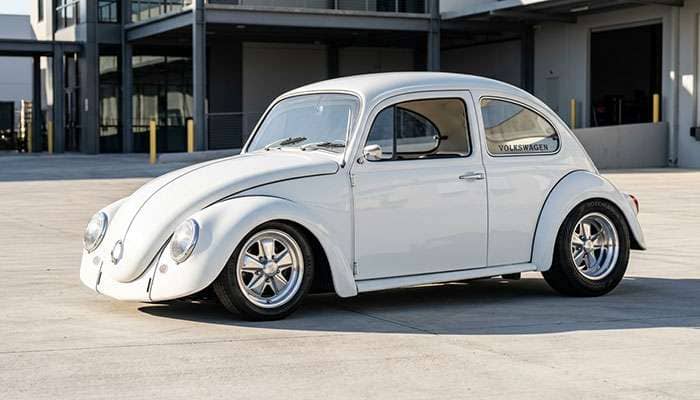
Yes, and only one tire matters. A Beetle's speedometer cable runs through the left front spindle and turns with the left front wheel. One turn of the tire is one turn of the cable. Owners put the factory calibration at a tire of roughly 24-3/4 to 25-1/4 inches, which is about what a 5.60-15 or a 165/80R15 measures.
Put a shorter tire on the left front and it turns more times per mile, so the speedometer and odometer both read high. Measured against a 25.4-inch 165/80R15:
That's the trade on a Cal Look front end. Reading fast is the safe direction, but your odometer is now adding miles you didn't drive. Our article on how tire size changes your speedometer covers the math in the other direction too.
The rear tires don't touch the speedometer, but their height sets your gearing. A shorter rear tire spins the engine faster at the same road speed, and a Beetle engine is already working hard on the freeway. That's why owners who want more rubber in back often pick a 195/65R15 or 205/65R15. Both sit right around stock height.
They do, and the reason is the most Beetle thing about the Beetle. The engine sits behind the rear axle, and Beetle owners usually put it at only about a third of the car's weight riding on the front tires. A classic Beetle weighs roughly 1,750 to 1,850 pounds at the curb. That leaves each front tire carrying something like 300 pounds.
Tire Size |
Load Index |
Capacity per Tire |
Height |
|---|---|---|---|
135/80R15 |
72 |
783 lb |
23.5 in. |
145/80R15 |
78 |
937 lb |
24.1 in. |
155/80R15 |
83 |
1,074 lb |
24.8 in. |
165/80R15 |
86 to 87 |
1,168 to 1,201 lb |
25.4 in. |
205/60R15 |
91 |
1,356 lb |
24.7 in. |
Even the skinny 135 carries more than twice what a Beetle puts on it up front. Capacity is the one thing a Beetle doesn't make hard.
Pressure is where people go wrong. Volkswagen's own numbers for bias-ply tires were 16 psi front and 24 psi rear with one or two people aboard, and 17 and 26 fully loaded. From January 1973 those went to 18 and 29. The split is there because the weight is in back. The maximum pressure on the sidewall is what the tire needs to carry its full rated load, and a Beetle never asks for that. Pump the fronts to the sidewall number and they ride on a narrow strip of tread. Many owners running radials settle a few psi above VW's bias-ply figures, with the rear still well above the front.
Front disc conversions are one of the most common upgrades on these cars, and they can change your bolt pattern and your wheel clearance at the same time.
Before you order wheels, put the caliper on and check it against the wheel you want. Our disc brake conversion wheel fitment guide walks through the clearance checks.
Each mistake on this list costs more than the one before it.
Every one of those costs more than checking the pattern, the thread, and the seat before you buy.
The bolt pattern on a classic Beetle is easy once you know the split: 5x205 through 1967, 4x130 from 1968. The trouble lives in everything around it. The lug bolt changed size, the aftermarket uses a different seat, the speedometer reads off the left front tire, and the front end carries so little weight that VW ran the front tires soft on purpose. Get those right and a Bug will wear almost anything from a stock steelie to a set of Empi BRMs.
When you're ready to pick a wheel, start with our Empi wheels for VW and Porsche, and match the pattern and the seat to your car. Call us if you get stuck. We've been answering Beetle questions in Long Beach for more than 50 years.
US-market Beetles switched with the 1968 model year, which went on sale in August 1967. Every US Beetle through 1967 is 5x205, and every Beetle and Super Beetle from 1968 on is 4x130. The 1967 European Beetle 1500 got the four-lug pattern a year early, along with front disc brakes.
A US-market 1967 Beetle is 5x205, the wide five, with M12x1.5 lug bolts. The 1967 European Beetle 1500 with front disc brakes is 4x130. Count the lugs, because many cars have had the front end or brakes swapped since.
The factory tire was a 5.60-15 bias-ply, later a 6.00-15, with 155SR15 and 165SR15 radials. The modern equivalents are 165/80R15 (25.4 inches) and 155/80R15 (24.8 inches). Owners who want more rubber in back often run a 195/65R15 or 205/65R15 on a 15x5.5 wheel.
Usually not. Stock VW steel wheels use ball-seat bolts, and most Empi alloy wheels, including the GT-8, GT-5, and Sprintstar, call for 60-degree conical-seat bolts. Check the seat listed for your wheel and match the bolts to it.
The speedometer cable is driven by the left front wheel, so a shorter left front tire turns more times per mile and reads high. A 135/80R15 or 205/40R17 up front reads about 8 percent fast compared with a stock-height 165/80R15.
Volkswagen's bias-ply figures were 16 psi front and 24 psi rear with one or two people, and 18 and 29 from January 1973. Many owners on radials run a few psi higher, but always lower in front than in back, and never the maximum printed on the sidewall.