Here is the spec most people skip when they bolt on a new set of wheels: the lug nut seat. They check the thread size, watch the nut spin on cleanly, and call it done. The problem is that a lug nut can thread perfectly onto a stud and still be the wrong nut for the wheel. The thread holds the nut on. The seat is what actually clamps the wheel to the hub, and if the seat geometry on the nut does not match the seat machined into the wheel, you have a fastener that grips on a sliver of metal instead of a full contact ring.
This is one of the most common fitment errors on aftermarket setups, and it stays invisible until something goes wrong. Below is how to read the three seat types, tell which one your wheel takes, and what a mismatch costs you in clamp load and runout.
A wheel stays attached because the lug nut, when torqued, generates clamping force that pins the wheel face against the hub flange. That force is created by stretching the stud slightly and is transferred to the wheel through the seat — the contoured surface where the nut meets the wheel. The thread pitch and diameter determine whether the nut will spin on. They do not determine whether the nut will seat correctly.
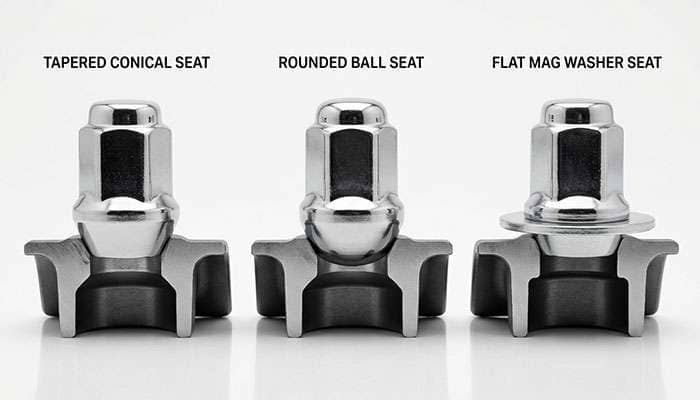
When the seat shapes match, the nut nests fully into the wheel's lug hole, contact is a continuous ring, and clamp load spreads evenly around the stud. When they do not, contact collapses to a thin line or a single point. You can still reach a torque-wrench reading, because the wrench measures resistance to turning, not the quality of the contact. That is the trap: a mismatched nut can "torque to spec" and still hold on by almost nothing. Understanding how the wheel fasteners actually transmit load is the foundation for everything that follows.
There are two seats in every wheel-nut connection, and they have to mirror each other. The first is on the wheel: each lug hole is machined with a specific contour — tapered, rounded, or flat — that the manufacturer chose to match a particular fastener style. The second is on the lug nut itself: the underside of the nut is shaped to bury into that contour.
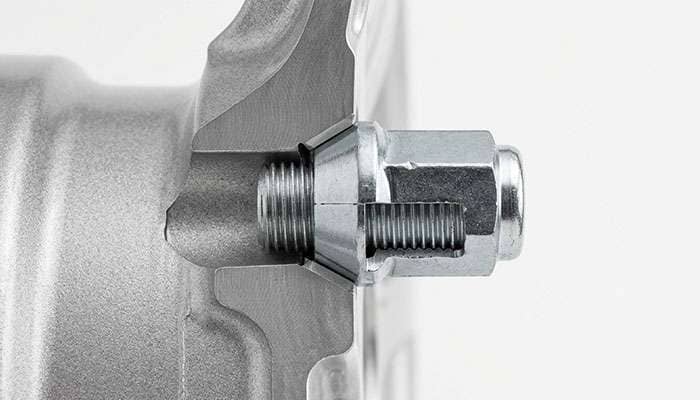
Think of it as a key and a lock: the wheel's lug hole is the lock, the nut's seat is the key. Match the geometry and the two surfaces marry across a wide contact band; mismatch them and the key only touches the lock in one spot. The seat is not cosmetic and it is not interchangeable — it is the load path. This is also why factory nuts do not automatically transfer to aftermarket wheels even when the studs are identical, a point that trips up buyers who are otherwise careful about every spec from bolt pattern to hub-centric versus lug-centric wheels.
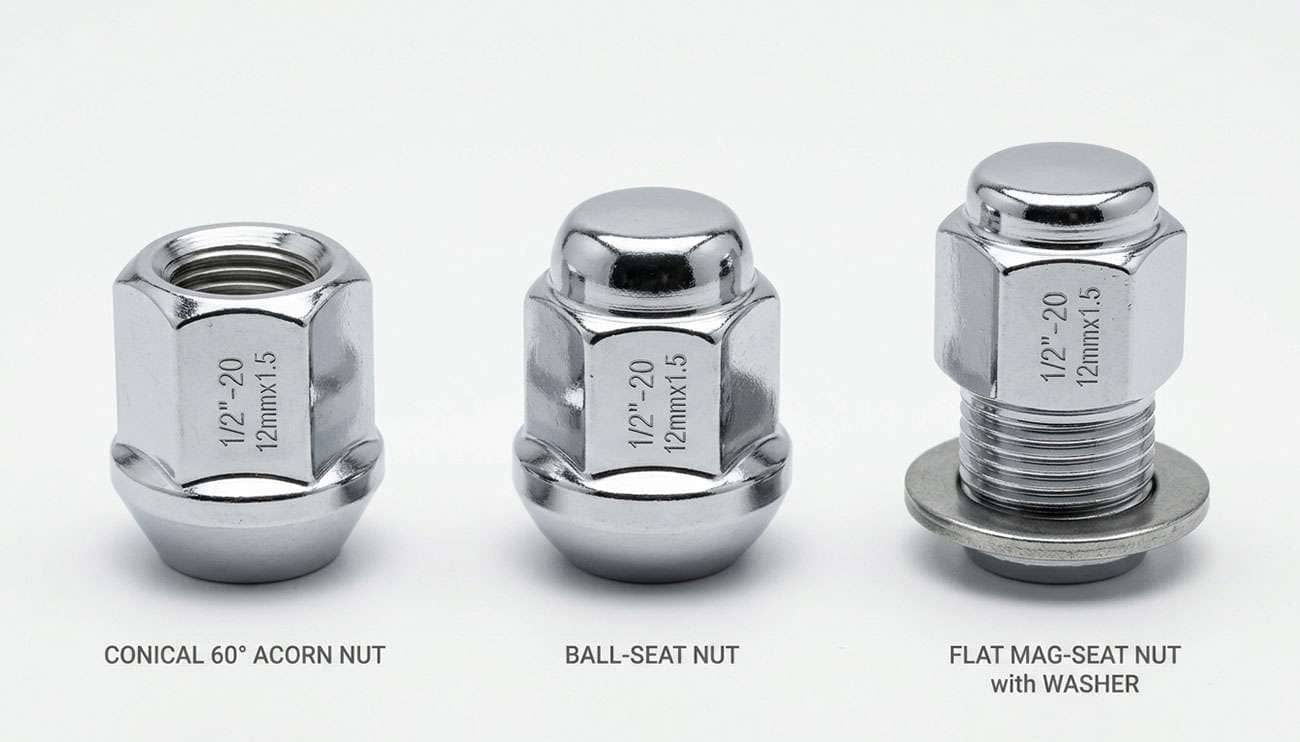
Ninety-plus percent of passenger vehicles and aftermarket wheels use one of three seat types. Here is how each one behaves and where it shows up.
Conical (acorn / tapered). This is the industry standard for aftermarket wheels. The nut has a cone-shaped underside, almost always cut to a 60-degree taper, that mates with a matching cone in the wheel's lug hole. The big advantage is self-centering: as you tighten, the taper guides the nut — and the wheel — into concentric alignment with the hub. That is exactly what you want on a custom wheel. A handful of circle-track and race wheels use a 45-degree conical seat with a wider contact face, but unless you are running purpose-built track wheels, assume 60 degrees.
Ball (radius / spherical). Instead of a cone, the nut's underside is a rounded, ball-shaped curve that seats into a matching radiused hole. This is largely an OEM design, and it shows up most on European vehicles — Audi, BMW, Mercedes-Benz, Volkswagen, and similar platforms. The catch is that ball seats come in different radii, commonly referenced as R12, R13, and R14. A ball nut head looks nearly identical to a conical head at a glance, so a ball-seat car wearing the wrong conical nuts is a genuinely common and dangerous mix-up.
Mag / flat (shank seat). This is the odd one out. Rather than a taper or a curve, the nut uses a flat washer face that bears against a flat surface around the lug hole, paired with an extended shank that drops down into the hole to center the wheel. Mag seats were widespread when aluminum wheels first arrived and are now relatively rare on consumer wheels, though the extended-shank concept lives on in some applications. The critical variable here is shank length: it has to match the depth of the wheel's lug pocket.
Seat Type |
Contact Surface |
Where You'll Find It |
Self-Centering? |
|---|---|---|---|
Conical (acorn) |
60-degree taper (45 on some race wheels) |
Most aftermarket wheels, many domestic OEM |
Yes, via the taper |
Ball (radius) |
Rounded curve (R12 / R13 / R14) |
European OEM (Audi, BMW, Mercedes, VW) |
Yes, via the radius |
Mag / flat |
Flat washer face + extended shank |
Older alloy wheels, niche applications |
By the shank, not the seat |
Two more styles deserve a mention, but understand that they are usually conical seats wearing a different jacket — the seat geometry is still a 60-degree taper. What changes is the drive interface and the diameter.
Tuner lug nuts are conical-seat nuts with a smaller outer diameter, designed for wheels whose lug pockets are too narrow for a standard hex nut to fit. They typically require a special key or splined socket to install, which doubles as a mild theft deterrent. The narrow body is the point: it clears the recessed lug holes common on tuner-style wheels.
Spline-drive nuts take the same idea further with grooves running the length of the nut and a dedicated tool that engages those splines. The smaller diameter and unique tool reduce the risk of stripping the nut and add a layer of security, which is why they overlap with the world of wheel locks and theft prevention. The lighter weight is also a small bonus for track-focused builds.
The takeaway: if your wheel has narrow or deeply recessed lug holes, a standard conical nut may physically not fit even though the seat type is correct. Clearance and seat type are two separate checks.
You do not need exotic tools — you need to look at the right places in the right order. Work through this sequence before you buy a single nut.
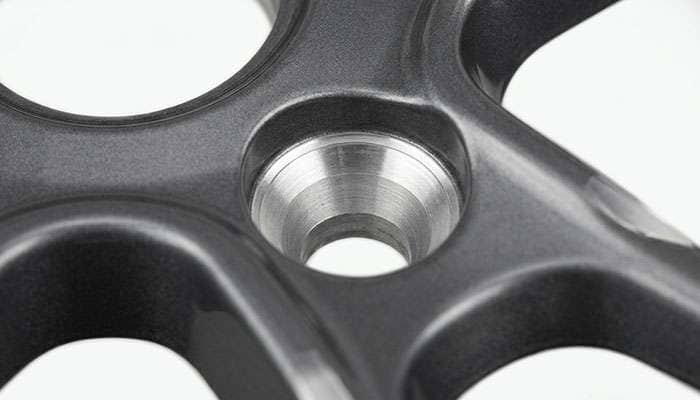
Start with the wheel, not the nut. The wheel dictates the seat; the nut has to obey it. Pull a wheel (or just remove the existing nuts on one) and inspect the lug hole. A cone-shaped, angled taper that funnels inward means conical. A smooth, rounded, bowl-like curve means ball seat. A flat machined surface around the hole with a deep pocket below means mag/flat.
Factory or aftermarket? If you are running aftermarket wheels, the odds strongly favor a 60-degree conical seat — that is the default for the custom-wheel industry. If you are on factory wheels, the seat follows the vehicle's origin: European platforms lean ball-seat, while many domestic and Asian factory wheels are conical. Do not treat this as a guarantee, but it tells you what to expect.
Check the existing nuts as a cross-reference. If the wheels came with nuts that have run trouble-free, examine their underside. A tapered cone, a rounded ball, or a flat washer face will tell you what the wheel was machined for. Just remember the warning about ball versus conical: the heads can look almost the same, so inspect the seating surface, not the top of the nut.
When in doubt, confirm before you torque. A correct nut starts threading and then settles smoothly and evenly into the seat by hand. If a nut cocks, drags, or refuses to sit flush, stop. That resistance is the wheel telling you the geometry is wrong. This check belongs in your routine when you prepare for a wheel installation, right alongside cleaning the mounting surfaces and verifying the studs are in good shape.
This is where the spec sheet stops being academic. A mismatched seat does not announce itself — it works for a while and then fails. Here is the chain of consequences, roughly in the order they appear.
Reduced clamp load. When the nut contacts the wheel on a thin line instead of a full ring, the stud cannot be tensioned the way it was designed to be. You may read correct torque at the wrench, but the actual clamping force pinning the wheel to the hub is far lower than it should be. The wheel is effectively under-secured even though the numbers looked right.
Loosening and vibration. Low clamp load lets the wheel micro-shift under cornering and braking loads. That movement lets the nuts back off over time, and the first symptom a driver usually notices is a shake. If you feel a new wobble after a wheel change, seat mismatch belongs on the suspect list — alongside balance and bent wheels — when you are diagnosing steering wheel vibration.
Lateral runout and brake pulsation. Uneven or partial seating can pull the wheel slightly out of true relative to the hub. That lateral runout transmits into the rotor plane and shows up as a pulsing brake pedal — a problem that gets misdiagnosed as warped rotors when the real cause is at the lug seat.
Wallowed-out lug seats. The most expensive outcome. Concentrated contact and constant micro-movement gouge and elongate the wheel's lug holes. Once the seats are wallowed out, the wheel can no longer locate or clamp correctly with any nut, and the wheel itself is compromised.
None of this is dramatic at first — the failure mode is slow, quiet, and easy to ignore until the wheel is visibly moving or the lug holes are ruined. That is exactly what makes it dangerous.
Seat type is the spec people miss, but it is one of three that all have to line up. Treat them as a checklist, not a single decision.
Seat type. Conical, ball, or mag — match the wheel exactly. This is the load path, covered above.
Thread pitch and diameter. The nut has to thread onto the stud, which means matching both the diameter and the pitch (for example, 12x1.5 versus 12x1.25 versus 14x1.5). A nut that threads on "mostly" but feels gritty is a pitch mismatch, and it will damage the stud threads.
Length and shank engagement. The nut must engage enough thread to develop full clamp load, and on shank-style nuts the shank length must match the pocket depth. Too short and you lose thread engagement; too long and the nut can bottom out before clamping. Open-end versus closed-end caps matter here too if your wheel has shallow pockets.
Get all three right and the final step is simply to tighten lug nuts properly in the correct star pattern and torque your lug nuts to spec with a calibrated wrench. Always pull torque figures from the wheel or vehicle manufacturer for your application rather than a generic chart — the right number depends on stud size, seat type, and the wheel. Doing the work at home? Our walkthrough on installing new rims yourself ties the whole sequence together.
The lug nut seat is the single most overlooked spec in wheel fitment, and it is the one that quietly governs whether your wheels stay clamped. A nut that threads on is not the same as a nut that seats — only matching geometry between the wheel's machined contour and the nut's underside delivers full, even clamp load. Identify your seat from the wheel first, confirm by hand before you torque, and remember that seat type, thread pitch, and length all have to agree. Get those right and you have removed one of the most common, and most preventable, causes of wheels loosening on the road. When you are sourcing a fresh set, our team can match the correct hardware to your custom wheels so the seat question is answered before the box ships.
Not automatically, even if the threads match. Most aftermarket wheels use a 60-degree conical seat, and if your factory nuts are ball seat or mag/flat, they will not clamp the new wheels correctly. Always confirm the wheel's seat type and match the nut to it.
Look at the seating surface, not the top of the nut — the heads look nearly identical. A conical nut has a straight angled cone underneath; a ball-seat nut has a rounded, curved surface. The easiest tell is the wheel itself: inspect whether the lug hole is a straight taper or a rounded bowl.
The nut contacts the wheel on a small area instead of a full ring, which lowers clamp load. Over time that leads to loosening, vibration, lateral runout that can mimic warped rotors, and eventually wallowed-out lug seats that ruin the wheel — even though the nut may have torqued to spec.
Usually no. Most tuner and spline-drive nuts use a standard 60-degree conical seat — what changes is the smaller outer diameter and the special tool needed to install them. They exist to fit narrow, recessed lug holes and to deter theft, not to change the seat geometry.
Torque specs depend on stud size, seat type, and the specific wheel, so use the figure published by your wheel or vehicle manufacturer rather than a generic value. A mismatched seat can also make a torque reading misleading, since the wrench measures turning resistance, not the quality of the clamp.