
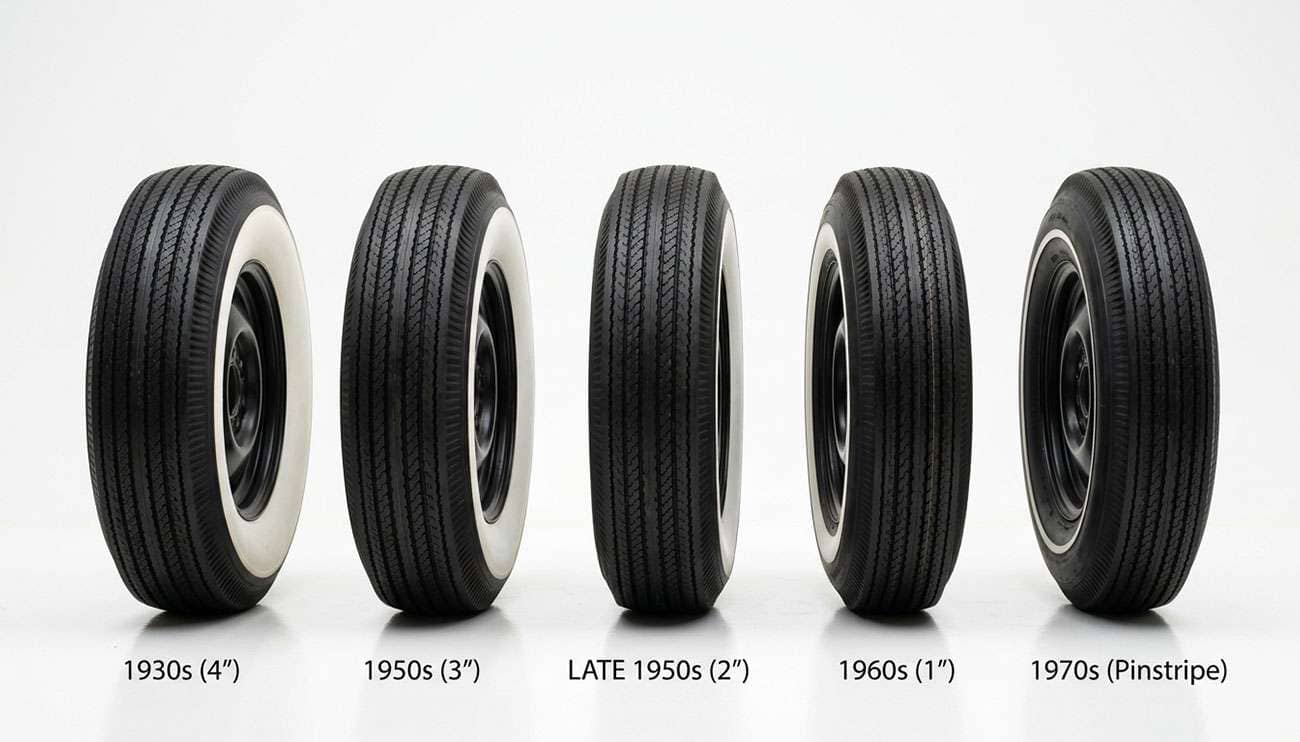
Put a 3-inch wide whitewall on a 1967 Cadillac and it looks like a costume. Put a ¾-inch pinstripe on a 1955 Bel Air and it looks like something's missing. The whitewall width on a classic car isn't a matter of personal preference — it's a matter of historical accuracy. Each era had a specific standard, and getting it wrong is one of the easiest ways to tell a knowledgeable restoration from a well-meaning guess.
I've been matching whitewall tires to classic cars for years, and the single most common mistake I see is width. Guys put wide whitewalls on cars that should have narrow ones, or narrow whitewalls on cars that should have wide ones. The fix is simple: match the width to the year. Here's exactly how.
Whitewall width isn't decorative randomness — it tracked directly with automotive design trends over four decades. Wide whitewalls dominated when cars had tall, rounded fenders and chrome everywhere. As body styles got lower, wider, and more angular through the 1960s, whitewalls narrowed to complement the cleaner lines. By the time muscle cars arrived, whitewalls had shrunk to thin pinstripes — and performance models dropped them entirely in favor of blackwalls, redlines, or raised white letters.
At a car show, a knowledgeable judge or fellow enthusiast will spot the wrong whitewall width instantly. It's like putting a 1970s disco collar on a 1950s suit — the individual pieces might be fine, but the combination is historically wrong. Getting the width right is one of the cheapest and most impactful details in any restoration.
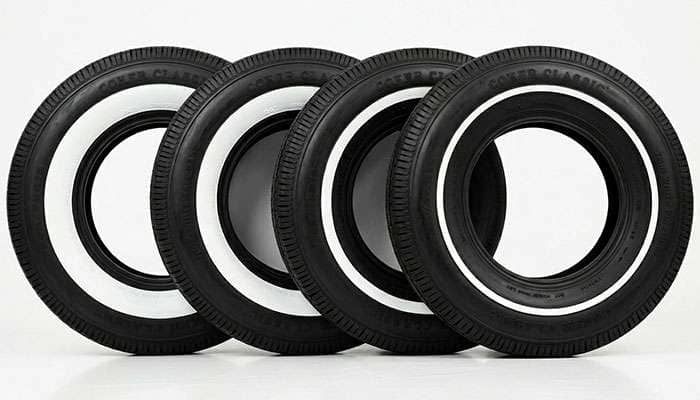
Here's the condensed history. Whitewalls started wide and got progressively narrower over roughly 40 years:
Tires were originally all white — natural rubber is off-white, and early tires were made entirely from it. In 1910, B.F. Goodrich introduced carbon black into tire manufacturing, which made the rubber stronger and longer-lasting but turned it black. Manufacturers kept a band of white rubber on the sidewall as a styling element, and the whitewall tire was born. Through the 1930s and 1940s, that white band covered most of the sidewall — 3 to 4+ inches wide. By the early 1950s, the standard width was 2½ to 3¼ inches. In the late 1950s, it began shrinking to 2 inches. In 1962, most American manufacturers made the official switch to 1-inch whitewalls. Through the mid-to-late 1960s, whitewalls continued narrowing to ¾ inch. By the early 1970s, the pinstripe whitewall — ⅜ to ½ inch — was the standard, and it persisted on luxury cars into the 1980s before disappearing from new car production entirely.
Here's the reference table I use when customers call. Find your car's year and you'll know the correct whitewall width:
Era |
Years |
Correct Whitewall Width |
Notes |
|---|---|---|---|
Pre-War |
1920s–1941 |
3"–4+" |
All-white or very wide band. Some tires were entirely white. |
Early Post-War |
1946–1954 |
2½"–3¼" |
The classic wide whitewall era. Standard on most sedans, optional on economy models. |
Mid-1950s Transition |
1955–1961 |
2"–2¾" |
Widths began narrowing. 2¾" common early, 2" common by 1960-61. |
The 1962 Switch |
1962–1964 |
1" |
Most manufacturers switched to 1" as standard. Wide whitewalls no longer offered on new cars. |
Mid-1960s |
1965–1968 |
¾"–1" |
Narrowing continued. Performance models shifted to redlines, raised white letters, or blackwalls. |
Pinstripe Era |
1969–1980s |
⅜"–¾" |
Thin pinstripe standard on luxury sedans. Muscle cars and sports cars used blackwalls. |
The single most important year in whitewall history is 1962. That's when virtually every American manufacturer — GM, Ford, Chrysler — discontinued wide whitewalls as a factory option and switched to 1-inch narrow whitewalls as the standard. If your car was built in 1961 or earlier, it should have wide whitewalls (2"+ depending on exact year). If it was built in 1962 or later, it should have narrow whitewalls (1" or less). This one detail is the most commonly gotten wrong in classic car restorations.
Luxury brands held onto wider whitewalls longer than mainstream manufacturers. Cadillac, Lincoln, and Imperial retained wider whitewalls (1½"–2") into the mid-1960s on some models, even after the rest of the industry had switched to 1-inch. Some Cadillac models featured unique double whitewall designs — a narrow white stripe separated by a thin black band from a second white stripe — that no other manufacturer used.
If you're restoring a luxury car from the early-to-mid 1960s, don't automatically assume 1-inch whitewalls are correct. Check the factory build sheet or original sales literature for your specific model and trim level. The base trim might have had 1-inch whitewalls while the top trim had 1½-inch. This is one area where trim-level accuracy really matters.
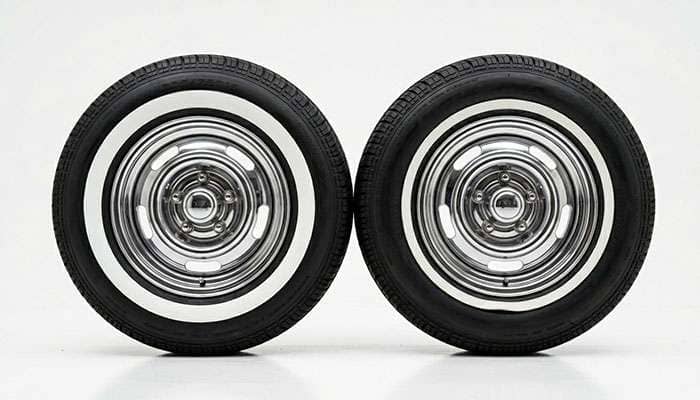
Not all whitewalls are created equal. There are three ways to get a white sidewall on a tire, and the differences in quality and longevity are significant:
The white rubber is molded into the tire during manufacturing — it's part of the tire's structure, not applied afterward. This is how original whitewalls were made, and it's how the best reproduction whitewalls are made today. The white goes all the way through the rubber layer, so it can be cleaned, lightly scuffed, and maintained without wearing through to black. Kontio Tyre WhitePaw uses genuine whitewall construction with white rubber built into every tire from day one — it's one of the reasons I recommend them so often.
Some manufacturers produce tires with a white rubber underlayer covered by a thin black veneer. The black veneer is then ground or buffed away to expose the white underneath. This produces a clean whitewall but the white layer is thinner than a genuine built-in whitewall. Aggressive cleaning or curb scuffing can wear through the white layer faster. Many mid-range whitewall tires use this method.
Portawalls are white rubber rings that clip between the tire bead and the rim, creating the appearance of a whitewall on a standard blackwall tire. They're removable, affordable, and available in various widths. The advantage is that you can add whitewalls to any tire without buying specialty tires. The disadvantage is that they can shift, collect dirt behind them, and don't look quite as clean as genuine whitewalls up close. For a show car or concours restoration, portawalls won't pass inspection. For a casual cruiser or a temporary solution, they're a reasonable option.
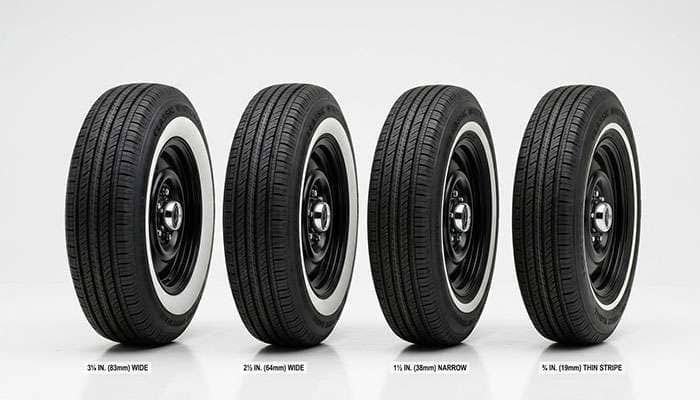
Here's what I recommend at each width based on build quality, value, and availability:
The Kontio Tyre WhitePaw Classic WW-Wide is my top pick. Genuine Finnish-made whitewall construction, 400 treadwear rating, A traction grade, available in 13-, 14-, and 15-inch sizes covering 1940s through early 1960s vehicles. The whitewall is built into the tire from day one — not ground or applied. For bias ply authenticity, Coker Classic and Firestone produce wide whitewalls in period-correct bias ply construction across virtually every pre-war and post-war size.
The Kontio Tyre WhitePaw Classic WW-Narrow delivers the same genuine construction in a narrow whitewall format. American Classic Narrow Whitewall Radial is another strong option with USA manufacturing and broad size coverage. For European classics, the Autobahn Bias Look Radial in Narrow WW gives you the correct narrow whitewall with Continental-replica tread patterns for VW, Porsche, and other European vehicles.
Pinstripe whitewalls are harder to find in quality reproductions because the market is smaller — most cars from this era that wore pinstripes were luxury sedans, not the high-demand muscle cars and hot rods that drive collector tire sales. Coker Classic produces pinstripe whitewalls in common 14- and 15-inch sizes. Diamond Back also offers thin-stripe options across a wider range of modern sizes for later model luxury cars.
Browse our full antique tire and classic tire selection to see every whitewall option we carry. Not sure which width is right? Call us at 888-926-2689 — tell me the year, make, model, and trim level and I'll tell you the exact factory whitewall specification.
A 1955 Chevrolet Bel Air should have wide whitewalls — approximately 2¾ inches. This was the standard whitewall width for mid-1950s American cars. The original tire size was 6.70-15, which converts to approximately 205/75R15 in modern radial sizing. Kontio Tyre WhitePaw Classic WW-Wide in 205/75R15 with a 2¾-inch genuine whitewall is the correct match. Coker Classic also produces this size in both bias ply and radial construction with the correct wide whitewall width.
Wide whitewalls were discontinued as a factory option on new cars in 1962, when most American manufacturers switched to 1-inch narrow whitewalls. Some luxury brands like Cadillac and Lincoln retained slightly wider whitewalls (1½ inches) for a few more years. However, wide whitewall tires are still manufactured today by specialty companies like Kontio Tyre, Coker Classic, American Classic, and Firestone for the restoration market. You can buy brand-new wide whitewall tires in virtually every antique and classic car size.
Portawalls serve a purpose — they're an affordable way to add a whitewall appearance to any blackwall tire without buying specialty tires. They clip between the tire bead and the rim and are removable. For casual cruisers, car show spectators who won't get on their knees to inspect sidewalls, and temporary installations, they work fine. For concours judging, serious restorations, or cars that see significant driving, genuine built-in whitewalls are worth the investment. Portawalls can shift, trap dirt, and don't hold up to close inspection the way a genuine whitewall does.
Generally, no. Most muscle cars from the late 1960s and early 1970s came standard with blackwall tires, redline tires, or raised white letter tires — all of which projected a sportier, more aggressive image than whitewalls. Narrow pinstripe whitewalls were sometimes available as an option on muscle car platforms, but they were associated with the "luxury" or "base" trim rather than the performance package. A 1969 Camaro SS, for example, would have had redline or raised white letter tires — not whitewalls. If you're restoring a muscle car, check the RPO codes on your build sheet to confirm the original tire style.
Use a dedicated whitewall tire cleaner and a soft-bristle brush — never bleach, which dries out the rubber and causes cracking. For stubborn brown staining (caused by antioxidants migrating from the black rubber — a process called "blooming"), a fine-grade abrasive pad like an SOS pad with gentle pressure works well. Rinse thoroughly and apply a water-based tire dressing for UV protection. Avoid silicone-based dressings, which attract dust and can yellow the white rubber over time. Clean your whitewalls every time you wash the car to prevent staining from building up.
The Kontio Tyre WhitePaw Classic comes in two whitewall configurations: WW-Wide (ranging from 2½ to 3¼ inches depending on tire size) and WW-Narrow (approximately 1½ inches). Both use the same genuine whitewall construction — white rubber built into the tire during manufacturing, not ground or applied. Both carry a 400 treadwear rating and A traction grade. The only difference is the width of the white band. Choose Wide for pre-1962 cars that should have broad whitewalls, and Narrow for 1962-and-later cars that should have slimmer whitewalls. Both are available across the same size range in 13-, 14-, and 15-inch fitments.



