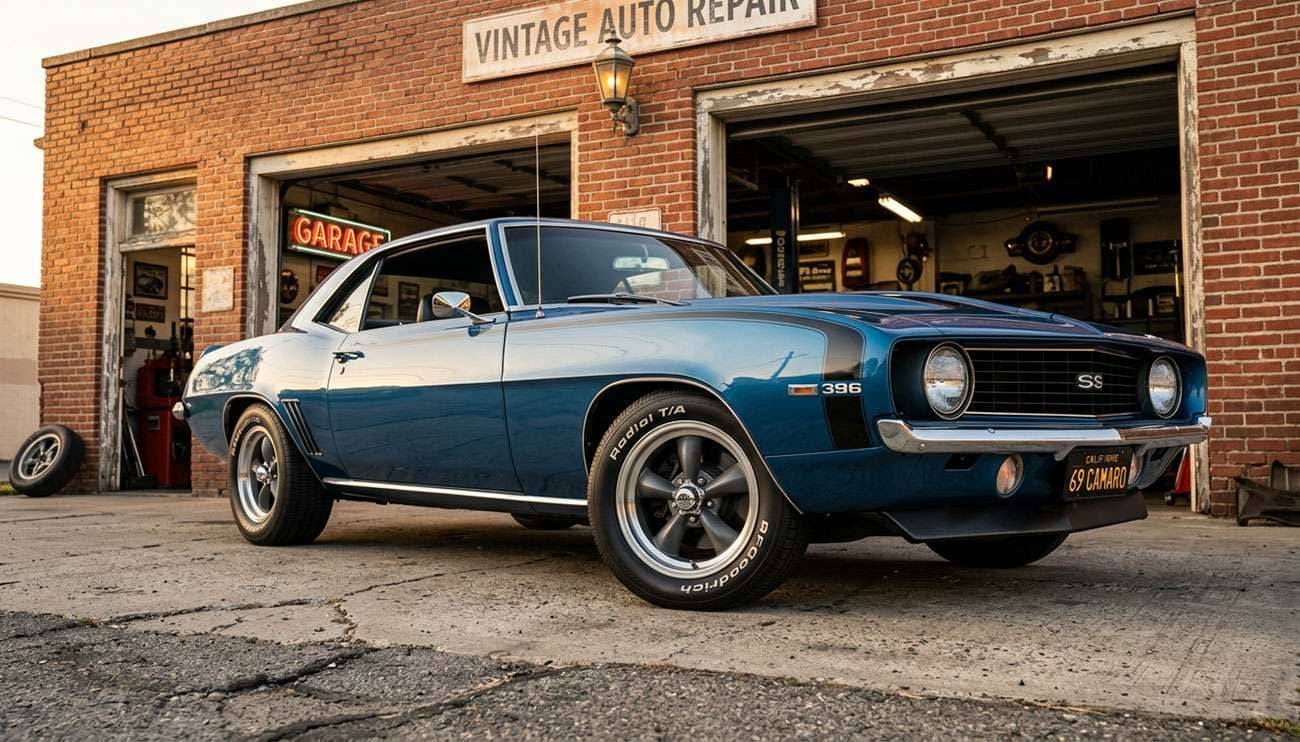
Your brakes pick the Torq Thrust before your taste does. Drum brakes or a factory 11-inch disc take a 14- or 15-inch Torq Thrust D, Torq Thrust II or Vintage, and the D's curved spokes were drawn specifically to clear the 1965 Corvette's new disc calipers. A 12- to 13-inch big-brake kit needs a 17-inch wheel, which means the one-piece Torq Thrust II or the Torq Thrust M. A 2005-and-up Mustang gets the M, because it's the only series cast with modern positive offsets. Most guides stop at "check your fitment." The part they skip is that each series runs its own backspacing family, and that's what decides whether the tire clears your springs and your fenders.
I've been bolting Torq Thrusts onto cars since we opened in 1971, and I've seen more of them sent back for the wrong series than for the wrong bolt pattern. So here's the table I'd hand you at the counter. Find your brakes and your era on the left.
Your Brakes and Era |
Torq Thrust Series |
Smallest Diameter |
Backspacing in That Series |
|---|---|---|---|
Drum brakes, 1950s and 1960s, period look |
Vintage or Original (VN309, VN109), Torq Thrust D |
14 to 15 in. |
2.16 to 4.5 in. |
Factory front discs, including 1965-82 Corvette four-wheel discs |
Torq Thrust D (VN105, VN105D, VN605) or Torq Thrust II 15-inch |
15 in. on a disc Corvette |
3.26 to 4.5 in. |
11- to 11.75-inch disc conversion kit |
Torq Thrust D or Torq Thrust II |
15 in. |
3.26 to 4.5 in. |
12- to 13-inch big brake kit, restomod or pro-touring |
Torq Thrust II one-piece (VN215, VN515, VN615) or Torq Thrust M |
17 in. |
4.0 to 7.06 in. |
13- to 14-inch track kit |
Torq Thrust II 18- or 20-inch, or a two-piece custom |
18 in. |
4.5 to 5.74 in. one-piece; built to spec two-piece |
2005-and-up Mustang without the Performance Pack brakes |
Torq Thrust M (AR105M, AR605M) |
17 in. |
5.66 to 6.02 in. in the Mustang offsets |
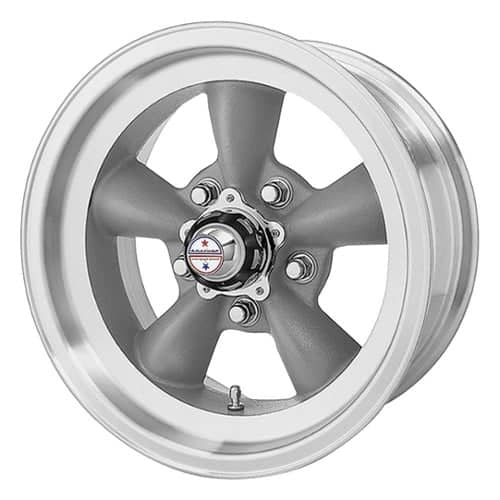
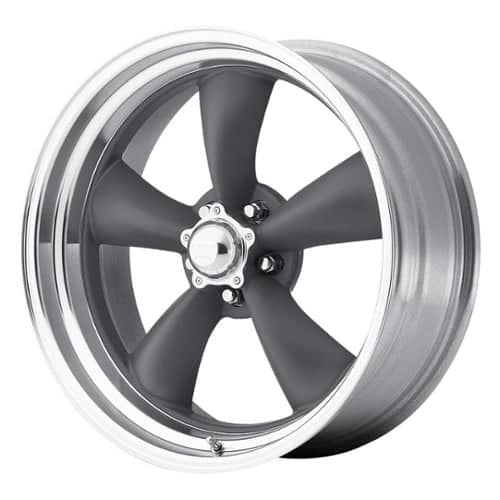
American Racing sells the Torq Thrust as a family, and a lot of the part numbers are the same wheel in a different finish. The VN215, VN515 and VN615 are the same one-piece Torq Thrust II casting in mag gray with a machined lip, polished, and chrome. The VN105, VN105D and VN605 are the same Torq Thrust D in satin black, gray, and chrome. Once you know that, the lineup gets a lot simpler.
Series |
Part Numbers and Finishes |
Diameters |
Backspacing Range |
Hub Bore |
Built For |
|---|---|---|---|---|---|
Torq Thrust Vintage and Original |
VN309 silver with machined lip; VN109 polished |
15 and 17 in. |
2.76 to 4.5 in. |
83.1 mm |
Straight-spoke 1960s look, drum-brake cars |
Torq Thrust D |
VN105 satin black; VN105D gray; VN605 chrome |
14 to 16 in. |
2.16 to 4.5 in. |
83.1 mm |
Curved spokes for classic disc brakes |
Torq Thrust II, one-piece |
VN215 mag gray; VN515 polished; VN615 chrome |
14 to 22 in. |
1.52 to 7.06 in. |
83.1 mm (87.1 mm on some 5x5.5 sizes) |
Classics through restomods, the widest size range |
Torq Thrust M |
AR105M anthracite or gloss black with machined lip; AR605M chrome |
16 to 18 in. |
4.0 to about 7.5 in. |
57.1 to 78.3 mm by bolt pattern |
Late-model cars, offsets from 0 to +45 |
Torq Thrust SL and two-piece Torq Thrust II |
VN425, VN505, VNC405 and others |
14 to 22 in. |
Wide range, many built to order |
About 72.6 to 83.1 mm |
Builds that need a backspacing the one-piece doesn't offer |
Every one of them carries the five-spoke shape that started the custom wheel business in 1963, but the details under the spokes are different, and those details are what this article is about. If you want the history and the looks side of the story, our American Racing Torq Thrust review covers it.
Because that's literally why the D exists. In 1965 Chevrolet put four-wheel disc brakes on the Corvette, and the original straight-spoke Torq Thrust didn't clear the new calipers. American Racing answered that same year with the Torq Thrust D, curving the spokes outward so they'd swing around the caliper. Sixty years later, the same rule holds: the shape behind the spokes decides whether a wheel clears your brakes, and the diameter decides whether it clears the rotor and caliper at all.
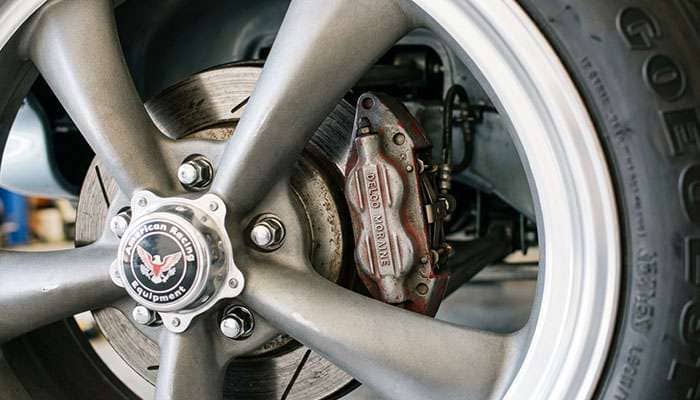
Start with diameter. This is the rotor-to-wheel cheat sheet I use for drum-to-disc conversions:
Rotor Size |
Smallest Wheel |
Torq Thrust Options |
|---|---|---|
Drums, or 10.5- to 11-inch OE-style discs |
14 or 15 in., check the kit's template |
D, II, Vintage on drums; D or II on discs |
11- to 11.75-inch performance discs |
15 in. |
Torq Thrust D or Torq Thrust II 15-inch |
12.19- to 13-inch big brake kits |
17 in. |
Torq Thrust II 17-inch or Torq Thrust M |
13- to 14-inch track kits |
18 in. or larger |
Torq Thrust II 18- or 20-inch, or a two-piece custom |
Then check the spoke shape. The Vintage and Original reproduce the straight-spoke look of the 1960s, which is exactly the shape that didn't clear Corvette discs in 1965, and Corvette owners still report having to space or machine them to clear the stock calipers. That's why I steer drum-brake cars to the Vintage and disc-brake cars to the D or the II. Diameter fixes the caliper's height. Backspacing and spoke shape fix its depth. For the full conversion walk-through, including the master cylinder and proportioning valve nobody budgets for, read my guide to wheel fitment after a disc brake conversion. And if you want to measure your own calipers, our guide to brake caliper wheel clearance shows the three measurements that matter.
Backspacing is the distance from the wheel's mounting pad to its inboard edge. Too much and the tire rubs the spring, frame or control arm. Too little and it hangs out and catches the fender lip. Classic car guides almost always give you backspacing in inches, and American Racing mostly lists offset in millimeters, so here's the conversion: backspacing equals half of the wheel width plus one inch, plus the offset divided by 25.4. A 15x8 at 0 offset is 4.5 inches. A 17x8 at minus 11 is 4.07.
Here's what the classic one-piece series actually come in, in the sizes most people buy:
Size |
Torq Thrust D |
Torq Thrust II One-Piece |
Vintage (VN309) |
Torq Thrust M |
|---|---|---|---|---|
15x7 |
3.76 in. |
3.76 in. |
3.76 in. |
Not offered |
15x8 |
4.5 in. |
3.79 or 4.5 in. |
3.81 in. (15x8.5) |
Not offered |
15x10 |
3.77 in. |
3.77 in. |
Not offered |
Not offered |
17x8 |
Not offered |
4.07, 4.81, 5.05 or 5.48 in. |
4.5 in. |
4.5 or 5.68 in. |
17x9 to 17x9.5 |
Not offered |
5.56 to 7.06 in. (17x9.5) |
Not offered |
5.94 or 6.77 in. (17x9) |
18x8 |
Not offered |
4.5 in. |
Not offered |
4.5 in. |
18x9 |
Not offered |
5.0 in. |
Not offered |
5.94 or 6.34 in. |
Notice the pattern. Up to 15 inches, the D, the II and the Vintage share nearly identical backspacing, so on a drum or small-disc car the choice is mostly about looks and spoke shape. At 17 inches and up, the Torq Thrust II gives you several backspacing choices in the same size, while the M jumps to modern offsets that push the wheel well inboard. Two wheels of the same size can sit more than an inch and a half apart. Before you order, measure your car; our step-by-step guide on how to measure backspacing on classic car rims shows you how, and our backspacing calculator does the offset math for you.
A 1967-69 Camaro uses the 5x4.75 bolt pattern, which American Racing lists as 5x120.65, on 7/16-20 studs. Here's how our first-gen Camaro backspacing targets line up with what the Torq Thrust family actually makes:
Camaro Target |
Best Torq Thrust Match |
How Close |
|---|---|---|
15x7 or 15x8 front at 4 to 4.5 in. |
Torq Thrust D or II 15x8 at 4.5 in. |
Right on target |
15x8 rear at 4.5 in. |
Torq Thrust D or II 15x8 at 4.5 in. |
Right on target |
17x8 front at 4.5 in. |
Torq Thrust M 17x8 at 4.5 in., or Torq Thrust II 17x8 at 4.81 in. |
M is exact; II sits about 5/16 in. deeper |
17x9 rear at 5 to 5.5 in. |
Torq Thrust II 17x9.5 at 5.56 in. |
Just past the top of the range, on a half-inch-wider wheel |
18x8 to 18x8.5 front at 4.75 to 5.25 in. |
Torq Thrust II 18x8 at 4.5 in. |
A quarter-inch shallow, so check the fender lip |
18x9 to 18x9.5 rear at 5.5 in. |
Torq Thrust II 18x9 at 5.0 in. |
A half-inch shallow; consider a two-piece built to spec |
The takeaway for a Camaro: 15s and 17s are easy, and 18s are where the one-piece Torq Thrust II runs out of backspacing. A factory J52 disc car clears a 15-inch D or II without drama. If you've gone to a 13-inch-class big brake kit, you're in the 17-inch Torq Thrust II or M. Our full first-gen Camaro wheel and tire guide has the tire sizes for each of those wheels. If a Rally look suits your Camaro better than a five-spoke, our own Hot Rod Hanks 55 Rally comes in 15x7 and 15x8 at just over 4 inches of backspacing.
The car the D was invented for. Every 1965-82 Corvette has four-wheel discs, so 14-inch wheels are out, and so is any straight-spoke wheel that hasn't been relieved behind the spokes. All 1963-82 Corvettes use 5x4.75 on 7/16-20 studs.
Thick aluminum mounting pads also eat stud length. The rule of thumb is thread engagement at least equal to the stud diameter, about 7/16 inch on a Corvette, so check before you torque. Our C2 and C3 Corvette wheel and tire guide has the factory specs by year.
The Torq Thrust M. It's the only series cast with the positive offsets a modern Mustang needs, and even here the brake package decides it. The published fitments for the 2010-and-up cars exclude the Performance Pack, because those bigger Brembo brakes change what clears.
Mustang |
Torq Thrust M Size |
Offset |
Backspacing |
|---|---|---|---|
2005-2009 GT and V6 |
18x9 |
+24 mm |
5.94 in. |
2010-2014 GT without Performance Pack, V6 |
17x8 or 18x9 |
+30 mm or +24 mm |
5.66 to 5.68 in. or 5.94 in. |
2015-2023 GT without Performance Pack, EcoBoost |
17x7.5 |
+45 mm |
6.02 in. |
Look at the jump. A 2015-and-up Mustang wants six inches of backspacing on a 17x7.5. The classic Torq Thrust II 17x8 tops out at 5.48. Put a classic Torq Thrust on a late-model car and the wheel sits so far out it hits the fender before it ever hits a caliper. The M also works on other late-model cars in its bolt patterns, including Corvettes, Challengers and Chargers, but confirm your exact offset and brake package before you order.
Lug nuts, usually yes. Hub rings, usually no. The classic one-piece Torq Thrusts have an 83.1 mm center bore, big enough to slide over nearly any classic hub. That makes them lug-centric: the lug nuts center the wheel, not the hub. That's how these wheels were designed to work, and it's fine as long as the nuts are right and torqued in a star pattern. The one-piece Torq Thrust II is listed with a conical lug seat and exposed lugs, so the flat-seat nuts from your old steel wheels may not be the right match. Our guide to lug nut seat types shows how to tell them apart.
The Torq Thrust M uses a tighter center bore matched to its bolt pattern, 72.56 mm on the 5x4.5 Mustang fitment, for example. That's a little larger than a Mustang's hub, so some owners add hub-centric rings to help with centering. And if your car has an odd bolt pattern, American Racing offers some Torq Thrust II sizes as blank five-lug wheels, made to be drilled for the pattern you need.
Here are the sizes I'd shortlist for the builds above, with our price per wheel as of this writing. The finish changes the price more than the size does: chrome runs well above mag gray in the same casting.
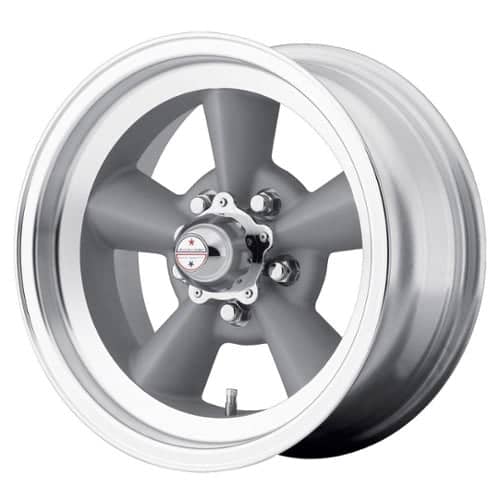
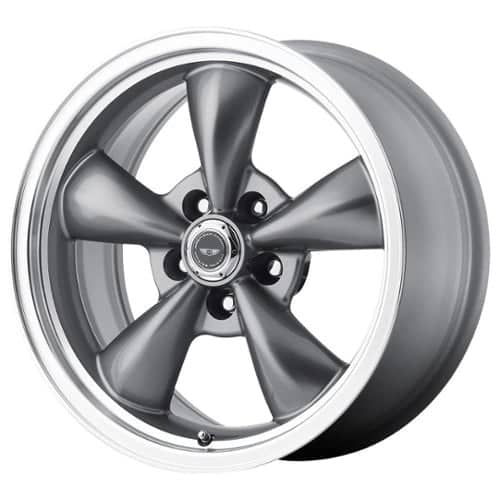
Wheel |
Size and Bolt Pattern |
Backspacing |
Price Each |
Best For |
|---|---|---|---|---|
15x7, 5x4.5 |
3.76 in. |
$205 |
Drum-brake Ford or Mopar, straight-spoke look |
|
15x7, 5x4.75 |
3.76 in. |
$207 |
C2/C3 Corvette, GM disc-brake classics |
|
15x8, 5x4.5 |
4.5 in. |
$223 |
Ford and Mopar classics with front discs |
|
15x8, 5x4.75 |
4.5 in. |
$180 |
First-gen Camaro, front or rear |
|
15x7, 5x4.5 |
3.76 in. |
$334 |
Show-car shine on a 15-inch build |
|
17x8, 5x4.75 |
4.07 in. |
$238 |
C3 Corvette, all four corners |
|
17x8, 5x4.75 |
4.07 in. |
$292 |
The same fitment in polished |
|
17x8, 5x4.75 |
4.81 in. |
$238 |
Big-brake Camaro or Chevelle fronts |
|
17x9.5, 5x4.75 |
5.56 in. |
$274 |
First-gen Camaro rears |
|
18x8, 5x4.75 |
4.5 in. |
$288 |
Pro-touring fronts with 13-inch brakes |
|
17x8, 5x4.75 |
4.5 in. |
$288 |
Modern look on a classic GM, exact 4.5-inch fit |
|
17x7.5, 5x114.3 |
6.02 in. |
$274 |
2015-2023 Mustang without Performance Pack |
|
17x8, 5x114.3 |
5.68 in. |
$288 |
2010-2014 Mustang GT without Performance Pack, V6 |
|
18x9, 5x114.3 |
5.94 in. |
$318 |
2005-2009 Mustang GT and V6; 2010-2014 without Performance Pack |
Every size above comes in other bolt patterns too, and the full lineup is on our American Racing Torq Thrust wheels page. For the rest of the brand, see our American Racing wheels page.
A Torq Thrust that's the wrong series or the wrong backspacing doesn't usually announce itself on the first drive. It costs you in stages.
The wrong spoke shape on a disc-brake car:
The wrong backspacing for your car:
Measuring first costs you twenty minutes and a straightedge. Getting it wrong costs you a set of wheels.
The Torq Thrust looks like one wheel, but it's five families with five different jobs. The Vintage and Original are for drum-brake cars that want the straight-spoke 1960s look. The D was built in 1965 for disc brakes and is still the right 15-inch answer for a classic Corvette or a disc-brake muscle car. The one-piece Torq Thrust II covers the most ground, from 15-inch classics to 17- and 18-inch big-brake restomods, with several backspacing choices in each size. The M brings modern offsets for late-model Mustangs and similar cars. And when your car needs a backspacing none of them makes, the two-piece customs are built to order. Start with your brakes, measure your backspacing, and the right Torq Thrust picks itself.
Start with your brakes. Drum-brake classics fit the Torq Thrust Vintage, Original, D or II in 14 or 15 inches. Classic disc brakes fit the Torq Thrust D or II in 15 inches. A 12- to 13-inch big brake kit needs a 17-inch Torq Thrust II or M. Late-model Mustangs need the Torq Thrust M with modern positive offsets. Then match the backspacing to your car.
The Torq Thrust D has curved spokes, introduced in 1965 to clear Corvette disc brakes, and comes in 14 to 16 inches. The Torq Thrust II has propeller-style spokes and a stepped lip, and the one-piece version comes in 14 to 22 inches with a wider range of backspacing choices in each size.
The Torq Thrust D and Torq Thrust II are designed to clear classic disc brakes in 15 inches, and the 17-inch and larger Torq Thrust II and M clear most 12- to 13-inch big brake kits. The straight-spoke Vintage and Original are best on drum-brake cars. Always check the brake kit's wheel template before ordering.
It depends on the series and size. A 15x7 Torq Thrust D, II or Vintage has 3.76 inches. A 15x8 has 3.79 or 4.5 inches. A 17x8 Torq Thrust II has 4.07, 4.81, 5.05 or 5.48 inches. The Torq Thrust M runs about 4.0 to 7.5 inches, depending on offset.
Yes. All three are the one-piece Torq Thrust II. The VN215 is mag gray with a machined lip, the VN515 is polished, and the VN615 is chrome. Fitment and backspacing match size for size; only the finish and price change.
The classic one-piece Torq Thrusts have an 83.1 mm center bore and are designed to center on the lug nuts, so rings usually aren't needed as long as you use the correct lug nuts and torque them properly. Some late-model owners add hub-centric rings to the Torq Thrust M for centering.