
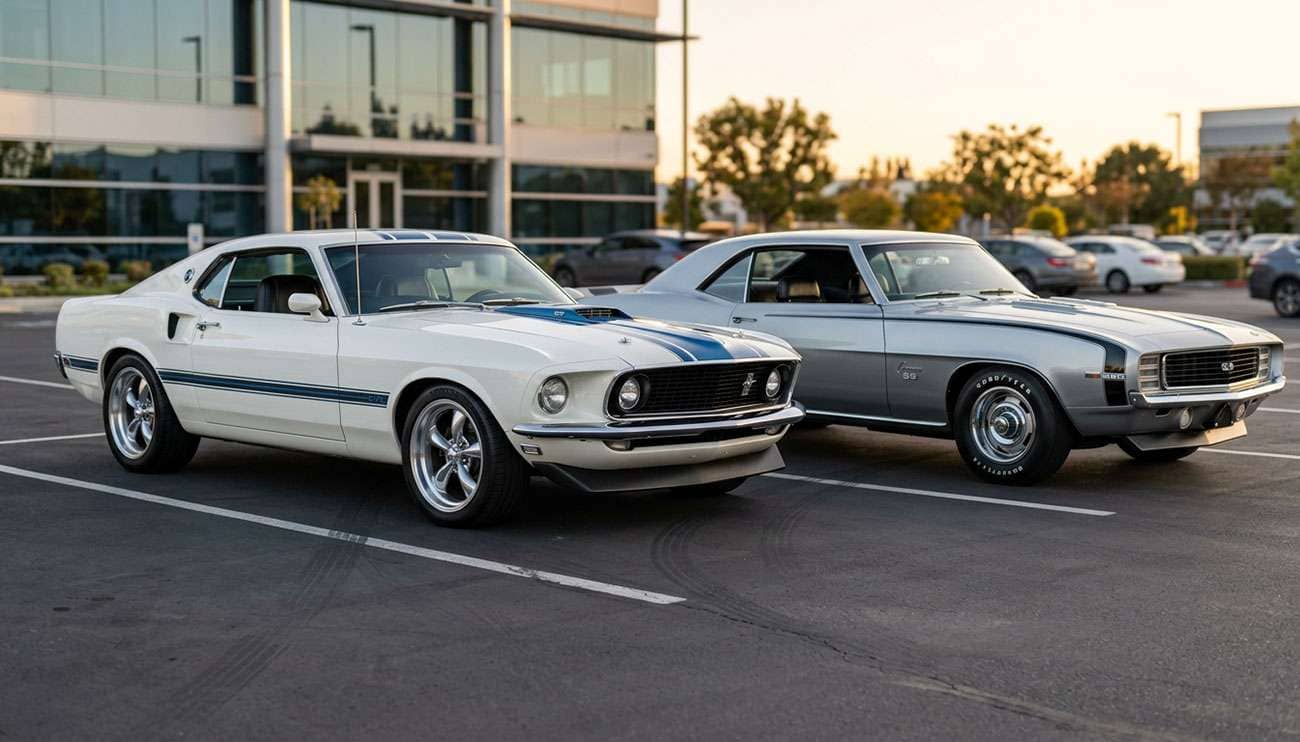
On a stock-body 1967-69 Camaro, the biggest combination that fits without cutting anything is about a 235/60R15 on a 15x8 wheel with 4.5 inches of backspacing. Move to 17s and you can run a 245/45R17 up front and a 255/40R17 in back. On 18s, a 275/35R18 is about as wide as the stock rear wheelhouse goes. Most answers you find online say it depends and stop there. It depends on three things: backspacing against the rear leaf spring, the brakes behind the front wheel, and which model year you have.
When we opened the shop in Long Beach in 1971, a '67 Camaro was a four-year-old used car, and I have been putting wheels and tires under them ever since. Here is what fits, what sets each limit, and how to measure your own car before you spend a dime.
This table is the short answer, keyed to wheel diameter. Every combination here assumes a stock-body car with factory wheelhouses, the factory rear leaf springs, and no cutting. Backspacing is measured from the mounting pad to the inner edge of the wheel.
Wheel Diameter |
Front Wheel and Backspacing |
Front Tire |
Rear Wheel and Backspacing |
Rear Tire |
Watch For |
|---|---|---|---|---|---|
14-inch |
14x6 or 14x7, about 4 in |
205/70R14 (25.3 in tall) |
14x7, about 4 in |
215/70R14 (25.9 in tall) |
Factory look; clears drums and factory discs |
15-inch |
15x7 or 15x8, 4 to 4.5 in |
225/60R15 (25.6 in tall) |
15x8, 4.5 in |
235/60R15 (26.1 in tall) |
Largest combination on a fully unmodified car |
16-inch |
16x8, 4.5 in |
225/50R16 (24.9 in tall) |
16x8, 4.5 in |
245/50R16 (25.6 in tall) |
Rear shock mount may need relocating |
17-inch |
17x8 at 4.5 in to 17x9 at 5.5 in |
245/45R17 (25.7 in tall) |
17x9, 5 to 5.5 in |
255/40R17 (25.0 in tall) |
Front 17x9 can touch the lower control arm with some steering boxes |
18-inch |
18x8 to 18x8.5, 4.75 to 5.25 in |
235/40R18 or 245/40R18 (25.4 to 25.7 in tall) |
18x9 to 18x9.5, 5.5 in |
275/35R18 (25.6 in tall) |
Tight cars may need the rear lips rolled |
Tire heights are calculated from each size and rounded to a tenth of an inch. Brands run a little tall or short, so check the listed overall diameter on the tire you pick.
Notice what changes as the wheels grow. The tire stays within about an inch of the same overall height, near 25 to 26 inches, because that is what the wheel opening and the rear gear were built around. The width grows only a little, from about 215 in back on 14s to about 275 on 18s. The number that moves the most is backspacing, from about 4 inches on a factory-style wheel to 5.5 inches on an 18. That is the part to get right.
Staggered setups are normal on these cars. A narrower front tire keeps the steering light and clears the tie rods at full lock, and the wider rear puts the power down. If you are weighing a square setup against a staggered one, our look at the muscle car staggered setup covers the trade-offs, including tire rotation.
Every first-gen Camaro left the plant on bias-ply tires, and most rode on 14-inch wheels. The Z28 was built on 15s, and 1968-69 buyers could order 15-inch wheels with a special tire. Here is what the factory order sheets list for tires by year.
Year |
Standard Tire |
Optional Tires |
Z28 Wheel and Tire |
|---|---|---|---|
1967 |
7.35-14 |
D70-14 red stripe, 7.35-14 whitewall or white stripe, 6.95-14 whitewall |
15x6 Rally, 7.35-15 red or white stripe |
1968 |
7.35-14 |
F70-14 white stripe or red stripe, 7.35-14 whitewall |
15x6 Rally, E70-15 |
1969 |
E78-14 |
E78-14 fiberglass belted, F70-14 white letter or stripe, E70-15 white letter |
15x7 Rally, E70-15 raised white letter |
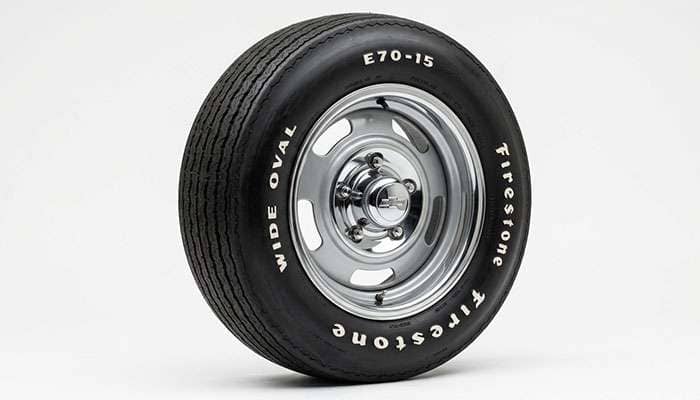
Those factory tires stood roughly 26 inches tall, and that number still matters. Your speedometer gear, your rear gear ratio, and the wheel opening all expect a tire in that range. Stay close to it with a radial and the car drives the way Chevrolet set it up.
If you are restoring a car to original, the letter-and-number bias sizes are still made. D70-14, F70-14, E70-15, E78-14, and 7.35-14 are all available as bias-ply reproductions with the stripes and lettering these cars wore. A 1968-69 Z28 on its correct E70-15 raised white letter tire, the Goodyear Speedway Wide Tread GT, is the look judges check for. If you are running white letters, get them facing the right way; our guide on which way raised white letter tires should face settles that argument.
If you are driving the car, radials are the upgrade that changes it the most for the least money. For the factory 14-inch stance, a 205/70R14 or 215/70R14 keeps the tall sidewall look, and a 195/75R14 replaces the E78-14 and 7.35-14 sizes. Our breakdown of muscle car tire sizes decoded walks through converting the old letter sizes, and our comparison of radial vs. bias-ply tires for classic cars covers what you give up and what you gain.
Here is the part nobody puts in front of you. On a first-gen Camaro, the rear tire lives in a narrow slot. The factory leaf spring sits on the inside. The quarter-panel lip sits on the outside. Backspacing decides where the tire sits in that slot, and on a stock body there is not much slot to work with.
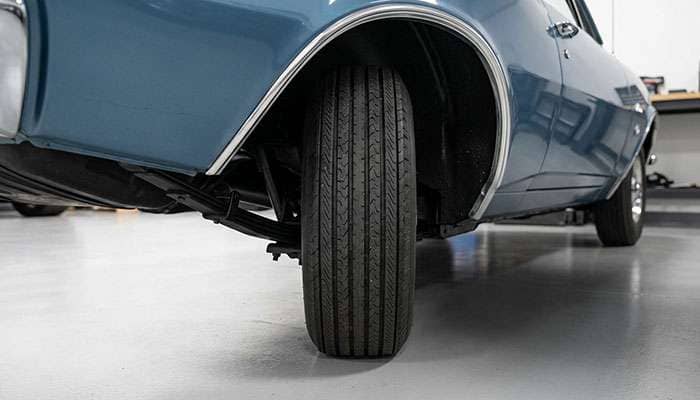
Too much backspacing pushes the tire inboard, and the inner sidewall rubs the leaf spring or the shock. Too little pushes it outboard, and the tread catches the quarter lip every time the suspension compresses. Width makes both problems worse, because a wider wheel adds material on both sides. That is why the rear numbers in the first table climb from 4.5 inches on a 15x8 to 5.5 inches on an 18x9.5. The wider wheel needs the extra backspacing to keep its outer edge inside the lip, and 5.5 inches is about as deep as you can go before the inside edge meets the spring.
The front is a different set of parts. Inside the front tire you have the frame rail, the lower control arm, and the tie rod end. Outside you have the fender lip. Too much backspacing and the tire hits the frame or tie rod at full lock. Too little and it rubs the fender when you turn and hit a bump at the same time. The front also has to clear the brake caliper, which is its own section below.
Watch out for 18-inch wheels in this bolt pattern. The 5x4.75 pattern is shared with Corvettes and a lot of later GM cars, and many 18x9.5 wheels on the market carry 6 to 7.5 inches of backspacing because they are built for those cars. On a leaf-spring first-gen, that puts the tire into the spring. A wheel can be the right diameter, the right width, and the right bolt pattern and still be wrong for your car. Our guide to the 5x4.75 bolt pattern lists which cars share it.
When you are shopping 15-inch wheels, the numbers are friendlier. Most 15x7 and 15x8 wheels made in this pattern sit between about 3.75 and 5 inches of backspacing, which is right where a first-gen wants them. Our own Hot Rod Hanks 55 Rally is built in 15x7 and 15x8 at a little over 4 inches of backspacing, which gives you the factory Rally look in the sizes a first-gen takes. If you are measuring a wheel you already own, our step-by-step on how to measure backspacing on classic car rims shows you how to get it right with a straightedge and a tape.
They do, and this is where people get caught. The brakes behind the front wheel set the smallest wheel you can run. Everything in the first table assumed the wheel clears your brakes. Here is what each common setup needs.
Front Brake Setup |
Rotor Diameter |
Smallest Wheel |
Notes |
|---|---|---|---|
Factory front drums |
None (drum) |
14 in |
How most first-gens were built |
Factory J52 disc, 1967-68 |
11 in |
14 in |
4-piston caliper; came with Rally wheels |
Factory J52 disc, 1969 |
11 in |
14 in |
Single-piston caliper |
11-inch bolt-on disc kit |
11 in |
Most factory 14s |
Check your exact wheel against the kit template |
12-inch class big brake kit |
12.19 in |
15 in |
Listed minimum on a common Wilwood kit |
13-inch class big brake kit |
12.88 in |
17 in |
Listed minimum on a common Wilwood kit |
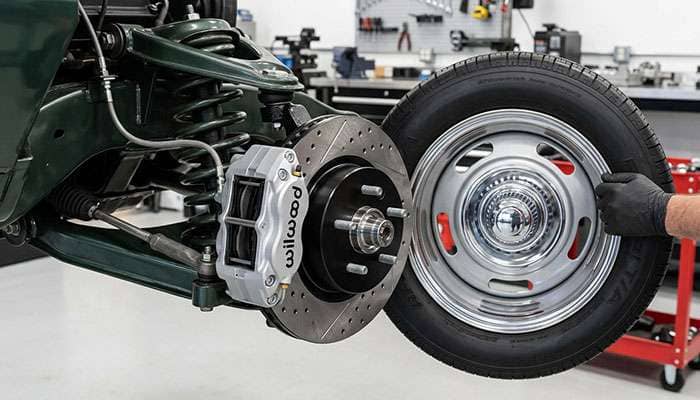
The factory disc brakes, RPO J52, used an 11-inch rotor in all three years. The 1967-68 version used a 4-piston caliper, and 1969 switched to a single-piston design. In 1967, ordering J52 got you Rally wheels, and those factory 14s were built to clear the caliper and let the brake breathe. The 1967 Z28 went to 15-inch wheels and required front discs.
Diameter is only half of it. The caliper also has to clear the back of the spokes. Wilwood's install sheet for its first-gen Camaro kit calls for at least 0.080 inch of clearance between the wheel and the caliper everywhere. That is about the thickness of a nickel. A wheel with spokes that curve inward toward the hub can pass the diameter test and still hit the caliper face. Every brake kit maker publishes a wheel template, and that template beats any chart, including mine.
Here is how it plays out at the counter. A customer upgrades to a 13-inch front brake kit, and his 15-inch Rally wheels no longer go on. Now he is shopping 17s, and the 17s change the tire size, the backspacing, and the look of the car. Pick your brakes first, then your wheels, then your tires. Do it in any other order and you may buy one of them twice.
On a stock body, the numbers in the first table cover all three years. The differences show up underneath and at the limit.
Start with the rear springs. The Camaro Research Group documents that every 1967 used mono-leaf rear springs. For 1968, only the 12-bolt cars got multi-leaf springs. For 1969, multi-leaf springs went on cars with a 12-bolt or a 350, while 307 and 327 cars kept the mono-leaf. Many cars have been through several sets of springs since then, so what came on your car and what is on it now may not match. Measure from the spring you actually have.
The bigger difference is at the limit. Detroit Speed builds mini-tubs for all three years and rates the 1967-68 cars for up to a 315 rear tire and the 1969 cars for up to a 335. Same basic chassis, different sheet metal, and 20 millimeters of difference in the widest tire the car will take once it is tubbed. If you are planning to go wide, the year of your car sets the ceiling.
The Z28 is its own case for restorers. It was built around 15-inch wheels from the start: 15x6 Rallys for 1967-68 and 15x7 Rallys for 1969. The 1968-69 Z28's E70-15 is the size restorers ask for by name, and the 1969 cars wore it with raised white letters.
Once you want more than about a 275 in back, you are cutting sheet metal. Mini-tubs replace the inner rear wheelhouses with wider ones. The Detroit Speed version adds up to 3 inches of wheel well width while keeping the stock outer body, and it is rated for up to a 315 on a 1967-68 and up to a 335 on a 1969.
The wheelhouse is only part of the job. With a wider tub, the stock leaf spring position becomes the thing in the way, which is why mini-tubs are also sold as part of rear suspension kits with their own leaf spring setup. Plan the tubs, the springs, and the wheels as one package. Buy the wheels last, after the car is on the ground and you can measure the real room you have.
Going wider than that means full tubs, a narrowed rear end, and usually a 4-link or other rear suspension. That is a different car and a different budget. For most street cars, the stock-body 275/35R18 or 255/40R17 puts more rubber down than the factory ever did, and it keeps the car looking like a Camaro.
A wheel and tire that almost fits costs you more every mile you drive on it. Here is the order it usually goes.
Go too far from about 26 inches of overall height and the speedometer reads wrong and the car feels different. A shorter 17 or 18-inch combination at about 25 inches reads fast and makes the rear gear feel steeper. A tall tire does the opposite. It is small, but it never goes away.
The rear tread starts catching the quarter lip on dips and driveway entrances, or the inner sidewall starts kissing the leaf spring under load. Up front it rubs the frame or tie rod at full lock. You hear it before you see it.
A sidewall rubbing a spring or a quarter lip wears through the rubber and into the cords. Once you see a scuff line, a cut, or a bulge, read our guide on tire sidewall damage and whether it is safe to drive, because some of it can wait and some cannot.
A tire that keeps hitting the quarter lip chips paint, cracks body filler, and can bend the lip. A wheel that rubs a caliper grinds the caliper and the spoke. On a car where one quarter panel costs more than a set of tires, this is the expensive step.
The end of the ladder is a second set of wheels, a second set of tires, or both, bought because the first set was a guess. Measuring first costs you an afternoon. Guessing costs you a set.
I tell every customer the same thing: your car has had fifty-plus years to be modified by somebody, so measure it instead of trusting a chart. Here is how.
A stock-body 1967-69 Camaro takes up to a 235/60R15 on 15x8 wheels, a 245/45R17 and 255/40R17 staggered on 17s, and up to a 275/35R18 in back on 18s. What decides it is backspacing between the rear leaf spring and the quarter lip, and the brakes behind the front wheel that set the smallest wheel you can run. The year matters at the limit, where a tubbed 1969 takes a wider tire than a tubbed 1967-68. Pick brakes, then wheels, then tires, and measure your own car. That order has saved a lot of my customers from buying things twice.
A stock-body 1967-69 Camaro fits up to a 235/60R15 on 15x8 wheels, a 245/45R17 front and 255/40R17 rear on 17s, and up to a 275/35R18 rear on 18s. Rear backspacing and the front brakes decide the exact fit.
On a fully unmodified car, about a 235/60R15 on a 15x8 wheel with 4.5 inches of backspacing. On 18-inch wheels, a 275/35R18 on an 18x9 to 18x9.5 at 5.5 inches of backspacing is about the widest rear the stock wheelhouse takes.
About 4 to 4.5 inches on 14 and 15-inch wheels, 4.5 inches on a 16x8 or 17x8, and about 5.5 inches on a 17x9 or 18x9 to 18x9.5. Deeper than that and the rear tire runs into the leaf spring.
The 1969 Z28 came on E70-15 raised white letter bias-ply tires mounted on 15x7 Rally wheels. The 1967-68 Z28 used 15x6 Rally wheels.
Yes, with factory disc brakes or most 11-inch bolt-on kits, as long as the wheel clears the caliper. Larger big brake kits need 15 or 17-inch wheels, so check the kit maker's wheel template.
The 1967-69 Camaro uses a 5x4.75 bolt pattern, also written 5x120.65, with 7/16-20 wheel studs from the factory.



