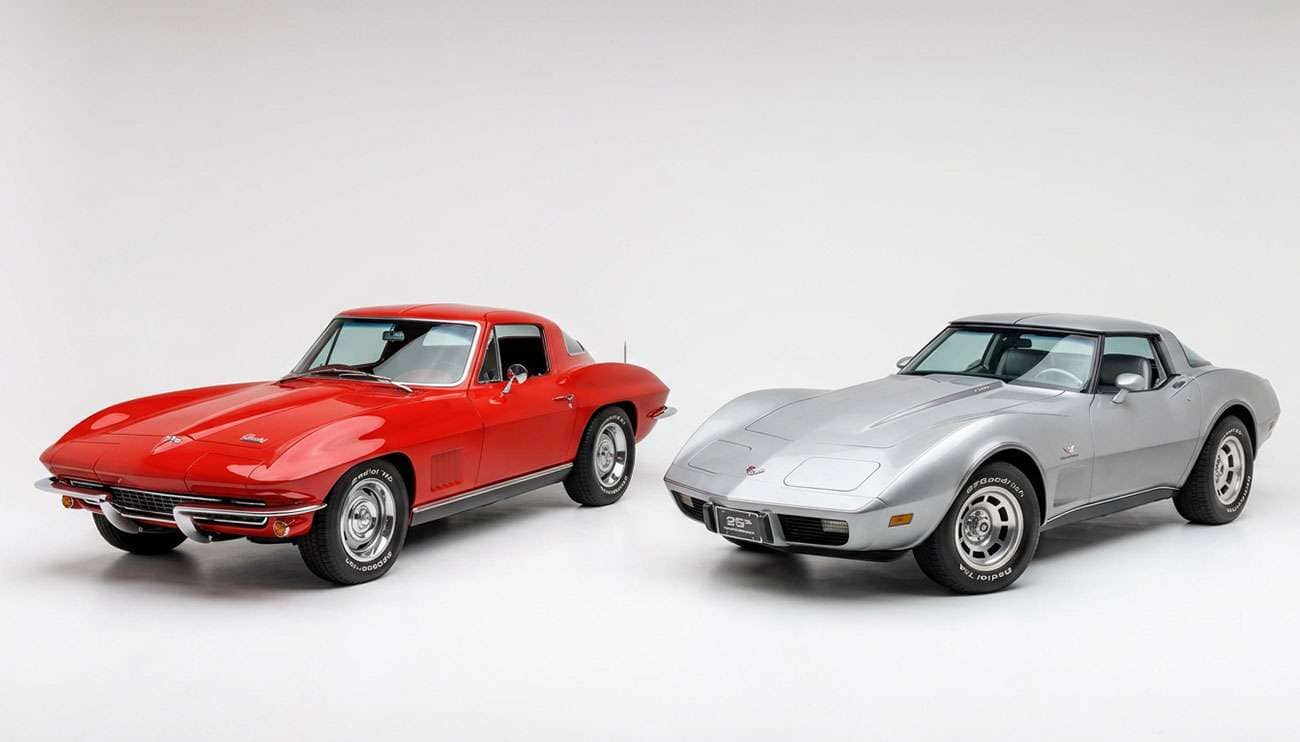
A stock 1969-82 Corvette takes a 15x8 Rally wheel at -13 mm offset with a 245/60R15 or 255/60R15, and on 17s a 17x8 with about 4 inches of backspacing and a 245/45R17 up front. A 1963-67 C2 is tighter: a 15x6 with a 215/70R15 is the combination that fits without trouble. Every one of them uses the same 5x4.75 bolt pattern on 7/16-20 studs.
Here's the part most guides skip. A Corvette Rally and a Chevelle or Camaro Rally look like the same wheel and bolt to the same hub, but they don't sit in the same place. Corvette wheels were built with less backspacing to clear the end of the rear leaf spring. Bolt on the wrong Rally and the tire rubs the spring on a car where everything else looks right.
I've been putting wheels and tires on Corvettes in Long Beach since 1971. The ones that roll in rubbing almost always have the right size and the wrong offset. Here's how to get it right by year.
This table is the short answer, keyed to the year. "Stock" means factory fenders, factory trailing arms and factory ride height. These are combinations owners and restorers run without cutting or flaring. Every Corvette body was laid up a little differently, so treat these numbers as a starting point and measure your own car.
Years |
Factory Wheel and Offset |
Safe 15-Inch Combination |
Wider Setup Owners Run |
Limit You Hit First |
|---|---|---|---|---|
1963-66 (C2) |
15x5.5 steel at +11 mm; optional 15x6 knock-off at +11 to +16 mm |
15x6 at the 1967 Rally offset with a 215/70R15 (26.9 in. tall) |
15x7 1968 Corvette Rally with a 215/70R15 |
Narrow fender openings; rear spring ends on the inside |
1967 (C2) |
15x6 Rally or bolt-on aluminum at +2 mm |
Factory 15x6 Rally with a 215/70R15 |
15x7 is a chancy fit on a 1967 |
Same tight C2 fenders |
1968 |
15x7 Rally at -7 mm |
15x8 Corvette Rally with a 245/60R15 (26.6 in.) |
255/60R15 (27.0 in.) on a 15x8 at stock offset |
No flare behind the wheel openings; a 255 can touch the forward lip |
1969 |
15x8 Rally at -13 mm |
245/60R15 |
255/60R15 on a 15x8, with the same slight lip risk as a 1968 |
Same unflared 1968-69 fenders |
1970-77 |
15x8 Rally at -13 mm; aluminum optional from 1976 |
255/60R15 |
17x8 at 4 in. with 245/45R17 front; 17x9.5 at 4.5 in. with 275/40R17 rear |
Stock rear trailing arms and parking brake on the inside |
1978-82 |
15x8 Rally or aluminum at -13 mm |
255/60R15, a factory option |
17x8 at 4 in. with 245/45R17 front; 18x9.5 at 4.75 to 4.875 in. with 275/40R18 rear |
Front tire to frame at full lock past a 255/60R15 |
Read the table by generation first. The C2 and the C3 don't share a wheel opening, and the 1968-69 C3 doesn't share one with the 1970-82 car. The rear numbers assume factory trailing arms. Offset aftermarket trailing arms or flares change the answer, and the measuring steps near the end of this guide will tell you by how much.
Every C2 and C3 Corvette rode on 15-inch wheels. The tire sizes grew with the car, from a skinny bias-ply in 1963 to a 255/60R15 radial option by 1978.
Years |
Factory Tire |
Closest Modern Radial |
|---|---|---|
1963-64 |
6.70-15 bias-ply |
205/75R15 |
1965-67 |
7.75-15 bias-ply |
215/70R15 to 215/75R15 |
1968-72 |
F70-15 bias-ply |
215/70R15; 245/60R15 for a wider look |
1973-77 |
GR70-15 radial |
225/70R15 |
1978-82 |
P225/70R15, or P255/60R15 as an option |
Same sizes are still made |
Two notes on that table. The jump to radials came with the 1973 GR70-15, five years before the metric sizes, so a 1973-77 car is already a radial car in factory form. And on the earlier cars, the bias-ply letter and number codes don't translate one for one into metric sizes. Our guide to muscle car tire sizes decoded walks through those conversions, including the F70-15 and GR70-15.
If you're restoring to original, the period bias-ply sizes are still made in redline, gold line and whitewall. They look right on a C2, and they ride and wear like 1960s tires, which is the tradeoff every restorer makes knowingly.
Because the rear suspension is different from every other Chevrolet of the era. The C2 and C3 use independent rear suspension with a single transverse leaf spring, and its ends sit just inside the rear wheels. The wheel has to sit far enough outboard to clear them. As one member put it on the NCRS forum, the negative offset on the Corvette wheel was required to clear the end of the rear spring.
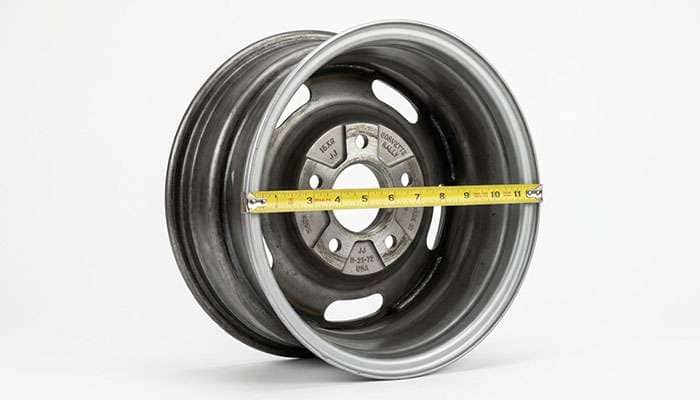
Factory Corvette Rally wheels carry a two-letter code: DC on the 1967 15x6, AG on the 1968 15x7, and AZ on the 1969-82 15x8. The look-alike to watch for is the FW, a 15x7 Rally used on Chevelles, Monte Carlos and Z28 Camaros. It's common, it's easy to mistake for the 1968 Corvette 15x7, and it has the wrong backspacing for a Corvette. Owners who have tried it report it rubs the spring.
Here's where a lot of Corvette owners get crossed up. Most Corvette restoration charts list backspacing as half the rim width plus the offset, which measures to the bead seat. Aftermarket wheel makers measure to the outer edge of the inner flange, which adds about half an inch. Same wheel, two numbers. A factory 15x8 Rally listed at 3.5 inches in a Corvette chart is about 4 inches the way an aftermarket wheel is listed, which is why C3 owners order 17x8 fronts at 4 inches to match it.
Wheel |
Years |
Size |
Offset |
Backspacing, Corvette Chart |
Backspacing, Aftermarket Method |
|---|---|---|---|---|---|
Steel wheel |
1963-66 |
15x5.5 |
+11 mm |
3.2 in. |
About 3.7 in. |
Knock-off aluminum |
1963 |
15x6 |
+16 mm |
3.61 in. |
About 4.1 in. |
Knock-off aluminum |
1964-66 |
15x6 |
+11 mm |
3.44 in. |
About 3.9 in. |
Rally DC and bolt-on aluminum |
1967 |
15x6 |
+2 mm |
3.06 in. |
About 3.6 in. |
Rally AG |
1968 |
15x7 |
-7 mm |
3.22 in. |
About 3.7 in. |
Rally AZ |
1969-82 |
15x8 |
-13 mm |
3.5 in. |
About 4.0 in. |
Rally FW (not a Corvette wheel) |
Chevelle, Monte Carlo, Z28 |
15x7 |
About +8 mm |
About 3.8 in. |
About 4.3 in. |
Compare the AG and the FW. Both are 15x7 Rallys. The Chevelle wheel sits more than half an inch farther inboard, and on a Corvette that's the difference between clearing the spring and rubbing it. If you want the full history of where the Rally design came from, our guide to what Rally wheels are covers it.
Reproduction Corvette Rally wheels are sold in several offsets under the same name. In 15x8, the versions on the market run from about 4 inches of backspacing, which matches the factory AZ, to about 5 inches, the aftermarket method in both cases. That top number is a full inch inboard of a factory wheel. A wheel labeled "Corvette Rally" is not a guarantee that it's built to Corvette offset, so read the backspacing before you order.
The same goes for 17-inch Rally-style wheels built for the C3 look. The common builds on the market sit at about 4-1/2 inches of backspacing on a 17x8 and 5 inches on a 17x9. That puts the inside of the wheel half an inch to an inch closer to the suspension than a factory 15x8 Rally, so check it against your own measurements before you order a set.
Every 1963-82 Corvette uses 5x4.75, the same circle as 5x120.65 mm, on 7/16-20 wheel studs. That's the same pattern as the classic Chevelle, Camaro and Nova, and the same pattern Corvettes kept through the C7. The pattern isn't what stops a wheel from fitting a classic Corvette. The offset, the caliper and the spring are.
The 1963-66 optional knock-off aluminum wheels don't mount on lug nuts at all. They ride on an adapter bolted to the hub and are held by a center spinner. If you buy a set of original or reproduction knock-offs, you're buying the adapters and spinners along with them, and you can't swap a knock-off wheel onto a car set up for lug nuts without them. For 1967, Chevrolet replaced the knock-off with a bolt-on aluminum wheel.
The 7/16-20 studs stayed through 1982. When you change wheels, match the lug nut seat to the new wheel and recheck thread engagement, because an aluminum wheel's mounting pad is usually thicker than a steel Rally's. Our guide to the 5x4.75 bolt pattern covers how to measure a five-lug circle and how to tell it apart from 5x5 and 5x120.
Because of the brakes. The Corvette went to four-wheel disc brakes in 1965, and the calipers are big for their day. Fourteen-inch wheels won't fit any 1965 and later Corvette with disc brakes. The 1963-64 drum-brake cars are the only C2s where a 14 is even a question.
The Corvette caliper sticks out past the wheel's mounting surface a little. A lot of aftermarket 15-inch wheels don't have their spokes clearanced for it, and a flat-faced wheel will hit the caliper unless it's spaced out. Corvette owners tell the story of the original Torq Thrust, which wouldn't clear the new Corvette brakes, and the Torq Thrust D that was introduced in 1965 to fix that. Wilwood's own fitment notes for its Corvette caliper flag wheel clearance issues with the factory 1965-66 15x5.5 steel wheels and some knock-off replicas.
If a wheel needs a spacer to clear the caliper, the stock studs usually come up short. The rule in the trade is thread engagement at least equal to the stud diameter. On a 7/16-20 stud, that's 7/16 of an inch, or about 9 full turns of the nut. Owners running flat-faced 15x10s report needing a 1/2 to 3/4 inch spacer and longer studs to match.
It depends on three things: the year of the fenders, the rear trailing arms, and how far the front tire swings at full lock. Here's how each one sets the limit.
The 1970-82 C3 has a flare molded in behind each wheel opening. The 1968-69 car doesn't. On a 1968-69, a 245/60R15 on a 15x8 Corvette Rally fits under all conditions. A 255/60R15 fits on a 15x8 at stock offset, with a slight chance of touching the forward lip of the opening. On a 1970-82 car, the 255/60R15 is a comfortable fit, and Chevrolet offered it from the factory for 1978-82.
Up front, a 255/60R15 is the largest tire owners can run before it hits the frame when turning. On 17s, the combination that works for almost everyone is a 17x8 with about 4 inches of backspacing and a 245/45R17. That backspacing matches the factory 15x8 Rally, so the tire sits where Chevrolet put it.
The stock rear trailing arms are the inside limit. Owners running a 17x9.5 at 4-1/2 inches with a 275/40R17 report it clears the stock arms and the parking brake, just barely. Others keep a 17x8 in back with a 255/50R17, which is the same height as the stock 255/60R15. On 18s, two different owners run an 18x9.5 at 4-3/4 to 4-7/8 inches with a 275/40R18 on stock trailing arms, paired with a 17x8 front. Go wider than that and you're into offset trailing arms or flares. A staggered setup like this one does mean you can't rotate front to rear.
A 255/60R15 is 27.0 inches tall. A 275/40R17 is only 25.7, about 1.4 inches shorter, and a 245/45R17 is the same 25.7. Owners who want the factory stance go with the 255/50R17 at 27.0 or the 275/40R18 at 26.7 in back. Shorter tires drop the car visually, and they also change speedometer readings. Plan the height, not just the width.
A 1963-67 C2 has less room than any C3. The combination restorers trust is the 1967 15x6 Rally with a 215/70R15, and the same tire on a 15x6 at 1967 offset works on the 1963-66 cars. One 1965 owner runs 1968 Corvette 15x7 Rallys with 215/70R15s without trouble, because the AG wheel carries Corvette offset. A 225/65R15 is generally too much tire for a stock C2. NCRS members call a 15x7 on a 1967 chancy, and that's the right word: some cars clear and some don't, and the only way to know which one you have is to measure. On a C2, measure before you buy anything wider than a 6-inch wheel.
They bolt on. They don't fit. Every Corvette from 1963 through the C7 shares the 5x4.75 pattern, but the offset moved in the opposite direction from the classic wheel. A factory C3 Rally sits at -13 mm. Replica C4 through C7 wheels on the market run from about +38 to +79 mm offset. That puts the late wheel two to more than three inches farther inboard than a C3 wants, right into the trailing arm and the spring.
Owners who run late Corvette wheels on a C3 do it with wheel adapters. One owner running 1992 Corvette wheels on a C3 uses 2.5-inch adapters to push them back out. That's a legitimate build, but it's a project, not a bolt-on. For what fits the later cars themselves, our guide to choosing Corvette aftermarket wheels covers the later generations.
A rub on a classic Corvette doesn't stay a noise. It climbs a ladder, and every rung costs more than the one below it.
Every one of those has the same fix: the right offset for your year, a wheel that clears the caliper, and a tire sized to the opening it lives in.
Ten minutes with a straightedge and a tape measure beats a set of wheels you can't use. Here's the order I'd do it in.
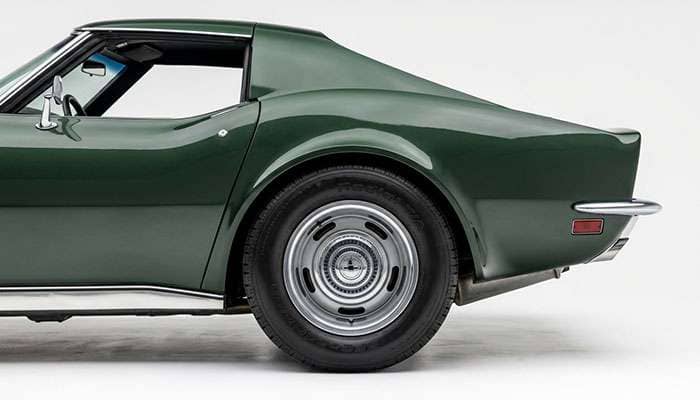
Here's how that half inch bites. Say you measure 5 inches from the hub face to the trailing arm. A wheel listed at 4-1/2 inches on an aftermarket spec sheet reaches 4-1/2 inches in, which leaves half an inch for the tire's sidewall bulge. A wheel listed at 4-1/2 inches in a Corvette chart actually reaches about 5 inches in, and the sidewall lands on the arm. Same number, different wheel.
Once you have your numbers, shop wheels and tires for your Corvette by year.
A classic Corvette shares its bolt pattern with half the Chevrolets of its era, and that's exactly what gets owners in trouble. The C2 and C3 need less backspacing than a Chevelle or Camaro to clear the rear spring, they need 15-inch or larger wheels that clear the disc brake calipers, and the fender openings change for 1968 and again for 1970.
Start with the factory offset for your year, a 15x8 at -13 mm on a C3 or a 15x6 on a C2, and size up from there by measuring, not guessing. Read the code on any used Rally, check the backspacing method on any new wheel, and count your threads. If you want a second set of eyes on your numbers, call the shop.
Here's the short version for your notes.
Every 1968-82 C3 Corvette uses 5x4.75, the same as 5x120.65 mm, on 7/16-20 wheel studs. The 1963-67 C2 uses the same pattern, except for the 1963-66 knock-off wheels, which mount on an adapter and a center spinner instead of lug nuts.
The 1967 Rally is a 15x6 at +2 mm offset, code DC. The 1968 Rally is a 15x7 at -7 mm, code AG. The 1969-82 Rally is a 15x8 at -13 mm, code AZ. All three use the 5x4.75 bolt pattern.
On 15s, a 255/60R15 on a 15x8 Rally, which Chevrolet offered from the factory for 1978-82. On 17s, owners run a 245/45R17 on a 17x8 up front and a 275/40R17 on a 17x9.5 at 4.5 inches of backspacing in back on stock trailing arms.
They bolt on, but they sit too far inboard. A Chevelle or Monte Carlo FW Rally carries more backspacing than a Corvette AG or AZ Rally, and owners report it rubs the end of the rear leaf spring. Use a wheel built to Corvette offset.
Not on a 1965-82 Corvette. The four-wheel disc brake calipers won't clear a 14-inch wheel. Only the 1963-64 drum-brake cars could even be considered, and every C2 and C3 came from the factory on 15s.
They share the 5x4.75 bolt pattern, but C4 through C7 wheels run high positive offsets that put the tire two to more than three inches farther inboard than a C3 wants. Owners who run them use thick wheel adapters to push the wheel back out, then check trailing arm and parking brake clearance.