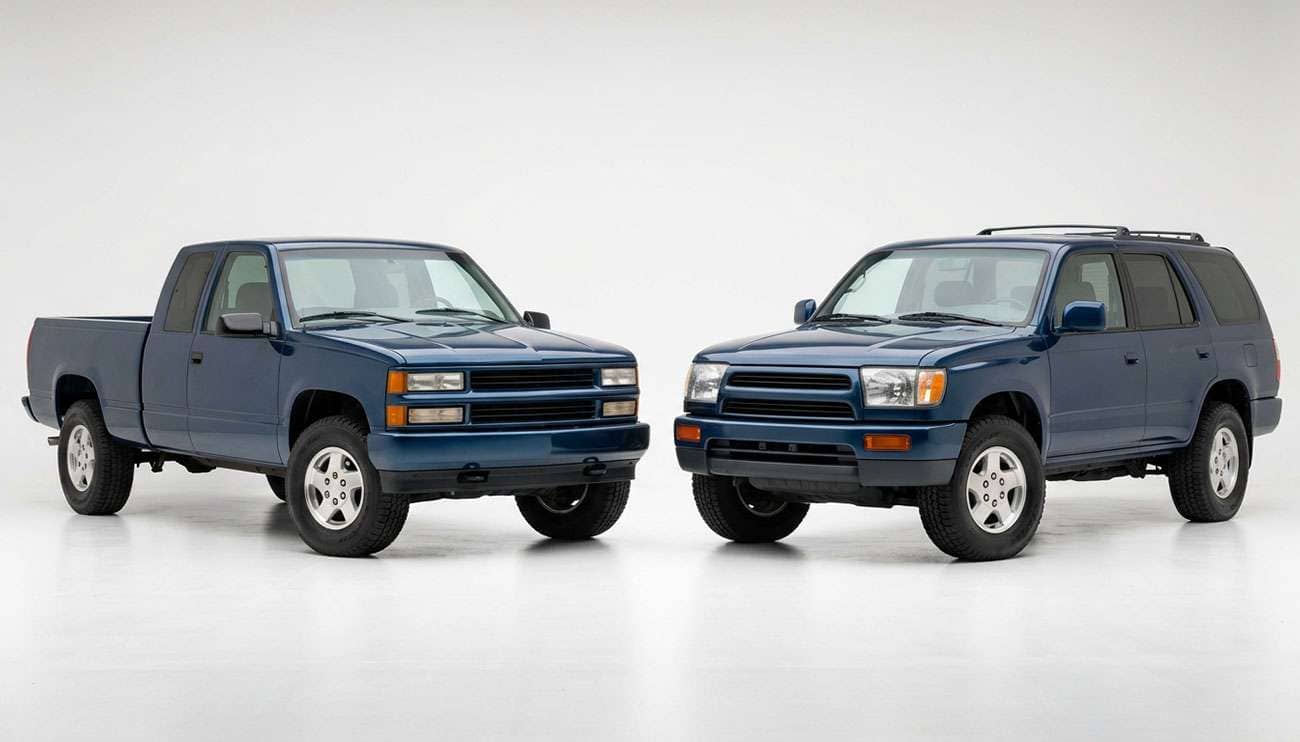
5x135 belongs to a single family of Ford trucks built across a nine-year window: the 1997-2003 F-150 including the 2004 Heritage, the 1997-2002 Expedition, the 1998-2002 Lincoln Navigator, and the 2002-2003 Lincoln Blackwood. That is the entire list. It is an orphan pattern, not shared with any other manufacturer and not carried forward by Ford. What makes it dangerous is that it sits within 5mm of two other patterns and shares its circle diameter with a third.
Most bolt pattern pages give you the vehicle list and stop there, which is fine right up until you are standing in front of a truck trying to figure out which wheels you can actually buy. The part that decides your order is that these same model years produced four different wheel configurations, and three of them are not 5x135. Here is how to tell them apart before money changes hands.
When Ford launched the tenth-generation F-150 for 1997, it moved the truck to a fully metric chassis. The 5x135mm bolt circle arrived with that redesign, spread to the new Expedition and the Navigator built on the same platform, and then disappeared when Ford went to six lugs. Nothing before it used 5x135 and nothing after it did either.
That leaves owners of these trucks in an unusual spot. The pattern is common enough that wheels exist, but it is not a growing category, and the wheels that share a lot with it belong to other trucks entirely. This table is the one to work from.
Vehicle |
Model Years |
Bolt Pattern |
Stud Size |
Hub Bore |
|---|---|---|---|---|
Ford F-150 |
1997 to 2003, plus 2004 Heritage |
5x135mm |
M12x1.75 early, M14x2.0 from 2000 |
87.1mm |
Ford Expedition |
1997 to 2002 |
5x135mm |
M12x1.75 early, M14x2.0 from 2000 |
87.1mm |
Lincoln Navigator |
1998 to 2002 |
5x135mm |
M12x1.75 early, M14x2.0 from 2000 |
87.1mm |
Lincoln Blackwood |
2002 to 2003 |
5x135mm |
M14x2.0 |
87.1mm |
F-150 with 7700 payload package |
1997 to 2003 |
7x150mm, seven lug |
M14x2.0 |
Not 5-lug compatible |
Ford F-150 and Bronco |
1980 to 1996 |
5x139.7mm, or 5x5.5 inch |
M12x1.75 |
87.1mm |
Ford F-150, Expedition, Navigator |
2003 and 2004 onward |
6x135mm, six lug |
M14x2.0 |
87.1mm |
Read down the stud size column, because that is the trap inside the trap. Ford changed stud diameter partway through the run, moving from M12x1.75 to M14x2.0 around the 2000 model year. The bolt pattern did not change. The lug nuts did. Two trucks with identical 5x135 wheels can need different lug nuts, and a used set of wheels bought with the seller's lug nuts included may come with the wrong ones for your truck.
Note also that hub bore is 87.1mm across nearly all of these, including the 6-lug trucks. That means bore is useless as a way to tell configurations apart. Only lug count and circle diameter do that work. Our reference on lug patterns and what they actually control covers the underlying geometry if you want the full picture.
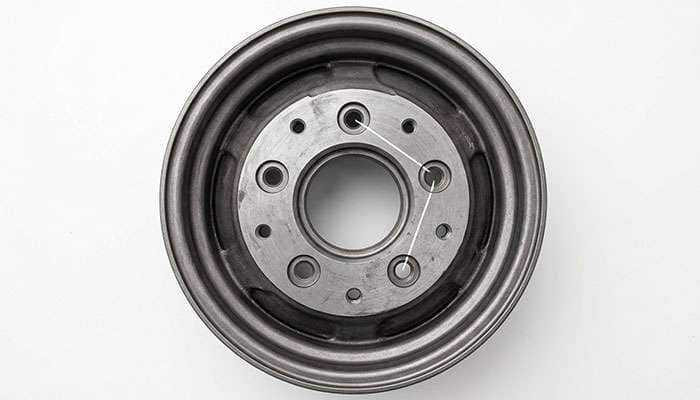
5x135mm equals 5x5.31 inches. The 135 is the pitch circle diameter, meaning the diameter of the imaginary circle passing through the center of all five studs, and 135 millimeters divided by 25.4 gives 5.315 inches.
That conversion is easy. The useful version of it is knowing how far 5x135 sits from every pattern it might be confused with, because that distance is what determines whether a wrong wheel will start onto your studs and fool you.
Metric Pattern |
SAE Equivalent |
Difference From 5x135 |
Will It Start On 5x135 Studs? |
|---|---|---|---|
5x127 |
5x5.00 in |
8.0mm smaller |
No, visibly wrong |
5x130 |
5x5.12 in |
5.0mm smaller |
Sometimes, then binds |
5x135 |
5x5.31 in |
Correct |
Yes, seats fully |
5x139.7 |
5x5.50 in |
4.7mm larger |
Often, and this is the dangerous one |
5x150 |
5x5.91 in |
15.0mm larger |
No, visibly wrong |
6x135 |
6x5.31 in |
Same circle, six studs |
No, wrong lug count |
The 5x139.7 row is why this matters. Under 5mm of difference across the whole circle means less than 2.4mm of error at any single stud, and stud holes are drilled with clearance. A 5x139.7 wheel will frequently push onto 5x135 studs far enough that all five lug nuts thread on. It will not be centered, the lug seats will not mate correctly, and the clamping force that holds the wheel is not there. It feels like it fit because the nuts turned.
There are two answers, and the model year decides which one applies to you. An F-150 built from 1980 through 1996 uses 5x139.7mm, written as 5x5.5 inches. An F-150 built from 1997 through 2003, plus the 2004 Heritage carryover, uses 5x135mm. Those two are 4.7mm apart and they are not interchangeable.
This is the single most common source of wrong-wheel purchases on these trucks. Somebody has a 1995 F-150 and a 1999 F-150 in the same driveway, or buys a used set of wheels off a truck that looks like theirs, and the two patterns are close enough that nothing obviously stops the install. Both eras also share the same 87.1mm hub bore, so even the center hole looks right.
The clean way to settle it is the model year, not the tape measure. If the truck is 1996 or earlier, it is 5x139.7. If it is 1997 or later and has five lugs, it is 5x135. If it has six lugs it is 6x135 and it is a 2004 or newer truck. If it has seven lugs, you have a 7700 heavy-duty payload truck and you are shopping an entirely separate category.
One more wrinkle worth knowing about the 7700. Those trucks were sold inside the same 1997-2003 generation, often looked identical from the outside, and used a 7x150mm pattern that shares nothing with the standard 5-lug. If you are buying wheels for a truck you have not personally counted the lugs on, count them. If you want the detail on the older pattern, our breakdown of the 5x139.7 bolt pattern covers what else uses it.
6x135 is what replaced 5x135 in the same Ford lineup. It covers the F-150 from 2004 forward, the Expedition from 2003 forward, the Lincoln Navigator from 2003 forward, the Lincoln Mark LT, and the F-150 Lightning. It remains current production, which is why the wheel selection in 6x135 dwarfs what is available in 5x135.
The circle diameter is identical. Both patterns place their studs on a 135mm circle. The only difference is that one has five studs on it and the other has six. That shared number causes real confusion in online listings, where a search for 135 returns both and the lug count is buried in the spec sheet.
There is no adapting between them in any practical sense. A 5-to-6 lug conversion means new hubs or a full axle swap, not a spacer. What does exist, and what people actually use, are adapters that take a 5x135 truck and let it run wheels in a different five-lug pattern. Those are legitimate parts when they are hub-centric, correctly torqued and properly sized, but they add stack height and move the wheel outboard, which changes your offset math. Our guide to the 6x135 bolt pattern lists the full vehicle range if you are cross-shopping between generations.
Wheels in 5x135 skew heavily toward truck and off-road styling, which reflects what the pattern is bolted to. The available sizes cluster at 16, 17, 20 and 22 inches, with widths concentrated between 8 and 10 inches and a smaller run of 12-inch widths for deep-lip builds. Load ratings sit where you would expect for a half-ton, commonly in the 2,200 to 2,500 lb range per wheel.
The offset story is the interesting one and it separates this pattern from most others. Where a typical passenger-car pattern clusters its aftermarket offerings around +35 to +45mm, 5x135 wheels sit almost entirely between zero and deep negative, with the middle of the market right around zero. Very little exists above +25mm. That is a direct reflection of how these trucks are built out, and it means a wheel that looks conservative on paper may still push your track width outward compared to a factory steel wheel.
Two practical notes on sourcing. First, because the pattern ended in 2004 and the vehicle population is shrinking, new wheel designs are released in 5x135 far less often than in 6x135. The selection is real but it is not growing, and OE-replica options in particular are thinner than they are for current trucks. Second, nearly every 5x135 wheel is built with an 87.1mm bore to match the Ford hub, which means hub-centric fitment is the norm rather than something you have to engineer around with rings. That is a genuine advantage of a dedicated single-application pattern.
If you are working out what width and offset combination suits your truck, our guide to F-150 aftermarket wheels covers the fitment envelope in detail.
No. They are half an inch apart, which is 12.7mm, and they are two entirely different patterns. 5x5 is 5x127mm. 5x5.5 is 5x139.7mm. Neither one is 5x135.
The naming convention is what causes the confusion. Written as 5x5 and 5x5.5 they look like variations of the same thing, the way 8x8 and 8x8.5 wheels would be. They are not. The second number in a bolt pattern is a circle diameter, so half an inch of change moves every stud position by a meaningful amount. A 5x127 wheel will not go onto a 5x139.7 hub and will not thread up even partway.
For a 5x135 owner, both of these are near neighbors worth knowing. 5x127 is 8mm smaller than yours and is common on Jeep Wrangler JK and older GM applications. 5x139.7 is 4.7mm larger than yours and is the pattern your truck's predecessor used, along with a long list of GM, Dodge and Suzuki trucks. Of the two, 5x139.7 is the one that will physically start onto your studs, so it is the one to be careful with. Our detailed pages on the 5x5 bolt pattern cover what else shares each of these circles.
5x130 is predominantly a German pattern. It covers the Porsche 911, Boxster, Cayman and Cayenne, the Mercedes-Benz Sprinter van, the Volkswagen Touareg and Crafter, and the Audi Q7. It converts to 5x5.12 inches.
It appears in the same conversation as 5x135 for one reason: five millimeters. That is the entire difference between the two circles, and five millimeters spread across a bolt circle is 2.5mm of positional error at any given stud. Depending on how generously a particular wheel's stud holes are drilled, a 5x130 wheel will sometimes start onto 5x135 studs before binding partway down.
Sometimes is the operative word, and it is worse than never. A pattern that clearly does not fit gets rejected in the driveway. A pattern that almost fits gets forced, gets torqued, and gets driven. The vehicle populations barely overlap here, so this is less common in practice than the 5x139.7 mix-up, but it shows up when somebody buys wheels online off a size search rather than a fitment search. Our page on the 5x130 bolt pattern covers its full application list.
No, and I want to be specific about why, because the usual answer is a flat safety warning with no mechanism behind it, and that is exactly the kind of advice people talk themselves out of.
A wheel is not held on by the studs. It is held on by friction between the wheel's mounting face and the hub face, generated by clamping force from the lug nuts. The studs are locating pins that create that clamp. They are not designed to carry the vehicle's weight in shear. When the bolt pattern is right, the tapered lug seats pull the wheel into perfect concentric alignment and the mounting faces press flat against each other across their whole area.
Stage one, the day of the install. With a mismatched pattern, the lug nut cannot center in its seat because the stud is not where the hole is. The nut contacts one side of the taper only. Torque reads normal on the wrench because the nut is still binding on something, but the clamping load is a fraction of what it should be and it is unevenly distributed.
Stage two, the first hundred miles. Because clamp is low, the wheel micro-moves against the hub face every time you brake or turn. That movement works the lug nuts loose. You notice they need retorquing and assume they simply settled, which is a normal thing for new wheels to do, so the signal gets misread.
Stage three. The repeated micro-movement wallows the stud holes in the wheel, turning round holes into ovals. Now even correct lug nuts cannot generate proper clamp, because the seat geometry is destroyed. The wheel is scrap at this point, and if it was an expensive one, that is the cheapest outcome on this list.
Stage four. With the wheel no longer clamped, the studs start carrying load in shear that they were never engineered for. Studs fatigue and crack, usually at the root where the shank meets the flange. They fail one at a time, and each failure loads the remaining ones harder.
Stage five. The last studs let go together, generally under braking or in a turn where the load is highest. A wheel departing a full-size truck at road speed is not a breakdown, it is an accident involving whoever is behind you.
There is one narrow exception worth naming honestly, because pretending it does not exist just sends people to worse sources. Properly engineered bolt-pattern adapters do exist. A good one is hub-centric on both faces, thick enough that the studs fully engage on both sides, made from forged aluminum or steel, and installed with the correct torque and a retorque interval. That is a different object from forcing the wrong wheel onto the right hub. Adapters also stack thickness, which pushes the wheel outboard and changes your effective offset, so they need to be part of the fitment math rather than a fix applied afterward. Our breakdown of wheel offset, backspacing and bolt patterns covers how those numbers interact.
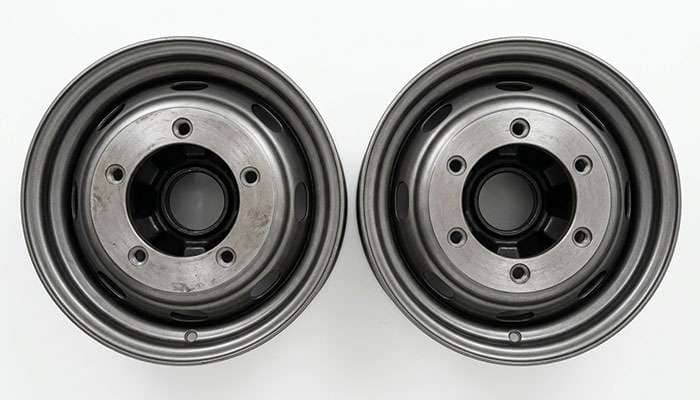
Five steps. The first one settles it for most people in about ten seconds.
Step 1: Count the lugs, then check the year. Five lugs on a 1997 through 2004 F-150, Expedition, Navigator or Blackwood means 5x135. Five lugs on a 1996 or older F-150 means 5x139.7. Six lugs means 6x135 and a 2003 or newer truck. Seven lugs means a 7700 payload package and a 7x150 pattern. That decision tree resolves the great majority of cases without touching a tool.
Step 2: If you still need to measure, use the two-studs-over method. On a five-lug wheel, do not measure between adjacent studs. Adjacent-stud spacing on 5x135 is 79.4mm against 82.1mm on 5x139.7, a difference of under 3mm, which is inside the error of most people with a tape measure. Instead measure center to center between two studs with one stud skipped between them. That gives 128.4mm on 5x135 and 132.9mm on 5x139.7, a 4.5mm gap that calipers will resolve cleanly.
Step 3: Confirm your stud thread size before you buy lug nuts. Trucks in this family used M12x1.75 studs earlier in the run and M14x2.0 from roughly the 2000 model year forward. If you are buying aftermarket wheels that require conical seat lug nuts, order the ones that match your studs, not the ones that match the wheels' description. Thread one on by hand before you trust a torque wrench.
Step 4: Verify hub bore at 87.1mm. Your hub is 87.1mm and nearly every wheel built for this pattern matches it. If a wheel you are considering lists a larger bore, order hub-centric rings in the correct pair of sizes at the same time and install them with the wheels. A truck this heavy centering on its lug seats instead of its hub will vibrate, and no balance job will fix it.
Step 5: Set your offset target against a factory reference, not against the listing. Because 5x135 aftermarket wheels sit almost entirely at zero or negative offset, the number you see is often further outboard than the steel wheel currently on your truck. Decide how much wider you actually want the stance, then shop to that number rather than accepting whatever a listing offers.
Once the pattern is confirmed, you can browse the full 5x135 bolt pattern wheel selection and filter by the diameter, width and offset your truck needs.
5x135 belongs to four Ford and Lincoln models built inside a nine-year window, and to nothing else. The 1997-2003 F-150 and its 2004 Heritage carryover, the 1997-2002 Expedition, the 1998-2002 Navigator, and the 2002-2003 Blackwood. Ford created the pattern for a single truck platform and retired it when the platform changed.
The reason that matters more than a normal vehicle list is what surrounds it. The truck that came before yours used 5x139.7, only 4.7mm larger. The truck that came after uses 6x135, the exact same circle with one more stud. And a heavy-duty version sold in your own model years used a seven-lug pattern entirely. Four configurations, two shared numbers, one badge on the tailgate.
Count the lugs, check the year, and confirm your stud thread before anything ships. Those three steps take under a minute and they close off every failure mode described above.
The Ford F-150 from 1997 through 2003 plus the 2004 Heritage, the Ford Expedition from 1997 through 2002, the Lincoln Navigator from 1998 through 2002, and the Lincoln Blackwood from 2002 through 2003. It is an orphan pattern used by no other manufacturer and not carried forward by Ford after the platform changed.
5x135mm equals 5x5.31 inches. The 135 is the pitch circle diameter, the diameter of the imaginary circle passing through the center of all five studs, and 135 divided by 25.4 gives 5.315 inches.
It depends on the year. From 1980 through 1996 the F-150 uses 5x139.7mm, written as 5x5.5 inches. From 1997 through 2003, plus the 2004 Heritage, it uses 5x135mm. Those two patterns are 4.7mm apart and are not interchangeable, even though both share an 87.1mm hub bore.
Truck and off-road styles dominate, in 16, 17, 20 and 22 inch diameters with widths mostly between 8 and 10 inches. Load ratings commonly sit in the 2,200 to 2,500 lb range per wheel. Offsets run from zero into deep negative territory, with very little available above +25mm, and almost all are built with an 87.1mm hub bore to match the Ford hub.
No. 5x5 is 5x127mm and 5x5.5 is 5x139.7mm, which puts them 12.7mm apart. They are two different patterns and neither one is 5x135. The naming makes them look like variants of each other, but the second number is a circle diameter, so half an inch changes every stud position.
The Ford F-150 from 2004 forward, the Expedition from 2003 forward, the Lincoln Navigator from 2003 forward, the Lincoln Mark LT and the F-150 Lightning. It uses the identical 135mm circle diameter as 5x135 with a sixth stud added, which is why the two get confused in online listings.
Mostly German vehicles: the Porsche 911, Boxster, Cayman and Cayenne, the Mercedes-Benz Sprinter, the Volkswagen Touareg and Crafter, and the Audi Q7. It converts to 5x5.12 inches and sits 5mm smaller than 5x135, close enough that a 5x130 wheel will sometimes start onto 5x135 studs before binding.
No. A wheel is held on by friction between the mounting faces, generated by clamping force from correctly seated lug nuts, not by the studs themselves. A mismatched pattern prevents the lug nuts from centering in their seats, so clamping load is low and uneven. The wheel then micro-moves, the stud holes wallow out, and the studs eventually fail in shear. Properly engineered hub-centric adapters are a separate matter and can be used correctly when sized and torqued to spec.