
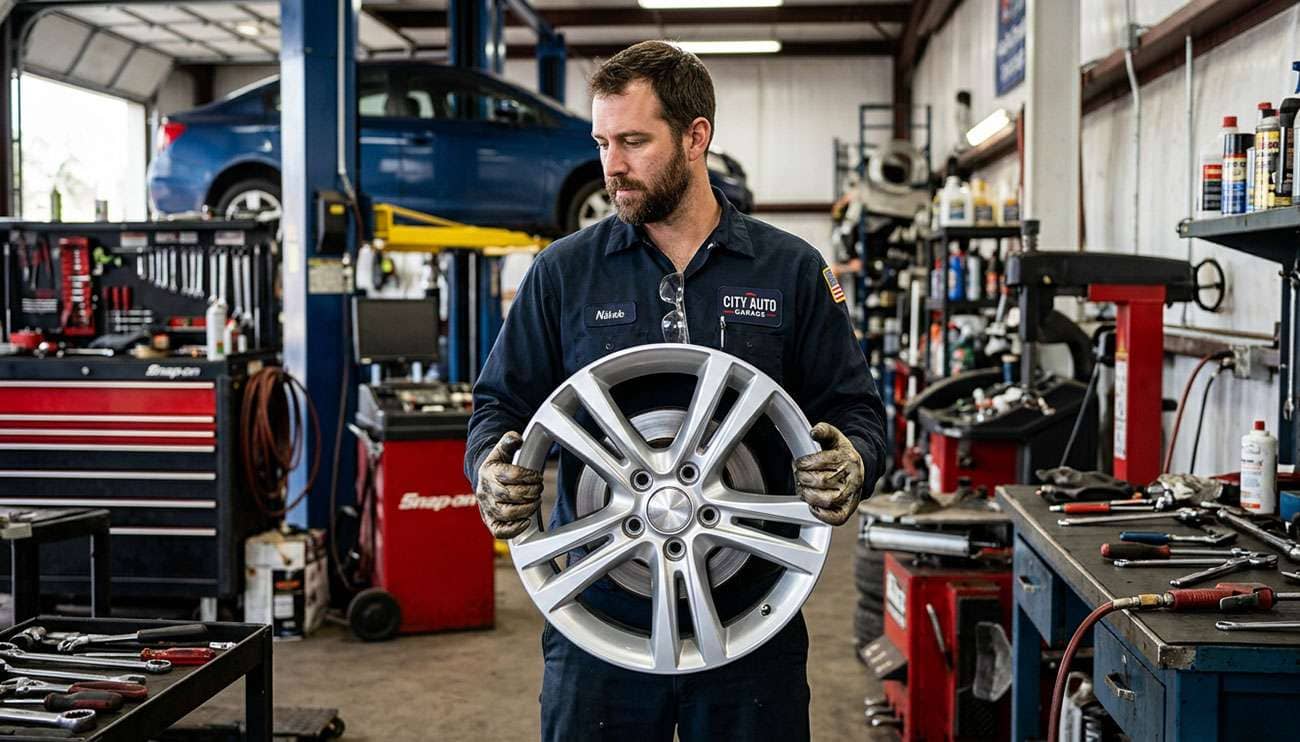
Wrong lug patterns mean expensive mistakes and wheels that won't fit your vehicle. Vehicle manufacturers use 4, 5, 6, or 8 bolt configurations depending on the specific make and model. These patterns appear as two-number designations like 5x120mm or 4x100mm.
Accurate lug pattern measurement prevents costly purchasing errors and ensures proper wheel fitment. We'll guide you through finding your vehicle's exact specifications, measuring techniques for different bolt patterns, and using bolt pattern charts effectively. You'll discover the various pattern types, proven measurement methods, and how to avoid common fitment mistakes.
At Performance Plus Tire, we have extensive experience helping customers select wheels that fit perfectly every time. Our expert knowledge ensures you get the right pattern match for safe, reliable performance.
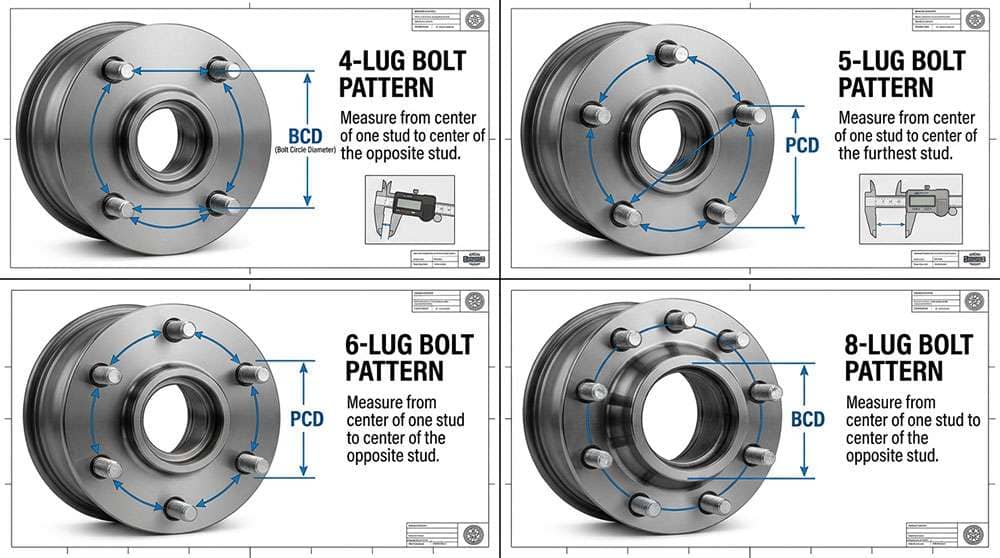
Understanding lug patterns is important before making any wheel purchase. A bolt pattern describes the arrangement of lug holes on your wheel's mounting surface, creating what engineers call the Pitch Circle Diameter (PCD). The pattern uses two numbers to tell you exactly how the wheel connects to your vehicle.
The first number indicates how many bolt holes the wheel has. The second number measures the diameter of an imaginary circle drawn through the center of all those holes. When you see 5x114.3, you're looking at 5 lug holes spaced evenly around a 114.3mm diameter circle. A 6x135mm pattern means 6 holes arranged on a 135mm circle.
These measurements appear in millimeters or inches, though metric measurements dominate modern wheel manufacturing. The bolt holes position themselves at equal intervals around this theoretical circle, matching the exact stud locations on your vehicle's hub. This precise arrangement determines whether your wheels will mount properly.
Proper bolt pattern alignment ensures your wheels mount securely to your vehicle's hub. When patterns match exactly, each lug nut threads correctly onto its stud, distributing weight evenly across all mounting points.
Mismatched patterns create serious problems during installation and driving. Wheels that don't align properly generate vibrations at highway speeds and during cornering. These vibrations result from improper centering, which disrupts the wheel's rotational balance.
Wrong bolt patterns compromise vehicle safety in multiple ways. Improper alignment causes uneven tire wear, reduces handling performance, and in severe cases, can lead to wheel separation while driving. The mounting system depends entirely on precise pattern matching to handle the constant forces generated during normal driving.
Ordering wheels with incorrect bolt patterns creates one of the most expensive mistakes in custom wheel purchasing. Many customers assume all wheels in the same style will fit their vehicle, only to discover compatibility issues after delivery.
Popular wheel designs come in multiple bolt pattern versions to fit different vehicles. Two wheels that look identical can have completely different mounting patterns. Ford trucks might use 6x135mm while Chevrolet, GMC, Toyota, and Nissan models require 6x139.7mm. The difference looks minimal but prevents any possibility of interchange.
The financial impact extends beyond the initial purchase price. You'll face return shipping costs, restocking fees, and potential tire mounting charges if you already installed tires. Many retailers refuse returns once tires are mounted, leaving you with wheels you can't use.
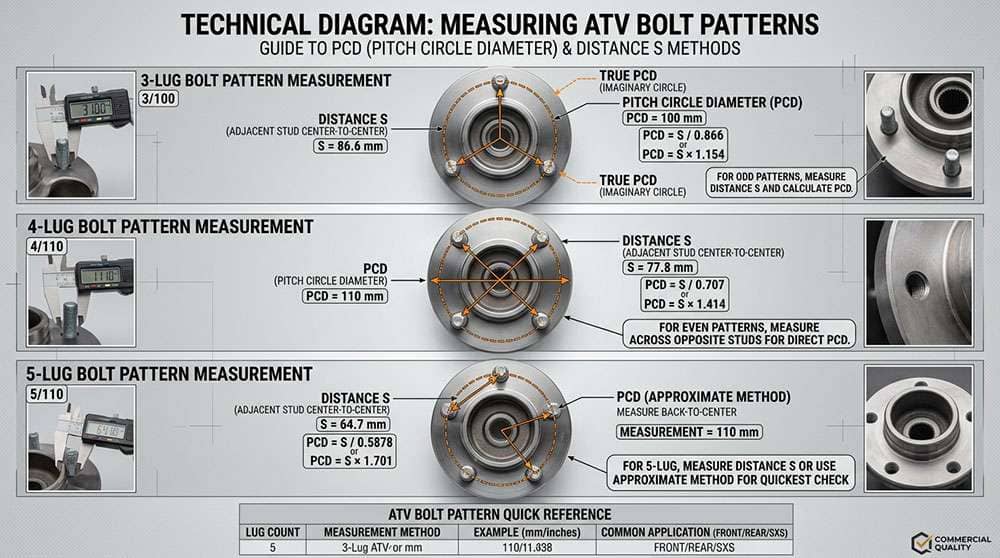
Different lug configurations require different measurement approaches. The technique you use depends entirely on whether your wheel has an even or odd number of bolt holes.
Even-numbered bolt pattern measurements are straightforward. Measure directly across from the center of one bolt hole to the center of the opposite hole. This straight-line measurement gives you the bolt circle diameter.
Remove the lug nuts from opposite holes for clear access to the bolt centers. Place your measuring tool at the center of one bolt and extend it to the center of the hole directly across. Record this measurement in either inches or millimeters.
Five-lug patterns create measurement challenges since no holes align directly opposite each other. Start at the center of any bolt hole and measure to the outer edge of the bolt hole that's furthest away. You can also measure from the center of one hole to the outside edge of a hole two positions away.
These measurements provide estimates rather than exact readings without professional tools. Multiple 5-lug patterns have very similar diameters, making precision essential.
Basic measurements require a ruler, tape measure, or digital calipers. Digital calipers deliver the most accurate readings, especially for 5-lug configurations. Bolt pattern gages eliminate guesswork completely and represent the professional standard for measurement. These tools cost very little and provide reliable results every time.
Five-lug patterns cause more measurement errors than any other type. Double-check your readings and take multiple measurements from different starting points. Even small measurement differences can mean the difference between proper fitment and expensive mistakes.
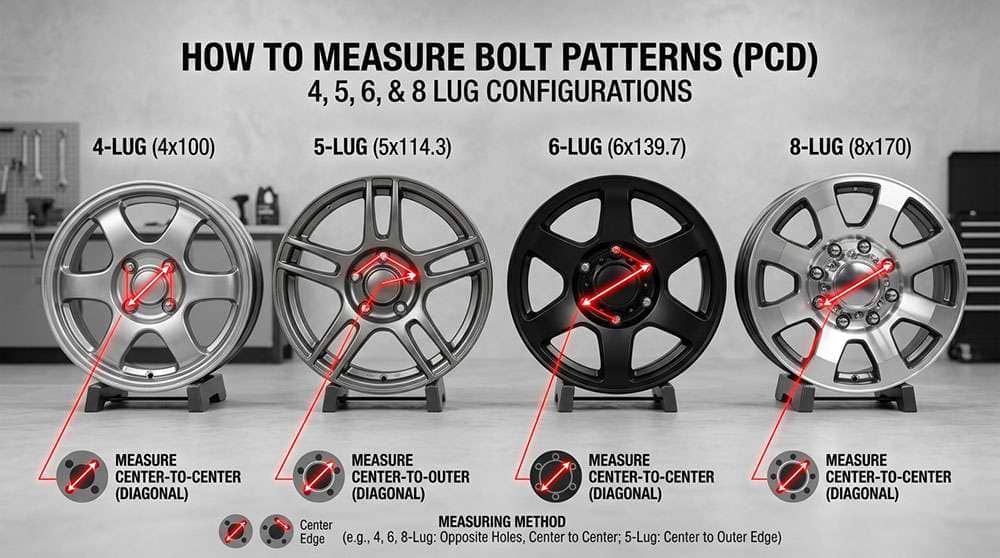
Four-lug wheels appear on compact cars, hybrids, and small city vehicles where lightweight designs improve fuel efficiency. Common patterns include 4x100mm and 4x114.3mm. You'll find 4-lug configurations on vehicles like the Honda Fit, Toyota Yaris, Ford Fiesta, Chevrolet Spark, and Mitsubishi Mirage.
These smaller patterns suit vehicles that prioritize efficiency over heavy-duty performance. The reduced number of bolts keeps wheel weight down while providing adequate strength for daily driving needs.
Five-lug patterns dominate passenger cars and SUVs as the most common configuration. The variety runs extensive, including 5x98, 5x100, 5x10⁵, 5x10⁸, 5x110, 5x112, 5x114.3, 5x115, 5x120, and 5x127 among others. This wide range makes verification critical before purchasing.
The popularity of 5-lug designs stems from their balance between strength and weight. They provide more secure mounting than 4-lug patterns while remaining lighter than 6 or 8-lug configurations.
Six-lug wheels suit light trucks and larger SUVs needing enhanced load-bearing strength. The 6x139.7mm pattern (identical to 6x5.5 inches) serves as the industry standard. Chevrolet adopted this pattern in the late 1960s for trucks like the Silverado 1500, Tahoe, and Suburban. Toyota Tacoma, 4Runner, GMC Sierra 1500, and Nissan Frontier also use this configuration.
This pattern delivers the additional strength required for towing and hauling applications. The extra bolts distribute loads more evenly across the hub assembly.
Eight-lug wheels equip three-quarter-ton and one-ton trucks requiring maximum strength. Ford Super Duty uses 8x170mm, while GM trucks from 2011 forward run 8x180mm. These patterns handle extreme loads and towing demands.
Heavy-duty applications demand the superior clamping force that eight bolts provide. Commercial users and serious haulers rely on these patterns for maximum reliability under stress.
Dual-drilled wheels feature two sets of bolt holes, allowing fitment on multiple bolt patterns. A wheel drilled for both 6x139.7 and 6x135 patterns creates twelve total holes. These wheels offer versatility across different vehicle makes while maintaining equal safety and strength.
This design eliminates the need to stock separate wheels for different bolt patterns, making them popular among wheel retailers and customers with multiple vehicles.
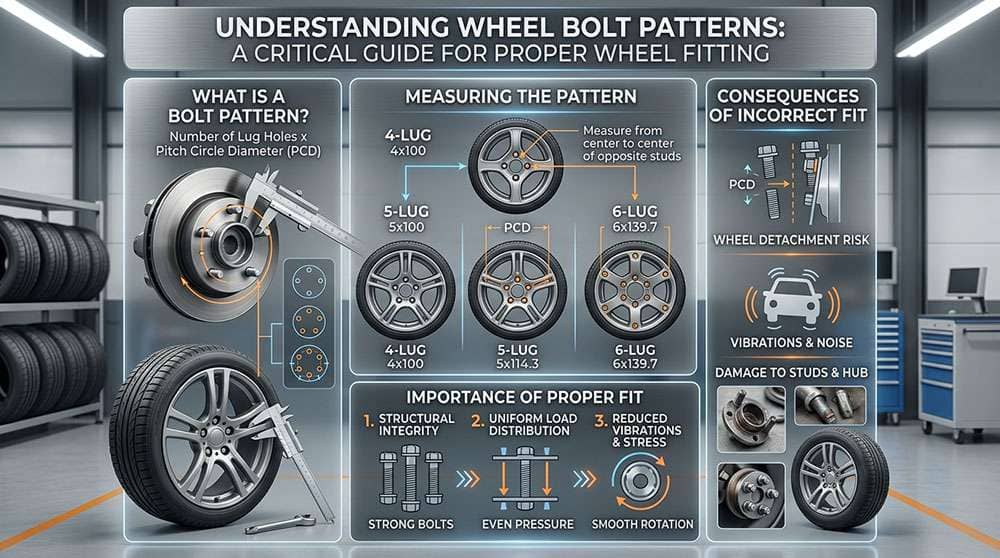
Start with your vehicle's owner's manual for the most accurate bolt pattern information. Vehicle manufacturers document these specifications in the technical section as part of the official vehicle data. This method gives you the exact factory configuration without any guesswork.
The manual eliminates uncertainty since it reflects your vehicle's original equipment specifications. Look for the wheel or tire section where you'll find the bolt pattern listed alongside other fitment details.
Examine your current wheels for stamped markings on the back surface. Wheel manufacturers typically mark the bolt pattern near the mounting holes along with other specifications. This approach works well when checking aftermarket wheels that previous owners may have installed.
Remove one wheel to access the inner surface where these markings appear. You'll see the pattern designation clearly stamped into the metal.
Online databases provide quick bolt pattern lookup using your vehicle's year, make, and model. These resources save time and eliminate manual measuring for standard applications. However, verify the results if aftermarket wheels were previously installed on your vehicle. Some owners install wheels that appear to fit but don't match the proper specifications.
Cross-reference multiple sources when using online tools to ensure accuracy.
Complex fitment situations benefit from professional expertise. Wheel specialists have access to detailed databases and precision measuring tools that guarantee correct identification. They can also evaluate offset and backspacing issues that affect proper wheel fitment beyond just bolt pattern matching.
Professional consultation proves especially valuable for modified vehicles or when installing wheels from different vehicle applications.
You now have the knowledge to select wheels with confidence and avoid costly fitment mistakes. Proper bolt pattern measurement takes only minutes, but getting it right saves you from expensive returns and safety concerns.
Accurate measurements before purchasing protect your investment and ensure optimal vehicle performance. Keep this information available when shopping for wheels, and you'll make the right fitment choice every time.
At Performance Plus Tire, we're here to help you find wheels that fit perfectly and perform reliably. Our expert team ensures you get the exact specifications your vehicle needs for safe, dependable performance.
Understanding lug patterns is crucial for safe wheel fitment and avoiding costly purchasing mistakes that could compromise your vehicle's performance and safety.
• Measure twice, buy once: Use proper tools like digital calipers or bolt pattern gages to accurately measure your wheel's bolt pattern before purchasing new wheels.
• Even vs. odd lug patterns require different measurement techniques: Measure straight across for 4, 6, and 8-lug patterns, but use center-to-outer edge method for 5-lug configurations.
• Vehicle type determines lug pattern: Compact cars use 4-lug, standard cars use 5-lug, trucks use 6-lug, and heavy-duty trucks require 8-lug patterns for proper load distribution.
• Wrong bolt patterns create serious safety risks: Mismatched patterns cause vibrations, uneven tire wear, compromised handling, and potential wheel detachment while driving.
• Multiple verification methods ensure accuracy: Check your owner's manual, examine existing wheel markings, use online databases, or consult professionals to confirm your vehicle's specifications.
Getting your lug pattern right the first time prevents expensive returns, ensures optimal vehicle performance, and most importantly, keeps you safe on the road.
Q1. Why is knowing my vehicle's bolt pattern important when buying wheels? Knowing your bolt pattern is critical because it determines how your wheels securely attach to your vehicle using lug nuts or bolts. The correct bolt pattern ensures a safe, proper fit and prevents serious issues like vibrations, uneven tire wear, and potential wheel detachment while driving.
Q2. What does a bolt pattern designation like 5x114.3 mean? A bolt pattern designation uses two numbers to describe your wheel's configuration. The first number indicates how many lug holes the wheel has (in this case, 5), while the second number represents the diameter in millimeters of the circle formed by those holes (114.3mm). This measurement tells you exactly which wheels will fit your vehicle.
Q3. Can wheels with similar bolt patterns be used interchangeably? No, even very similar bolt patterns cannot be safely interchanged. For example, 5x120mm and 5x120.65mm differ by less than 1mm but are not compatible. While some wheels might appear to fit, using an incorrect pattern compromises safety and can lead to wheel failure, regardless of how close the measurements seem.
Q4. Do different trim levels of the same vehicle always use the same bolt pattern? Not necessarily. Vehicles with different engines or performance packages within the same model can have different bolt patterns. For instance, higher-performance variants often use 5-lug patterns while base models might use 4-lug patterns to accommodate the additional power and upgraded suspension components.
Q5. What's the easiest way to find my vehicle's correct bolt pattern? The most reliable method is checking your vehicle's owner's manual, which lists the bolt pattern in the technical specifications section. You can also examine the back of your existing wheels for stamped markings, use online databases by entering your vehicle's year, make, and model, or consult with a professional mechanic or wheel specialist.



