
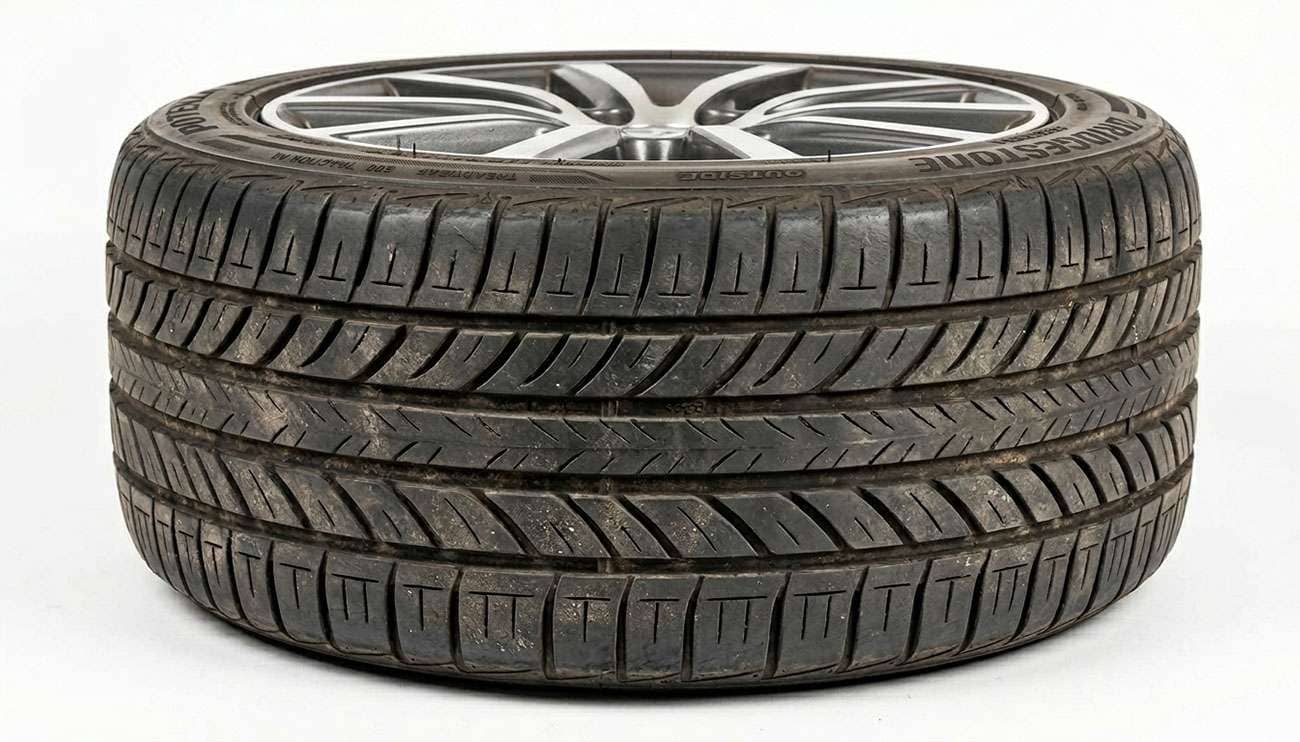
Most uneven wear is hard to read. Feathering is the exception. When a tire feathers, it's leaving you a precise record of exactly what your suspension geometry has been doing for the last several thousand miles, and once you know how to read it, you can name the cause before the car ever goes on an alignment rack. I spend my days matching tires and wheels to vehicles by the numbers, and feathering is one of the clearest diagnostic signals a tire can give you. Let's break down what it is, what it's telling you, and how to stop it before it costs you a set of otherwise good tires.
Feathering is a specific, angled wear pattern across the width of the tread. Look closely at the individual tread ribs and blocks: on a feathered tire, each block is worn smooth and rounded on one edge and left sharp, even with a thin lip of rubber hanging off, on the opposite edge. Run your fingers across the tread one direction and it feels smooth; run them back the other direction and you feel a row of little ramps catching your skin. That directional, ramped texture is the signature, and it's why feathering is sometimes called scuffing.
Here's the mechanism, because the "why" matters more than the label. A tire is designed to roll straight ahead so the tread meets the road squarely. When the wheel is pointed even a fraction of a degree off straight, the tire doesn't roll cleanly. It gets dragged sideways a tiny amount with every single revolution. That sideways scrub shaves the rubber off one side of each tread block and packs it toward the other, building the ramp shape. Multiply that micro-scrub across hundreds of revolutions per mile and thousands of miles, and you get a fully feathered tire. It is, almost always, the visible fingerprint of a toe angle that's out of specification.
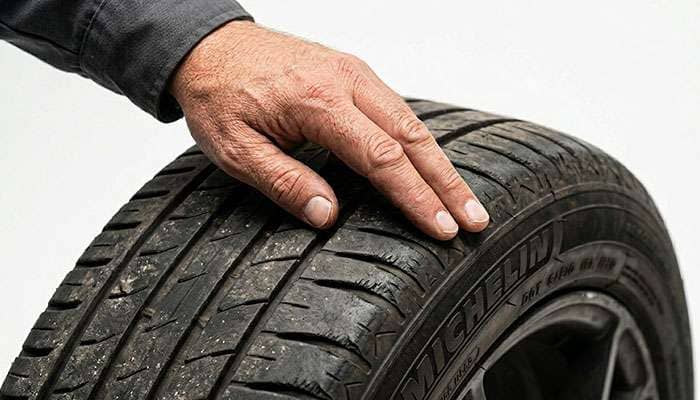
Feathering is often easier to feel than to see, especially early on. Park the car, and with the engine off and your hand flat, sweep your palm across the tread from the inside edge of the tire toward the outside edge, then sweep back the other way. One direction will feel smooth. The other will feel like dragging your hand over rows of saw teeth.
The direction tells you which way the toe is off, and this is the detail most write-ups skip. If the sharp edges face inboard, meaning the tread feels rough as you sweep from outside toward the center of the car, you're typically looking at a toe-in problem. If the sharp edges face outboard, the rough direction is from center toward the outside, that points to toe-out. Doing this check on all four tires, front and rear, before you say a word at the shop lets you walk in with an actual diagnosis instead of just "it sounds funny." For the broader vocabulary of what different wear shapes mean, our guide on how to read tire wear patterns is a good companion, and the deeper piece on what those patterns reveal about hidden car problems connects them to specific failures.
There's an audible clue too. A feathered tire produces a low rumble or roar that rises with speed, often mistaken for a worn wheel bearing or even mud-terrain tires. If you've got that roar plus the saw-tooth feel, feathering is your answer. If the noise is more of a hum or drone without the texture, you may be chasing something else, and our breakdown of what causes tire noise covers those other sources.
This is where a lot of diagnoses go sideways, because several wear patterns get lumped together. Precision matters here, because each one points at a different repair. Here's how the common irregular patterns separate out.
Wear Pattern |
What It Looks and Feels Like |
Most Likely Cause |
|---|---|---|
Feathering |
Each tread block sharp on one edge, rounded on the other; saw-tooth feel across the tread |
Toe out of specification |
Cupping (scalloping) |
Dips and high spots in a repeating pattern around the tire; feels wavy |
Worn shocks or struts, or a bouncing wheel |
One-shoulder wear |
Inner or outer edge worn smooth, rest of tread fine |
Camber out of specification |
Both shoulders wear |
Both edges worn faster than the center |
Chronic underinflation |
Center wear |
Center band worn faster than the edges |
Chronic overinflation |
Heel-toe wear |
Each block worn high-to-low front-to-back, like a staircase around the tire |
Lack of rotation, mild alignment issues |
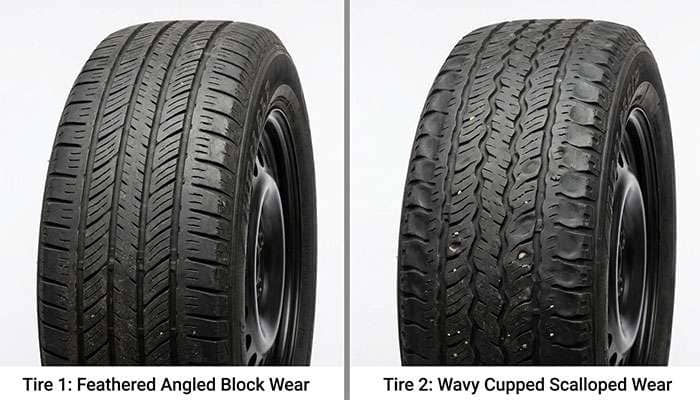
The key distinction people miss: feathering runs across the tread (block-to-block, side to side) and is an alignment story, while cupping runs around the tire and is a suspension-damping story. If you want the full picture on the wavy one, our dedicated guide on what causes tire cupping goes deep, and if you're curious which corner tends to go first, which tire wears out fastest covers that.
Feathering has one primary cause and a short list of accomplices. In order of how often I see them behind a feathered tire:
Toe misalignment (the primary cause). Toe is how far the front edges of the tires point in or out relative to dead straight, and it's measured in fractions of a degree, often just a few hundredths. That's how sensitive this is. A toe error far too small to feel in the steering wheel is more than enough to feather a tire over a few thousand miles, because the scrub happens every revolution. Excess toe-in feathers one way, excess toe-out the other. This is why a feathered tire almost always means an alignment is due, and our overview of car wheel alignment explains exactly what the tech is adjusting.
Worn suspension components. Here's the catch that fools people: you can get a perfect alignment and the feathering comes right back. That happens when a worn part lets the toe angle change while you drive, even though it measured fine sitting still on the rack. Tie rod ends, control arm bushings, and ball joints are the usual culprits. Worn-out shocks and struts can also contribute by letting the contact patch load unevenly. If feathering returns shortly after an alignment, you have a worn component, not a bad alignment, and a competent shop will check for play before resetting the angles.
Tire pressure. Pressure is more often behind shoulder or center wear, but chronic underinflation lets the tread squirm and flex enough to contribute to edge feathering, especially combined with a marginal toe setting. Keeping pressure on spec removes a variable, so start there. Our guides on finding your recommended tire pressure and why proper tire pressure matters cover the numbers.
Skipped rotations. Rotation won't fix the underlying cause, but it spreads developing wear across positions so a single tire doesn't feather badly before you catch it. A tire left in one spot for the life of the set will show problems far worse than one rotated on schedule. See how often to rotate tires and how to rotate tires for the intervals and patterns.
This is the part that gets overlooked, and it's squarely in my wheelhouse. When you put aftermarket wheels on a car, the wheel's offset and the resulting track width change the suspension geometry the engineers designed around. Run a wheel with significantly less offset, pushing the tire outward, and you change the scrub radius. That alters how the tire responds to steering input and how it loads under cornering, and on some setups it accelerates edge scrub that looks a lot like feathering, even with the factory toe spec.
The fix isn't to give up on the wheels. It's to choose offset correctly for the vehicle in the first place and to get a fresh alignment after any wheel change, because the right alignment numbers for a modified track width may differ from stock. If you're running or planning a wheel setup that changes offset, our explainer on how wheel offset affects tire wear walks through the geometry in detail. Matching the wheel to the car by the numbers is the cheapest insurance against premature wear there is.
The repair sequence is straightforward once you've identified it. First, have the suspension inspected for play in tie rods, bushings, and ball joints, because there's no point aligning a car with a worn part that will move under load. Replace anything worn. Second, get a four-wheel alignment and bring the toe back into specification. Third, rotate the tires so the partly feathered ones move to positions where the wear can even out as they continue to wear.
Can you save a feathered tire? Sometimes. If you catch it early, fix the cause, and rotate, the high edges can wear back down toward even and the tire lives out a normal life, often getting quieter as it does. The roar won't vanish overnight, but it should fade as the pattern smooths. If the feathering is severe, with deep ramps and a noticeable depth difference across the tread, the rubber is gone and no alignment brings it back. At that point the tire is a replacement. Check your depth against the standards in our guide on tread depth to replace tires to make the call objectively. And if you're putting on new tires, it's worth confirming whether you need an alignment with new tires first; with a feathering history, the answer is absolutely yes.
Feathering isn't only a noise complaint. The numbers behind ignoring it add up fast. A feathered tire is being dragged at an angle every mile, which measurably increases rolling resistance and trims fuel economy. The uneven contact patch reduces grip, lengthening braking distances and hurting cornering stability, because the tread isn't meeting the road at the angle it was engineered to. And the wear accelerates: a tire that should last 50,000 miles can be finished in a fraction of that once it's feathering hard. You're paying for it three ways at once, in fuel, in safety margin, and in tire life. A modest alignment cost stops all three, and our look at what a wheel alignment costs puts that number in perspective against a premature set of tires.
Replace a feathered tire when the wear has gone deep enough that the cause is fixed but the tire stays loud and the tread depth is uneven or low, when any part of the tread reaches the wear bars, or when feathering has thinned one edge to the point of approaching the cords. Our guide on when car tires should be replaced lays out the safety thresholds.
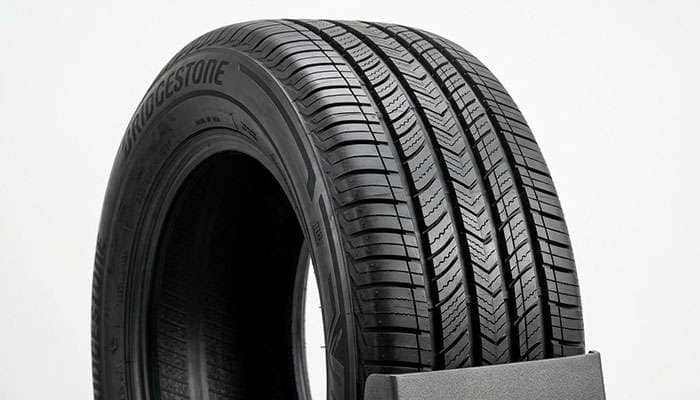
When it is time, fix the alignment first, then put on a tire built to wear evenly and stay quiet so you start clean. A few we stock that hold up well: the Michelin Defender 2 and Primacy Tour A/S for long, even-wearing mileage, or the CrossClimate2 if you want all-weather capability; the Continental TrueContact Tour for a strong wear-and-grip balance; the Bridgestone Turanza QuietTrack for low noise; the Goodyear Assurance MaxLife for sheer tread life; or the Pirelli Cinturato P7 All Season Plus 2 for a sportier feel. For a ranked shortlist, see our 12 best all-season tires for 2026. Whatever you choose, get the alignment set and keep a rotation schedule, and the new set won't repeat the pattern.
Tire feathering is one of the most readable signals your car gives you. Sharp on one edge, rounded on the other, a saw-tooth feel across the tread, and a rising roar at speed: that's a toe angle out of specification, full stop, until proven otherwise. Feel all four tires, note which direction the sharp edges face, check for worn suspension parts, set the alignment, and rotate. Catch it early and you save the tire. Catch it late and at least you stop paying the fuel, safety, and wear penalty going forward. Either way, the tire told you exactly what was wrong. The trick is reading it.
Run your hand flat across the tread from one side to the other. A feathered tire feels smooth in one direction and like a row of saw teeth or small ramps in the other, because each tread block has worn rounded on one edge and sharp on the opposite edge. You can often feel feathering before you can clearly see it.
The primary cause is incorrect toe alignment, which drags the tire sideways a tiny amount with every revolution and scrubs each tread block at an angle. Worn suspension parts such as tie rod ends, bushings, and ball joints can cause it too by letting the toe angle change while driving, and chronic underinflation or skipped rotations can make it worse.
No. Feathering is angled wear that runs across the width of the tread, block to block, and points to an alignment problem, usually toe. Cupping is a wavy pattern of high and low spots that runs around the circumference of the tire and points to worn shocks or struts or a bouncing wheel. They feel and look different and require different repairs.
You can fix the cause, and if you catch feathering early you can often save the tire. Repair any worn suspension components, get a four-wheel alignment to bring toe back into specification, and rotate the tires so the wear evens out as they continue to wear. If the feathering is severe and the tread is deeply uneven or low, the tire needs to be replaced.
The angled, uneven tread blocks of a feathered tire meet the road in a way that produces a low rumble or roar that rises with speed. It's commonly mistaken for a worn wheel bearing or for aggressive off-road tires. Once the cause is corrected and the tread wears back toward even, or the tire is replaced, the noise fades.



