
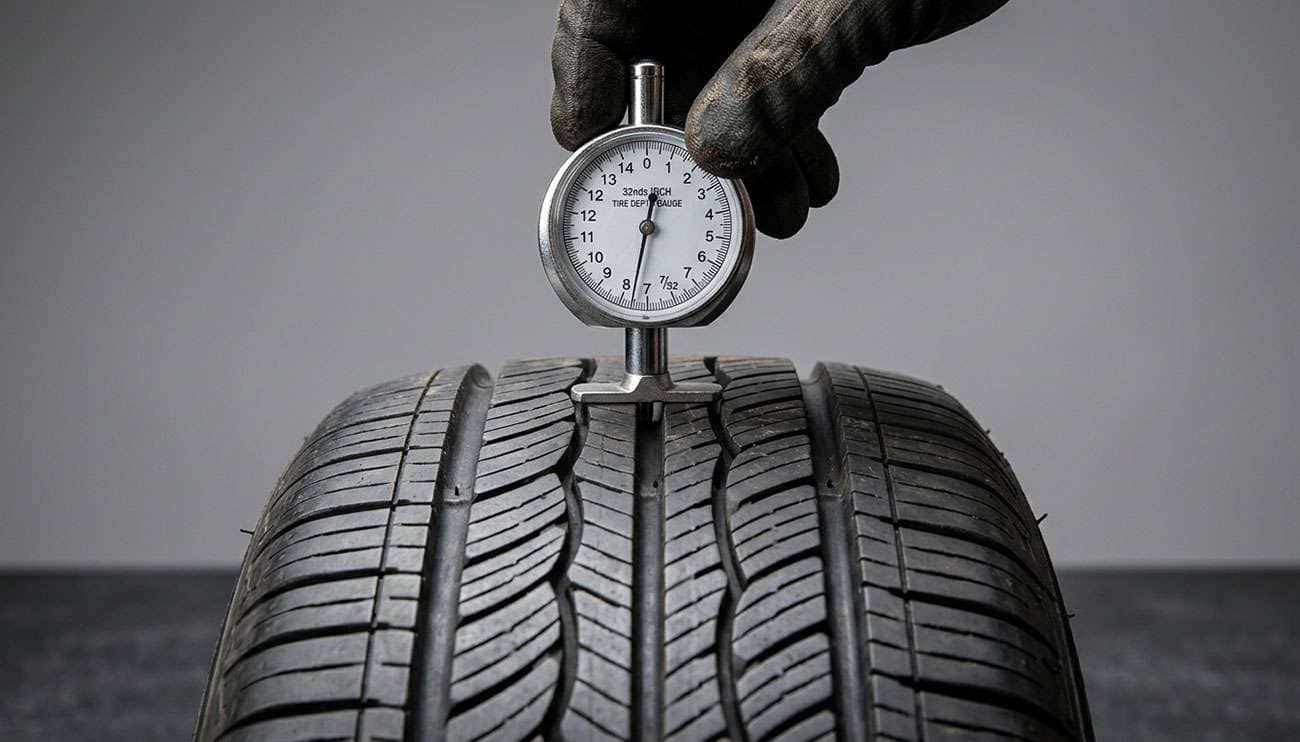
The legal answer is 2/32 of an inch. That's the federally mandated minimum tread depth in the United States, and every DOT-regulated passenger tire is built with tread wear indicators (also called "wear bars") that become flush with the tread surface at exactly 2/32. Drop below that and the tire is legally unsafe to drive on.
But the safer answer is different. At 2/32 of remaining tread, wet-weather stopping distance has roughly doubled compared to a new tire. Snow traction is effectively gone. Hydroplaning resistance is minimal. The legal minimum and the practical replacement point are not the same number — and understanding the gap between them is what separates drivers who know when to replace from drivers who find out the hard way.
Here's what each common tread depth reading actually means, how to measure it yourself in 30 seconds, and what each specific /32 value does to your stopping distance and traction.
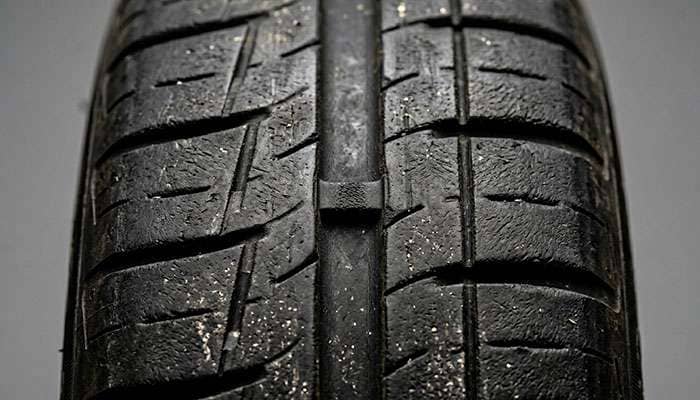
The 2/32 threshold comes from federal regulation. The Department of Transportation requires all passenger car, light truck, and motorcycle tires sold in the U.S. to include tread wear indicators integrated into the tire casting. These are raised bars of rubber running across the bottom of each main circumferential tread groove. When the surrounding tread wears down to the same height as the indicator bar, the groove measures 2/32 of an inch deep. At that point, the tire is considered legally worn out.
A few specifics about how this works:
The legal minimum was established decades ago, based on dry-pavement stopping performance. The problem is that modern tire engineering, road design, and driver expectations have all moved past what 2/32 represents in terms of real-world performance — especially in wet or snowy conditions.
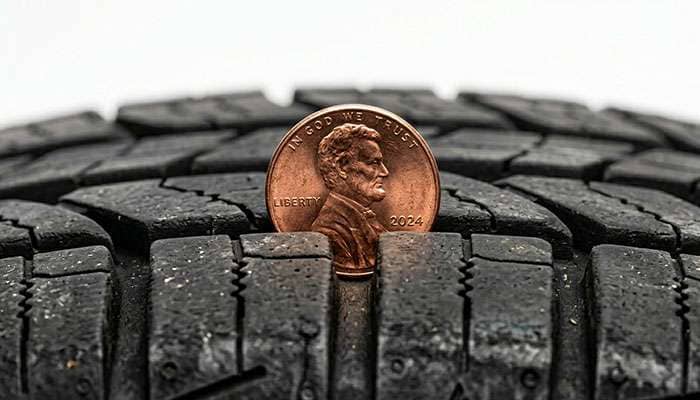
Four common methods, ranked from most to least precise:
1. Dedicated tread depth gauge (most accurate). A small tool with a probe that extends into the tread groove and a numbered scale showing the depth in 1/32-inch increments. Costs USD 5 to 15 at any auto parts store. Measures exactly — no approximation. Place the gauge flat across the tread blocks with the probe in the groove, push the probe down until the base contacts the tread surface, read the scale. Check in multiple places around the tire because tread wears unevenly.
2. Digital depth gauge (also accurate). Same principle as the mechanical gauge but with a digital readout. Slightly more expensive but idiot-proof.
3. Penny test (good approximation). Insert a penny into the tread groove with Lincoln's head pointing down. If the tread covers any part of Lincoln's head, your tread depth is greater than 2/32 — you're above the legal minimum. If Lincoln's entire head is visible, your tread is at or below 2/32 and the tire is legally worn out.
4. Quarter test (marks the 4/32 threshold). Insert a quarter with Washington's head pointing down. If the tread covers part of Washington's head, you have more than 4/32 of tread remaining. If all of Washington's head is visible, you're at or below 4/32 — approaching the wet-weather replacement threshold. This is a better real-world check than the penny for safety-conscious drivers.
5. Wear bar visual check (easiest but binary). Look for the raised rubber bars running across the bottom of the tread grooves. If the wear bars are flush with the tread surface anywhere on the tire, the tire is at 2/32 and needs immediate replacement.
For a full step-by-step walkthrough with photos, our guide on how to check tire tread covers each method in more detail.
Here's where the legal minimum and the practical replacement threshold diverge. Consumer Reports and AAA stopping-distance studies have documented significant performance differences between tires at new depth (roughly 10/32), at 4/32, and at 2/32. The short version:
Those extra 175 to 210 feet at 2/32 are the length of half a football field. That's the difference between stopping before the vehicle in front of you and hitting it at highway speed. The physics is straightforward: tread grooves exist to evacuate water from the contact patch. Less tread depth means less water evacuation capacity, which means more water staying under the tire, which means less grip and more hydroplaning risk.
At 4/32 the tire still has meaningful water-channeling capability. Below 4/32, that capability drops sharply. Many automotive safety organizations — including AAA — recommend replacement at 4/32 rather than 2/32 for drivers who regularly drive in rain, on wet roads, or in any climate where wet conditions are common.
Snow traction requires more tread depth than wet traction, and significantly more than dry traction. Snow tires are typically manufactured with 10/32 to 12/32 of tread and include specialized tread block designs (sipes, deeper voids, softer rubber compound) that depend on adequate depth to work.
Below roughly 6/32, even dedicated snow tires lose most of their snow performance advantage. The tread blocks can't dig into snow the way they're engineered to, and the void ratio between blocks drops below what's needed for snow evacuation. At that point, a worn snow tire performs roughly the same as a worn all-season — which means both perform poorly in snow.
For drivers in northern states, mountain regions, or anywhere that sees regular winter snow, the 6/32 threshold is the practical replacement point for any tire expected to handle winter conditions. If you drive a dedicated snow tire set, replace them when the tread drops to 6/32 or when the snowflake symbols between the shoulder blocks disappear, whichever comes first.
Here's how each common tread depth reading maps to real-world performance:
Tread Depth |
Condition |
What It Means |
|---|---|---|
10/32 - 12/32 |
New tire |
Full tread depth. Maximum grip in all conditions. Most passenger tires start in this range. |
8/32 - 10/32 |
Nearly new |
Excellent performance across all conditions. Typical for tires with 10,000 to 20,000 miles. |
6/32 - 8/32 |
Good tread |
Strong wet and dry performance. Acceptable for winter conditions on all-season or winter tires. |
4/32 - 6/32 |
Monitor closely |
Snow performance degraded. Wet performance noticeably reduced. Plan for replacement if you drive in wet or winter conditions regularly. |
3/32 - 4/32 |
Wet-weather replacement zone |
Hydroplaning risk significantly elevated. Wet stopping distance 30-50% longer than new. AAA and Consumer Reports recommend replacement. |
2/32 |
Legal minimum - replace immediately |
Federally mandated replacement threshold. Wear bars flush with tread surface. Wet stopping distance roughly double that of a new tire. |
Below 2/32 |
Illegal and dangerous |
Tire is legally unsafe. Immediate replacement required. Driving on tires below 2/32 can result in failed inspections and citations. |
For the full lifespan picture from purchase to replacement, see our guide on the lifespan of a tire. And if you want the framework that combines age and tread depth into a single decision rule, the 7-7 rule for tires is a useful complementary standard.
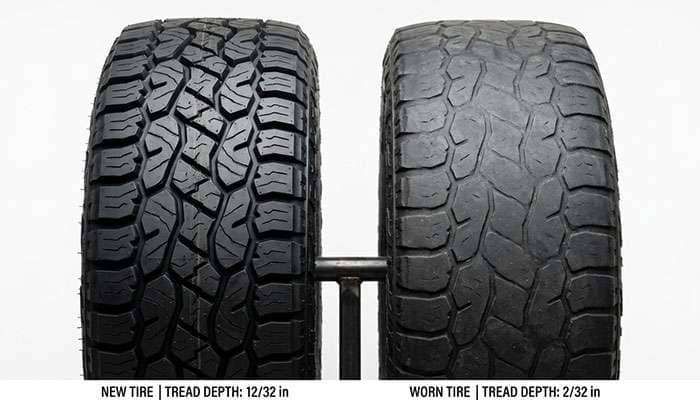
Measured tread depth isn't the only reason to replace a tire. Specific wear patterns can indicate replacement-level problems even above the 2/32 threshold:
For more on how to decode what your tread is telling you about the vehicle, how to decode tire tread patterns covers what wear patterns reveal about alignment, inflation, and suspension condition.
Take action based on where your tread measurement falls:
If you're deciding whether to replace two or four tires at once, that's a separate decision. Most tire shops recommend replacing all four when at all possible, particularly on AWD and 4WD vehicles where significant tread differences between tires can damage the drivetrain. For the full replacement decision framework, when to replace car tires walks through the practical considerations. For a mechanic's perspective on replacement frequency and timing, how often should tires be replaced covers what a shop actually looks for.
One more consideration: tread depth on new tires varies by tire category. Performance tires often start at 8/32 to 10/32. Touring and all-season tires commonly start at 10/32 to 11/32. Dedicated off-road and winter tires can start at 12/32 to 18/32. A tire category's new-depth starting point affects how quickly it reaches the replacement threshold, which matters when comparing tire options. For more on how the starting depth relates to the UTQG treadwear rating, how to read tire treadwear ratings breaks down the system.
2/32 of an inch is the legal minimum tread depth in the United States. All DOT-regulated passenger tires include tread wear indicators (wear bars) that become flush with the tread surface at exactly 2/32. For wet-weather driving, AAA and Consumer Reports recommend replacement at 4/32 because wet stopping distance and hydroplaning risk both increase significantly below that point. For snow and winter driving, 6/32 is the practical replacement threshold.
Both are valid thresholds — they just answer different questions. 2/32 answers "when is this tire legally unsafe." 4/32 answers "when does this tire stop performing safely in wet conditions." If you live somewhere with frequent rain or drive on wet roads often, 4/32 is the more honest replacement point. If you only drive in dry conditions, 2/32 is the legal minimum you're required to replace at.
Three ways. First, check for wear bars in the tread grooves — when they're flush with the surrounding tread surface, the tire is at 2/32. Second, insert a penny upside down into the tread groove; if you can see all of Lincoln's head above the tread, you're at or below 2/32. Third, use a tread depth gauge — the most accurate method, reads the depth in 1/32 increments.
No. Most U.S. states enforce a 2/32 minimum tread depth and can cite you for driving on tires below that threshold. More importantly, driving on tires below 2/32 creates significant safety risk — wet stopping distance is roughly double that of a new tire, and blowout risk increases sharply. If a tire is below 2/32, replace it before your next drive.
No. New tread depth varies by category. Most performance tires start at 8/32 to 10/32. Touring and all-season tires start at 10/32 to 11/32. Dedicated winter tires start at 10/32 to 12/32. Off-road tires can start at 12/32 to 18/32 or more. The starting depth affects how long the tire lasts before reaching replacement thresholds, which is why a tire's UTQG treadwear rating only tells part of the story.
When possible, yes. Matching tread depths all around gives the most predictable handling, even wear, and no drivetrain stress. On AWD and 4WD vehicles, mismatched tread depths can actually damage the center differential or transfer case. If budget forces a two-tire replacement, put the new tires on the rear axle regardless of whether the vehicle is front- or rear-wheel drive — this keeps the better-gripping tires at the back where oversteer is less controllable than understeer.



