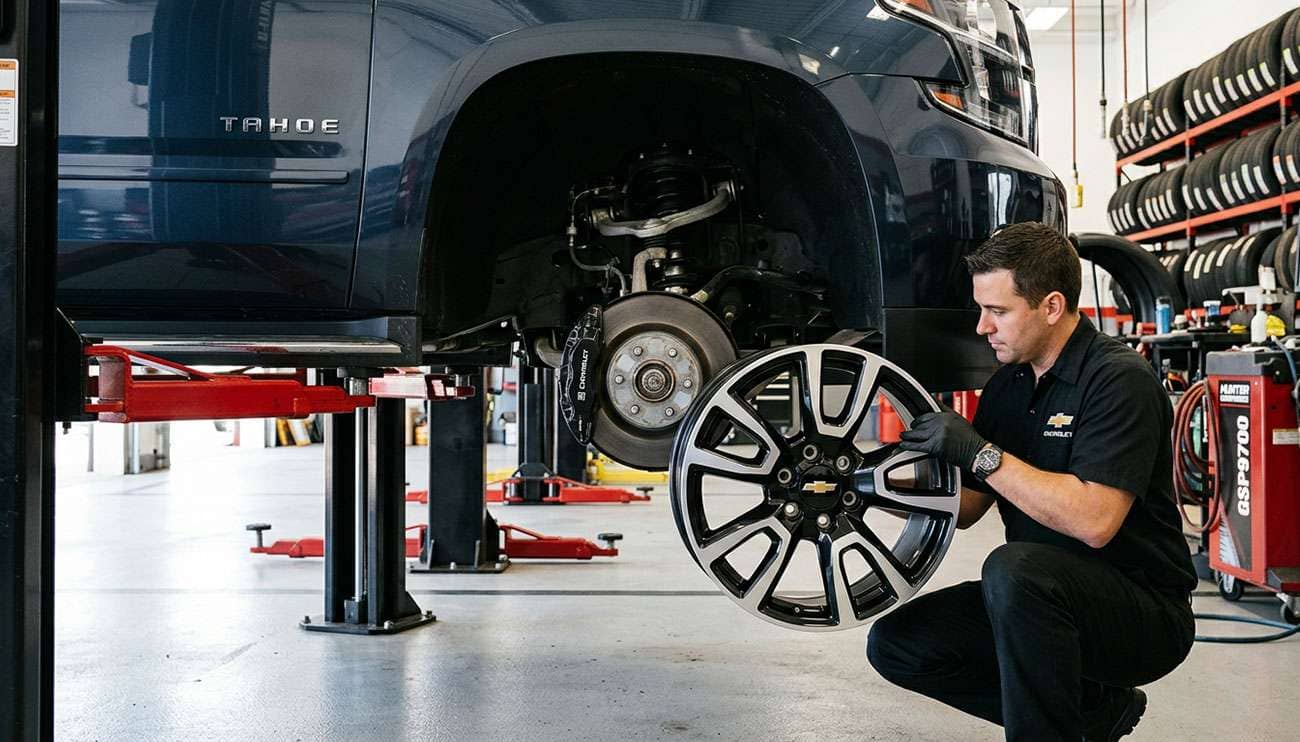
Short answer: yes, if it's a Silverado 1500 wheel and the years line up with the brakes. Every half-ton Silverado since 1999 and every Tahoe since 2000 shares the 6x139.7 bolt pattern, the 78.1 mm hub bore, and M14 x 1.5 studs, and their factory offsets sit in the same narrow range. The catch is the front brakes. The 2019+ Silverado 1500 and 2021+ Tahoe use larger front calipers, and many older wheels hit them. Silverado 2500HD and 3500HD wheels are eight-lug and fit no Tahoe at all. Most answers stop at "same bolt pattern." On these two trucks, the bolt pattern was never the question. The caliper is.
I'm Hank Feldman. I've been swapping wheels between GM trucks since before there was a Tahoe, and this is one of the friendliest swaps in the business. GM built the Tahoe from the Silverado, so the wheels have always been close cousins. But a customer who buys a set of 2016 Silverado take-offs for his 2023 Tahoe is about to learn what changed in 2019, and I'd rather he learn it here than in my parking lot.
Start with the chart. Find where your Silverado wheel came from and which Tahoe you have.
Silverado Wheel |
Tahoe |
Fits? |
What Decides It |
|---|---|---|---|
2019+ Silverado 1500 |
2021+ |
Yes |
Same platform and the same larger front calipers |
2019+ Silverado 1500 |
2007-2020 |
Yes |
Built to clear bigger brakes than the older Tahoe has; similar offset |
1999-2018 Silverado 1500 |
2000-2020 |
Yes |
Same pattern, bore, studs, and brake generation; compare offsets |
1999-2018 Silverado 1500 |
2021+ |
Often no |
Many hit the larger front calipers. Test-fit before you buy. |
Silverado 2500HD or 3500HD |
Any |
No |
Eight-lug wheels on a six-lug hub |
If you're shopping for wheels instead of buying take-offs, this second chart is what any wheel has to meet on your Tahoe, whether it came off a Silverado or out of a box.
Spec |
2007-2020 Tahoe |
2021+ Tahoe |
|---|---|---|
Bolt pattern |
6x139.7 (6x5.5) |
6x139.7 (6x5.5) |
Hub bore |
78.1 mm |
78.1 mm |
Stud thread |
M14 x 1.5 |
M14 x 1.5 |
Factory offset |
About +24 to +31 mm |
About +24 to +28 mm |
Front brake clearance |
Clears most GM half-ton wheels |
Needs a wheel built for the larger calipers |
Aftermarket 6x139.7 wheels |
Bores of 106 mm and up need a hub ring down to 78.1 mm |
Bores of 106 mm and up need a hub ring down to 78.1 mm |
Minimum wheel load rating |
Higher axle rating (GAWR) divided by two, plus margin |
Higher axle rating (GAWR) divided by two, plus margin |
Yes, and a lot more than the bolt pattern. The Tahoe is built on the same body-on-frame architecture as the Silverado 1500, and since the 1999 Silverado and 2000 Tahoe, the two have shared the wheel specs that matter: six lugs on a 139.7 mm circle (6x5.5 inches), a 78.1 mm center bore, and M14 x 1.5 studs. The same goes for the GMC Sierra 1500, Yukon, Suburban 1500, Yukon XL, and Escalade. A factory wheel from one centers on the hub of another exactly the way it was designed to.
That 78.1 mm bore is the part people miss when they shop by bolt pattern alone. Toyota, Nissan, and a long list of other trucks also use 6x139.7, but most of them have a hub of 106 mm or more. In the 6x139.7 wheel market, only about one wheel in five is bored 78.1 mm for GM trucks, and those are mostly factory-replica designs. The other four in five are bored 106 mm or larger, so they slide over a GM hub with room to spare and need a hub-centric ring to center properly. Our guide to the 6x139.7 bolt pattern lists the trucks that share it.
If your truck is a 1988-1998 C/K or a first-generation Tahoe, everything in this article still points you the right way on bolt pattern and bore, but check the stud thread and lug nuts on those older trucks before you mix wheels across generations.
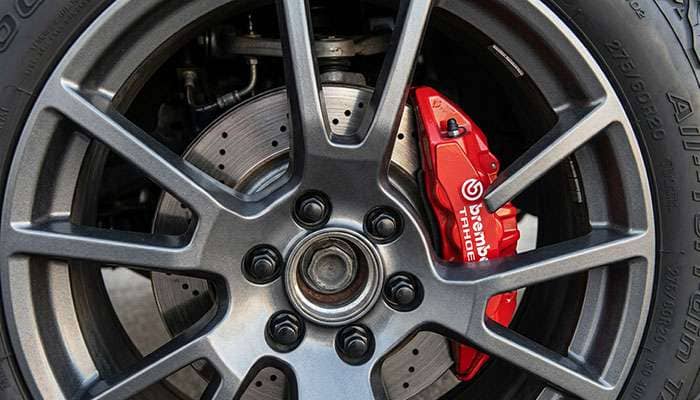
Yes. This is the easy one. When GM redesigned the Silverado 1500 for 2019, it put larger front calipers on the truck. When the new Tahoe, Suburban, Yukon, and Escalade arrived for 2021, they got the same front calipers, according to owners who have swapped brake parts between them. Tahoe owners who have done the swap report that 2019 and newer Silverado and Sierra wheels go right on, and so do wheels from any 2021 and newer GM full-size SUV.
That includes the smallest ones. One owner reports that even the 2019+ Silverado's 17-inch steel wheel clears the 2021+ brakes, which makes sense, because GM had to design that wheel around the same caliper. The 2021 Tahoe starts at 18 inches from the factory, so a 17-inch Silverado wheel is a real option for anyone who wants more sidewall for gravel roads.
The 2021 Tahoe also switched to an independent rear suspension, while the Silverado kept its solid rear axle. That changes how the SUV rides, not what bolts to its hubs. The rear hubs use the same pattern, bore, and studs as the front.
Often not, and this is where people lose money. A 2014-2018 Silverado wheel has the right pattern, the right bore, and the right studs. It will thread on. But a lot of them were designed around the smaller calipers of their day, and on a 2021+ Tahoe the inside of the spokes or barrel runs into the bigger caliper.
Owners on the Tahoe forums report the cutoff plainly: most 2018-and-older Silverado and Sierra wheels, and most 2020-and-older Tahoe, Suburban, and Yukon wheels, hit the front calipers on the new trucks. One owner who bought 22-inch Silverado wheels for his 2021 Tahoe found they still touched the calipers with 6 mm spacers, and 7 mm wasn't enough either. Deeply concave designs are the worst, because the spokes curve inward right where the caliper sits.
Not every older wheel fails. It depends on the spoke shape and how far the spokes sit from the mounting face. That's why I tell customers to test-fit one wheel before they hand over cash for four.
Sometimes a spacer pushes the wheel far enough out to clear. I don't love it as a fix. A spacer adds a second bolted joint, moves the tire outboard, and puts more leverage on the wheel bearing every time you hit a pothole. If a wheel needs a spacer to clear your brakes, it wasn't built for your truck, and there are plenty of wheels that were. Read do wheel spacers hurt your car before you go that route.
Yes. Going the other way, a 2019+ Silverado wheel was designed to clear the larger caliper, so it has room to spare over the smaller brakes on a 2007-2020 Tahoe. The pattern, bore, and studs match, and factory offsets are close enough that the tire sits about where the original wheel put it.
Between older trucks of the same era, a 2007-2018 Silverado wheel on a 2007-2020 Tahoe is about as close to a direct swap as wheels get. GM shared wheel designs across the trucks and SUVs, and the brakes were the same family.
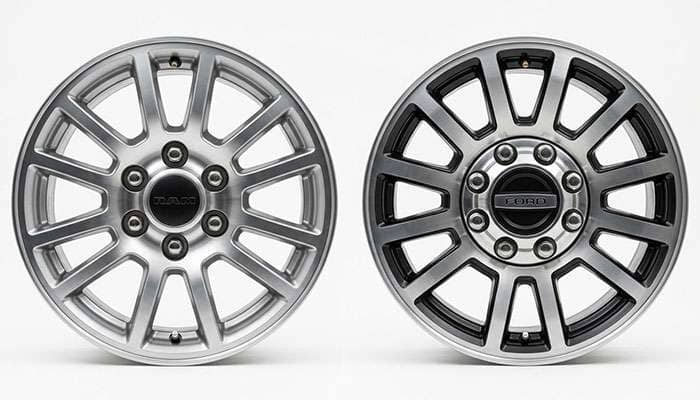
No. "Silverado wheels" covers two very different families. The Silverado 1500 is a six-lug truck. The Silverado 2500HD and 3500HD are eight-lug trucks: 8x180 since 2011, and 8x165.1 (8x6.5) before that. No Tahoe has ever been eight-lug, so an HD wheel won't even line up with the studs.
HD take-offs are some of the most common used wheels for sale, and they look a lot like half-ton wheels in a photo. Count the lug holes before you drive across town. If you want the look of an HD wheel on your Tahoe, buy that style in 6x139.7. Our guide to the 8x180 bolt pattern covers which trucks those wheels do fit.
The same rules apply, because they're the same family. The GMC Yukon and Yukon XL are Tahoe and Suburban twins, and the Sierra 1500 is the Silverado's twin, so a Sierra wheel is a Silverado wheel for fitment purposes. The year cutoff is the same: 2019+ truck wheels and 2021+ SUV wheels share the larger front calipers, and the older wheels are the ones to test-fit.
Two exceptions to watch. Older three-quarter-ton Suburban and Yukon XL 2500 models were eight-lug, like the HD pickups, so a Silverado 1500 wheel won't fit them, and their wheels won't fit your Tahoe. And the high-performance Escalade-V carries much larger brakes than the rest of the family, so don't assume a regular GM wheel clears it.
The Suburban also deserves a second look at load, which we cover below. It's the longest and heaviest of the half-ton SUVs.
Off-road trims don't change the rules. A Silverado Trail Boss or ZR2 wheel is still a six-lug, 78.1 mm half-ton wheel. Match the year to the brakes, check the offset, and remember those wheels usually come wrapped in bigger all-terrain tires that may not fit a stock-height Tahoe as easily as they fit the truck they came off.
Not much. Factory GM half-ton wheels have run in a tight offset range for years. Tahoe owners put the 2007-era wheels at about +24 to +31 mm, and current factory-style Silverado and Tahoe wheels sit around +24 to +28 mm. A Silverado wheel on a Tahoe from the same era usually sits within a few millimeters of where the Tahoe's own wheel did.
Width matters too. A 9-inch-wide Silverado wheel in place of an 8-inch Tahoe wheel moves both the inside and outside edges about half an inch at the same offset. On a stock-height Tahoe on factory-size tires, that's rarely a problem.
Aftermarket wheels are a different story. Only about one in five 6x139.7 wheels on the market runs a factory-like +20 to +31 mm. Nearly four in five sit at +19 mm or lower, which pushes the tire well outboard of stock. That's the look a lot of people want. Just know it changes how a bigger tire clears the fender and the front bumper at full lock.
Lug nuts: not for factory wheels. Both trucks use M14 x 1.5 studs, and GM's factory lug nuts fit factory GM wheels from either truck. If your factory nuts are the chrome-capped kind from the 2007-2018 trucks, check them while you're at it. Those caps are known to swell and stop fitting a standard socket, and a swap day is a good day to replace them. Aftermarket wheels are where you check. The nut's seat, the surface that clamps against the wheel, has to match the shape machined into the lug hole. Most aftermarket truck wheels take a 60-degree cone seat, but not all of them, and some need longer or narrower nuts to reach through thick spokes.
TPMS: the sensors are generally compatible, but your Tahoe doesn't know their IDs. GM's half-ton trucks and SUVs have used the same family of 315 MHz sensors for years. If you bolt on take-offs with sensors installed, plan on a relearn with a TPMS tool so the Tahoe registers the new sensor IDs. Moving your Tahoe's own sensors into the Silverado wheels during mounting avoids buying new ones. Our guide to TPMS sensors for aftermarket wheels covers what carries over.
For the most part, yes. A Silverado 1500 is built to haul and tow, and its factory wheels are engineered for that. A Tahoe is a heavy SUV, but it's in the same weight class, so a factory Silverado 1500 wheel on a Tahoe is not a load problem the way a light passenger-car wheel would be.
Two cases deserve a closer look. The first is the Suburban and Yukon XL, which are longer and heavier than a Tahoe, especially loaded with a family and a trailer. The second is any aftermarket wheel, where the load rating varies from one design to the next.
The check takes a minute. Open the driver's door, find the gross axle weight ratings (GAWR) for the front and rear, take the higher number, and divide by two. That's the minimum each wheel has to carry. Add margin if you tow or haul. Reputable aftermarket wheels list their load rating, and in the 6x139.7 market the most common rating is 2,500 lbs, with about three in four rated at 2,400 lbs or more. Our wheel load rating guide walks through the math.
A wheel that almost clears doesn't stay almost.
Stage 1: Caliper scrape. A wheel that kisses the caliper makes a scraping or ticking sound, usually at low speed or in a turn. The spoke starts wearing a groove in its own finish and in the caliper.
Stage 2: Brake damage. Keep driving and the contact wears into the caliper body or its bleeder. That's a brake part you're now replacing, on a 5,500-plus-lb SUV.
Stage 3: The spacer patch. Many people fix stage 1 with a spacer. Done right with a quality hub-centric spacer, it can work. Done cheap, it adds a joint that can loosen and puts extra leverage on the wheel bearing.
Stage 4: Lug-centric vibration. An aftermarket wheel with a 106 mm bore and no hub ring is centered only by the lug nuts. That shows up as a highway shake that no amount of balancing cures, and as lug nuts that need re-torquing. Our explainer on hub-centric vs. lug-centric wheels covers why.
Used wheels usually come with used tires, too. Check the date codes, the tread, and the sidewalls, and read tire sidewall damage: is it safe to drive if anything looks off.
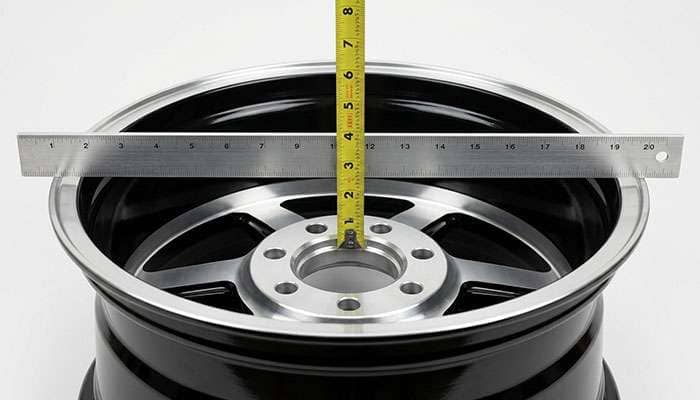
Here's the order we go in at the shop.
Step 1: Count the lugs. Six means half-ton. Eight means HD, and you're done.
Step 2: Get the years. Ask what year Silverado the wheels came off, and know your Tahoe's year. If the wheel is 2018 or older and your Tahoe is 2021 or newer, plan on a test-fit.
Step 3: Read the back of the wheel. GM and most aftermarket makers cast or stamp the size and offset on the back of a spoke or the mounting pad. GM wheels also carry a part number you can look up.
Step 4: Measure the bore. Factory GM wheels are 78.1 mm. Anything larger needs a hub ring down to 78.1. Anything smaller won't fit.
Step 5: Test-fit for the caliper. Hand-thread three lug nuts snug and spin the wheel. Look at the gap between the caliper and the spokes and barrel. You want at least an eighth of an inch at the closest point.
Step 6: Match the nuts and sensors. Factory nuts for factory wheels. For aftermarket wheels, match the seat. Plan for a TPMS relearn.
Step 7: Check the load. Higher GAWR divided by two, plus margin, against the wheel's rating.
Step 8: Torque and re-torque. Torque in a star pattern to your owner's manual spec, then re-check after the first 50 miles.
If the take-offs don't pass, start with the Chevy Tahoe wheels and tires that fit your truck.
Silverado 1500 wheels and Tahoe wheels have been cousins since the turn of the century. They share the 6x139.7 pattern, the 78.1 mm bore, the M14 studs, and close to the same offset. The line that matters is the 2019 Silverado and 2021 Tahoe, when GM moved both to bigger front calipers. Newer wheels clear older trucks. Older wheels often don't clear newer trucks. And HD wheels don't fit any Tahoe at all.
Count the lugs, check the years, and spin one wheel by hand before you mount four. It's ten minutes of work, and it keeps a good deal from turning into a set of wheels you can't use.
Silverado 1500 wheels from 1999 on and Tahoe wheels from 2000 on share the 6x139.7 bolt pattern, 78.1 mm hub bore, and M14 x 1.5 studs. The exception is brake clearance: many 2018-and-older Silverado wheels hit the larger front calipers on a 2021 and newer Tahoe.
Yes. The 2019+ Silverado 1500 and 2021+ Tahoe share the same wheel specs and the same larger front brakes, and owners report the wheels bolt on directly, including the Silverado's 17-inch steel wheel.
Often not. They match on bolt pattern, bore, and studs, but many were designed around smaller calipers and hit the 2021+ Tahoe's larger front brakes. Test-fit one wheel before buying a set.
No. Silverado 2500HD and 3500HD wheels are eight-lug, 8x180 since 2011 and 8x165.1 before that. Every Tahoe is six-lug.
Yes, under the same rules. A Tahoe wheel fits a Silverado 1500 of the same era, and 2021+ Tahoe wheels fit a 2019+ Silverado. Older Tahoe wheels may hit the larger calipers on a 2019+ Silverado.
The Tahoe uses 6x139.7, also written 6x5.5, with a 78.1 mm hub bore and M14 x 1.5 studs on 2000 and newer models.