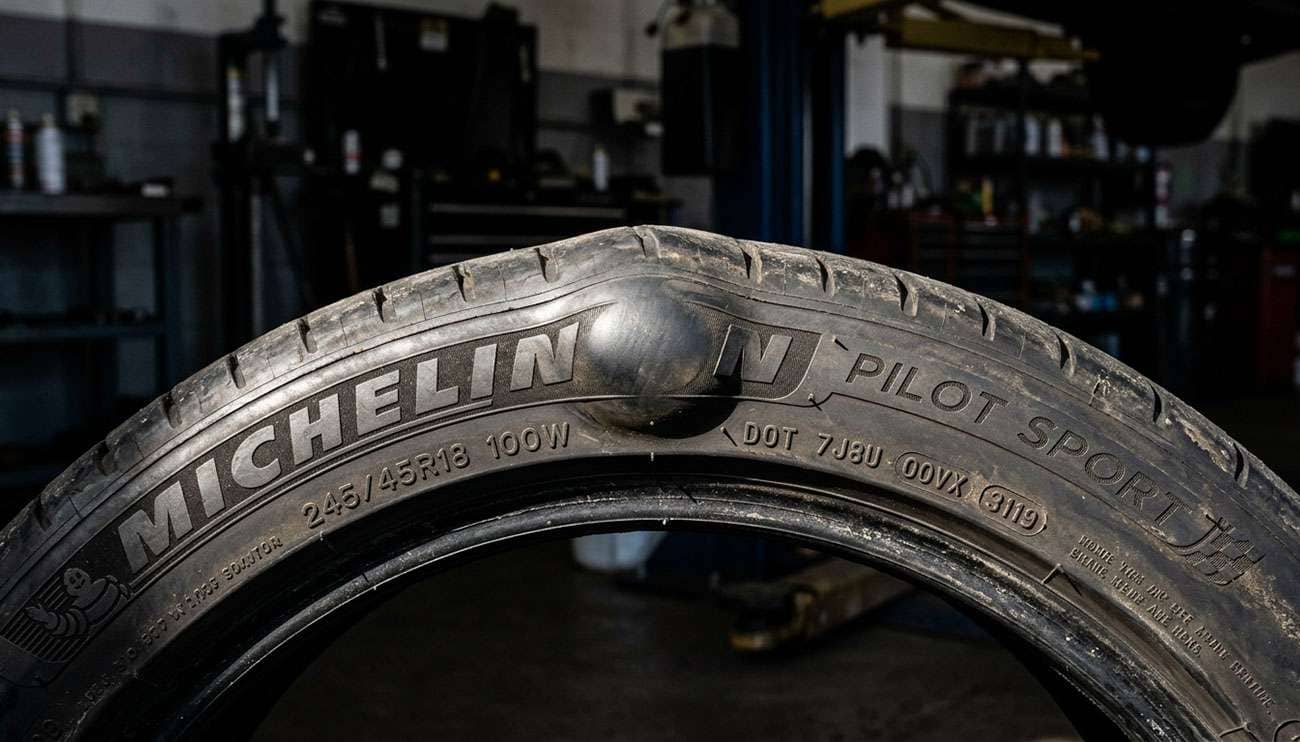
You hit a pothole. You scraped a curb parking. You noticed something on the sidewall that wasn't there before — a bubble, a scrape, a cut, a crack. Now you're standing next to your car wondering if you can drive on it. This is one of the most common and most urgent tire questions drivers face, and the answers vary dramatically depending on what type of damage you're actually looking at. Some sidewall damage is cosmetic and poses no immediate safety risk. Some demands you stop driving immediately, right now, full stop. The difference between those two categories is what this guide is about — a clear, type-by-type breakdown so you know exactly what you're dealing with and exactly what to do about it.
If you're in a hurry and just need to know whether to keep driving, here's the decision framework. Scroll down for the full explanation of each type.
Damage Type | Safe to Drive? | Repairable? | Action Required |
|---|---|---|---|
Bulge or bubble |
No — stop immediately |
Never |
Replace the tire now |
Deep cut (cords visible) |
No — stop immediately |
Never |
Replace the tire now |
Cut less than 1/4" deep, no cords |
Marginally — get inspected today |
Sometimes (professional judgment) |
Professional inspection same day |
Sidewall puncture |
No |
Never |
Replace the tire now |
Shallow surface scrape / curb rash |
Usually yes, if superficial |
No repair needed |
Monitor; inspect if rubber is missing |
Hairline surface cracks |
Usually yes — monitor closely |
No |
Professional inspection, consider age |
Deep cracks / dry rot |
No |
No |
Replace the tire now |
Before getting into specific damage types, it's worth understanding why the sidewall is treated so differently from the tread — because the rules that apply to tread punctures (plugs, patches, repair-and-drive) do not apply to sidewall damage. The physics and engineering are completely different.
The tread area of your tire — the part that contacts the road — is reinforced with multiple layers of steel belts beneath the rubber. It's the toughest part of the tire, engineered to resist punctures, cuts, and abrasion from the road surface it rolls on constantly. Small punctures in the tread (like nails) can often be repaired because the surrounding steel belt structure is largely intact and the repair restores the seal without compromising overall structure.
The sidewall is structurally different. It's built for flexibility, not puncture resistance. The sidewall flexes continuously as the tire rotates — it compresses under load and springs back, thousands of times per mile. The sidewall's job is to support the vehicle's weight through that air pressure and to absorb vertical impacts. The cords inside the sidewall are arranged radially (in radial tires) specifically to allow that flex. Those cords are the structural skeleton of the sidewall, and once they're damaged, no patch or plug can restore their integrity.
Your tire doesn't carry the vehicle's weight through the rubber — it carries it through compressed air. The sidewall contains and directs that air pressure into the load-bearing column that supports the wheel and vehicle above. When the sidewall is compromised — whether by a cut that reaches the cords, a puncture that creates a pressure leak path, or a bulge that indicates broken internal cords — the structural system that contains that air is compromised. A sidewall that fails under pressure doesn't slowly deflate. It blows. And a blowout at highway speed is a loss-of-control event.
This is why sidewall damage is treated with much more urgency than equivalent tread damage, and why the repair options are so much more limited.
A bulge or bubble on the sidewall of your tire is the most serious visible form of sidewall damage, and the answer to "can I drive on this?" is an unambiguous no. Not "be careful." Not "get it looked at this week." Stop. Right now.
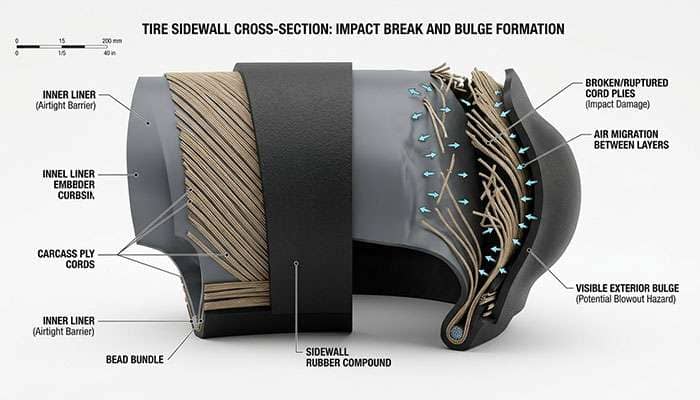
A sidewall bulge — that visible protrusion, often described as looking like a blister or a bubble on the side of the tire — is not simply rubber deformation. It's a symptom of internal cord failure. When an impact (a pothole, a curb strike, road debris) compresses the sidewall violently, the force can snap or separate the internal cords — the structural threads that give the sidewall its integrity. Once those cords break, the inner liner separates and air from inside the tire migrates into the now-open space between the inner liner and the outer rubber. That pressurized air pocket is the bubble you see from the outside.
The outer rubber looks intact. The tire holds pressure. It appears driveable. It is not. What you're looking at is a load-bearing structure with broken internal bones that's being held together by only the outer rubber — which was never designed to carry structural load. The NHTSA classifies sidewall bulges as grounds for immediate tire replacement. Michelin states explicitly that a tire with a bulge or bubble cannot be repaired — replacement is the only safe solution.
The reason sidewall bulges are treated with such urgency is that failure is not gradual. A bulge doesn't give you warning. There's no slow leak, no noise, no progressive handling change that tells you it's about to go. The remaining outer rubber can hold for an hour, a day, or a week — and then it fails suddenly and completely at highway speed. At that point, you have a blowout. The tire's sudden complete deflation at speed causes the vehicle to lurch violently toward the side of the blown tire, requiring immediate and skilled counter-steering to maintain control. Many drivers can't respond quickly enough. This is a documented cause of serious accidents.
If you find a bulge: put your spare on immediately. Don't drive to the tire shop on the damaged tire — put the spare on first, then drive to the shop. If you don't have a spare or the spare isn't functional, call for a tow. The marginal convenience of driving a few more miles on a bulged tire is not worth the risk of a blowout at speed.
Cuts in the sidewall are common — they happen from road debris, glass, sharp rocks, and curb strikes. Unlike bulges, cuts exist on a spectrum from truly minor to immediately dangerous, and the depth of the cut is the determining variable.
A cut that only penetrates the outer rubber layer without reaching the internal cords is a different situation from one that goes all the way through. The internal cord structure is typically located 1/8" to 3/16" (roughly 3–5mm) into the sidewall from the outside surface. A cut shallower than that — one that you can't see into and doesn't expose any fibrous material when you gently open it — may not have compromised the structural cords.
That said, "may not have" is not "definitely hasn't." Even shallow cuts can progress. Road grit, moisture, and continued flexing can cause a shallow cut to work deeper over time. A cut that was superficial when you first noticed it can reach the cords in a few thousand miles. Get any cut inspected by a professional on the same day you notice it — not next week, not "when it's convenient." Let a tire technician probe the cut and assess how deep it actually goes. If they can confirm it doesn't reach the cords and isn't creating a structural weak point, continued driving may be acceptable. If there's any doubt, the tire comes off.
If you can see fibrous material in the cut — white threads, silvery metallic threads, or any texture that looks like fabric or wire — the cords are exposed. That tire needs to come off immediately. Exposed cords mean the sidewall's structural integrity is directly compromised. The cords are now exposed to air, moisture, and debris, and the structural failure pathway is open. There is no repair for this. The tire is replaced, full stop.
A puncture in the sidewall — from a nail, screw, or sharp object that penetrated into the tire rather than just cutting the surface — is always a replacement situation regardless of depth. Unlike tread punctures, sidewall punctures cannot be safely plugged or patched. The continuous flexing of the sidewall means any repair material is subject to constant stress cycling that will eventually cause the patch to fail — and when a sidewall patch fails, it fails suddenly. Professional tire organizations and manufacturers are unanimous on this: sidewall puncture equals new tire.
The most common form of sidewall damage most drivers encounter is curb rash — that streaky abrasion along the sidewall from parking too close, catching a curb, or misjudging a tight corner. The good news is that most curb scrapes are surface damage to the outer rubber and don't compromise the structural cords. The bad news is that "most" isn't "all," and it takes an assessment to know which category you're in.
Run your hand along the scraped area. If the surface feels abraded and rough but the rubber is intact — no chunks missing, no cuts into the rubber, no fibers visible — you're looking at cosmetic damage. The outer rubber has lost some material, but the structural integrity is intact. This is driveable, but monitor it. Watch the area over subsequent drives for any changes — swelling, cracking from the abraded zone, or any development that wasn't there before.
If there are chunks of rubber missing — especially chunks larger than your thumbnail — the assessment changes. Missing rubber means the outer protective layer has been breached and the underlying cord structure may be closer to the surface than it should be. Any hit from debris or another curb strike in that area now has a shorter path to the cords. Get it professionally inspected. If the chunk is deep or exposes any fibrous material at the bottom of the missing section, the tire comes off.
Low-profile tires — those with an aspect ratio of 45 or lower — have shorter sidewalls with less rubber between the outer surface and the internal cords. A curb scrape that would be purely cosmetic on a standard-profile tire can reach the cords on a low-profile tire because there's simply less rubber in the way. If you're running low-profile performance tires, treat any curb scrape with more caution than you would on a standard-profile tire, and get it inspected rather than assuming it's cosmetic.
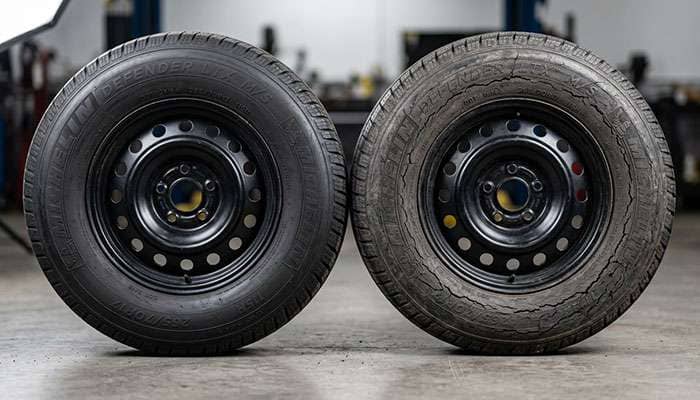
Unlike the dramatic visual impact of a sidewall bulge or a visible cut, cracking develops gradually and is often overlooked precisely because it doesn't look alarming — at least not at first. But cracking is a serious age-related failure mode that can make a tire dangerous even when it has plenty of tread remaining.
Tire rubber contains chemical stabilizers called antiozonants that protect it from the atmospheric ozone and UV radiation that cause rubber to harden and crack over time. These stabilizers are depleted through use and age — which is why older tires, and tires that have sat stationary for long periods, crack more readily than newer tires with full antiozonant reserves. Heat, UV exposure, and prolonged static storage all accelerate the process. A tire that's been sitting in a garage on a rarely-driven vehicle can develop cracking faster than one that gets regular exercise, because the antiozonants circulate through the rubber compound during driving.
Not all cracking is equally urgent. Fine, shallow surface cracks that are barely visible — sometimes described as "checking" — indicate that the outer rubber layer is beginning to oxidize. These cracks don't penetrate deep enough to compromise the cord structure, and a tire with minor surface checking can still have meaningful safe service life remaining. The key indicators to watch are crack depth, width, and pattern. Use the tire age DOT date checker to verify how old the tires are — cracking in a tire that's 7+ years old carries more urgency than the same cracking in a 3-year-old tire.
Deep cracks — ones you can see into, ones that run in multiple directions, ones that appear in the tread grooves as well as the sidewall, or ones that are wide enough to open noticeably when you flex the sidewall — are a replacement trigger. Cracking that severe means the rubber compound has lost significant elasticity, and the tire is at elevated risk of sudden failure regardless of how much tread remains. Many drivers replace cracked tires purely on tread depth, not realizing their 6-year-old tires with half their tread remaining are already beyond safe service life based on age and condition alone.
Most tire manufacturers recommend replacing tires at 6 years from manufacture date regardless of appearance and condition, and treat any tire over 10 years old as beyond safe service life no matter how it looks. These aren't arbitrary numbers — they reflect the pace of rubber compound degradation that produces cracking and brittleness. If your tires are approaching or past these thresholds and showing any cracking, the decision is straightforward: they need to come off.
This is the question every driver hopes has a yes answer, because a repair is always cheaper than a replacement. The answer, in the vast majority of cases, is no — and understanding why helps you evaluate any shop that tells you otherwise.
The reason sidewall damage can't be repaired is the same reason it's so dangerous: the sidewall is a dynamic, load-bearing, constantly-flexing structure. Tread puncture repairs work because the steel belt structure surrounding the repair is largely intact and stable — the patch is essentially filling a hole in an otherwise sound system. In the sidewall, the patch itself becomes the load-bearing element in the damaged zone. Every rotation of the tire flexes that zone. Every bump and load cycle stresses the repair. No adhesive bond or patching material can sustain that dynamic loading indefinitely, and when it fails, it fails suddenly.
Bulges cannot be repaired — the cords are broken and nothing can restore them. Punctures cannot be repaired — the continuous flexing will eventually work the plug loose. Deep cuts that have reached the cords cannot be repaired — the structural compromise is irreversible. The only sidewall "repair" that's ever defensible is a very shallow cosmetic surface scrape that doesn't reach the cords and doesn't create a structural weak point — and even that isn't really a repair, it's just confirming the damage is superficial enough to leave alone.
Any shop that offers to repair a sidewall cut, puncture, or bulge is either uninformed or willing to put you at risk to avoid a sale they think they'll lose. The industry consensus — from tire manufacturers, from the Tire Industry Association, from NHTSA — is that sidewall damage cannot be safely repaired. If a shop tells you they can fix a sidewall bulge or patch a sidewall puncture, walk out. The cost of a new tire is not worth comparing to the cost of a blowout at highway speed.
Understanding the causes helps you prevent future damage and also helps you identify what happened to assess severity correctly.
Potholes are the leading cause of sidewall bulges. When a tire drops into a pothole at speed, the impact can momentarily pinch the sidewall between the pothole edge and the wheel rim — a phenomenon called a "pinch flat" or "impact break." The compressive force is severe enough to snap internal cords even without any visible external damage. You can hit a pothole, hear a thump, feel a jolt, and drive away thinking nothing happened — while your tire has just developed internal cord damage that will manifest as a bulge hours or days later. After any significant pothole impact, inspect all four tires, including inner sidewalls, before your next drive.
Parking too close, misjudging a corner, clipping a median — curb contact is the primary cause of sidewall scrapes and cuts. Low-speed curb scrapes are usually cosmetic. Higher-speed curb strikes, especially at an angle that causes the tire to roll over the edge, can cause pinch damage similar to a pothole impact. The angle matters: a glancing scrape along the sidewall is different from the tire being forced against the vertical face of a curb at speed.
Chronically underinflated tires flex more than designed, generating excess heat in the sidewall cords and accelerating the fatigue that leads to cord failure and eventual sidewall failure. Overloading — running the vehicle above its GVWR or loading a tire beyond its rated load index — puts the same kind of excessive stress on the sidewall structure. Neither of these typically produces sudden dramatic damage, but they create conditions where sidewall damage from any subsequent impact is more severe than it would be on a properly inflated, properly loaded tire. Check the inflation pressure vs. load calculator to confirm your tires are correctly inflated for your vehicle's actual load.
Sharp objects on the road — metal debris, broken glass, construction materials, shredded tire fragments from other vehicles — can cut or puncture a sidewall if they're at the right angle and height. Unlike tread punctures where the tire simply rolls over the object and drives it upward, sidewall punctures happen when an object contacts the tire at an angle that drives it laterally into the sidewall. These are less common than tread punctures but not rare, particularly in construction zones and on roads with significant debris.
UV radiation, ozone, extreme temperature cycling, and contact with petroleum products (oil drips in a garage, for example) all degrade the rubber compound over time. This is the cause of cracking and dry rot — and it happens regardless of how carefully you drive. A tire stored outdoors or on a rarely-driven vehicle is exposed to more UV and ozone than one stored in a cool, dark garage, and will show more aggressive age-related cracking.
Most drivers never look at their tires' sidewalls until something is obviously wrong. A monthly inspection takes five minutes and can catch damage before it becomes a crisis.
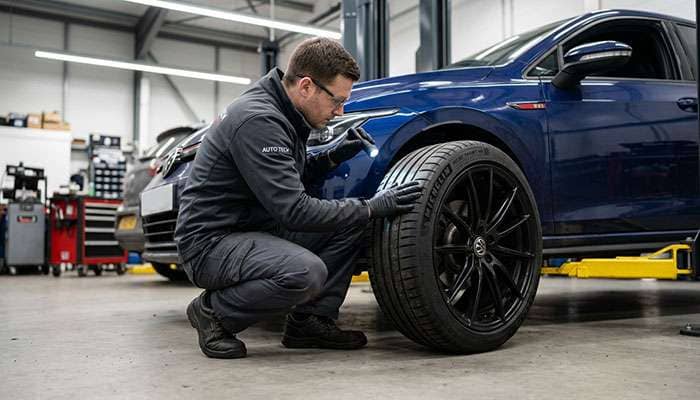
Park on a flat surface with good lighting. Start at the valve stem and work your way around each tire systematically. Look at the full outer sidewall — not just the visible portion when the tire is in the normal position. You're looking for: any protrusions or bubbles (run your hand along the sidewall — a bulge you can feel but not quite see is still a bulge), cuts of any depth, chunks of missing rubber, scrapes where rubber has been removed, cracks especially those that are deep enough to see into, and any discoloration or distortion in the sidewall profile.
Don't forget the inner sidewall — the side facing the vehicle. This is the side that contacts curbs first when you park too close, and damage here is just as serious as damage on the outer face. You'll need to turn the wheel to full lock in each direction to see the inner sidewall fully, or get low and use a flashlight to check the inward-facing surface.
Any time you hit a pothole hard, scrape a curb, or feel an unusual impact while driving, inspect all four tires before your next drive. Not after — before. Bulges from impact can develop within minutes of the impact, and driving on a freshly bulged tire even a short distance increases the risk of blowout. If you hit something significant and aren't near somewhere you can safely stop and inspect, drive to the nearest safe location at reduced speed, then inspect before continuing.
You've found damage. Here's exactly what to do, in order.
Use the table at the top of this guide. Is it a bulge? A cut? A scrape? Cracking? Each has a different urgency level and a different action path. If you're not sure what you're looking at, err toward caution — treat it as more serious rather than less serious until a professional has confirmed otherwise.
If the damage falls into the "stop driving now" category, don't drive to the shop on the damaged tire. Install your spare tire first, then drive to the shop on the spare. If your spare is a compact donut spare, remember it has speed and distance limitations — typically 50 mph maximum and 50–70 miles before replacement. Get to a tire shop quickly. If you don't have a serviceable spare, call for roadside assistance rather than driving on a compromised tire.
If you're unsure whether what you see is superficial or structural, get it in front of a professional. A quick inspection takes minutes and gives you certainty. Most reputable tire shops will do a visual inspection at no charge — they're not going to charge you just to look at the tire. What they tell you may or may not require a purchase, but you'll know with certainty rather than guessing.
If you're replacing one or two tires due to sidewall damage, evaluate the condition of the remaining tires at the same time. If they're worn, mismatched, or old, this is the opportunity to address everything in one visit. When you do need replacement tires, browse tires at Performance Plus Tire — filter by your vehicle and size to find the right replacement in the right load rating and speed rating for your car. If you're replacing only one or two, always put the new tires on the rear axle for best safety outcomes.
If the damage was from a pothole, your municipality may have a pothole damage claim process. If it's a manufacturing defect (a bulge on a relatively new tire with no impact history), contact the manufacturer — some defects are covered under warranty. Road hazard coverage, if you purchased it, typically covers damage from road debris and potholes. Keep the damaged tire and any documentation of where and when the damage occurred. If financing the replacement is needed, options are available to keep an urgent safety repair from becoming a budget crisis.
The sidewall is not the tread. The rules that apply to a nail in the tread — plug it and drive — do not apply to the sidewall. Sidewall damage is serious, often unrepairable, and can lead to sudden catastrophic failure without warning. The type and depth of damage determines urgency, but the bar for "acceptable to drive on without professional assessment" is very high. A bulge or bubble means stop driving now. A puncture means the tire is done. A deep cut that reaches the cords means the tire is done. A shallow surface scrape or hairline cracking in an otherwise sound tire may be manageable — but get a professional eye on it before you decide that.
Don't ignore sidewall damage hoping it goes away. It doesn't go away. It gets worse, and it fails at the worst possible moment. If you've found sidewall damage that needs replacement, Performance Plus Tire carries tires in every size across every performance category — from standard all-season replacements to performance and truck applications. Find your size, confirm your specs, and get back on the road safely.
Here's every type of sidewall damage and what to do about it — condensed.
• Bulges and bubbles mean stop driving immediately: A sidewall bulge indicates broken internal cords. The tire cannot be repaired, cannot be driven on safely, and will fail without warning. Install the spare and get to a shop.
• Sidewall punctures and deep cuts are always replacements: Unlike tread punctures, sidewall damage cannot be patched. The continuous flexing of the sidewall makes any repair unsustainable. Any shop offering to repair a sidewall puncture should be avoided.
• Surface scrapes and shallow cuts may be manageable: Curb rash and very shallow cuts that don't reach the internal cords may be cosmetic — but get professional confirmation before deciding they're safe. Low-profile tires have less rubber between the surface and the cords, so treat scrapes more seriously on those.
• Cracking varies from minor to urgent: Fine surface checking on a relatively new tire is a monitoring situation. Deep cracks, widespread cracking, or any cracking on a tire older than 6 years is a replacement trigger.
• Inspect after every significant impact: Pothole and curb strikes can cause internal cord damage that manifests as a bulge hours or days later. Inspect all four tires — including inner sidewalls — after any hard impact before your next drive.
No. A sidewall bubble indicates that internal cords have broken and air has migrated between the inner liner and outer rubber. The structural integrity of the tire is compromised and it can fail without any warning at any moment. Do not drive on a tire with a sidewall bubble — install your spare and replace the tire immediately. A sidewall bubble cannot be repaired under any circumstances.
In most cases, no. Bulges, punctures, and cuts that reach the internal cords cannot be safely repaired — the sidewall flexes continuously under load, and any repair material will eventually fail under that dynamic stress, usually suddenly. The industry consensus from tire manufacturers, NHTSA, and the Tire Industry Association is that sidewall damage generally requires replacement rather than repair. Be skeptical of any shop that offers to repair a sidewall puncture or bulge — the liability of a subsequent blowout far outweighs any repair savings.
The threshold varies by damage type. Any bulge is too much — there's no acceptable bulge size. Any puncture is too much. Any cut that exposes the internal cords (visible fibrous material in the cut) is too much. For surface cuts without cord exposure, cuts deeper than approximately 1/4 inch should be professionally evaluated and likely replaced. For cracks, deep visible cracking or any cracking combined with a tire older than 6 years is too much. When in doubt, err toward replacement — a new tire costs far less than a blowout.
A sidewall bubble appears as a distinct protrusion or blister on the side of the tire — a localized area where the sidewall bulges outward beyond the normal tire profile. It can range from the size of a marble to significantly larger, and may be visually obvious or only detectable by running your hand along the sidewall and feeling the irregularity. The outer rubber appears intact and the tire holds air normally, which is what makes it deceptive — the external appearance gives no indication of how close it is to failure.
It depends on the damage type. For surface scrapes, shallow cuts without cord exposure, and hairline cracking, driving carefully to a shop for evaluation is acceptable — drive at reduced speed and avoid highway speeds. For bulges, punctures, deep cuts with exposed cords, and severe cracking: install your spare first, then drive to the shop on the spare. Do not drive on a bulged tire even a short distance if you can avoid it — the failure risk is real and the consequences are severe. If you don't have a functional spare, call roadside assistance.