
A customer rolled into the shop last spring ready to pull his hair out. He'd bought a beautiful set of aftermarket wheels for his F-150, had them mounted and balanced at a chain tire shop, torqued to spec, all the right lug nuts. Everything by the book. And at 45 miles per hour, the steering wheel shook like it was trying to get off the column. He'd taken the truck back to the shop three times. They rebalanced the wheels twice, checked the tires, checked the lug nut torque. Nothing.
I put it up on my lift, spun the wheels by hand, watched the centerlines. Two of the four wheels were wobbling almost a sixteenth of an inch off true. Not bent. Not out of balance. Just not centered on the hub. The center bore on his aftermarket wheels was 87 millimeters. The hub on his truck was 78 millimeters. That's a nine-millimeter gap — almost three-eighths of an inch of slop between where the wheel sits and where the hub is actually pointing. No balance job in the world was going to fix that. He needed a set of hub-centric rings, which ran him about thirty-five bucks and took ten minutes to install. Vibration gone.
That's the hub-centric versus lug-centric question in a nutshell. If you're running aftermarket wheels and you've got a vibration that nobody can diagnose, this is almost certainly what's going on. Let me walk you through what the terms mean, why it matters, and when you need to worry about it.
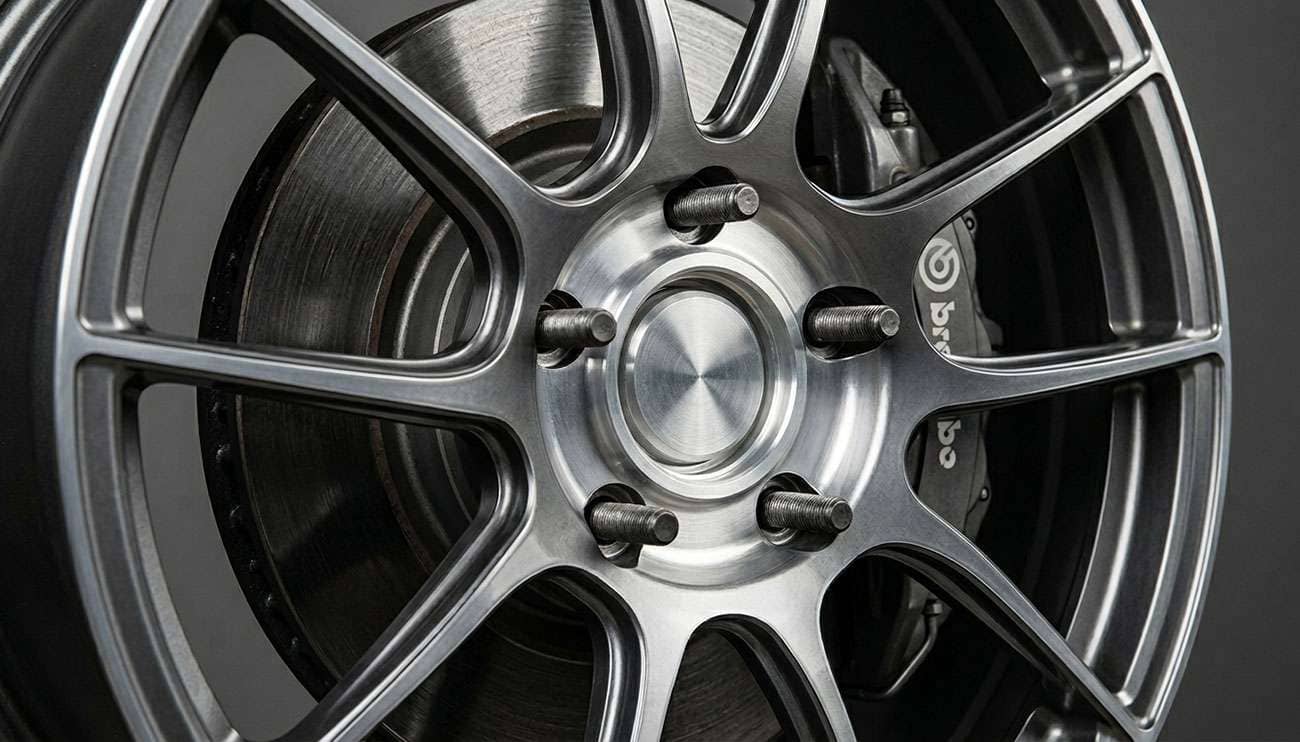
Every wheel has two sets of holes on the back side. The lug holes, where the lug nuts or wheel bolts go through to attach the wheel to the hub studs. And the center bore, which is the big round hole in the middle that sits over the raised ridge on the vehicle's hub. Those are the two things that can keep a wheel centered on the hub — the lug holes, or the center bore.
Hub-centric means the wheel is centered by the center bore. The bore is machined to exactly match the raised hub diameter on the vehicle. When you set the wheel on the hub, it drops over that raised ridge with almost zero slop — a few thousandths of an inch at most. The wheel is already perfectly centered before you touch a single lug nut. The lug nuts just hold it there.
Lug-centric (sometimes called lug-centric mounting or lug-conic mounting) means the wheel is centered by the lug nuts themselves. The center bore on the wheel is bigger than the hub — sometimes significantly bigger — so the wheel doesn't touch the hub in the middle. Instead, when you tighten the lug nuts, their tapered seats wedge into the lug holes and pull the wheel into center alignment. The lug nuts are doing double duty: clamping the wheel AND centering it.
Both systems can work. A properly designed lug-centric setup using quality lug nuts and careful installation holds a wheel true. But in my shop experience, hub-centric is more forgiving, more consistent, and causes a lot fewer mystery vibration calls. That's why modern OEM wheels are almost universally hub-centric.
Here's the geometry. The hub on your car or truck sticks out from the rotor face as a raised cylindrical boss — a machined ridge that the wheel mounts over. That hub boss has a specific diameter. On a modern Honda, it might be 64.1 mm. On a Ford half-ton truck, 87 mm. On a GM 1500, 78 mm. BMWs typically run 72.56 mm. The manufacturer machines that hub to a precise diameter, and they machine the factory wheel's center bore to match it within a few thousandths.
When you lift a hub-centric wheel onto the hub, it drops down onto that raised boss and is immediately locked in the correct position. The weight of the wheel rests on the boss, not on the wheel studs. The lug nuts just hold it against the rotor face — they don't have to carry any lateral load to keep the wheel centered.
On a lug-centric wheel with an oversized center bore, the wheel doesn't touch the hub boss at all. When you're holding the wheel up trying to get those first lug nuts started, you're holding the full weight of the wheel on the studs. Gravity tends to pull the wheel down so the top lug holes sit against the top of their studs and the bottom lug holes hang off the bottom of theirs. If you tighten the lugs that way, the wheel gets locked in slightly off-center — and that's where mystery vibrations come from.
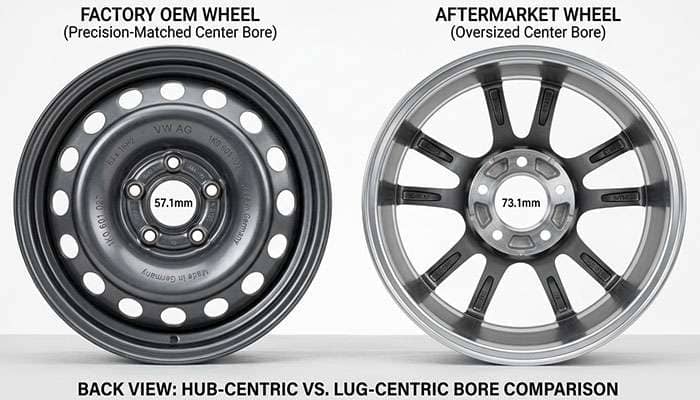
When the factory builds a 2025 Toyota Camry, every single one of those cars has the same hub diameter. Toyota knows exactly what that number is — 60.1 mm, pick your value — and they machine the factory wheels to drop on with a precision fit. There's no reason for them to make it any other way, because every Camry shares the same hub spec.
This means OEM wheels are always hub-centric by design. They're machined for one hub specification, they drop right onto that hub, they stay centered forever. Swap a factory wheel off a factory car onto a different vehicle and you've got problems — the bore won't match. But on the original car, it's dead-on every time.
Factory engineers love hub-centric because it solves two problems at once. First, it takes the centering load off the wheel studs, which means the studs can be optimized for clamping force rather than lateral load. Second, it makes balance shops' lives easier. A hub-centric wheel gets balanced on a machine, bolted onto the car, and stays in the same rotational orientation forever. Balance job holds.
Aftermarket wheels are a different animal. The guys building aftermarket wheels have to design one wheel that fits a huge range of vehicles. A single-piece cast aluminum wheel from any of the big aftermarket brands — American Racing, Fuel, KMC, XD — might be available in dozens of bolt patterns to fit everything from a Civic to a Tundra. Each of those vehicles has a different hub diameter.
The solution is to machine the wheel's center bore larger than the biggest hub diameter that wheel is ever going to see. Call it 108 mm, or 110 mm, or even 115 mm on some truck wheels. That way the wheel will physically slide onto any hub in the list of compatible vehicles without binding. Then the gap between the oversized bore and the smaller actual hub gets filled with a hub-centric ring — a cheap plastic, aluminum, or steel spacer sleeve that slides into the wheel's bore and around the vehicle's hub.
This is a manufacturing economics decision. It lets one wheel SKU serve a dozen applications. The trade-off is that you, the owner, are responsible for getting the right hub-centric ring. Most reputable wheel shops include the right rings when you buy the wheels, which is exactly why we ship hub rings free with every aftermarket wheel we sell. Some shops don't include them. Some installers forget them. And that's the scenario that lands trucks on my lift with vibrations nobody can figure out.
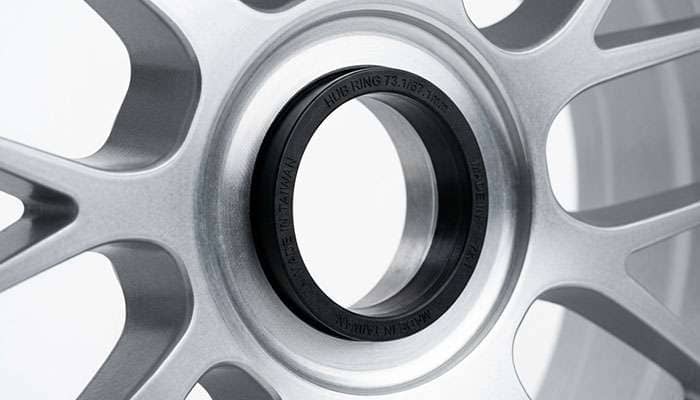
A hub-centric ring is a cylindrical sleeve, usually 3 to 15 mm thick, that fills the gap between an aftermarket wheel's oversized center bore and the vehicle's smaller hub. Its outer diameter matches the wheel bore; its inner diameter matches the hub. You slide it into the wheel from the back side, and it stays seated against the back of the wheel barrel.
When you mount a wheel equipped with hub-centric rings, the ring's inner surface contacts the vehicle's hub boss, and the ring's outer surface contacts the wheel's bore. Now the wheel is centered by the hub again — just through an intermediate sleeve rather than direct contact. Functionally, you've converted a lug-centric aftermarket wheel into a hub-centric one.
Good rings fit snug. You press them into the wheel with a firm push, they don't fall out when you flip the wheel over, and they stay put during installation. Cheap or mismatched rings rattle, fall out during installation, or sit off-center themselves — none of which does you any favors.
The specs are simple. You need two numbers: the wheel's center bore diameter (larger number, in millimeters) and the vehicle's hub diameter (smaller number, in millimeters). A hub ring spec looks like "108 to 78.1" — meaning it fits a 108 mm wheel bore and a 78.1 mm hub. Get those two numbers right and the ring does its job.
Here's what tells me a customer's problem is a centering issue and not a balance issue or a bent rim.
The vibration appeared right after a wheel change. Balance issues usually creep in gradually as wheel weights fall off or tires wear unevenly. A centering problem shows up the moment new wheels go on and never goes away, no matter how many times you rebalance.
It vibrates at specific speed ranges. Centering-related vibrations typically show up between 35 and 55 mph, feel worse in the steering wheel than in the seat, and tend to plateau or fade slightly at highway speed. A true balance issue usually gets worse the faster you go.
Rebalancing doesn't fix it. You've taken the car to two or three shops. They've rebalanced, road-force balanced, rotated the tires. Some days it feels better, some days it's worse. That's the fingerprint of a wheel that's wobbling because it's not centered, not because it's out of balance.
Visible runout on a lift. Put the car up on a lift and slowly spin each wheel by hand while watching the tread or the outer lip. A wheel that wobbles in and out as it rotates — we call this "runout" — isn't bent. It's installed off-center. For a full diagnostic walk-through, see our guide on steering wheel vibration: is it your tires or your wheels.
Vibration changes when wheels are rotated position-to-position. If you rotate the front wheels to the back and the vibration pattern changes — maybe the steering wheel calms down but now you feel it in the seat — you've essentially confirmed the wheel-and-hub combination is the culprit, not the tire or the balance.
I don't want anyone walking away thinking lug-centric is always wrong. There are applications where it's perfectly acceptable and sometimes even preferred.
Drag race wheels with mag lug seats. True drag race wheels often use a mag-style lug seat — a 60-degree flat taper with a shank that locates precisely in the lug hole. Paired with correct open-end lug nuts that bottom out in the hole, these setups can hold a wheel true by the lugs alone at racing speeds. Weld, Centerline, and Race Star have been doing this successfully for decades.
Custom billet wheels with machined lug bosses. Some high-end custom wheels are machined to such tight tolerance at the lug holes that lug-centric mounting is dead-on every time. If you're spending $2,000+ per wheel, this is often the case.
Short-duration track use. If you're swapping wheels on and off for race weekends, and you're carefully following a star pattern torque sequence while the car sits on the lugs just enough to center itself, lug-centric works fine. Just don't expect that same technique to produce perfect results every time during a rushed pit stop.
Properly engineered dedicated applications. Some race-only or purpose-built setups are lug-centric by design. The key word is "designed." They're engineered around lug-centric mounting, with specific lug nuts, specific studs, and specific torque procedures. That's very different from an aftermarket street wheel that ended up lug-centric because somebody forgot to install the hub rings.
For everything else — a daily driver, a cruiser, a lifted truck, a weekend project car — you want hub-centric mounting. It's more forgiving, easier to install correctly, and it isolates the lug nuts from lateral load.
Measuring tells you whether you need hub rings or not.
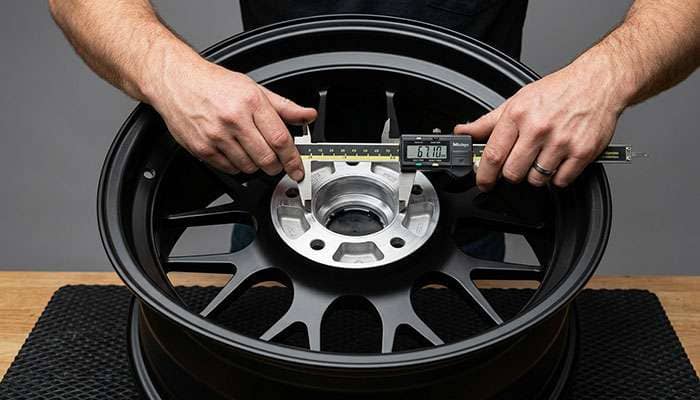
Measuring the wheel's center bore. Pull a wheel off the car and lay it face-down on a clean floor. Take a digital caliper or a good machinist's rule and measure the diameter of the big center hole. Measure across the center, not the edge. Record in millimeters. Example: 108 mm, 110 mm, 115 mm.
Measuring the hub. With the wheel off, look at the hub on the car. You'll see the brake rotor, the wheel studs sticking out, and a raised cylindrical boss in the center — that's the hub. Measure across the boss at its widest point. Record in millimeters. Example: 63.4 mm, 70.5 mm, 78.1 mm, 87 mm.
Doing the math. Subtract. If the difference is more than about 0.5 mm, you've got a lug-centric setup that needs hub rings. If the wheel bore and hub measurement match within a few tenths of a millimeter, you're hub-centric already.
Look up the specs if measurement isn't practical. Most reputable aftermarket wheel manufacturers publish the center bore spec on their product page. Your vehicle's hub diameter is sometimes in the owner's manual, usually in aftermarket wheel fitment databases, and always available from a good wheel shop. When in doubt, call somebody who knows fitment.
A decent wheel shop can measure both for you in about three minutes on a lift. If you're buying new wheels, insist that the seller include the correct hub rings in the package. For additional fitment detail on bolt patterns, offsets, and backspacing, our breakdown on wheel offset, backspacing, and bolt patterns explained covers the rest of the fitment picture.
Even with hub rings installed, there's a right and wrong way to mount a wheel. Here's how we do it in my shop.
1. Clean the hub and the wheel. Wire-brush any rust off the hub face and the wheel mounting surface. Corrosion between the surfaces throws off centering and makes the wheel hard to remove later.
2. Install the hub ring into the wheel. Press it in from the back until it seats. It should be snug but not require a hammer.
3. Lift the wheel onto the hub. With the ring installed, the wheel should drop straight onto the hub without binding and come to rest with zero slop. If it's still sloppy, the ring isn't right.
4. Start all lug nuts by hand. Thread every nut finger-tight before touching a wrench. This confirms the wheel is centered and evenly seated before you apply any clamp force.
5. Tighten in a star pattern. Never tighten consecutive lugs. Work across the wheel in a star pattern so the wheel is pulled down against the rotor evenly, not one side at a time.
6. Torque to spec. Every vehicle has a torque spec — typically 80 to 150 foot-pounds depending on vehicle weight and lug size. Use a proper torque wrench, not a breaker bar. For the full procedure, see our guide on how to torque lug nuts perfectly.
7. Re-torque after 50 to 100 miles. The wheel settles in, the materials compress slightly, and the initial torque reading can loosen. A quick re-torque after that break-in period is cheap insurance.
Hub rings come in three materials. Each has its place.
Plastic (polycarbonate, ABS, or similar). The most common type and what ships free with most aftermarket wheel packages. Lightweight, won't corrode, zero galvanic reaction with aluminum wheels. Plenty strong enough for street use — remember, the lug nuts carry the clamp force. Downside: they can distort in extreme heat (think heavy-duty towing or continuous track use) and they wear out faster than metal over many install/remove cycles.
Aluminum. A step up. Better heat tolerance, rigid, won't corrode, pairs well with aluminum wheels on aluminum hubs. Cost about double what plastic rings cost. I recommend these for trucks that tow, performance cars driven hard, or anyone who swaps wheels frequently.
Steel. Overkill for most street applications. Heavy-duty commercial, tow truck, or high-heat racing use cases where the maximum possible rigidity matters. Downside: steel-on-aluminum-hub contact can create mild galvanic corrosion over time, especially in salt-belt climates. Manage that with a light smear of anti-seize on the hub boss.
For 95 percent of street vehicles, plastic rings are completely sufficient. Just make sure they're the right size and that they stay in the wheel when you flip it around to install it.
Hub-centric versus lug-centric is one of those little details that separates a wheel install that works flawlessly from one that produces a mystery vibration nobody can figure out. For the vast majority of street vehicles — daily drivers, pickups, classic cars, and weekend cruisers — you want hub-centric mounting. That means either an OEM-spec wheel that matches your hub exactly, or an aftermarket wheel fitted with the correct hub-centric rings to close the gap.
If you've got a vibration you can't diagnose after a fresh wheel install, pull a wheel and measure. More often than not, the problem is sitting right there in the center bore. Thirty-five bucks and ten minutes of labor later, the truck drives like new.
At Performance Plus Tire, every aftermarket wheel package we ship includes the correct hub-centric rings for your specific vehicle — no extra charge, no guesswork on your end. We've seen too many customers come in with vibration complaints caused by missing rings from other retailers to let that happen on our watch.
Hub-centric wheels are centered by the vehicle's raised hub boss fitting into a precisely machined center bore on the wheel. Lug-centric wheels are centered by the lug nuts themselves as they tighten into tapered lug seats. Hub-centric is more forgiving and consistent; lug-centric requires careful installation technique to avoid vibration issues.
Almost always yes. Aftermarket wheels typically have oversized center bores to fit multiple vehicle applications, which means they don't drop onto your specific hub with the precision fit an OEM wheel would. A hub-centric ring fills the gap and converts the installation back to hub-centric mounting. Most reputable wheel sellers include the correct rings with your wheel purchase.
Yes, especially if installation technique is inconsistent. Without a hub boss doing the centering work, the lug nuts alone have to pull the wheel into true alignment as they tighten. If the wheel shifts even slightly before the nuts seat, the wheel ends up installed off-center, producing a vibration that no amount of rebalancing can fix.
Yes. Factory wheels are machined for the exact hub diameter of the vehicle they ship on, producing a precision fit with effectively zero slop between the wheel bore and the hub boss. This is why a factory wheel almost never produces a centering-related vibration.
Lay the wheel face-down on a clean floor and measure the diameter of the large center hole using digital calipers. Measure across the widest point, not the edge. Record the number in millimeters. Compare that figure to your vehicle's hub diameter, which is measured across the raised boss at the center of the brake rotor. The difference tells you whether you need hub-centric rings.
Yes, for street use. Plastic hub-centric rings are completely adequate for daily driver applications because they're not carrying clamp force — the lug nuts handle that. The rings only center the wheel. Plastic resists corrosion, doesn't react galvanically with aluminum wheels, and ships with most aftermarket wheel packages. Aluminum or steel rings are preferred for heavy-duty towing, continuous track use, or frequent wheel swaps.



