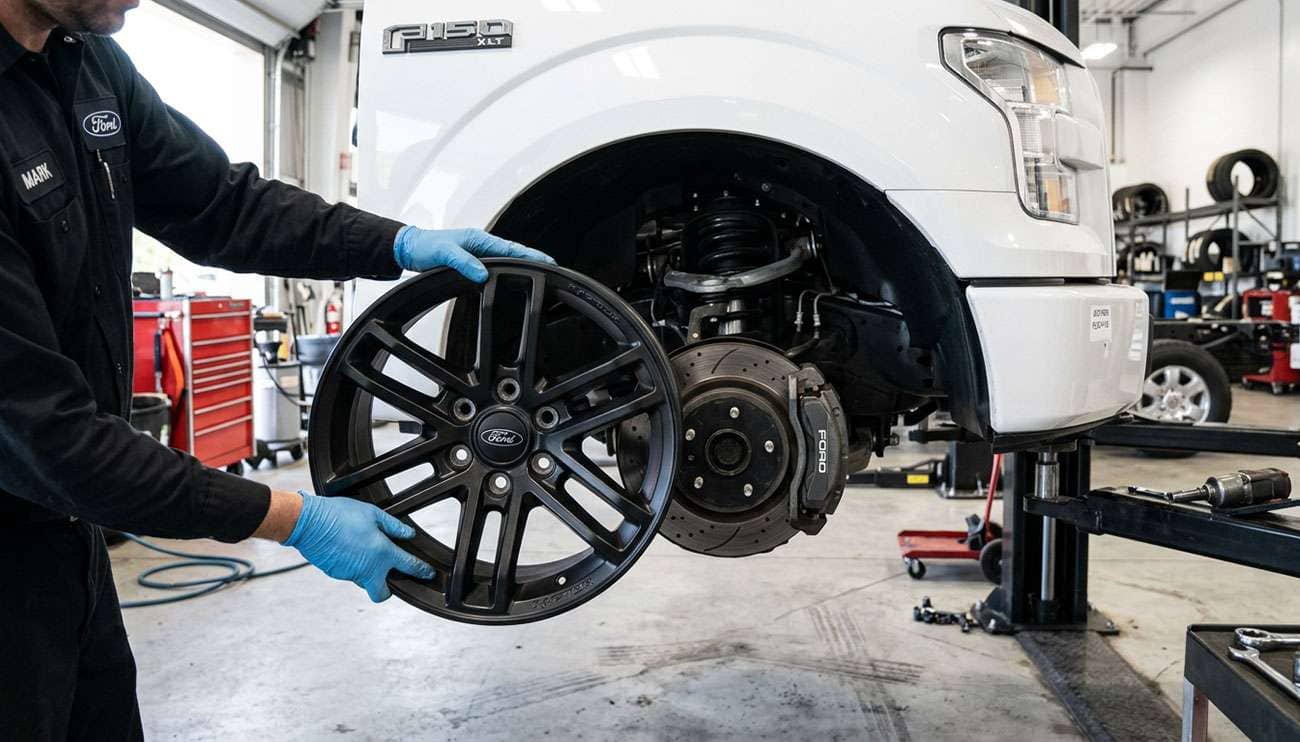
Yes, on nearly every one. Every factory F-150 Raptor wheel since 2010 matches the hub of every 2004 and newer six-lug F-150: the same 6x135 bolt pattern, 87.1 mm bore and M14 studs. Most answers stop at "same bolt pattern." The part nobody puts in front of you is that the Raptor's stance doesn't live in the wheel. A 17x8.5 Raptor wheel at +34 mm sits less than an inch further out than a stock 17-inch F-150 wheel. The tire that usually comes on it, plus three truck-specific details, decides whether the swap works.
Use the first table to see whether the wheel itself goes on your truck, then the second to see which tire belongs on it.
Your F-150 |
Raptor Wheels Bolt On? |
Lug Nuts to Use |
Watch For |
|---|---|---|---|
1997-2003 F-150 and 2004 F-150 Heritage |
No |
Not applicable |
Five-lug 5x135 hub; no six-lug wheel fits |
2004-2014 F-150 |
Yes |
Your truck's M14 x 2.0 nuts |
Tire size; newer Raptor TPMS sensors may not talk to your truck |
2015-2020 F-150 |
Yes |
Your truck's M14 x 1.5 nuts |
Tire size; 2010-2014 Raptor wheels need your nuts, not theirs |
2021-2023 F-150 |
Yes, unless it has Max Trailer Tow |
Your truck's M14 x 1.5 nuts |
Rear brake clearance on Max Trailer Tow trucks |
2024 and newer F-150 |
Yes, unless it has Max Trailer Tow |
Your truck's M14 x 1.5 nuts |
Pre-2024 Raptor TPMS sensors run on a different frequency |
F-150 Lightning |
No, not at 17 inches |
Not applicable |
Ford's Raptor R wheel kit is listed as not compatible |
If the wheel goes on, the tire decides the rest. Raptor wheels usually come with Raptor tires, and that is where most regular F-150s run out of room.
Tire on the Raptor Wheel |
Height x Width |
Stock-Height F-150 |
With a 2 to 2.5 Inch Level |
Typical Approved Rim Width |
|---|---|---|---|---|
265/70R17 (factory XL and XLT size) |
31.6 x 10.4 in |
Fits |
Fits |
7 to 9 in |
285/70R17 |
32.7 x 11.2 in |
Fits most trucks |
Fits |
7.5 to 9.5 in |
33x12.50R17 |
33.0 x 12.5 in |
Owners report it fits |
Fits |
8.5 to 11 in |
285/75R17 |
33.8 x 11.2 in |
Owners report it fits; check full lock |
Fits |
7.5 to 9.5 in |
LT315/70R17 (Raptor's 35-inch tire) |
34.4 x 12.4 in |
Some trucks clear; light rub at full lock is common |
The usual owner setup |
8 to 11 in |
37x12.50R17 (Raptor 37 package) |
37.0 x 12.5 in |
No |
No; suspension-lift territory |
8.5 to 11 in |
Yes, from 2004 on. Ford moved the F-150 to six lugs on a 135 mm circle with the 2004 redesign, and every Raptor from the 2010 SVT Raptor through today's Raptor R uses the same 6x135 pattern and the same 87.1 mm hub bore. Because the bore matches, a factory Raptor wheel centers on a regular F-150 hub exactly the way the truck's own wheel does, with no hub-centric ring.
Two older trucks are out. The 1997-2003 F-150 and the 2004 F-150 Heritage, a carryover of the old design, use a five-lug 5x135 pattern. No Raptor wheel fits either one. Our guide to what cars have a 6x135 bolt pattern covers the rest of the family, and the Expedition is the one most people ask about next. Raptor wheels fit a 2017 and newer Expedition for the same reasons, with the same tire problem, as our breakdown of whether F-150 wheels fit an Expedition explains.
Here is what Ford actually put on each Raptor generation:
Ford Performance has also sold its Raptor beadlock wheel, 17x8.5 at +34 mm, as a part listed for 2021-2024 F-150s, not only Raptors. Every wheel on that list is a 17, and that detail comes back in the brake section.
Less than an inch on most trucks. The Raptor's extra width is real. Ford lists the Raptor at 86.3 to 86.6 inches wide without mirrors, against roughly 79.9 inches for a standard 2015 and newer F-150. That works out to about 3.25 inches per side. Almost none of it comes from the wheel. It comes from the Raptor's suspension and flared fenders, which don't ship with a set of take-offs.
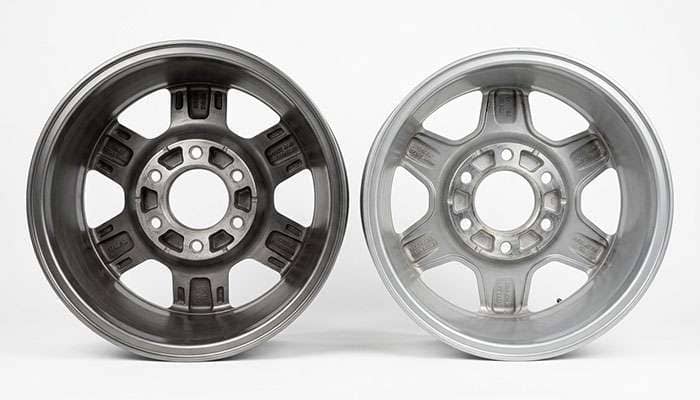
Here is the math. Most factory 17- and 18-inch F-150 wheels are 7.5 inches wide at +44 mm. A Raptor wheel is 8.5 inches wide at +34 mm.
Against the 8.5-inch-wide factory 20 at +44 mm, a Raptor wheel moves both edges outward by 10 mm, about 0.4 inch, which actually gives the tire a little more room on the inside. The Raptor R's forged wheel at +30 mm pushes the outer lip about 1.05 inches past a stock 17x7.5. In backspacing terms, a Raptor wheel runs about 6.1 inches, and a stock 17x7.5 at +44 mm works out to about 6.0.
By aftermarket standards, that is a mild wheel. Across the 17-inch 6x135 wheels on the market, the median offset is 0 mm, about 9 in 10 sit at +18 mm or lower, and fewer than 2 in 100 run +30 mm or higher. A zero-offset 17x8.5 puts the tire about 1.3 inches further out than a Raptor wheel does. So the Raptor wheel won't hide a tire that's too big for your fender opening.
This is the question the bolt pattern answer skips. Raptor wheels are usually sold with Raptor tires on them, and the standard Raptor tire is an LT315/70R17. Ford calls it a 35-inch tire. On paper it is 34.4 inches tall and 12.4 inches wide, against 31.6 by 10.4 inches for the 265/70R17 on a 17-inch XL or XLT.
Our guide to the biggest tire on a stock F-150 with no lift puts the practical ceiling on an unmodified truck at about 33 inches, and treats 34.8 inches as the point where a level, trimming or both become the expectation. The 315/70R17 lands between those numbers, and owner reports land in between too:
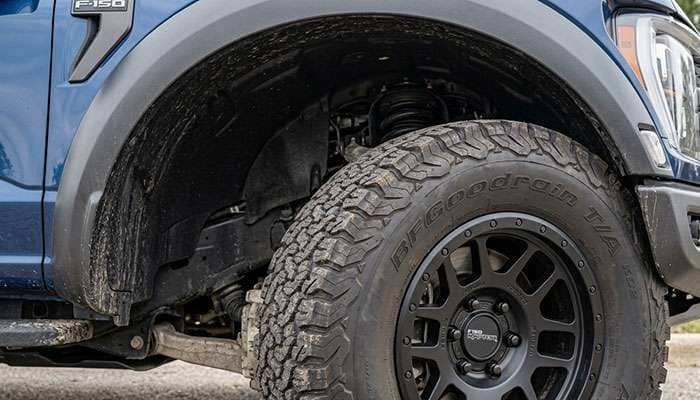
Trucks that run them without complaint usually have a 2 to 2.5 inch leveling kit. The 315's height is also why Raptor take-offs often fit a leveled F-150 when a true 35x12.50 doesn't. At 34.4 inches, it sits most of an inch under a real 35, and our lift kit tire size chart treats a true 35 on a half-ton as a suspension-lift job.
Take-offs from a 37-inch-package Raptor are a different project. A 37x12.50R17 is 2.6 inches taller than the 315/70R17, and 37-inch tires in that size average about 76 pounds each. On a regular F-150, that is full suspension-lift territory with trimming, the same class the lift chart puts every 37 in. Some Raptor owners report that 37-package wheels and tires won't even clear a stock earlier-generation Raptor.
If you want the Raptor wheel without the lift, change the tire, not the wheel. The Raptor's 8.5-inch width is a better platform for a wide 33 than a factory 7.5. Most 33x12.50R17 tires list an approved rim range that starts at 8.5 inches, which a stock 17-inch F-150 wheel doesn't meet and a Raptor wheel does. A 285/70R17 or 285/75R17 is the other common choice, and both sit comfortably inside the Raptor wheel's width.
No. Two F-150s are the exceptions where the wheel itself is the problem, and both come down to brakes.
2021 and newer with Max Trailer Tow: On 2021 and newer F-150s, Ford's Max Trailer Tow Package adds larger rear brakes. Owners consistently report that 17-inch wheels don't clear the rear calipers, and at least one aftermarket 17x8.5 F-150 wheel is listed as not compatible with 2021 and newer Max Tow trucks. One owner reported making Raptor beadlock 17s fit with a 1.25-inch spacer; I wouldn't build around that. If your truck has Max Trailer Tow, treat 18 inches as your minimum, which rules out every factory Raptor wheel.
F-150 Lightning: The Lightning is also 6x135, so the lug holes line up. Ford's Raptor R wheel kit is still listed as not compatible with it, and Lightning owners report 17-inch Raptor wheels hitting the brakes.
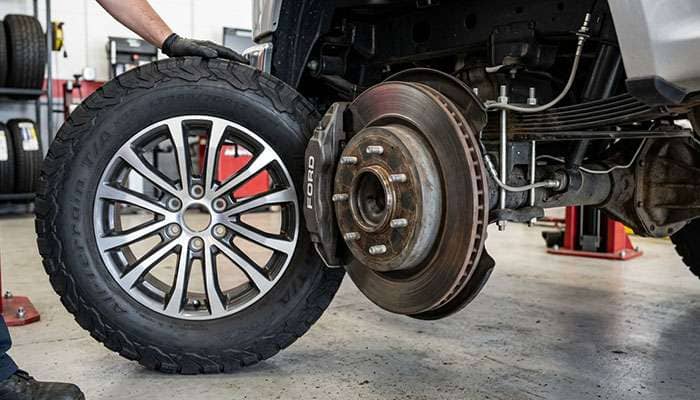
For everyone else, a 17-inch Raptor wheel clears the brakes. Ford put 17s on base XL trucks, and the Raptor's own brakes were designed around a 17. If your truck left the factory on 18s or 20s and you are not sure which tow package it has, check the window sticker or build sheet for Max Trailer Tow, then do a bare-wheel test fit. The method and the gap you want are in our guide to brake caliper wheel clearance.
Only when the truck and the wheel come from opposite sides of 2015. 2004-2014 F-150s use M14 x 2.0 studs, and 2015 and newer F-150s use M14 x 1.5. The Raptor followed the same split. A 2010-2014 SVT Raptor is an M14 x 2.0 truck, and 2017 and newer Raptors are M14 x 1.5.
The rule is simple: mount the wheels with your own truck's lug nuts, never the ones that came with the wheels. The two thread pitches look nearly identical, and an impact gun will happily drive the wrong nut onto a stud and ruin both. Hand-thread every nut at least two full turns before any tool touches it. Torque to Ford's spec for your truck, which is 150 lb-ft on most F-150 years (confirm it in your owner's manual), and check again after the first 50 to 100 miles.
Factory Raptor wheels share the F-150's 87.1 mm bore, so they center on the hub with nothing in between. Raptor-style replicas are a different story. About 4 in 10 aftermarket 6x135 wheels are bored larger than Ford's hub so one casting can fit several trucks, and those need hub-centric rings. Our guide to hub-centric vs. lug-centric wheels explains why the ring, not the lug nuts, should carry the wheel.
Sometimes, and the year line that matters here is 2024, not 2015. Every F-150 and Raptor built since the 2008 model year has direct tire pressure monitoring under NHTSA's FMVSS 138 requirement, with a sensor on the back of each valve stem.
Ford Performance pairs its Raptor wheel kits with one TPMS kit for 2015-2023 F-150s and a separate 433 MHz kit for 2024 and newer F-150s. One retailer's listing for the 2024-2025 Raptor wheel kit warns that its sensors aren't compatible with 2017-2023 Raptors. In practice:
Matching the sensor part number to your truck, or using programmable sensors set to your truck, is the dependable path. A pressure light you learn to ignore can't warn you.
This is the part that usually gets skipped. Ford rated the 2021 Raptor for 1,400 pounds of payload. The same year's regular F-150 tops out at 3,325 pounds. Ford sized the Raptor's tires for the Raptor's job, not for a work truck's.
2017-2023 Raptors left the factory on an LT315/70R17 in Load Range C, load index 113. That tire carries 2,535 pounds at its 50 psi maximum. Across the market, more than half of LT315/70R17 tires are Load Range E at load index 121, good for 3,197 pounds, and about 1 in 10 is the Load Range C build. A Raptor take-off set is likely to be the C, so read the sidewall before you assume.
Now compare it to your own placard, the tire and loading information label that FMVSS 110 requires on the door jamb:
The quick check: divide the rear gross axle weight rating (GAWR) on your door sticker by two. That is the minimum each rear tire must carry. A Load Range C 113 tops out at 2,535 pounds, so any rear GAWR above 5,070 pounds rules it out before you even get to inflation. If your truck came on Load Range E tires, put Load Range E back on.
On a factory Raptor wheel, the tire is the number to check first. Replicas need both checked. The most common rating on aftermarket 6x135 wheels is 2,500 pounds, and about 1 in 7 is rated lower. Ask for a rating tested to SAE J2530, and run the axle math in our wheel load rating guide.
They bolt on, with the same thread rules in reverse, but every factory Raptor wheel is a 17, so treat 17 inches as the floor and test-fit a bare wheel first. The bigger catch is the tire. A 17x7.5 factory F-150 wheel is narrower than the 8-inch minimum most LT315/70R17 tires list, so the Raptor's own tires don't belong on it. The +44 mm offset also tucks the tire about 0.9 inch further in on a truck built around a +34 mm wheel.
Regular F-150 wheels work best on a Raptor as a winter or spare set with a narrower tire, such as a 265/70R17 or 285/70R17.
A Raptor swap that's almost right costs you in stages, each more expensive than the last:
The fix costs less than any of it: a tire size that fits your truck on the Raptor wheel, or Load Range E tires if you need the capacity.
If the numbers don't work, or you'd rather start with a wheel sized for your truck, browse our 6x135 bolt pattern wheels and match the offset, bore and load rating to your F-150 before you buy.
Raptor wheels fit a regular 2004 and newer F-150 because the hub is the same: 6x135, 87.1 mm and M14 studs. The Raptor's stance comes from its suspension and fenders, so its wheel moves your tire out less than an inch, and the tire does the deciding. A 315/70R17 usually wants a 2 to 2.5 inch level, a 37 wants a real lift, and a factory Load Range C tire may not carry what your truck is rated to haul. Check the brakes on Max Trailer Tow trucks, use your own lug nuts and sort out TPMS by model year.
Yes. A 2015 F-150 shares the Raptor's 6x135 pattern, 87.1 mm bore and M14 x 1.5 studs. Use your truck's own lug nuts, especially with 2010-2014 SVT Raptor wheels, which came off M14 x 2.0 trucks. The tire mounted on the wheels is what decides whether you need a leveling kit.
Yes, unless the truck has the Max Trailer Tow Package. Max Trailer Tow trucks use larger rear brakes, and owners report that 17-inch wheels, including Raptor wheels, don't clear the rear calipers. Every factory Raptor wheel is a 17, so check your build sheet before you buy.
Factory Raptor wheels are 17x8.5 at +34 mm, with about 6.1 inches of backspacing, from the 2010 SVT Raptor through the current truck. The Raptor R's forged 17x8.5 runs +30 mm. Most regular F-150 factory wheels sit at +44 mm.
Sometimes. Owner reports for the Raptor's LT315/70R17 range from no rubbing at stock height to light rubbing at full lock, and most trucks that run them cleanly have a 2 to 2.5 inch leveling kit. The 37-inch tires from a Raptor 37 package need a suspension lift on a regular F-150.
No. Raptor wheels bolt directly to the F-150 hub with no spacers or hub-centric rings, because the bolt pattern and 87.1 mm bore match. Spacers would push the 12.4-inch-wide Raptor tire closer to the fender and make full-lock rubbing worse.
No. The Lightning shares the 6x135 bolt pattern, but Ford's Raptor R wheel kit is listed as not compatible with it, and Lightning owners report that 17-inch Raptor wheels hit the brakes.