
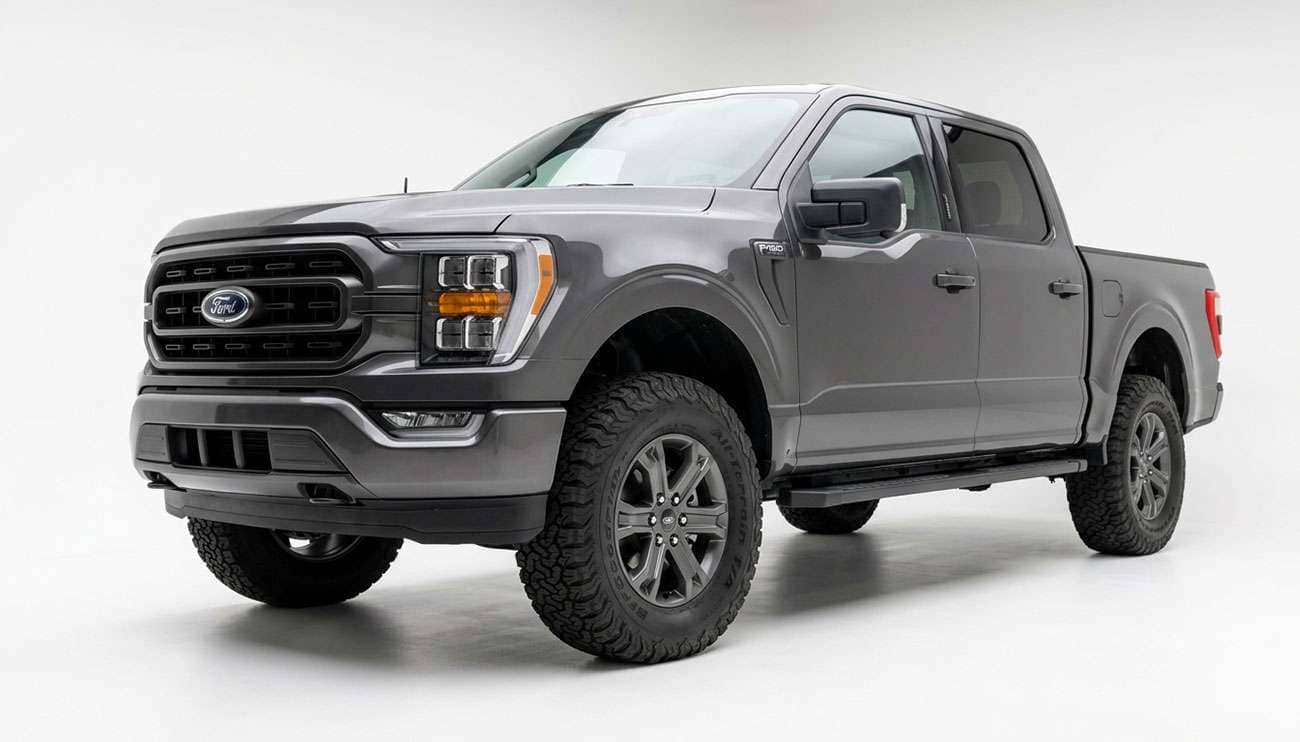
About 33 inches, and you don't have to take my word for it, because Ford builds one. The Tremor rolls off the line on a 33-inch tire, on a standard F-150 body, on stock suspension. That is the factory telling you where the ceiling is. What almost nobody mentions is that your starting point varies by nearly three inches of diameter depending on which F-150 you bought, and that the thing standing between you and that ceiling is usually your wheel rather than your wheel well.
Most charts hand you one number for the entire F-150 lineup. That works if everybody's truck came the same way, and they didn't. A base truck on 18s and a King Ranch on 20s are not the same fitment problem, and neither one is the Tremor. Let's sort out which one you're driving before we talk about what to buy.
Your factory tire |
Actual diameter |
Typically found on |
Room to the 33-inch ceiling |
|---|---|---|---|
265/60R18 |
30.5 in. |
Base and work-trim 18s |
About 2.7 in. of headroom |
265/70R17 |
31.6 in. |
XL and XLT on 17s |
About 1.6 in. of headroom |
275/65R18 |
32.1 in. |
XLT and Lariat on 18s |
About 1.1 in. of headroom |
275/50R22 |
32.8 in. |
Platinum and Limited on 22s |
Practically none, and the thinnest tire selection of the group |
275/60R20 |
33.0 in. |
Lariat and King Ranch on 20s |
You are already standing on it |
275/70R18 |
33.2 in. |
Tremor |
Ford already put the ceiling on your truck |
Find your row. If you're in the bottom two, the honest answer to "what's the biggest tire I can run" is that you're already on it, and anything further is a width conversation rather than a height one. If you're in the top three, you've got real room and this is an easier job than the internet makes it sound.
I've been putting wheels and tires on trucks since 1971, and one thing I've learned is that when a manufacturer builds a version of a truck with bigger tires on it, they've already done the engineering you're about to guess at.
The Tremor is a standard-width F-150. Same cab, same bed, same wheel openings, no fender flares extending the body. Ford put a 33-inch tire under it and sold it with a warranty. That is the most reliable data point in this whole conversation, and it beats every forum photo you'll find.
So what did Ford change to make it work? A modest bump in ride height over the off-road trims, and a wheel with a different width and offset than the standard truck's. That's essentially it. They didn't cut the body and they didn't widen it. Which means the path from your truck to a 33 is a ride height nudge and a wheel decision, not a fabrication project.
The Raptor is a different story and worth setting aside right now. It runs a 34-inch tire, but it also runs a substantially wider track and factory flares covering it. You cannot reason from the Raptor to your XLT. The Tremor you can, because it's your truck's body with better shoes on it.
Go look at your door jamb before you go any further. The placard tells you the original tire size, and that one line determines most of what follows.
Here's the thing that trips people up. A guy on 20-inch wheels with a 275/60R20 is already running a 33-inch tire and doesn't know it, because nobody ever told him that a 275/60R20 is 33 inches tall. He goes shopping for "a 33" thinking it's an upgrade and ends up with the same height he started with, in a wider casing, wondering why it rubs now when the old ones didn't.
Meanwhile a guy on a base truck with 265/60R18 has almost three inches of diameter available to him and thinks he needs a lift kit to use it. He doesn't. He needs a taller sidewall in the same wheel, and it'll bolt on and drive away.
That's the spread. Just under three inches of factory diameter across a lineup that people talk about as if it were one truck. Any answer that doesn't start by asking which F-150 you have is guessing at your truck from somebody else's.
The good news is that everything from the base wheel to the Tremor wheel shares the same hardware. Same bolt pattern, same hub bore, same lug thread across these trucks, which means factory wheels interchange freely and so do most aftermarket ones. If you're not sure what you're working with, our rundown on what runs the 6x135 bolt pattern covers the family.
Here's the part I wish somebody had told me thirty years ago, and the reason a lot of F-150 owners spend money on suspension when they should have spent it on wheels.
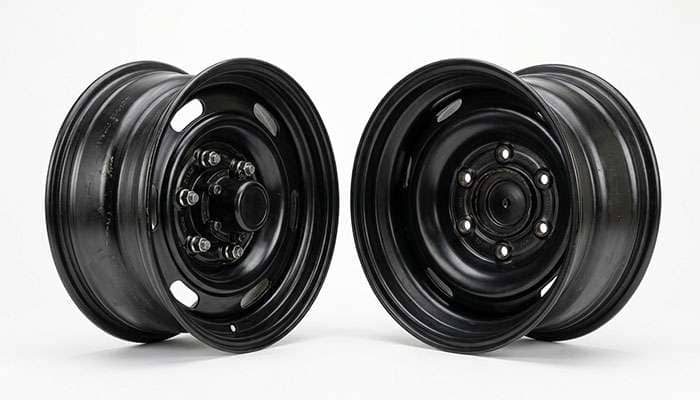
Factory F-150 wheels in the 17 and 18-inch sizes run narrow, generally in the seven-and-a-half to eight-and-a-half inch range, with a deep positive offset that tucks the wheel well inboard. Ford does that for steering feel, for scrub radius, and because it keeps the tire out of the spray path. It's a good engineering decision for a truck on the factory tire.
It is not a good starting point for a wide tire. A narrow rim squeezes the tire's section width down and stands the sidewalls up, which puts more of the tire's shoulder in the air instead of on the ground. And that deep offset pushes the whole assembly inboard, toward the control arms, the frame rail, and the crash bar, which on these trucks is where a lot of the contact actually happens.
Ford's own answer to this was to build a wider wheel with a lower offset for the trims that wear bigger tires. The Raptor's 17-inch wheel is wider and sits further out than a standard truck's, and it bolts directly onto any F-150 because the bolt pattern and hub bore never changed. Owners have run a 33-inch, 12.5-inch-wide tire on stock suspension using that wheel with no flares and no cutting, which is not a thing that happens on the narrow factory wheel.
You do not have to buy a factory takeoff to get there. Any aftermarket wheel in the eight-and-a-half to nine-inch width with an offset somewhere in the plus-twenty to plus-thirty-five range accomplishes the same thing, and there are a lot of them for this bolt pattern. The point is that the wheel is the lever, and it's the one most people never touch. Our F-150 aftermarket wheel guide gets into the ranges worth shopping, and the Raptor wheel guide covers the wider factory-style sizing.
One caution and I'll leave it alone. Going too far the other direction, to a zero or negative offset, pushes the tire out past the fender lip and puts you right back into trimming, plus it loads the wheel bearings and ball joints differently than the truck was drawn for. Wider is the goal. Sticking out is not.
Once you know your starting point and your wheel, here's the menu.
Size |
Diameter |
Section width |
What it asks of the truck |
|---|---|---|---|
275/70R18 |
33.2 in. |
10.8 in. |
The factory-proven 33. Widest selection at this height, fits the stock wheel |
275/65R20 |
34.1 in. |
10.8 in. |
An inch taller with no extra width. The easiest step up on a 20-inch truck |
285/70R18 |
33.7 in. |
11.2 in. |
Often recommended, but one of the thinnest selections in 18-inch truck sizing |
295/70R18 |
34.3 in. |
11.6 in. |
Reported to work on stock height with a proper wheel; liner trim likely |
33x12.50R17 |
33.0 in. |
12.5 in. |
Same height as the Tremor tire, much wider. Needs the wider wheel |
305/70R18 |
34.8 in. |
12.0 in. |
Past the stock ceiling. Expect a level, trimming, or both |
Two things to pull out of that table. The first is 275/65R20, which is the most underrated move on the whole list for a 20-inch truck. Same width you already have, an inch more height, deep selection, and it drops straight onto the factory wheel. Nobody talks about it because it isn't exciting, and it's the answer for a lot of guys.
The second is 285/70R18. It gets recommended constantly as the sensible 34, and it is one of the leanest selections in common 18-inch truck sizing. A handful of models rather than a category. Before you settle on it, make sure the tire you actually want exists in it.
Note also that every size on that list above the factory tire is light truck construction, which means a heavier casing and a load index that only pays out at its own rated pressure rather than the number on your door jamb. Look up the load and inflation table for whatever you land on and set your cold pressures from that.
Contact works through the wheel well in an order, and knowing the order tells you how much work your specific truck needs.
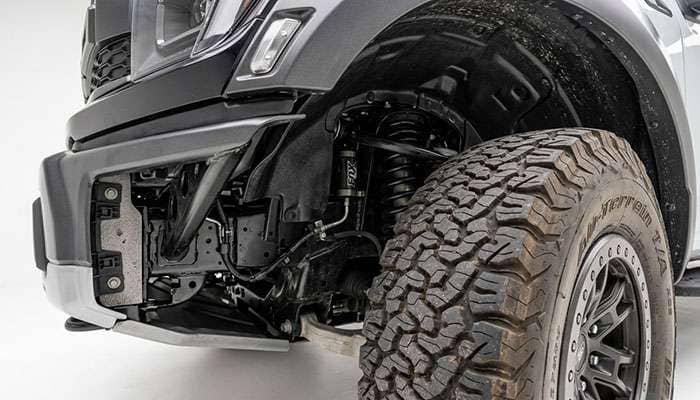
The mud flaps go first and they cost nothing. On a mild upsize with the right wheel, that's occasionally the whole job.
The plastic fender liner is next, and a heat gun with a trim tool will get you further than a knife will. The liner is where most of the noise comes from and it's the cheapest thing in there to modify.
Then the crash bars, and this one is specific to these trucks. There's structure behind the front of the wheel opening that a wide tire finds at full lock under compression, and it shows up in owner reports constantly. It's the difference between a tire that clears in the driveway and one that clears when you're actually using the truck.
The upper control arm and the frame rail are the inboard side of the same problem, and they're the ones a deep factory offset makes worse rather than better. That's the argument for the wider, lower-offset wheel in one sentence: it moves the tire away from the inboard structure without pushing it past the fender lip.
If you're already hearing something, our walkthrough on why your tires are rubbing helps you place the contact before you start cutting anything you can't put back.
It never stays where it started. I've pulled enough of these apart to know the sequence.
It opens as a scuff on the liner and a noise you only hear backing out of the driveway. Ignore it and the liner tears at its clips, hangs down, and then catches the tread on every compression instead of only at full lock. A cheap plastic part turns into a fender clip and a body shop visit.
Then it finds metal, and now you have a steel edge working against a sidewall. Sidewall rubber is the thinnest structural area on the tire and it's the one part that can't be repaired. Once the casing cords are compromised, that tire is done. No plug, no patch, no argument. If you're seeing a shiny scuff on a sidewall, read our piece on tire sidewall damage and whether it's safe to drive before you take that truck out of town.
And the guy who lets air out to quiet the rub is making it worse in a way he can't see. A light truck tire below the pressure its load requires runs hot in the shoulder, wears both outer ribs off, and heat is what tears belts loose at highway speed. NHTSA has been pointing at underinflation as a leading cause of tire failure for as long as I've been reading their bulletins.
There's one more cost that isn't damage but will annoy you daily. A 33 on a truck that came with a 31.6 reads the speedometer about four percent low, so an indicated 70 is closer to 73. Our article on how bigger tires affect your speedometer covers correcting it, and on these trucks a dealer or a handheld programmer can reset it for the new size in a few minutes.
Half an hour in the driveway settles this better than a week of forum reading.
Read the door jamb. Original tire size, cold pressures, and the axle weight ratings. Find your row in that first table.
Find your wheel's real numbers. Diameter, width, and offset are usually stamped on the back of the spokes or the inner barrel. If it's a factory wheel, look up the part number. Do not assume, because the factory numbers vary by trim and wheel.
Decide wheel first, tire second. If your wheel is narrow and deeply offset and you want real width, change the wheel before you pick the tire. Doing it the other way around is how people end up cutting.
Pick width against your offset, not height against a chart. Every 33 on the market is within a fraction of an inch on height. They spread out nearly two inches on width, and width is what makes contact.
Confirm the tire exists in the size. Some of the most-recommended sizes have the thinnest shelves. Check that your actual tire is offered before you commit to the number.
Test it turned, loaded, and compressed. Weight in the bed, steering to full lock both ways, roll slowly over a driveway lip with somebody watching the wheel well. A tire that clears parked and straight hasn't been asked anything yet.
The biggest tire on a stock F-150 with no lift is right around 33 inches, and the proof is that Ford sells one. If you're on a 20-inch truck you're already there and your next move is 275/65R20 for an easy extra inch. If you're on a base 18 you've got nearly three inches of room you didn't know about. If you want real width rather than just height, the wheel is what's holding you back, not the suspension.
And whatever you land on, look up the load and inflation table for that tire and set your pressures from it rather than from the door jamb, because every size above the factory tire is a heavier casing that wants a different number.
For the general version of this question across other platforms, our article on the biggest tire you can run without a lift covers the same reasoning more broadly. And when you're ready to look at the wheel that makes the tire work, our 18-inch off-road wheel selection lets you filter by width and offset before you buy.
Yes. Ford builds the Tremor on a 33-inch tire on a standard F-150 body with stock suspension, so a 33 at similar width fits without a lift. A narrow 33 such as a 275/70R18 goes on with little or no work. A wide 33 such as a 33x12.50 generally needs a wider, lower-offset wheel and some fender liner trimming to clear the inboard structure.
On 18-inch wheels, a 275/70R18 is 33.2 inches, which is the factory Tremor size. On 20-inch wheels, the factory 275/60R20 is already 33.0 inches. A 33x12.50R17 is a flat 33 inches and considerably wider than either. All three are called 33s and they are not interchangeable fitment problems.
Not on stock height without significant work. Sizes in the 34.8-inch range and up put you into trimming, a leveling kit, or both, and the wider ones reach the crash bars and inboard structure at full lock under compression. Ford's own 34-inch application is the Raptor, which uses a much wider track and factory flares that a standard F-150 does not have.
Not for a taller tire at the same width, which usually drops onto the factory wheel. You do for real width, because factory F-150 wheels in the 17 and 18-inch sizes are narrow with deep positive offset, which squeezes the tire's section width and pushes it toward the control arms and frame rail. A wider wheel with moderate offset is the single most useful change for a wide tire.
Some, and more from the weight and tread than from the height. A light truck casing in an aggressive tread pattern is heavier and has more rolling resistance than the highway tire it replaced, and that shows up at the pump. Correcting the speedometer for the new size also corrects the odometer, which means the mileage you calculate afterward is accurate where the old number was flattering.
They bolt on, because these trucks share a bolt pattern, hub bore, and lug thread across the lineup. The Raptor wheel is wider and carries a lower offset than a standard truck's wheel, which is exactly what a wide tire wants. Verify the specific offset of the wheel you are buying against your own, since factory numbers vary by trim and wheel part number.



