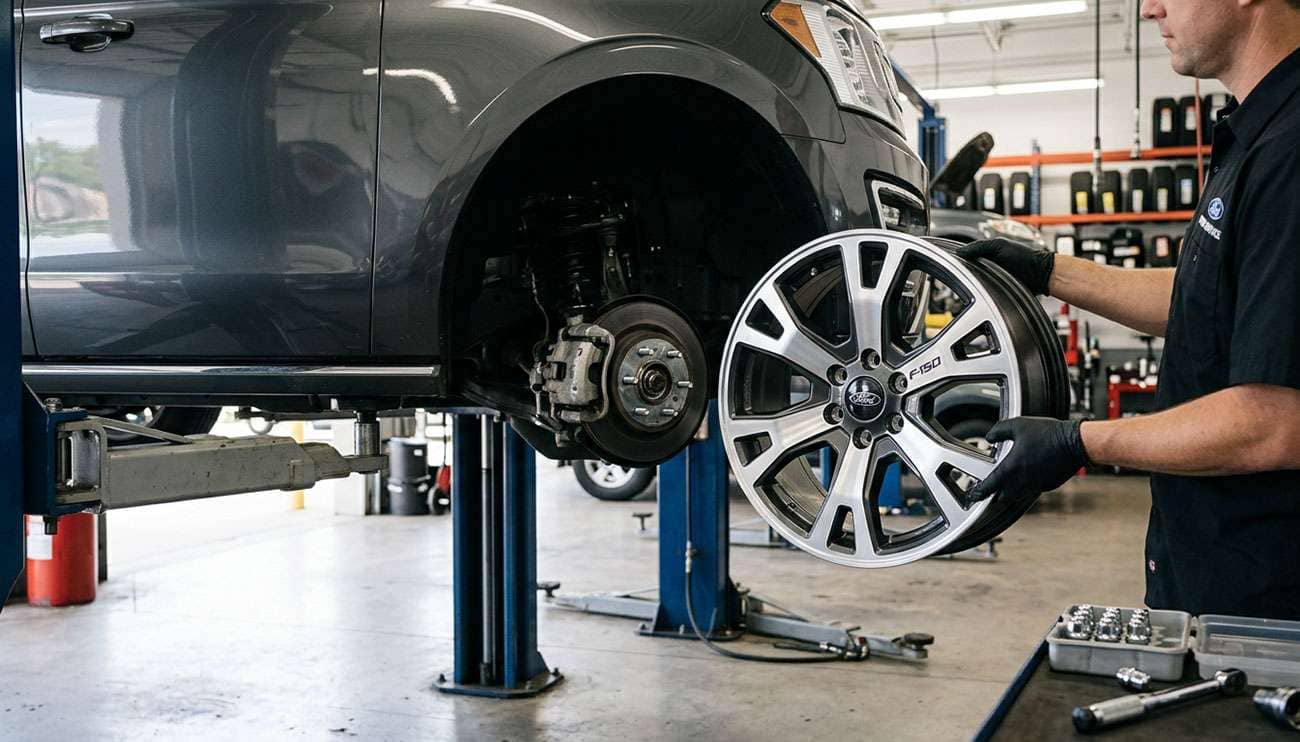
Short answer: yes, as long as both trucks are six-lug. Every 2004-and-newer F-150 and every 2003-and-newer Expedition shares the 6x135 bolt pattern, the 87.1 mm hub bore, and a +44 mm factory offset, and Ford has released some wheels under one part number for both trucks. What decides whether your swap is safe is the 2015 thread change: both trucks moved from M14 x 2.0 studs to M14 x 1.5 studs that model year. The second check is the wheel's load rating against your Expedition's rear axle rating. Most answers stop at "same bolt pattern" or "check your year." Here is what the year actually changes.
I'm Dennis Feldman, and I handle fitment questions at Performance Plus Tire. This swap lands on my desk whenever someone finds F-150 take-offs for half the price of new wheels. The wheels almost always bolt on. The trouble rides in the bag of lug nuts that comes with them, or in a load rating nobody checked before loading seven people and a camper onto a three-row SUV.
Start with the chart. Find the year of the F-150 the wheels came from, then find your Expedition.
F-150 Wheel |
Expedition |
Bolts On? |
Reuse the F-150 Lug Nuts? |
What Decides It |
|---|---|---|---|---|
2015 and newer |
2015 and newer |
Yes |
Yes, both M14 x 1.5 |
Load rating; 17-inch wheels on a 2018+ need a caliper test-fit |
2015 and newer |
2003-2014 |
Yes |
No, keep the Expedition's M14 x 2.0 nuts |
Lug nuts and TPMS sensors |
2004-2014 |
2003-2014 |
Yes |
Yes, both M14 x 2.0 |
Closest thing to a direct swap; some wheels share a Ford part number |
2004-2014 |
2015 and newer |
Yes |
No, keep the Expedition's M14 x 1.5 nuts |
Lug nuts and TPMS sensors |
1997-2003 (five-lug) |
1997-2002 (five-lug) |
Yes, 5x135 |
Only if the stud threads match |
Late-1990s trucks used M12 x 1.75 studs; 2000-up used M14 x 2.0 |
1997-2003, or 2004 Heritage |
2003 and newer |
No |
Not applicable |
Five lugs on the wheel, six on the hub |
2004 and newer |
1997-2002 |
No |
Not applicable |
Six lugs on the wheel, five on the hub |
Every six-lug combination bolts on. The lug nut column flips at 2015 on both trucks, in the same year. Same side of that line, the nuts interchange. Straddle it, and the nuts that came with the wheels go in a drawer.
The year tells you whether the wheel bolts on. Where the wheel came from tells you what to check next.
Wheel Source |
Hub Bore |
Offset |
Load Rating |
Verdict |
|---|---|---|---|---|
Ford factory alloy, 2004 and newer |
87.1 mm |
+44 mm |
Validated for the truck it shipped on; look up the cast part number |
Bolts on hub-centric; match the lug nuts to your Expedition |
Ford factory 17-inch steel |
87.1 mm |
+44 mm |
Look up the part number |
Fine on 2003-2017; test-fit on 2018 and newer |
2017-2020 Raptor 17x8.5 |
87.1 mm |
+34 mm |
Look up the part number |
Bolts on and sits slightly further out; the Raptor's tires are a separate question |
OE-style replica |
87.1 mm |
+44 mm |
Some 22-inch designs are rated 2,200 lb |
Confirm the rating beats your rear axle rating divided by two |
Aftermarket 6x135 |
87.1 mm, or larger on about 4 in 10 multi-fit designs |
Most run 0 mm or lower |
Most rated about 2,500 lb |
Hub rings for oversize bores, an offset check, and a stamped rating that clears your axle |
Yes, from the 2003 Expedition and 2004 F-150 forward. Both trucks use 6x135: six studs spaced evenly on a circle 135 mm across. Ford built the Expedition on F-150 underpinnings from day one, and the Lincoln Navigator rides the same hubs. For the full list of vehicles that share the pattern, see what cars have a 6x135 bolt pattern.
Before that, the 1997-2002 Expedition and 1997-2003 F-150 both ran 5x135. Five-lug wheels swap between those older trucks, never with anything six-lug.
Ford switched the two trucks to six lugs a year apart. The redesigned 2003 Expedition got six-lug hubs. The 2003 F-150 was still the old five-lug truck. Then for 2004, Ford sold the new six-lug F-150 alongside the F-150 Heritage, a carryover of the old design with five-lug hubs. So "2003-2004 F-150 wheels" can mean either pattern. Count the lug holes before you count your money.
Both trucks use an 87.1 mm hub bore, the hole in the center of the wheel that pilots on the hub. That match makes a factory F-150 wheel hub-centric on an Expedition: the hub centers the wheel and carries the load, and the lug nuts clamp it. When the bore is larger than the hub, the nuts have to do both jobs, which is how vibration and loosening start. The difference is laid out in hub-centric vs lug-centric wheels. Factory Ford wheels never need a hub ring on either truck. Aftermarket wheels often do, because roughly 4 in 10 aftermarket 6x135 wheels are machined with a larger bore so one casting can fit several trucks.
Only when both trucks sit on the same side of 2015. This is the part most guides skip.
The F-150 changed with the 2015 aluminum-body truck; the Expedition changed the same year with its EcoBoost refresh. Both use a 60-degree conical seat and a 21 mm hex, so the nuts look identical in your hand. If you're mixing in aftermarket wheels or locks, the seat shape matters too; see lug nut seat types.
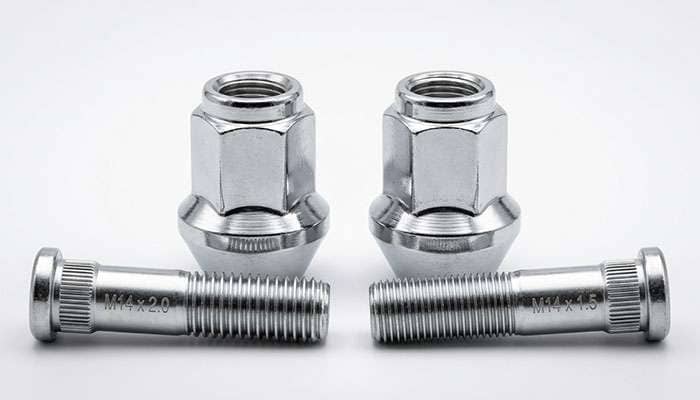
Thread pitch is the distance a nut travels in one full turn. An M14 x 2.0 nut advances 2.0 mm per turn; an M14 x 1.5 nut advances 1.5 mm. Spin the wrong one onto a stud and the first turn feels normal, because both share a 14 mm diameter. By the end of that turn the threads are 0.5 mm out of step. By the second turn the flanks ride on each other, and the nut binds.
By hand, you'd stop there. An impact gun drives right through it, cutting new grooves into the stud and nut. A torque wrench then clicks at spec, because it measures friction, and galled threads have plenty. It can't tell you that only one or two threads are carrying clamp load.
Thread one nut from the wheel set onto one stud by hand. If it stops after a turn or two, it's the wrong pitch. A thread gauge settles it too: across a 14 mm length, an M14 x 2.0 stud shows 7 threads and an M14 x 1.5 stud shows a little over 9.
The rule I give every customer: lug nuts belong to the truck, not the wheel. Your Expedition's own nuts already match its studs and the factory seat. Use them.
For factory wheels, yes. Ford's 2004-and-newer F-150 alloys and steels run +44 mm offset almost across the board, Raptor aside, and so do the Expedition's. A polished 20x8.5 wheel Ford released for the 2009-2014 F-150 carries the same part number on the 2010-2014 Expedition, which tells you how closely Ford engineered the two.
Offset is the distance from the wheel's mounting face to its centerline. At +44 mm, the mounting face sits toward the outside of the wheel, tucking it under the fender. Put a factory F-150 wheel on an Expedition and the tire lands where Ford put the original, with steering feel and fender clearance unchanged.
Across the aftermarket 6x135 market, more than half of all wheels run 0 mm offset or lower, and fewer than 1 in 50 run +35 mm or higher. Most are built to push the tire out for a wider stance. On an Expedition, a 0 mm wheel puts the mounting face on the wheel's centerline, 44 mm inboard of where a factory wheel has it, so at the same width the whole wheel and tire sit about 1.7 inches further out per side. That adds leverage on the wheel bearings and can put the tread into the fender liner at full lock. How far you can move offset before that bites is covered in how much can you change offset.
A factory F-150 wheel, usually. An aftermarket or replica wheel sold as "F-150 fitment," only if its stamped rating clears your Expedition's rear axle.
Start with the truck. Ford lists the 2019 Expedition 4x4 at a 5,623 lb base curb weight and the long-wheelbase Expedition MAX 4x4 at 5,794 lb, before a single passenger climbs in. A 2023 Expedition MAX Limited carries a 7,300 lb GVWR. Owner-posted certification labels from 2018-and-newer trucks show rear axle ratings around 4,200 to 4,380 lb, depending on axle ratio. Divide by two and each rear wheel needs to be rated for roughly 2,100 to 2,190 lb.
Most aftermarket 6x135 wheels are rated around 2,500 lb, which clears that with margin. But roughly 1 in 14 is rated at 2,200 lb or less, and some 22-inch factory-replica designs sold for both trucks are rated at exactly 2,200 lb. On a rear axle rated 4,380 lb, a 2,200 lb wheel leaves you a 10 lb margin per wheel. That's not a safety factor. That's a rounding error.
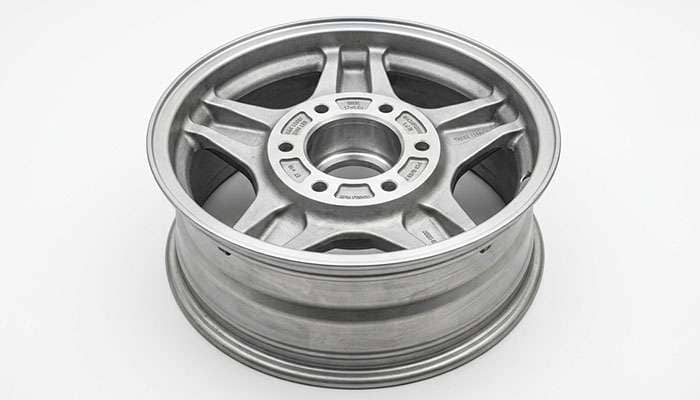
The third row, the cargo area, and any trailer tongue weight all land on the rear axle. The front carries the engine; the rear carries everything you add. Ford rates the Expedition to tow well over 9,000 lb in some configurations, and at a typical 10 percent tongue weight, that's more than 900 lb pressing down on the rear axle on top of passengers and cargo.
A wheel's load rating is the maximum static weight it's built to carry at its rated tire pressure. Aftermarket wheels are validated against SAE J2530, which runs wheels through radial fatigue, cornering fatigue, and impact tests at loads multiplied well above the rating. The multiplier exists because potholes and curbs spike the real load far above the static number. Run a wheel at its rating every day and you've spent that cushion before the first pothole.
Your Expedition's GAWR (gross axle weight rating) for each axle is printed on the certification label on the driver's door jamb. The Tire and Loading Information placard required by FMVSS 110 sits nearby. Aftermarket wheels have the load rating stamped or cast on the back pad or inside the barrel. Ford factory wheels usually don't print a rating; read the part number cast into the back and ask a parts counter which models it was released for. A number released for the Expedition was validated for the Expedition. One released only for the F-150 was validated for F-150 axle ratings, which can run higher at the rear, but confirm it rather than assume it. The full method is in our wheel load rating guide.
On a 2003-2017 Expedition, yes. Ford offered 17-inch factory wheels on those trucks, including a 17x7.5, so a 17-inch F-150 wheel at the same +44 mm offset sits in a space the brakes were designed around.
On a 2018-and-newer Expedition, it's a test-fit question. Ford hasn't put a factory wheel smaller than 18 inches on these trucks; the 2019 lineup came on 18, 20, and 22-inch wheels, and the 2025 Expedition Tremor rides on 18s. Some 17-inch wheels clear the newer brakes, and some don't.
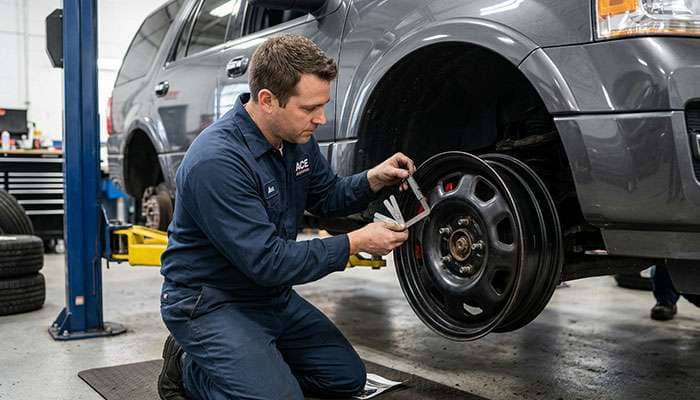
Two dimensions. A 17-inch barrel is half an inch smaller in radius than an 18's, leaving less room around the caliper's outer edge. And the caliper's outer face sits close to the back of the spokes, so every millimeter of extra positive offset brings them closer. That's why the same 17-inch diameter can fit in one design and hit in another.
F-150 owners ran into the same thing when the 2021 Max Trailer Tow package added larger rear rotors: owners reported 17-inch Raptor wheels touching the rear calipers, while 0 mm offset 17s cleared. Bolt one bare wheel on, spin it by hand, and check the gap. How much is enough is covered in brake caliper wheel clearance.
Sometimes. Every Expedition and F-150 built since the 2008 model year has tire pressure monitoring under NHTSA's FMVSS 138 requirement, and Ford does it with a direct sensor inside each wheel. Each sensor broadcasts a unique ID, and the truck's receiver only listens for IDs it has learned.
The 2015 line shows up here too. Owners who have moved pre-2015 F-150 wheels onto 2015-and-newer Expeditions report that the older sensors don't communicate with the newer trucks. Wheels from the same side of 2015 have a better shot, but Ford revised sensor part numbers within generations, so the dependable path is to match the part number to your Expedition or install programmable aftermarket sensors set to your truck. Either way, plan on a relearn, or the warning light stays on until you learn to ignore it.
The wheels do. The 2017-2020 Raptor rides on 17x8.5 wheels at +34 mm offset with the same 6x135 pattern, 87.1 mm bore, and M14 x 1.5 studs as a 2017-and-newer Expedition. Used Raptor wheel sets get listed for 2019-2021 Expeditions, and it's a popular look.
One number changes. The +34 mm offset puts the wheel 10 mm further outboard than a factory +44 mm wheel of the same width. That's mild. The bigger question is the tire. The Raptor's factory 315/70R17 is a lift-and-trim conversation on an Expedition, not a wheel-swap conversation. Mount an Expedition-sized tire and you're within normal limits.
Yes, by the same rules in reverse. Six-lug to six-lug bolts on, the hub bore matches, the factory offsets match, and the 2015 lug nut line applies exactly the same way. On load, this direction is usually the easier one, because an F-150's rear axle rating can run higher than an Expedition's and Ford sized the Expedition's wheels for a heavy three-row SUV.
One quirk shows up going this way. Since 2003, the Expedition has used an independent rear suspension, while the F-150 kept a solid rear axle. On some F-150s, the end of the rear axle shaft sits proud enough that an Expedition center cap won't seat on the rear wheels. Test-fit a cap before you assume a set will look finished.
Neither failure announces itself on day one. Both get more expensive the longer you drive on them.
Every rung on both ladders costs more than doing it right the first time: the Expedition's own lug nuts, and a wheel whose stamped rating clears your rear axle with real margin. If you're shopping, start with the correct pattern and check each wheel's stamped rating in our 6x135 bolt pattern wheels.
Six-lug to six-lug, F-150 wheels fit an Expedition: the pattern, bore, and factory offset all match, and Ford has released some wheels for both trucks under one part number. The bolt pattern was never the question.
Two questions are left, and they're easy to answer and expensive to skip. Is the F-150 on the same side of 2015 as your Expedition, and if not, did the lug nuts stay with the truck? And does the wheel's load rating clear your rear axle rating divided by two? If you're buying new rather than used, start with our 6x135 bolt pattern wheels and let the load rating narrow the list.
Yes. The 2004-and-newer F-150 and 2003-and-newer Expedition both use 6x135 with an 87.1 mm hub bore. The 1997-2003 F-150, 2004 F-150 Heritage, and 1997-2002 Expedition are five-lug 5x135.
Yes, six-lug Expedition wheels bolt onto six-lug F-150s with the same pattern, bore, and factory offset. Use the F-150's own lug nuts, and test-fit the rear center caps, since the F-150's axle shaft can keep some Expedition caps from seating.
Only within the same era. 2004-2014 F-150s and 2003-2014 Expeditions use M14 x 2.0 studs. 2015-and-newer models of both trucks use M14 x 1.5. Always hand-thread one onto a stud before using an impact gun.
The wheels fit, but the lug nuts don't. A 2015 F-150 uses M14 x 1.5 nuts and a 2012 Expedition has M14 x 2.0 studs, so mount the wheels with the Expedition's own nuts. Expect to sort out TPMS sensors as well.
Yes. 2017-2020 Raptor 17x8.5 wheels share the 6x135 pattern, 87.1 mm bore, and M14 x 1.5 studs with 2017-and-newer Expeditions and sit 10 mm further out at +34 mm offset. The Raptor's 315/70R17 tires are the part that needs a lift, not the wheels.
Not for Ford factory wheels, which share the Expedition's 87.1 mm bore. Aftermarket wheels with a larger multi-fit bore need hub-centric rings so the hub, not the lug nuts, carries and centers the wheel.