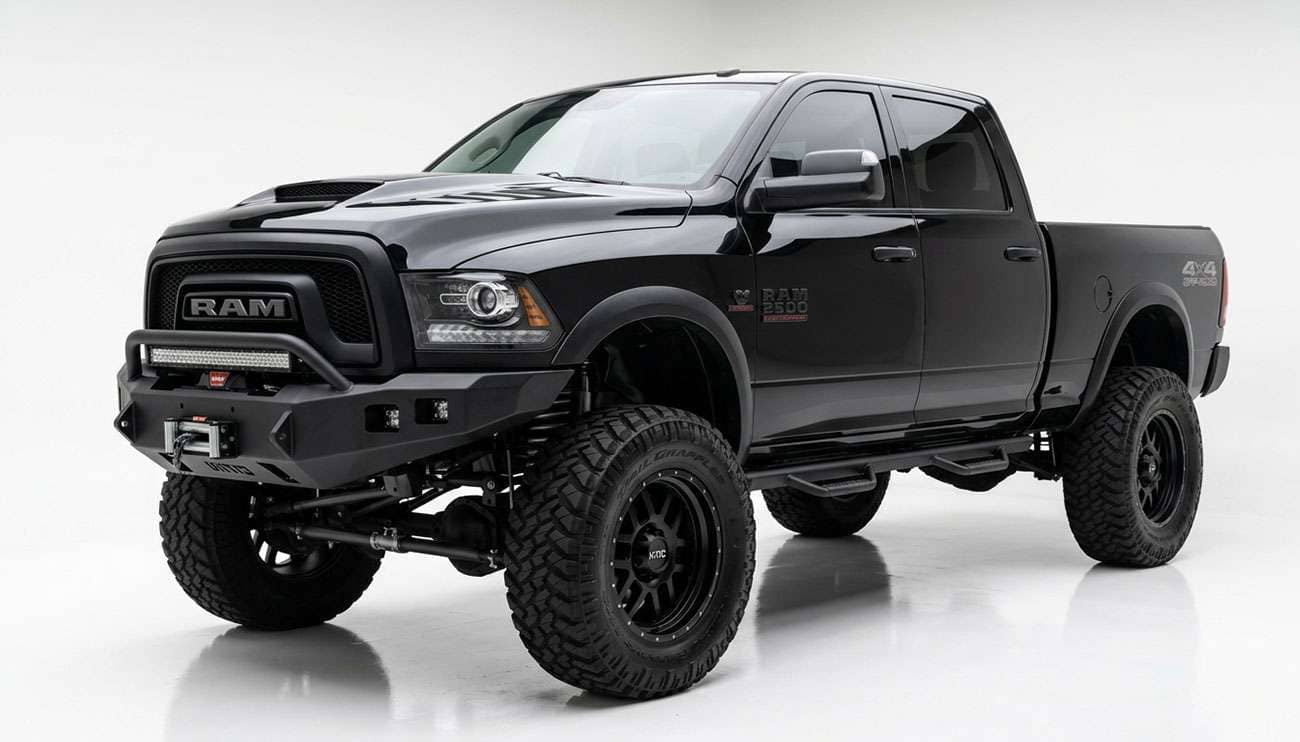
I get the same call about three times a week. Someone just dropped two grand on a lift kit, the box is sitting in their garage, and now they want to know how big a tire they can run. The answer they want is a single number. The real answer is a conversation about wheel offset, backspacing, bump stops, and the specific make and model of their truck.
There's a rule of thumb that gets repeated on every forum: for every inch of lift, you can fit roughly one inch of additional tire diameter. That's not wrong — it's just the start of the math, not the end of it. A 3-inch lift on a Wrangler JL clears 35s without breaking a sweat. The same 3-inch lift on a 2019 Tacoma fights 33s without trimming. Same lift height, totally different outcomes.
This article gives you the real chart — by lift height and by vehicle — plus the fitment variables that actually decide whether a tire rubs or clears. By the end you'll know what size to buy, what wheel specs you need to make it work, and what else in the budget you're about to spend.
Before we get to numbers, understand what's actually at play. Fitment isn't one variable — it's four working together, and ignoring any of them is how you end up with a tire that rubs at full steering lock or grinds the inner liner on a hard bump.
1. Lift height and lift type. A suspension lift raises the entire vehicle by lifting the frame off the axles, which gives you real clearance gain when the suspension cycles. A body lift raises only the cab off the frame — it creates fender-to-tire clearance but doesn't help when the suspension compresses. A leveling kit raises just the front of the truck to eliminate factory rake. These three things do not give you the same tire room, even at the same nominal height.
2. Wheel offset and backspacing. Where the tire sits inside or outside the fender well changes everything. Push the wheel outboard with an aggressive negative offset and you might clear the suspension components, but the tire pokes past the fender and rubs the inner lip at full lock. The factory wheel and the aftermarket wheel are not interchangeable for fitment purposes.
3. Tire width and section width. Tire diameter is the headline number, but width is what kills you on a turn. A 35x12.50 fits more places than a 35x14.50. A 295-width metric tire fights less than a 315. Always check both numbers.
4. Vehicle-specific clearance zones. Every truck has its own rub points — control arms, sway bar links, frame rails, bump stops, fender lips, inner liners. Two trucks at the same lift height with the same wheel and tire can have completely different outcomes because their wheel wells are different shapes.
This is the chart the call usually centers on. These ranges assume you're running a compatible aftermarket wheel with sensible offset (more on that below) and that you're willing to address bump stops or do minor trimming where noted. Stock wheels with stock offset will generally land you on the conservative end of each range.
Lift Height |
Lift Type |
Tire Diameter Range |
Common Sizes |
Notes |
|---|---|---|---|---|
Stock |
None |
+1" max over OEM |
30–32" |
Width matters more than diameter at this stage |
2" leveling kit |
Strut spacer / front level |
+1.5" to +2" |
32–33" |
33s borderline on most half-tons; needs right offset |
2.5–3" |
Suspension lift |
+2" to +3" |
33–34" |
35s possible with aftermarket wheel and bump stops |
4–5" |
Full suspension lift |
+3" to +4" |
35" |
Standard size at this lift height; minimal trimming |
6" |
Full suspension lift |
+4" to +6" |
35–37" |
37s clear cleanly; some trim work for full lock |
7"+ |
Long-arm or high-clearance lift |
+6" and up |
37–40" |
Regear required; fender trimming common at 40" |
The chart is a starting point, not a guarantee. Once you cross 33", the wheel you put under it matters as much as the lift kit you put over it. Once you cross 35", you're committing to other changes — gear ratio, possibly bump stops, definitely your fuel budget. We'll get to all of that. First, the by-vehicle breakdown.
Generic charts get you in the ballpark. Specific platforms have specific quirks. Here's what I see come through the shop on the most common builds.
The Wrangler has the most generous factory clearance of any modern 4x4. A stock JL Rubicon will swallow 33s without a lift, no questions. Add a 2.5-inch lift and 35s become standard equipment — most Wrangler owners running 35s aren't even at 3 inches of lift. At 3 to 3.5 inches of lift with a fender flare clearance trim, 37s are achievable. The Rubicon's higher factory ride height gives you about a half-inch of headroom over Sport and Sahara trims.
An F-150 on stock suspension tops out around 32s before rubbing becomes a daily issue. A 2-inch leveling kit gets you cleanly into 33s. A 3-inch lift makes 34s easy and puts 35s within reach with the right offset wheel. Most Rough Country and ReadyLIFT 3" kits explicitly advertise clearance for up to 34" tires; pushing to 35s usually means going to a wheel with around -12mm to 0mm offset.
The half-ton GM twins behave nearly identically. A 2.5-inch lift handles 33s comfortably. A 4-inch lift clears 35s with no drama. Stay clear of the upper control arm — it's the first thing the tire wants to hit when you go wide. Aggressive negative offset wheels move the rub problem from the inner UCA to the outer fender lip, which is the easier problem to solve.
The Ram's coil-spring rear suspension behaves differently than the leaf-spring competition under compression. A 4-inch lift on a Ram clears 35s with room to spare. Owners running 33s on a leveling kit and stock wheels report clean fitment in most cases.
The Tacoma is the cautionary tale here. Factory wheel wells are tight, particularly at the front. A 3-inch lift on a Tacoma will fit 33s but rub at full lock without aftermarket wheels carrying around 4.5 inches of backspacing — far less than the factory 6+ inches. Getting clean 33s on a Tacoma is more about the wheel than the lift. If you're still debating 31s, 33s, or 35s, the Tacoma is where the gap between sizes shows up most.
The Tundra clears 33s on a leveling kit alone. A 3-inch lift gets you 35s cleanly. A 6-inch lift opens the door to 37s, though the factory steering geometry doesn't love that height without geometry correction.
This is where most fitment problems come from, and most owners don't realize it until the tire is mounted.
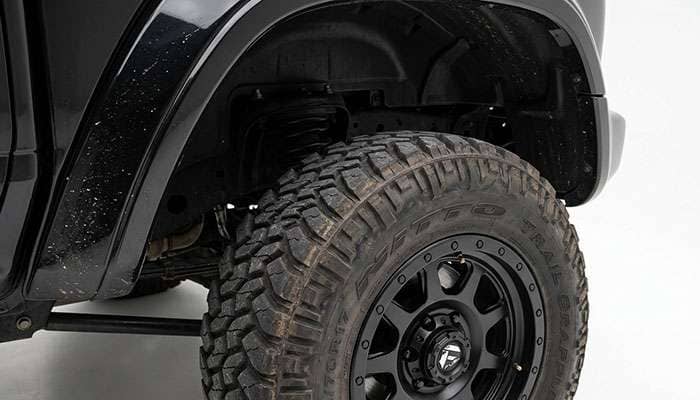
Factory truck wheels typically run an offset in the +20mm to +45mm range. That positive offset tucks the wheel and tire inboard, close to the suspension and frame. Aftermarket truck wheels often run offsets between -12mm and +18mm, which pushes the tire outboard, away from the suspension components and toward the fender lip.
The result: the same lift kit, same tire size, gets two completely different fitment outcomes depending on which wheel you bolt up. A 35x12.50 on a stock wheel with +30mm offset will usually contact the upper control arm or sway bar long before it contacts anything else. The same tire on an aftermarket wheel with -12mm offset clears the suspension cleanly but pokes past the fender by half an inch.
Backspacing tells the same story in inches instead of millimeters. Factory wheels often run 6 to 6.5 inches of backspacing. Aftermarket off-road wheels frequently land between 4.5 and 5 inches. That inch and a half of difference is the difference between clearing the suspension and not.
The practical takeaway: when you go bigger than 33", you usually need an aftermarket wheel too. There's a reason every lift kit manufacturer lists maximum tire size with a specific wheel offset spec. Wheel offset also drives tire wear and bearing life, so the choice has consequences beyond fitment.
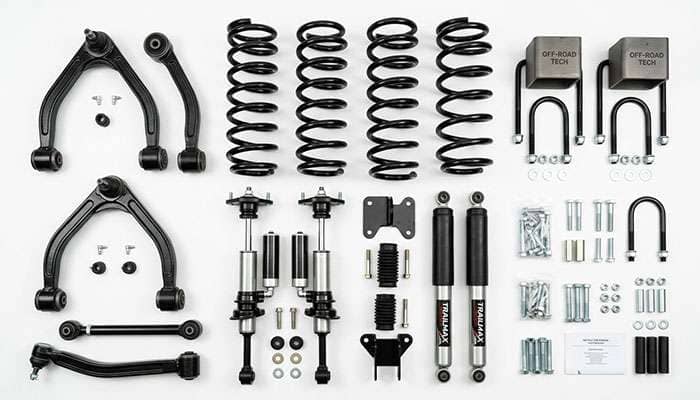
The lift kit and the tires are the headline purchase. The supporting cast adds up.
Bump stops. This is the single most overlooked item on a lift build. Bump stops limit how far the suspension can compress before the chassis hits the axle. When you upsize tires, the tire reaches the fender or inner liner before the bump stop catches the suspension. The fix is taller bump stops, which prevent the compression rub even at full articulation. If your tire rubs only on hard bumps, this is almost always the answer.
Fender or inner liner trimming. At 35" and above on most trucks, expect to trim plastic liners or pinch weld seams in the fender well. This is fifteen minutes of work with a cutting wheel and doesn't show on the outside. Don't confuse this with cutting the visible fender — that's a separate decision.
Gear ratio. Going from a 32" stock tire to a 35" tire effectively changes your final drive ratio. The engine RPMs at any given speed drop, acceleration drops, and the transmission spends more time downshifting. A truck with a 3.55 stock gear ratio that gets 35s often benefits from a regear to 4.10 or 4.56. The MPG impact of larger tires is real — the engine works harder, regardless of how efficient the rolling resistance gain looks on paper.
Speedometer recalibration. A 35" tire travels about 9% more distance per revolution than a 32" tire. Your speedometer and odometer don't know that, so they under-report. You'll be driving 76 mph when the gauge shows 70. Most modern trucks can be recalibrated through the OBD-II port with a programmer.
Load rating. Bigger LT tires are heavier, with stiffer sidewalls and higher load ratings. That's good for towing but bad for ride quality at lower pressures. Match the load range to how you actually use the truck — Load Range E for serious towing, Load Range C or D if it's a daily driver that occasionally hits the trail.
These are tires I'd actually put on a customer's truck at each lift tier. All are in current PPT inventory in the sizes shown. All-terrain versus mud-terrain is a separate decision driven by how much pavement you do — I've listed AT and MT options for each tier.
For half-tons running a leveling kit or modest lift, the sweet spot is a 33" all-terrain that doesn't beat up the road manners. The BFGoodrich All-Terrain T/A KO3 in LT285/70R17 is the safest pick across the category — quieter than the outgoing KO2, more aggressive sidewall, three-peak severe snow rating. The Falken Wildpeak A/T4W in LT285/75R18 is a competitive newer option with a strong wet-weather story. Both come in 10-ply Load Range E for towing.
This is where the build gets serious. For all-terrain at 35", the BFGoodrich All-Terrain T/A KO3 in LT35x12.50R17 is the default. For mud-terrain duty, the BFGoodrich Mud-Terrain T/A KM3 in 35x12.50R17 or the Cooper Discoverer STT Pro deliver hard-core off-road performance with manageable highway noise. The Falken Wildpeak A/T4W is also offered in this size for buyers who want all-terrain durability with a more aggressive look.
At this size you're in dedicated-build territory. The Mickey Thompson Baja Legend MTZ brings the classic three-ply sidewall toughness off-roaders trust. The BFGoodrich Mud-Terrain T/A KM3 is also offered in 37x12.50, and the AMP Terrain Attack M/T A is a strong value option in LT37x12.50R17. Expect to give up MPG and gain weight at every size step here — that's the trade.
For the wheel side of the equation, our off-road wheel category filters by lug pattern and offset so you can match the wheel to the lift kit spec before you buy. If you're working a Wrangler specifically, the step-by-step guide for Wrangler aftermarket wheels walks through what works at each lift height.
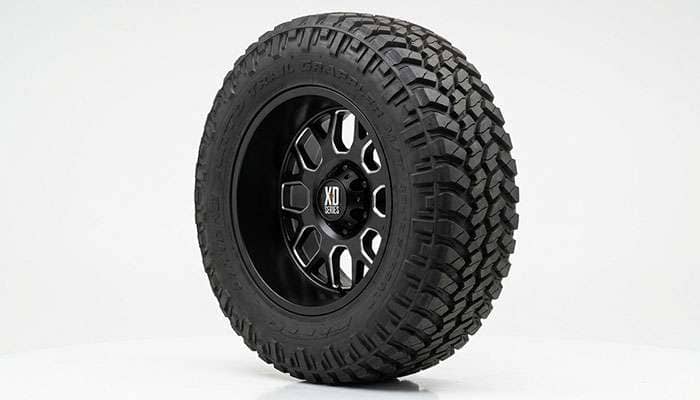
I've seen all of these enough times to know they're the rule, not the exception.
Buying tires before the lift kit. You buy 35s on sale, then discover your lift kit only clears 33s without trimming. Now you've got 35s sitting in the garage. Order the tires after the lift is on the truck — or at least after you've confirmed the kit's published max tire size.
Ignoring wheel offset. The most common rubbing complaint isn't tire diameter — it's tires that contact suspension components because the wheel offset wasn't matched to the build. Check the lift kit manufacturer's recommended wheel offset and don't deviate.
Skipping bump stops. If your tire rubs only on hard bumps or at full articulation, it's a bump stop issue. Owners spend hundreds on smaller tires before realizing a $80 set of taller bump stops would have fixed it.
Forgetting the gear ratio. A 35" tire on a 3.42-geared half-ton makes the truck feel sluggish, towing capacity drops, and transmission temps climb under load. Either size down or budget for a regear.
Mismatched load ratings. Lifted truck buyers sometimes downsize to a P-metric tire to save weight and improve ride quality. If you tow, that decision drops your effective towing capacity. Stay in LT-metric for any truck doing real work.
The "one inch of lift equals one inch of tire" rule isn't wrong — it's just incomplete. Lift height tells you the tire diameter ceiling. Wheel offset, bump stops, vehicle clearance zones, and the supporting modifications tell you whether that ceiling is actually reachable.
If you're shopping right now, start with the lift kit manufacturer's published max tire size. Then check that the wheel offset matches their recommendation. Then verify the supporting list — bump stops, gear ratio, speedometer calibration. Doing it in that order saves the customer-service call and the second order of tires.
On most modern half-ton trucks, 33s will mount on stock suspension but rub at full steering lock or under hard suspension compression. A 2-inch leveling kit clears the issue on F-150, Silverado, Sierra, and Ram. Jeep Wrangler JL and JK trims handle 33s on stock suspension cleanly. Tacomas typically rub even with a leveling kit unless wheel offset is adjusted.
Not cleanly on most half-ton trucks. A leveling kit raises only the front of the vehicle and does not create the suspension cycling clearance that 35s need. Owners who run 35s on a leveling kit usually have aftermarket wheels with aggressive offset, trimmed fenders, and tolerate rubbing on uneven terrain. For a clean 35" fitment, plan on at least a 3.5-inch full suspension lift.
Usually yes once you go past 33". Factory wheels are designed with offset and backspacing that keep the tire tucked in close to the suspension. Larger tires need to sit further out from the suspension components, which means an aftermarket wheel with reduced backspacing or negative offset. Check the lift kit manufacturer's wheel spec before ordering.
A body lift adds fender-to-tire clearance because it raises the cab off the frame, but it doesn't help the suspension cycling clearance — when the suspension compresses, the tire is still moving toward the inner fender well. Body lifts are most useful as a supplement to a suspension lift on Jeeps and older trucks, not as a replacement.
Expect a 1 to 3 MPG drop going from 32s to 35s, and a further 1 to 2 MPG drop going from 35s to 37s. The exact loss depends on tire weight, tread aggressiveness, gear ratio, and how the truck is driven. Regearing recovers some of the loss but not all of it.
Yes. A larger tire covers more ground per revolution, so the speedometer under-reports speed and the odometer under-reports mileage. A 35" tire on a truck originally equipped with 32s will show roughly 9% slow on the speedometer. Recalibration through an OBD-II programmer is the standard fix on modern trucks.