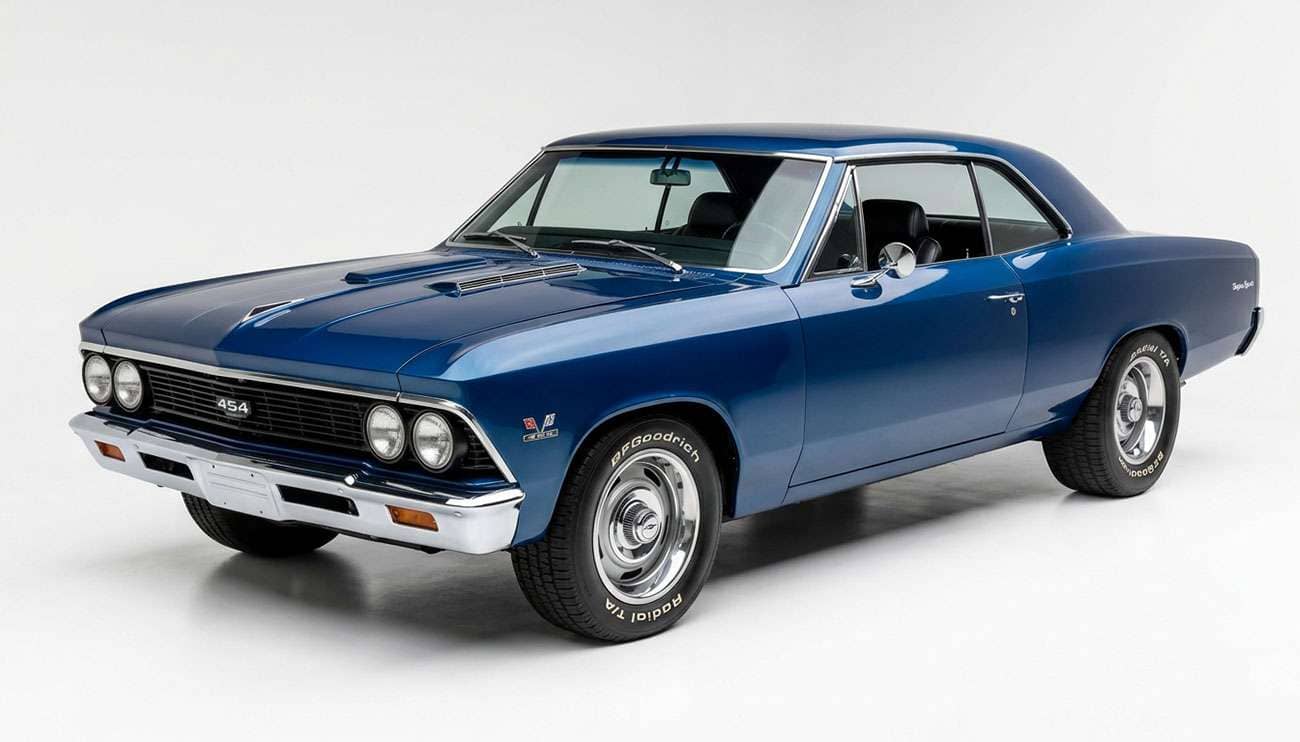
A stock-body 1968-74 Nova takes a 235/60R15 up front on a 15x7 with about 4.25 inches of backspacing, and a 255/60R15 out back on a 15x8 with about 4.5 inches. Plenty of guys run a 275/60R15 in back on that same wheel. Whether yours clears comes down to something most guides never mention: the rear springs. A tired set of factory mono-leafs lets the axle ride up into the wheelhouse, and the 275 that fits your buddy's Nova rubs on yours.
I've been putting wheels and tires under Novas since the shop opened in 1971, back when a '72 Nova SS was a new car on a dealer lot. The X-body is one of the friendliest cars to fit that GM ever built. The front end is proven, the bolt pattern is the common GM 5x4.75, and the rear wheelhouse takes more tire than you'd guess from looking at it. It's also a car where fifty years of sagging springs, mismatched parts, and swapped wheels mean you can't trust the last guy's numbers. Let's go through it the way I'd walk you through it at the counter.
Here's the whole picture by wheel diameter. "Stock body" means no tubs, no cut inner wheelhouses, and factory-height suspension in decent shape. Rolled fender lips are noted where they matter.
Wheel Diameter |
Front Wheel and Backspacing |
Front Tire |
Rear Wheel and Backspacing |
Rear Tire |
Watch For |
|---|---|---|---|---|---|
14 in. |
14x6, 3.5 to 3.75 in. |
195/70R14 or 205/70R14 (24.7 to 25.3 in.) |
14x7, about 4 in. |
215/70R14 to 225/70R14 (25.9 to 26.4 in.) |
Factory look; clears drums and factory discs |
15 in. |
15x7, about 4.25 in. |
235/60R15 (26.1 in.) |
15x8, about 4.5 in. |
255/60R15 (27.0 in.); 275/60R15 (28.0 in.) with healthy springs |
About 1/2 to 3/4 in. to the frame at full lock up front |
17 in. |
17x7, about 4 in. |
225/45R17 or 245/45R17 (25.0 to 25.7 in.) |
17x8, about 4.75 in. |
255/45R17 (26.0 in.); 275/40R17 with rolled lips |
Rear lip contact on hard cornering without rolling |
Every number in that table is a starting point, not a guarantee. These cars left the factory with looser tolerances than anything built today, and half a century later no two sit exactly alike. Measure your own car before you order. I'll show you how at the end.
If you want the most tire under a Nova without cutting metal, 15-inch wheels are where it lives. You get a tall sidewall that fills the wheel opening the way the body was designed to look, you keep the overall diameter close to what the gearing expects, and you have more tire choices in 60-series sizes than anywhere else. A 15x7 front and 15x8 rear is the classic Nova stance for a reason. If you want to understand why the front and rear go different widths, our muscle car staggered setup guide lays out the logic.
A 17 gets you sharper steering and a modern look, and it gives room for bigger brakes. It costs you sidewall, and on a car with 50-year-old roads in mind, that's ride quality. It also makes the fender lips more of a problem. A 45-series tire has a squarer shoulder than a 60-series, and that shoulder is what catches the lip when the body rolls.
Here's the part nobody puts in front of you. A Nova's rear tire lives in a narrow box. The leaf spring sits on the inside. The quarter-panel lip and the outer wheelhouse sit on the outside. The top of the wheelhouse sits above it. How much room is in that box depends on where the axle rides, and the springs decide where the axle rides.
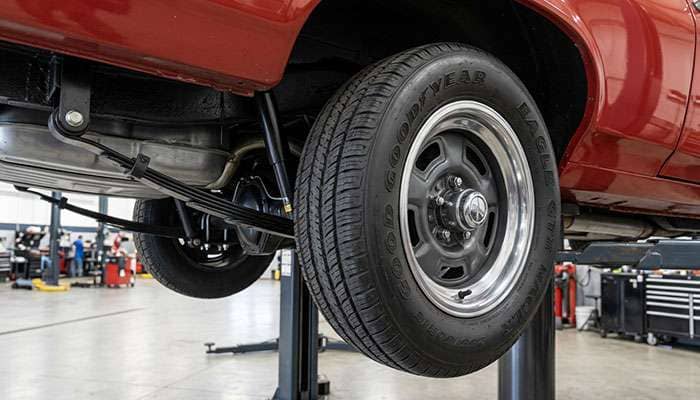
Most 1968-74 Novas left the factory on mono-leaf rear springs, a single thick tapered leaf per side. They rode nicely when new and saved weight. Multi-leaf springs came on heavier-duty and performance configurations. Today, the aftermarket sells kits specifically to convert a mono-leaf Nova to multi-leaf, which tells you how common the mono-leaf car is and how many owners have outgrown it.
The trouble with a mono-leaf isn't that it was a bad design. It's that it's a single leaf carrying the whole back of the car, and after fifty years a lot of them have flattened out. A flat spring puts the axle higher in the wheelhouse at rest, and it lets the axle travel farther up over a bump. Less room on top, less room on the outside as the tire moves up and out toward the lip.
Owners running a 275/60R15 on a 15x8 with about 4.5 inches of backspacing report rubbing only rarely, on big bumps or with a load in the trunk. Owners running the same 275 on sagged mono-leafs report the outboard side touching the wheelhouse on bumps. Same car, same wheel, same tire. The difference is the springs. That's why I don't tell anybody a 275 fits a Nova until I know what's holding the axle up.
Rear Spring Condition |
How the Axle Sits |
255/60R15 on 15x8 |
275/60R15 on 15x8 |
|---|---|---|---|
Original mono-leaf, sagged |
High in the wheelhouse, extra upward travel |
Usually clears; check over bumps |
Likely to rub over bumps and with a load |
New mono-leaf at factory height |
At design height |
Clears |
Clears in most cars; may touch on big hits |
Multi-leaf, new or converted |
At design height, better controlled |
Clears |
Clears in most cars |
Two more things live in that rear box. The rear shock sits close to the inside of the tire on these cars, and some owners gain clearance by running shocks without the dust cover tube. And the quarter-panel lip is a folded edge that can be rolled flat to gain a little room on the outside. Rolling is a real fix. Grinding or cutting is the start of a different project, and it's not one you undo.
Backspacing is the distance from the wheel's mounting face to its inner edge. On a Nova it decides whether the tire hits something on the inside or something on the outside. Too much backspacing and the rear tire crowds the leaf spring and the front tire finds the frame rail at full lock. Too little and the tire pushes out into the fender lip.
Up front, a 15x7 at about 4.25 inches with a 235/60R15 leaves roughly half an inch to three-quarters of an inch between the tire and the frame at full lock, with similar room to the tie rods and sway bar. That's enough, but it's not a lot. Go wider or deeper on backspacing and the frame is what you hit first. On 14s, a 14x6 at 3.5 to 3.75 inches is the traditional number.
In back, a 15x8 at about 4.5 inches centers the tire between the spring and the lip. One owner running a 14x8 found 4.5 inches rubbed the lip in hard cornering and 5 inches cleared, on fresh springs. That's the tradeoff in action: every quarter-inch you take from the outside, you give to the spring side. Wheel width goes up, and backspacing has to climb with it to keep the tire centered.
Good news for Nova owners: the numbers the car wants are the numbers the wheel makers build. In the 5x4.75 bolt pattern, most 15x8 wheels come at about 4.5 inches of backspacing and most 15x7s at about 4 inches, with 4.25-inch versions common. If you want the factory rally look with modern construction, our own Hot Rod Hanks 55 Rally comes in a 15x7 at about 4.25 inches, right on the front number above. For the details on the pattern itself, see our 5x4.75 bolt pattern guide.
If the backspacing on a used set isn't stamped anywhere, measure it. Our walkthrough on how to measure backspacing on classic car rims takes a straightedge and a tape measure.
Every 1968-74 Nova rolled on 14-inch wheels. Width and tire depended on trim and year. Here's the typical lineup, with the modern radial size that matches each original's height. Your trim tag, build sheet, or the date codes on original wheels tell you what your car actually had.
Years and Trim |
Factory Wheel |
Typical Factory Tire |
Closest Modern Radial |
|---|---|---|---|
1968-72 base and Custom |
14-in. steel, 5 to 6 in. wide, hubcap or wheel cover |
7.35-14 bias-ply |
205/75R14 |
1968-72 SS |
14x7 steel, SS hubcap or optional rally |
E70-14 wide-tread (1970 SS 396: E70-14 on 14x7 per GM) |
215/70R14 |
1973-74 base and Custom |
14-in. steel, 6 in. wide |
E78-14 bias-belted; steel-belted radial options |
205/75R14 |
1973-74 SS |
14x6 or 14x7 rally |
70-series white-letter |
215/70R14 |
Tire sizing changed three times while the Nova was in production, from numeric sizes like 7.35-14, to letter-series sizes like E70-14 and E78-14, and then to metric radials. If you're matching an old size to a new tire, our guide to muscle car tire sizes decoded breaks each system down.
If you're restoring an SS for judging, you want the correct wheel and a period-correct tire. If you're driving the car, a modern radial with the old look is the better tire in every way that matters: grip, wet braking, and not flat-spotting in the garage. That middle ground has a name: bias-look radial tires, which put a period sidewall on radial construction.
Yes, and the reason is under the car. The 1968-74 Nova shares its front subframe with the 1967-69 Camaro. The aftermarket sells one bare subframe for both cars. Same front suspension geometry, same 5x4.75 bolt pattern, same factory brake options. A first-gen Camaro front wheel and tire combination is a proven starting point for a Nova front, and the other way around.
The back half is different. The Nova and the Camaro have their own bodies, their own rear wheelhouses, and their own quarter panels, so rear fitment numbers don't transfer one-for-one. Both use rear leaf springs, so the same spring-side versus lip-side balancing act applies, but check rear numbers for the car you actually own. Our first-gen Camaro wheels and tires guide covers the Camaro side.
Chevelle wheels share the bolt pattern, but the Chevelle is a bigger car on a full perimeter frame with coil springs in back. Its rear wheels are often set up with backspacing that suits coils, not leafs. Bolt pattern is only step one. For the A-body numbers, see our Chevelle wheel and tire guide.
The factory setup doesn't. Aftermarket big brakes do. Because the Nova shares its front subframe with the first-gen Camaro, the brake numbers are the same on both cars.
Most 1968-74 Novas came with four-wheel drums. Front disc brakes were an option. Both the factory drums and the factory 11-inch disc setup fit inside a 14-inch wheel, which is why every Nova could roll on 14s from the factory.
Bolt-on 11-inch disc conversion kits usually still clear most 14-inch wheels, but check the kit's wheel template. A 12-inch big brake kit generally needs at least a 15-inch wheel. A 13-inch kit generally needs a 17. And the spoke design matters as much as the diameter. A wheel can be the right size and the right bolt pattern and still touch the caliper because its spokes curve inward. Pick the brakes first, then the wheel.
Not where it counts. The 1968-74 Nova is one platform: same front subframe, same rear leaf-spring layout, same bolt pattern, same wheelhouses. The fitment numbers in this guide apply across all seven model years.
The later cars got larger impact-rated bumpers, which add weight at both ends of the car, and 1973 brought the hatchback body. Extra weight on tired springs is extra sag, which puts you right back in the rear-spring section above. If you have a 1973-74 car with original springs, check your ride height before you trust anybody's rear tire numbers, including mine.
The 1973-74 cars also moved toward radials at the factory, and rally wheels were a common option. If you're restoring, the wheel style and tire type should match the year. If you're driving, the same modern 15s fit a '74 as well as a '68.
A wheel and tire that almost fits doesn't fail all at once. It costs you in stages, and I've watched every one of them roll into the shop.
A factory Nova tire stood around 25 to 26 inches tall. A 275/60R15 stands about 28. That's roughly 8 to 10 percent taller, which means the speedometer reads slow and the rear gear feels taller. On a car with a 3.08 or 2.73 rear, that can take the snap out of it. Plan the gear and the tire together.
The first sign is a chirp or a scrub over a dip, or at full lock in a parking lot. It's easy to ignore. Don't. That sound is the tire's sidewall or shoulder touching metal, spring, or the shock.
Repeated contact wears through the rubber on the shoulder or sidewall. A sidewall cut can't be repaired. If you're not sure what you're looking at, read our guide on tire sidewall damage and whether it's safe to drive.
A tire that hits the quarter-panel lip hard enough will crack paint and bend the lip. A front tire that rides on the frame rail wears a groove in it. On a car where a quarter panel is expensive to replace and harder to match, that's real money.
The last stage is replacing the wheels, the tires, or both, with what you should have bought the first time. A tape measure costs less.
Here's how I check a Nova before anybody spends a dime.
Step 1: Check ride height and springs. Park on level ground with a normal fuel load. Measure from the center of each wheel to the fender lip. Big side-to-side differences or a rear that sits noticeably low tells you the springs are tired. Fix that before you fit tires.
Step 2: Identify your springs. Look under the back. One thick leaf per side is a mono-leaf. A stack is a multi-leaf. Note whether a previous owner added lift shackles.
Step 3: Know your brakes. Drums, factory discs, or an aftermarket kit? If it's a kit, find the brand and rotor size. That sets your minimum wheel diameter.
Step 4: Measure the rear box. With the current wheel on, measure from the inside of the tire to the leaf spring and from the outside of the tire to the lip. Add those to the current tire width, and you know how much room is in the box and where it sits.
Step 5: Measure the front at full lock. Turn the wheel full left and full right and measure from the tire to the frame rail and tie rod. Half an inch or more is working room.
Step 6: Match the wheel and tire. Pull up the 1970 Chevrolet Nova wheel and tire fitment page, pick your size, and order backspacing from your measurements, not from a forum post.
The 1968-74 Nova rewards anybody who takes the time to measure. The front end is shared with the first-gen Camaro and well mapped: a 235/60R15 on a 15x7 at about 4.25 inches of backspacing is the proven number. The rear is where cars differ, and the difference is almost always the springs. A 255/60R15 on a 15x8 at about 4.5 inches is the safe bet on any healthy Nova. A 275/60R15 is realistic on good springs and a gamble on tired mono-leafs.
Check ride height, identify your springs, pick your brakes, and then pick your wheels. Do it in that order and you'll only buy one set.
Every 1968-74 Nova uses a 5x4.75-inch bolt pattern, also written as 5x120.65 mm. It's the same pattern as the first-gen Camaro, the Chevelle, and many other GM cars of the era, so wheels bolt on across all of them, but backspacing and fitment still have to match the car.
On a stock-body 1968-74 Nova, a 275/60R15 on a 15x8 wheel with about 4.5 inches of backspacing is the practical maximum in the rear, and it fits cleanly on cars with healthy rear springs. On sagged original mono-leaf springs, a 255/60R15 is the safer choice. Up front, a 235/60R15 on a 15x7 is the proven maximum.
For a 1968-74 Nova, run about 3.5 to 3.75 inches on a 14x6 front, about 4.25 inches on a 15x7 front, and about 4.5 inches on a 15x8 rear. On 17s, about 4 inches on a 17x7 front and 4.75 inches on a 17x8 rear. Measure your car first, since spring condition and tolerances vary.
Yes. The 1968-74 Nova shares its front subframe with the 1967-69 Camaro and uses the same 5x4.75 bolt pattern, so first-gen Camaro wheels bolt on and front fitment numbers carry over. Rear fitment is different because the two cars have their own rear wheelhouses and quarter panels.
The 1970 Nova SS 396 came on 14x7 wheels with E70-14 tires. The closest modern radial size by overall height is 215/70R14. If you're restoring for judging, check the date codes and build documentation for your specific car.
Not always, but tired springs are the most common reason a Nova rubs. A 255/60R15 usually clears on original springs. If you want a 275/60R15 and your car sits low in back, new springs, either fresh mono-leafs or a multi-leaf conversion, restore the room the tire needs.