
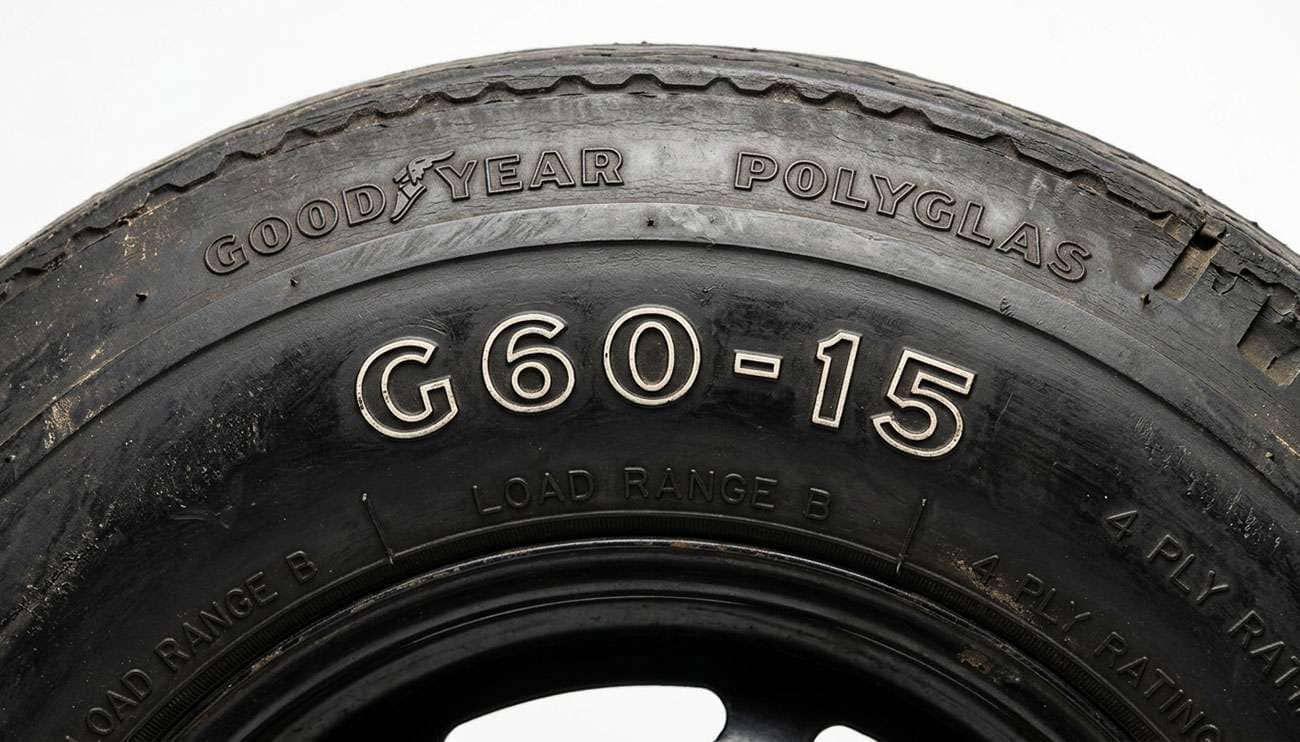
Here is the short version, because I know that is what you came for. On a muscle-era tire, a size like G60-15 breaks into three parts: the letter tells you the load-and-width class (roughly how wide and how much weight the tire carries), the number is the aspect ratio (how tall the sidewall is compared to its width), and the last number is the rim diameter in inches. So G60-15 is a G-class tire, a 60-series (low, wide profile), on a 15-inch wheel. That is it. Once you see those three pieces, every one of those alien-looking sizes on your Chevelle, Mustang, or Road Runner starts making sense.
I have been mounting these on hot rods and muscle cars for longer than I care to admit, and I still get a call a week from a fellow who just dragged home a numbers-matching car with a set of dry-rotted G70s on it and no idea what to buy. The kid at the chain store shrugs, the internet gives him ten different answers, and he ends up on the phone with me. This is the letter system, the one Detroit used from roughly 1968 through the mid-1970s, and if your car is a genuine muscle car there is a real good chance it wore these from the factory. Let me walk you through the whole thing the way I would across the counter.
If you want the wider view of every vintage sizing system going back to the brass era, I covered that separately in our antique tire sizes guide. This piece stays parked right on the muscle-car letter code, because that is the one that trips up the most people.
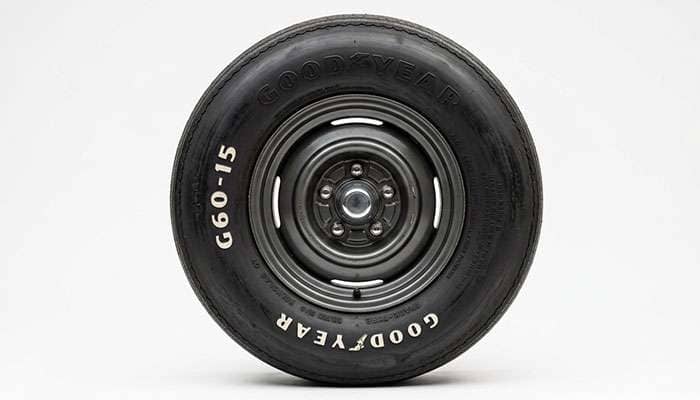
Let us take G60-15 apart one character at a time so you never have to guess again.
The letter (G). This is the load and size class. The alphabet runs light to heavy: an A tire is a skinny economy-car tire, and by the time you get to L you are talking Cadillac and big-block territory. A G sits right in the fat middle, which is exactly why so many muscle cars used it. The letter is really telling you how much air the tire holds and how much weight it can carry, and in practice a heavier letter is also a wider tire.
The number (60). This is the aspect ratio, same idea as the middle number on a modern tire. Sixty means the sidewall height is about 60 percent of the section width. Lower number, shorter and wider-looking tire. The muscle guys loved the 60-series because it gave that planted, filled-out fender look and put more rubber on the road than the tall 78-series grocery-getter tires.
The last number (15). Rim diameter in inches, plain and simple. G60-15 mounts on a 15-inch wheel. Almost every serious muscle car of the era rolled on 14s or 15s, and the 15-inch wheel is still the sweet spot for that correct stance.
Put it together and G60-15 reads as "G-class, low 60-series profile, 15-inch wheel." Do the same trick on F70-14 (F-class, taller 70-series, 14-inch wheel) or L78-15 (big L-class, tall 78-series, 15-inch wheel) and you have got the whole system beat.
The single thing that throws people is the letter, because a modern tire does not have one. Think of it as a load-and-width ladder. Every step up the alphabet is a wider, heavier-duty tire that carries more weight. Here is the practical breakdown I give folks at the counter.
Letter |
Relative Size / Load |
Where You Saw It |
|---|---|---|
A - B |
Lightest, narrowest |
Economy and compact cars |
C - D |
Light |
Compacts and small sedans |
E - F |
Medium |
Mid-size cars, pony car base |
G |
Medium-heavy |
Muscle car standard, full-size |
H - J |
Heavy |
Full-size and station wagons |
L |
Heaviest common |
Cadillac, big-block rears |
N |
Oversize, aftermarket |
Pro-Trac and drag rears |
That last one, the N50-15, was never a factory size. Companies like Pro-Trac cooked up the big letters for the boulevard-cruiser and pro-street crowd who wanted the widest meat they could stuff under a fender. If your car wears something bigger than an L, you are almost certainly looking at an aftermarket tire somebody fitted for looks or traction, not what rolled off the showroom floor.
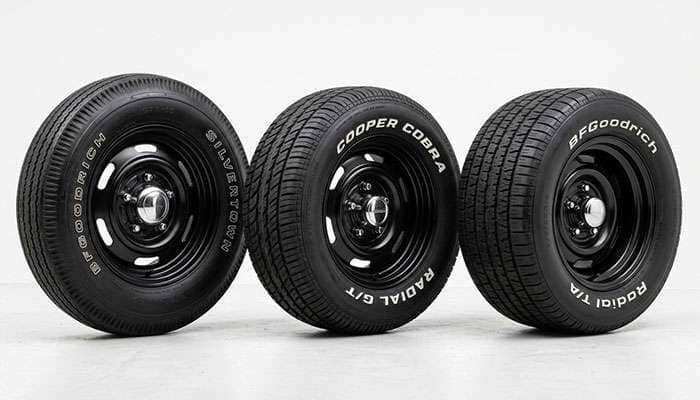
Here is where a lot of guys get burned. A G78-15, a G70-15, and a G60-15 are all G-class tires rated to carry about the same load, but they are not the same tire. The aspect-ratio number changes the sidewall height, which changes the whole outside diameter. Run the numbers and it looks like this: a G78-15 stands roughly 28 inches tall, a G70-15 about 27.5 inches, and a G60-15 around 26.4 inches. Same letter, three different heights. Grab the wrong one and your speedometer is off, your fender gap is wrong, and the stance is not what the factory intended.
So think of the number as the personality of the tire. The 78-series is the tall, comfortable, correct-for-a-base-car profile. The 70-series is the performance-and-looks compromise, the one the Firestone Wide Oval made famous; I broke that legendary tire down in our Wide Oval tire guide. And the 60-series is the low, mean, filled-fender look that says muscle car from fifty feet. When a fellow tells me he wants his GTO to "look right," nine times out of ten he wants a 60-series out back.
One more thing worth knowing: because the letter is tied to a specific rim diameter, a G78-14 and a G78-15 are not the same width either. The load class is set per wheel size, so you always read the whole code together, never just the letter on its own.
Somewhere in the early 1970s radials started elbowing out the old bias-ply tires, and the sizing picked up one more character to tell them apart. When you see an R dropped into the letter code, that is a radial. So G70-15 is bias-ply, and GR70-15 is the radial version of the same size. Same trick on FR70-14 or HR78-14. No R, and you are looking at an old-school bias-ply tire.
Why do you care? Because the two drive like different animals. Bias-ply tires give you that authentic period ride and the correct look for a show-correct restoration, but they wander a little on the highway and follow ruts. Radials track straighter, steer lighter, and last longer. Plenty of guys keep the vintage look with a modern radial underneath, which is the best of both worlds. I get deeper into that trade-off in our guide to bias-look radial tires, which are radials built to look like the old bias-ply rubber. If originality is not your religion, that is usually the smart way to go.
This is the chart people print out and tape to the toolbox. It lines up the common muscle-car letter sizes with their closest modern metric equivalents. The golden rule is to match the overall diameter, not just the width, so your speedometer stays honest and everything clears. Treat these as close, correct-diameter substitutes, and when in doubt, measure the old tire. You can also run any size through our antique and classic tire size conversion tool to double-check before you buy.
Original Letter Size |
Series |
Approx. Modern Metric |
Typical Application |
|---|---|---|---|
E78-14 |
78 |
195/75R14 |
Compact / economy |
F78-14 |
78 |
205/75R14 |
Mid-size sedan |
G78-15 |
78 |
215/75R15 |
Muscle base / full-size |
H78-15 |
78 |
225/75R15 |
Full-size / wagon |
L78-15 |
78 |
235/75R15 |
Cadillac / big cruiser |
F70-14 |
70 |
205/70R14 |
Mustang / Camaro |
G70-14 |
70 |
215/70R14 |
Chevelle / mid-size perf |
G70-15 |
70 |
225/70R15 |
Muscle car standard |
E60-15 |
60 |
215/60R15 |
Performance front |
G60-15 |
60 |
235/60R15 |
Muscle rear |
L60-15 |
60 |
275/60R15 |
Big-meat rear / pro-street |
A couple of notes so nobody gets crossed up. These are the closest common substitutions, but tire brands vary an inch here and there, so always confirm the listed diameter before you order. And a 78-series can often move to a modern 75-series metric size and land within a whisker of the original height, which is why you will see 205/75R14 listed for an F78-14.
Want to know what your car should be wearing? A typical 1968-1972 muscle car left the factory on something in the neighborhood of a G70-15, which lands right around a modern 225/70R15. Step up to the heavy hitters and you would find L60-15 rubber under the rear of the meanest cars, which translates to about a 275/60R15 today. Base pony cars often came on F70-14s, and full-size cruisers ran the taller 78-series sizes. The pattern is simple: more car and more motor meant a heavier letter and often a lower series out back.
If you are chasing exact factory correctness for a show car, that rabbit hole runs deep, and I put together the details in our piece on factory muscle car tires. The other half of getting the stance right is the wheel itself, since the tire size only looks correct on the right rim width and diameter. Our muscle car wheel size guide lays out which widths fill the fenders without rubbing.
One more period detail folks love: the sidewall dress. These sizes came with redlines, raised white letters, and thin whitewalls depending on the year and trim. If you are sorting out which look is correct, we cover redline tires and even which way raised white letter tires face, because yes, there is a right way and folks argue about it.
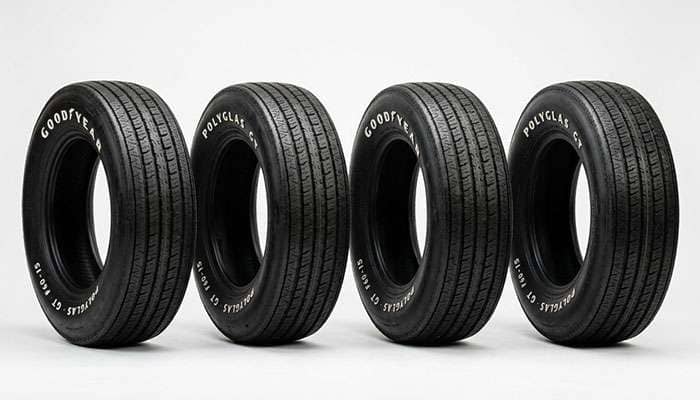
Good news: you do not have to hunt junkyards. These letter sizes are still made, both in genuine bias-ply for the purists and in bias-look radials for the guys who actually drive their cars. Here are the ones I reach for.
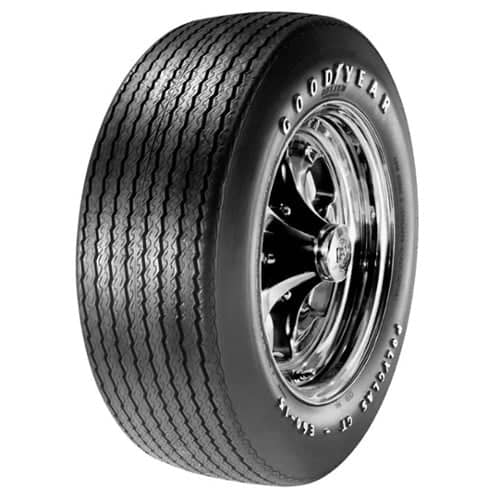
For the correct 60-series muscle look, the Goodyear RWL Polyglas GT in G60-15 is about as period-perfect as it gets, with that raised white letter and the fat 60-series stance. It runs around 495 dollars, and if you want the biggest meat out back, the same tire comes in L60-15 at about 520 dollars.
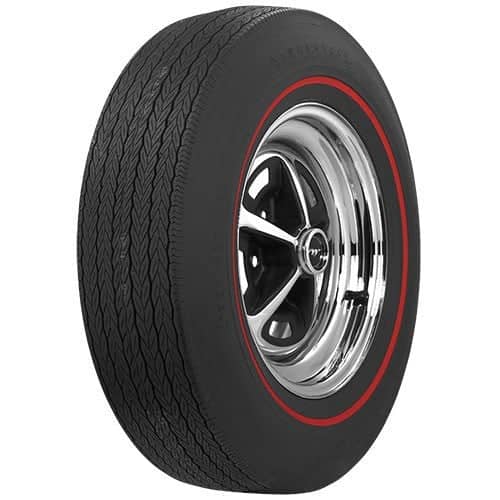
For the 70-series Wide Oval look, the Firestone Red Wide Oval in F70-14 is the tire that defined the era, around 374 dollars, and it also comes in G70-15 for the 15-inch cars.
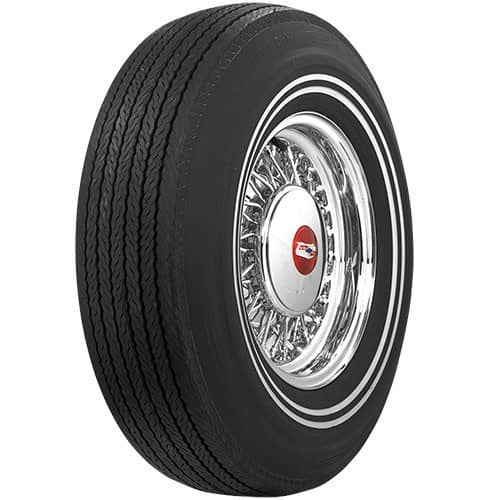
For the tall 78-series standard sizes, the BFGoodrich Silvertown Bias in G78-14 covers the full-size and base-muscle crowd at about 310 dollars. And if you are watching the budget, the Coker Classic Bias H spread starts around 243 dollars with a proper whitewall.
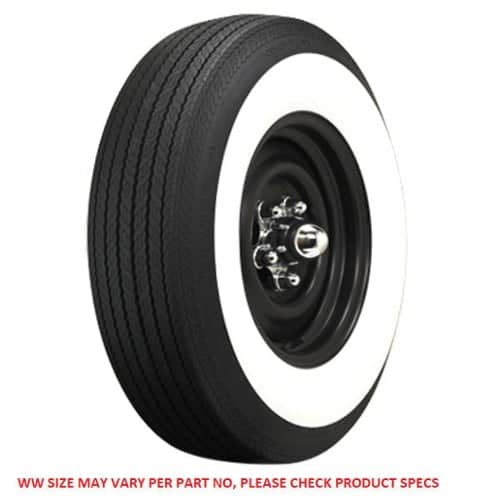
Want radials underneath the vintage look? The Firestone Red Wide Oval Radial FR70-14 gives you the Wide Oval face with modern radial manners at about 321 dollars, and the Diamond Back Auburn Premium HR78-14 is a clean whitewall radial around 279 dollars. Both wear that R in the size so you know they are radials.
Whatever you land on, you can browse the full spread of period sizes and sidewall styles over in our Classic Tires collection, and if you get stuck matching a size, that is exactly the kind of call we like to take.
Read it in three pieces. Letter equals load-and-width class, first number equals aspect ratio, last number equals rim diameter. G60-15 is a G-class, 60-series, 15-inch tire.
The letter is a ladder. A is lightest and narrowest, L is heaviest common, and anything bigger than L is almost always an aftermarket size like the Pro-Trac N50.
Same letter, different diameters. G78, G70, and G60 carry similar loads but stand at different heights, so always match overall diameter when you convert.
The R means radial. GR70-15 is the radial version of G70-15. Bias-look radials let you keep the vintage face with modern road manners.
These sizes are still available. From Goodyear Polyglas GT to Firestone Wide Oval to budget Coker whitewalls, you can buy the correct letter size new today.
G60-15 is an alpha-numeric muscle-car tire size. The G is the load-and-width class (a medium-heavy tire common on muscle cars), the 60 is the aspect ratio (a low, wide 60-series profile), and the 15 is the rim diameter in inches. It stands roughly 26.4 inches tall and converts to about a 235/60R15 in modern metric sizing.
An F70-14 converts to approximately a 205/70R14 in modern metric sizing. It was a common pony-car size on early Mustangs and Camaros. The 70 tells you it is a 70-series tire, so you replace it with a 70-series metric size to keep the same overall diameter and correct speedometer reading.
The letter indicates the tire's load-carrying capacity and, in practice, its width. The scale runs from A (lightest and narrowest) up through N (largest). Each step up the alphabet is a wider, heavier-duty tire. A G is a typical muscle-car tire, while an L was used on Cadillacs and big-block rears.
No. All three are G-class tires rated for a similar load, but the middle number is the aspect ratio, so they stand at different heights. A G78-15 is about 28 inches tall, a G70-15 about 27.5 inches, and a G60-15 about 26.4 inches. Always match overall diameter, not just the letter, when converting.
Yes, and most drivers do. Radials track straighter, steer lighter, and last longer than the original bias-ply tires. Bias-look radials give you the vintage sidewall appearance with modern road manners. Just match the original overall diameter so your stance, clearance, and speedometer stay correct.
An L60-15 converts to approximately a 275/60R15 in modern metric sizing. It was the big-meat rear tire on the heaviest muscle cars and popular with the pro-street crowd. Confirm the listed overall diameter before ordering, since brands vary slightly, and make sure your wheel width and fender clearance suit the wide 60-series profile.



