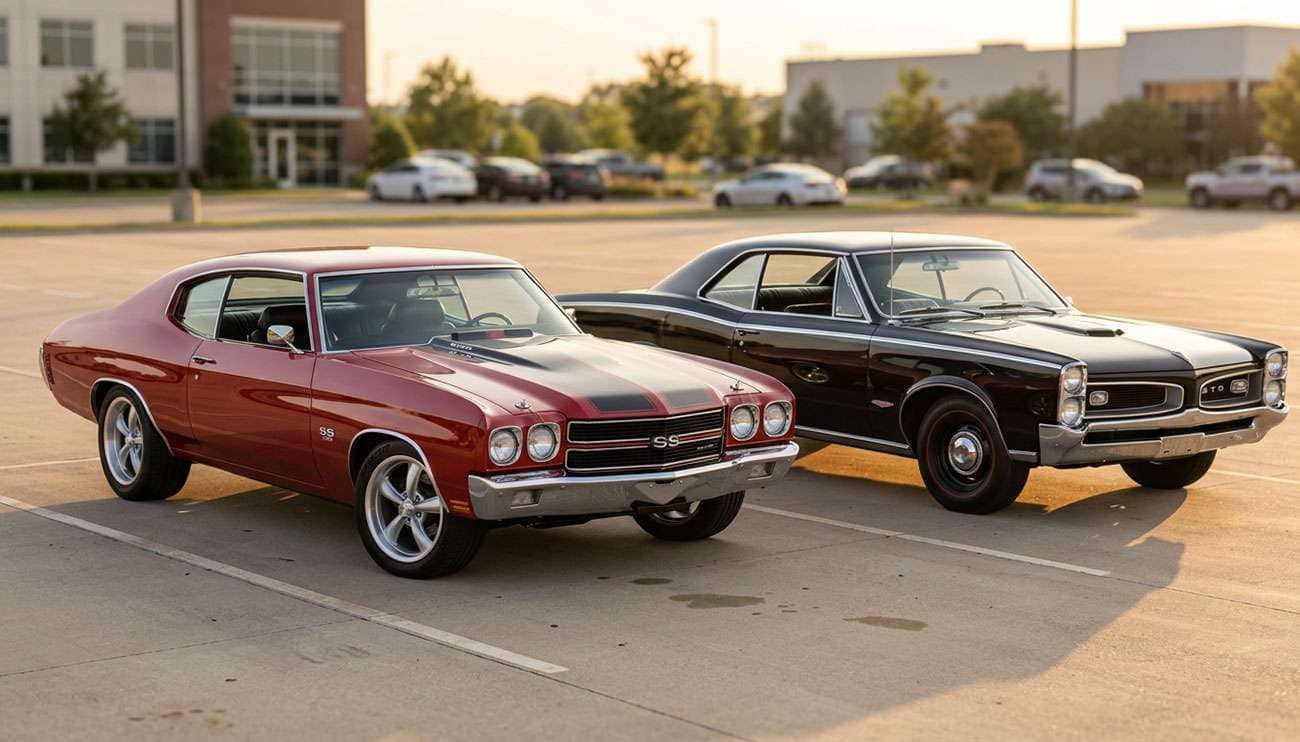
A stock-body 1964-72 Chevelle takes more tire than most people expect. On 15s, a 235/60R15 front and 245/60R15 rear fit without cutting anything. On 17s, owners run a 245/45R17 up front and a 275/40R17 in back on a 17x9.5 with 5.5 inches of backspacing. On 18s, an 18x10 rear with 5.5 inches of backspacing carries a 285 or 295 in the stock wheelhouse. Most guides stop at the sizes. What decides them is the rear frame rail, which sits right inside the tire on this body-on-frame car, and the brakes behind the front wheel.
I have been putting wheels and tires on Chevelles since before most of them were classics. Here is what came on them, what fits now, and why a Chevelle behaves differently from the unibody muscle cars when you go wide.
This table is the short answer, keyed to wheel diameter. Every combination assumes stock wheelhouses, a stock frame, and no cutting. These are the combinations owners run on stock-body cars, and they cover both the 1964-67 and 1968-72 bodies unless noted.
Wheel Diameter |
Front Wheel and Backspacing |
Front Tire |
Rear Wheel and Backspacing |
Rear Tire |
Watch For |
|---|---|---|---|---|---|
14-inch |
14x6 or 14x7, about 4.25 in |
215/70R14 (25.9 in tall) |
14x7, about 4.25 in |
225/70R14 (26.4 in tall) |
Factory look; clears drums and factory discs |
15-inch |
15x7, 3.75 to 4.25 in |
235/60R15 (26.1 in tall) |
15x8, 3.75 to 4.5 in |
245/60R15 (26.6 in tall) |
Classic Rally look with modern radials |
17-inch |
17x8, 4.5 to 5 in |
245/45R17 (25.7 in tall) |
17x9.5, 5.5 in |
275/40R17 (25.7 in tall) |
Some owners fit a 285/40R17 in back |
18-inch |
18x8, 4.5 to 5 in |
245/40R18 (25.7 in tall) |
18x10, 5.5 in |
295/35R18 (26.1 in tall) or 285/40R18 (27.0 in tall) |
An 18x11 rear is pushing a stock wheelhouse |
Tire heights are calculated from each size and rounded to a tenth of an inch. Brands run a little tall or short, so check the listed overall diameter on the tire you choose.
Two things jump out. First, the front runs out of room before the rear does. An 8-inch front wheel is about as wide as a stock front end takes comfortably, because the tire has to swing through full lock between the frame and the fender. Second, the rear takes a wider tire than a lot of muscle cars of the same era, up to about a 10-inch wheel and a 285 to 295 tire. That is the A-body's roomier rear wheelhouse at work, and the frame rail is what finally stops it.
Staggered setups are the norm. A narrower front keeps the steering light and clears at full lock, and the wider rear puts the power down. Our look at the muscle car staggered setup covers the trade-offs, including what it does to tire rotation.
Every 1964-72 Chevelle left the plant on bias-ply tires, and nearly all of them on 14-inch wheels. The 15-inch Rally wheel did not become a Chevelle SS standard until 1971. Here is what Chevrolet's own specifications list for selected years.
Year |
Standard Tire |
SS Tire |
Factory Wheels |
|---|---|---|---|
1964 |
6.50-14 or 7.00-14 |
Not listed separately |
14x5 |
1966 |
6.95-14 or 7.35-14 |
SS396: 7.75-14 red line |
14x5; SS396 14x6 |
1967 |
7.35-14 or 7.75-14 |
SS396: F70-14 red stripe |
14x5; SS396 14x6 Rally with disc brakes |
1968 |
7.35-14 |
SS396: F70-14 (G70-14 optional) |
14x5 or 14x6 |
1970 |
E78-14 (six) or F78-14 (V8) |
SS396/454: F70-14 white letter |
14x6 Rally; SS with discs 14x7 |
1971-72 |
E78-14 or F78-14 |
F60-15 |
14x5 or 14x6; SS 15x7 Rally |
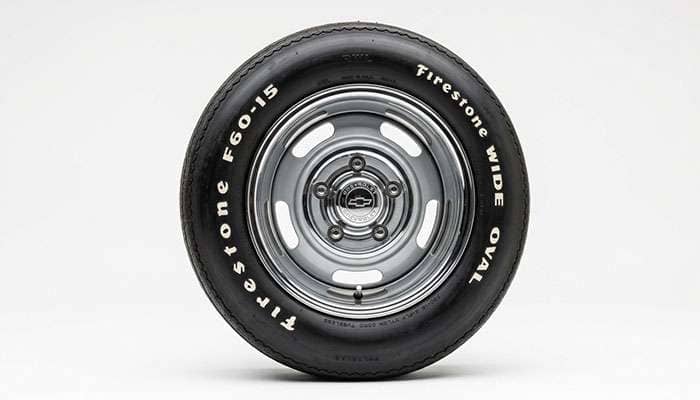
White letters were a big part of the look from 1970 on. The 1970 SS came on F70-14 white letter tires, and the 1971-72 SS's F60-15s carried raised white letters too. Plenty of owners mount them black side out for a quieter look, and plenty run the letters out the way the factory did. Our guide on which way raised white letter tires should face covers the case for each.
The factory tires stood about 26 inches tall, and that number still matters. The speedometer gear, the rear gear ratio, and the wheel opening all expect a tire in that range. Every combination in the first table stays between about 25.7 and 27 inches for that reason.
If you are restoring to original, the period sizes are still made. The 1966 SS396's 7.75-14 red line, the F70-14 and G70-14 of 1967-70, and the 1971-72 SS's F60-15 are all available as bias-ply reproductions. For a 1971-72 SS, the Goodyear Polyglas GT in F60-15 with raised white letters is the look judges expect. Red lines have their own history and their own care rules; our guide to what red line tires are covers both.
If you drive the car, radials change it more than anything else you can bolt on for the money. On 14-inch wheels, a 215/70R14 or 225/70R14 keeps the tall-sidewall look. Check the wheel width before you mount them, though. Tire makers list a 215/70R14 for rims about 5.5 to 7.5 inches wide and a 225/70R14 for about 6 to 8 inches, so the factory 14x5 found on most base cars is narrower than either tire wants. A 14x6 or 14x7 Rally puts the radial on the rim it was designed for and keeps the sidewall from bowing out past the tread. Our breakdown of muscle car tire sizes decoded walks through turning the old letter sizes into modern metric ones.
Here is the part nobody puts in front of you. A Chevelle is a body-on-frame car. Behind the rear axle, the frame rail runs right along the inside of the rear tire. On the outside you have the quarter-panel lip. The tire lives between those two, and on a Chevelle it is the steel frame, not a sheet metal wheelhouse, that stops the tire from moving inboard.
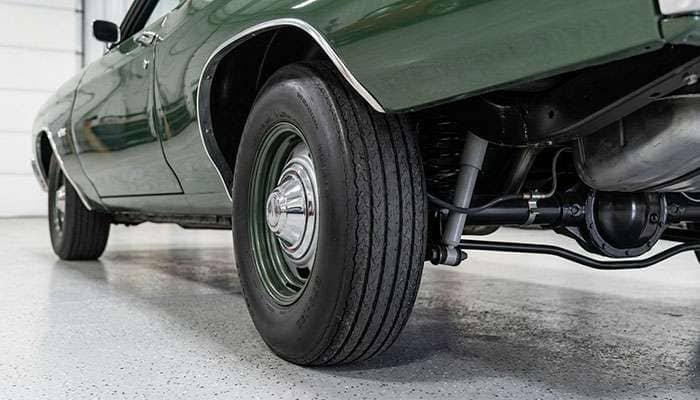
That changes how you go wider. On a unibody car like a first-gen Camaro or Nova, you can cut in wider inner wheelhouses and move the springs, and the tire gains room. On a 1968-72 Chevelle, a wider sheet metal tub by itself gains you little, because the frame rail is still right there. The common answer is to move the frame. Frame narrowing kits built for the 1968-72 GM A-body frame, like one sold for the GTO and LeMans, move the rear rails inboard 1-1/2 inches, and that maker rates its kit for a 315/30R18 under the rear, or a 335/30R18 with wider wheel tubs added.
The rear suspension adds its own parts to the inside of the wheel opening. Chevelles use a four-link rear with coil springs between the axle and the frame, and the control arms and spring pockets all sit in the same neighborhood as the inner sidewall. Too much backspacing and the tire meets the frame rail or its brackets. Too little and the tread catches the quarter lip every time the suspension compresses.
For most street cars, the stock-frame 18x10 with a 295/35R18 puts down more rubber than any Chevelle had from the factory. Going wider than that is a frame job, a rear end job, and a budget conversation, all at once.
Start from what Chevrolet used. GM listed Chevelle wheel offsets in its specifications, and working them out, the factory wheels sat at roughly 3.5 to 4.4 inches of backspacing. The 1964 14x5 at a 0.44-inch offset works out to about 3.5 inches, and the 1965-68 14x5 at 1.00 inch to about 4 inches. The 1967-69 14x6 Rally at 0.88 inch comes to about 4.4 inches. The 1969 SS 14x7 at 0.40 inch and the 1970-72 15x7 Rally at about 0.30 to 0.34 inch land near 4.3 to 4.4 inches.
That is your baseline. Wider wheels need more backspacing to keep their outer edge inside the fender lip, which is why the rear numbers in the first table climb from about 4 inches on a 15x8 to 5.5 inches on a 17x9.5 or 18x10. Past about 5.5 inches in the rear, the inside of the wheel starts meeting the frame rail. Up front, 4.5 to 5 inches on an 8-inch wheel keeps the tire clear of the frame and control arms at full lock and inside the fender lip over bumps.
Be careful with 17 and 18-inch wheels in this bolt pattern. The 5x4.75 pattern is shared with Camaros, Novas, Corvettes, and later GM cars, and a lot of wide wheels on the market are built with 6 to 7.5 inches of backspacing for those cars. On a Chevelle, that puts the rear tire into the frame. A wheel can be the right diameter, width, and bolt pattern and still be wrong for your car. Our guide to the 5x4.75 bolt pattern lists what shares it.
On 15s, the numbers are friendlier. Most 15x7 and 15x8 wheels made in this pattern sit between about 3.75 and 5 inches of backspacing, right where a Chevelle wants them. Our own Hot Rod Hanks 55 Rally is built in 15x7 and 15x8 at a little over 4 inches of backspacing, close to the factory figure and the right look for a 1970-72 car. If you are checking a wheel you already have, our step-by-step on how to measure backspacing on classic car rims takes a straightedge and a tape.
Chevelles came from the factory with 7/16-20 wheel studs. Aluminum wheels with thick mounting pads can leave too little thread for the lug nuts, so check engagement and plan on longer studs if you need them.
Yes, in the body, the wheelbase, and the factory wheels, even though the bolt pattern never changed.
The 1964-67 Chevelle rode on a 115-inch wheelbase across the line. For 1968, Chevrolet redesigned the body and split the wheelbase: coupes and convertibles went to 112 inches, and four-door sedans and wagons went to 116. The quarter panels, wheel openings, and fender shapes all changed with it. A combination that fits a 1966 coupe is a starting point for a 1970 coupe, not a promise.
Owner-reported setups show both bodies taking similar sizes on stock frames. A 1966 SS396 runs a 17x8 front at 4.5 inches of backspacing with a 245/45R17 and a 17x9.5 rear at 5.5 inches with a 275/40R17. A 1965 El Camino runs a 285/40R17 on the same rear wheel. A 1967 convertible runs an 18x10 rear at 5.5 inches. On the 1968-72 side, the 18x10 at 5.5 inches with a 285/40R18 or 295/35R18 is the setup owners keep coming back to, and an 18x11 is where they start calling it too much.
The factory wheels changed too. The early cars ran narrow 14x5s at 0.44 to 1.00-inch offsets. By 1969 the SS had a 14x7 at 0.40 inch, and by 1971 the SS was on a 15x7 Rally. If you are hunting correct factory wheels, the year matters more than the badge. El Caminos from these years share the Chevelle chassis, and the 1968-72 El Camino rides on the longer 116-inch wheelbase, so measure one on its own terms.
They do. The brakes behind the front wheel set the smallest wheel you can run, and every combination above assumes the wheel clears them.
Front Brake Setup |
Rotor Diameter |
Smallest Wheel |
Notes |
|---|---|---|---|
Factory front drums |
None (drum) |
14 in |
Every 1964-66 Chevelle |
Factory disc, 1967 |
4-piston caliper |
14 in |
SS396 disc cars used a 14x6 Rally |
Factory disc, 1969-72 |
11 in |
14 in |
Single-piston floating caliper |
11-inch disc conversion |
11 in |
Most factory 14s |
Check your wheel against the kit template |
12-inch class big brake kit |
12.19 in |
15 in |
Listed minimum on a common kit for these GM cars |
13-inch class big brake kit |
12.88 in |
17 in |
Listed minimum on a kit that covers 1964-72 Chevelles |
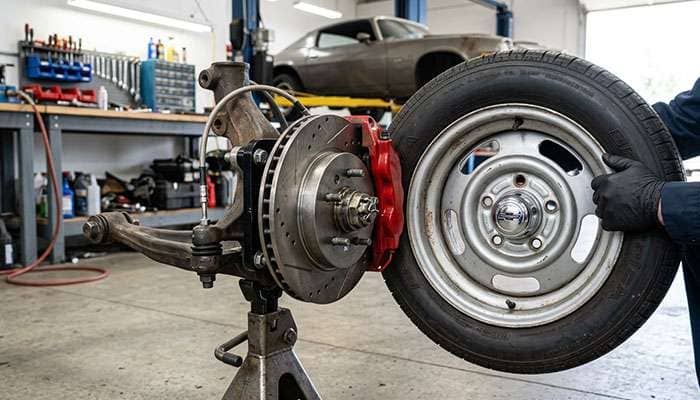
Disc brakes reached the Chevelle in 1967 with a four-piston caliper. By 1969, GM had moved to the single-piston floating caliper on an 11-inch rotor, the design most Chevelle disc conversions still copy. Factory disc cars rode on 14-inch Rally wheels, so a stock-style disc setup never forces you off 14s.
Diameter is only half the test. The caliper also has to clear the back of the spokes. Wilwood's install sheet for its 1967-69 Camaro kit, a close cousin of Chevelle front hardware, calls for at least 0.080 inch of clearance between the wheel and the caliper everywhere. That is about the thickness of a nickel. Every brake kit maker publishes a wheel template, and that template beats any chart, including mine.
Watch the spindle, too. Some disc swaps use taller spindles from 1970-81 Camaros and Firebirds or from full-size GM cars. Those raise the front of the car about an inch and change the geometry, which can change what fits at full lock. Pick your brakes first, then your wheels, then your tires. Any other order and you may buy one of them twice.
A setup that almost fits costs you a little more every mile. It usually goes in this order.
Stray far from about 26 inches of overall height and the speedometer reads wrong and the rear gear feels different. It is small, and it never goes away.
The rear tread catches the quarter lip on dips and driveways, or the inner sidewall starts kissing the frame rail under load. Up front, the tire touches the frame or fender at full lock.
A sidewall rubbing steel wears through the rubber and into the cords. Once you see a scuff line, a cut, or a bulge, read our guide on tire sidewall damage and whether it is safe to drive, because some of it can wait and some cannot.
A tire that keeps hitting the quarter lip chips paint, cracks filler, and can bend the lip. A wheel that rubs a caliper grinds both. On a car where a quarter panel costs more than a set of tires, this is the expensive step.
The end of the ladder is a second set of wheels, tires, or both. Measuring first costs an afternoon. Guessing costs a set.
Your Chevelle has had fifty-plus years for somebody to change its springs, spindles, rear end, or brakes. Measure it instead of trusting a chart.
A stock-body 1964-72 Chevelle takes a 235/60R15 and 245/60R15 on 15s, a 245/45R17 and 275/40R17 on 17s, and up to a 295/35R18 or 285/40R18 in back on an 18x10 with 5.5 inches of backspacing. What decides it is the rear frame rail on the inside of the tire and the quarter lip on the outside, plus the brakes that set your smallest front wheel. The 1964-67 and 1968-72 bodies share the bolt pattern but not the sheet metal or the wheelbase, so measure your own car. Pick brakes, then wheels, then tires. That order has saved a lot of my customers from buying things twice.
On a stock body, about a 235/60R15 front and 245/60R15 rear on 15s, a 245/45R17 front and 275/40R17 rear on 17s, and up to a 295/35R18 or 285/40R18 rear on an 18x10 with 5.5 inches of backspacing.
About a 285 to 295 on an 18x10 with 5.5 inches of backspacing. Wider than that usually means narrowing the rear frame rails, which one kit maker rates for a 315/30R18.
Every 1964-72 Chevelle uses a 5x4.75 bolt pattern, also written 5x120.65, with 7/16-20 wheel studs from the factory.
The 1970 Chevelle SS 396 and SS 454 came on F70-14 white letter bias-ply tires, with 14x7 wheels on disc brake cars. The 1971-72 SS moved to F60-15 tires on 15x7 Rally wheels.
Yes. A 17x8 front at 4.5 to 5 inches of backspacing with a 245/45R17 and a 17x9.5 rear at 5.5 inches with a 275/40R17 is a common stock-body setup.
They share the 5x4.75 bolt pattern, so the wheels bolt on. The bodies, wheelbase, and wheel openings changed for 1968, so a setup that fits one generation is a starting point for the other, not a guarantee.