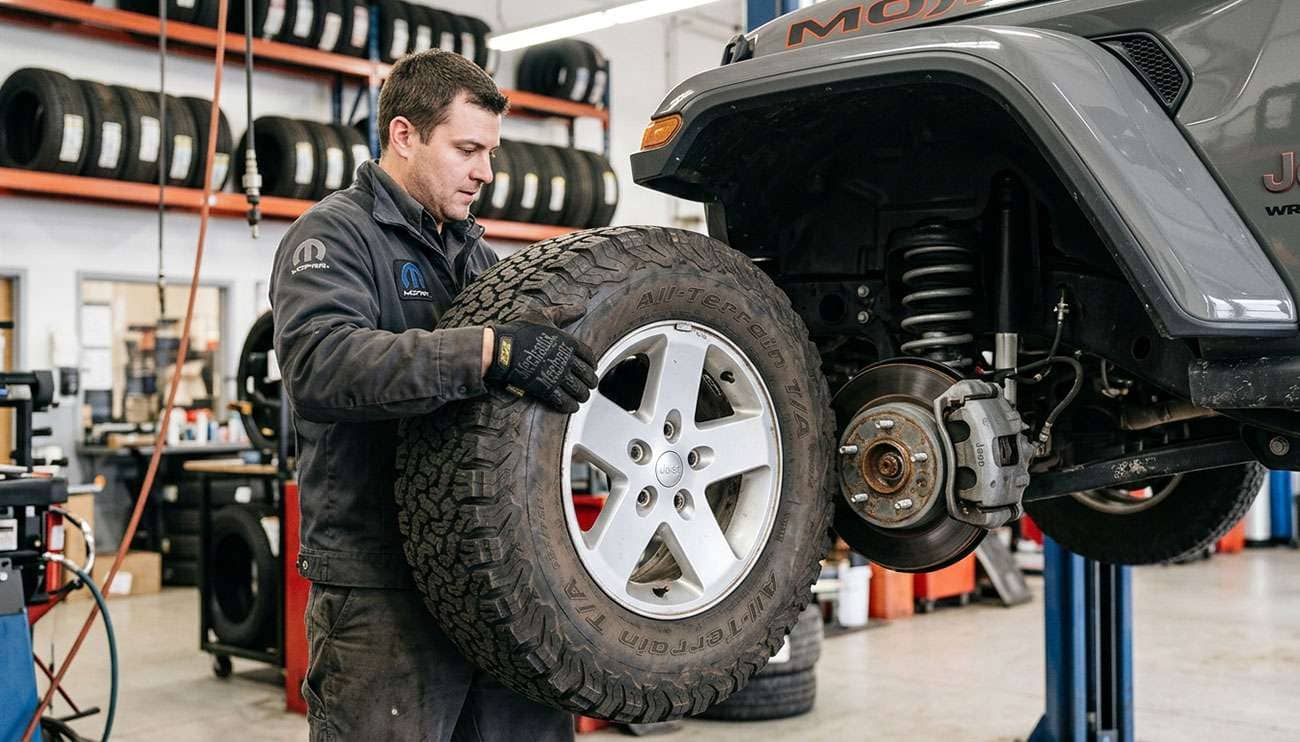
Short answer: yes, factory JK wheels bolt onto a JL Wrangler, but not with JK lug nuts. Both Jeeps use a 5x5 (5x127) bolt pattern, a 71.5 mm hub bore, and nearly the same factory offset. What changed for the JL is the wheel stud: the JK uses 1/2-20 studs and the JL uses M14 x 1.5. So the wheel fits and the JK hardware doesn't. Two more things decide whether a specific JK wheel works on your JL: whether its lug holes clear a 14 mm stud, and, for 16-inch JK steel wheels, whether the wheel clears the JL's larger front brakes. "Same bolt pattern" is where most answers stop. It is the first check, not the last.
I'm Dennis Feldman, and Jeep wheel swaps land on my desk every week. JK take-off wheels are everywhere and cheap, and plenty of new JL owners want the Rubicon look without paying for new wheels. The swap usually works. When it doesn't, it fails at the stud, the caliper, or the TPMS light, not at the bolt pattern.
JK-Era Wheel |
Fits a JL? |
Lug Nuts on the JL |
What to Watch |
|---|---|---|---|
Factory JK 17- or 18-inch alloy (2007-2018) |
Yes |
M14 x 1.5, cone seat |
Lug holes are a snug fit over 14 mm studs; TPMS sensors depend on the JK's year |
Factory JK 16x7 steel (base Sport and X) |
Test-fit first |
M14 x 1.5, seat matched to the wheel |
Front caliper clearance; every JL front rotor is about an inch larger than the JK's |
Aftermarket 5x5 wheel listed for JK, JL and JT |
Yes |
M14 x 1.5, seat matched to the wheel |
Backspacing and tire size |
Aftermarket 5x5 wheel listed for JK only |
Check before buying |
M14 x 1.5, seat matched to the wheel |
Lug holes may be drilled for 1/2-inch studs |
TJ or YJ wheel (1987-2006) |
No |
Not applicable |
5x4.5 bolt pattern, which no JL uses |
Find your wheel's row first. Then use the second table, keyed to your JL's build, to see what else the swap needs before the Jeep goes back on the ground.
Your Jeep |
Lug Nuts |
TPMS Sensors in JK Wheels |
Load Check |
|---|---|---|---|
JL built before June 2021 |
M14 x 1.5, seat matched to the wheel |
2013-2018 JK sensors (433 MHz) can usually be registered; 2007-2012 sensors (315 MHz) cannot |
Wheel rating at least half the heavier axle's GAWR |
JL built June 2021 or later |
M14 x 1.5, seat matched to the wheel |
Plan on new sensors matched to the later JL design |
Wheel rating at least half the heavier axle's GAWR |
JL 4xe |
M14 x 1.5, seat matched to the wheel |
Same build-date rule as above |
At least 1,775 lb per wheel (3,550 lb rear GAWR) |
Gladiator JT |
M14 x 1.5, seat matched to the wheel |
Same build-date rule as above |
Check the door-jamb label; a loaded bed adds rear axle load |
Yes. The 2007-2018 JK, the 2018-and-newer JL, and the 2020-and-newer Gladiator JT all use a 5x127 bolt pattern, which is five lugs on a 5-inch circle and usually written 5x5. Wheel fitment references list the same 71.5 mm center bore for all three. That is the reason JK wheels are the first thing a JL owner looks at on the used market, and the reason so many listings say "fits JK and JL" without another word.
Offset lines up too. Wheel-fitment references put factory JK offsets at about +44 to +51 mm and factory JL offsets at about +44 to +52 mm. Most factory JK wheels sit around 6.25 inches of backspacing, and with nearly identical offsets, factory JL wheels land in the same place. A factory JK wheel on a JL puts the tire where Jeep put it, not an inch outboard.
The bolt pattern break in Wrangler history is earlier. The 1987-1995 YJ and 1997-2006 TJ use 5x4.5, so those wheels fit neither a JK nor a JL. If the seller says "Wrangler wheels" and nothing else, ask the year. Our 5x5 bolt pattern guide lists every other vehicle on this pattern.
On some interchange questions the center bore kills the swap. Not this one. The hubs are the same size, so a factory JK wheel centers on a JL exactly as it did on the JK. In the aftermarket, about a third of 5x5 wheels are bored at the Jeep's 71.5 mm and nearly all the rest are bored larger. A larger bore still goes over the hub; it just centers on the lug nuts unless you add a ring. Our guide to hub-centric vs. lug-centric wheels covers when that gap matters.
Jeep sold both generations as 2018 models, so a "2018 Wrangler" can have either stud. Don't order lug nuts, sensors, or wheels by model year alone for a 2018. The quickest field test is the lug nut: JL factory nuts take a 22 mm socket, a size the JK's smaller nuts don't use.
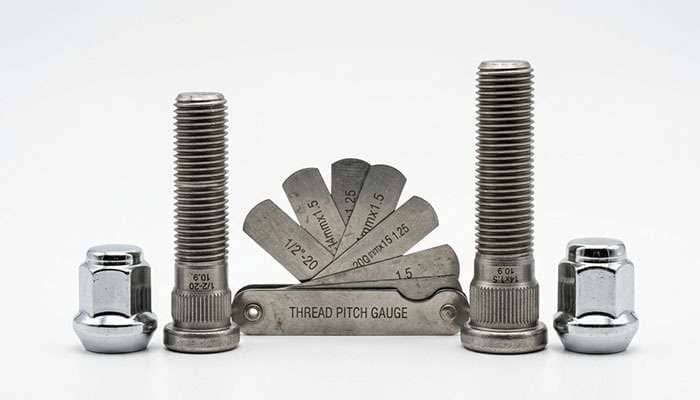
JL lug nuts. The JK's studs are 1/2-20, meaning half an inch across with 20 threads per inch. The JL's studs are M14 x 1.5, meaning 14 mm across with a thread every 1.5 mm. A JK nut will not start on a JL stud, so that mistake announces itself right away. The nuts that came off your JL are the starting point, and owners running factory JK alloys on JLs mount them with JL hardware.
Thread size is half the lug nut question. The other half is the seat, the surface on the nut that clamps against the wheel. It has to match the shape machined into the wheel's lug hole: a 60-degree cone on most Jeep wheels, a ball or a flat seat with a washer on some aftermarket designs. A mismatched seat still torques up and feels tight, but it touches the wheel on a thin ring instead of the full surface, and the clamp load drops as the wheel flexes. For any JK wheel moving to a JL, the right nut is M14 x 1.5 with the seat that wheel was designed for. Our lug nut seat types guide shows how to tell them apart.
A 14 mm stud is about 1.3 mm larger than a 1/2-inch stud, and a lug hole drilled for the smaller stud does not have much to give. Owners who run factory JK wheels on JLs report the lug holes are a snug fit over the 14 mm studs. They go on, but they go on tight. Most current aftermarket 5x5 off-road wheels are drilled to clear 14 mm studs and are sold for the JK, JL, and JT together. Some older designs were made for the JK only and drilled for 1/2-inch studs. A wheel listed for "07-18 JK" and nothing newer is a question, not a yes.
The rule in the bay: the wheel slides over the studs by hand and sits flat against the hub face before a single nut goes on. If you have to tap it on or pull it on with the nuts, stop. A wheel drawn down onto a stud it binds on can look seated and not be.
Maybe, and this is the one case where I would not buy before a test-fit. Base JK Sport and X models rode on 16x7 steel wheels in many years; a 2010 Sport is one example. Those wheels were sized around the JK's brakes, and the JK's front rotor is 11.9 inches across.
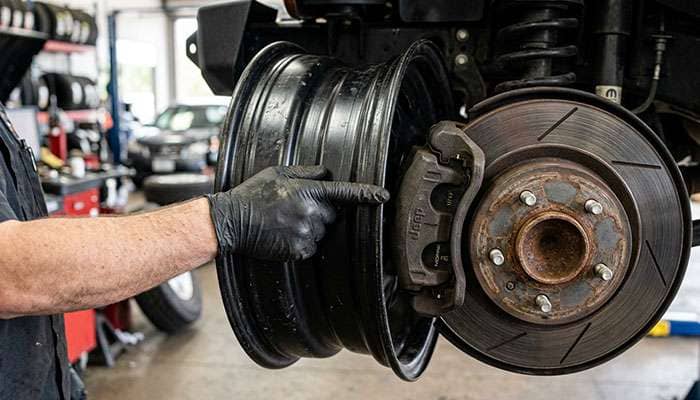
The JL's front rotor is 12.9 inches (330 mm) on every trim. Published JL spec sheets list that diameter on the Sport, the Sahara, the Rubicon, the 4xe, and the 392. A rotor an inch larger in diameter puts the caliper about half an inch farther out from the hub center, which is exactly where a 16-inch steel wheel's barrel and center section are tightest. The JL Sport's base wheel is a 17x7.5 steel wheel, so there is no factory 16-inch JL wheel to compare against.
Some 16-inch wheels clear the JL's calipers and some don't, depending on barrel shape and center design. The only reliable test is to bolt one on with no tire, hand-tighten the nuts, and spin it a full turn while you watch the caliper. If anything scrapes, that wheel is done on that Jeep. Our brake caliper wheel clearance guide explains how to measure it.
A 2009 JK Rubicon carried a 12.4-inch rear rotor. The JL Sahara and Rubicon run 13.4 inches, and the 4xe and 392 run 14 inches. Spin the rear wheel too.
It depends on the JK's year and the JL's build date, and this is where most JK-wheel swaps end up with a light on the dash. Every JK and JL left the factory with tire pressure monitoring, which NHTSA's TPMS rule, FMVSS 138, requires on new light vehicles. The sensors live inside the wheels, so JK wheels come with JK sensors.
2007-2012 JK sensors: These run at 315 MHz. Jeep moved the Wrangler to 433 MHz for 2013. A 315 MHz sensor cannot talk to a JL's receiver at all.
2013-2018 JK sensors in a JL built before June 2021: Aftermarket sensor makers sell one 433 MHz sensor listed for both the 2013-2018 JK and JLs built through early June 2021, a strong sign these carry over. The JL still has to learn the new sensor IDs, so plan on a relearn with a scan tool.
Any JK sensor in a JL built June 2021 or later: Mopar lists a different sensor for JLs and JTs built after early June 2021. Plan on new sensors. The build date is on the sticker in the driver's door jamb.
They fit the JL. Whether a 35 belongs on them is a backspacing question and a rim-width question. On backspacing, the answer is the same as a factory JL wheel, because the offset is nearly the same. A JK Rubicon 17x7.5 at about +44 mm puts a 35-inch tire in the same spot as a JL Rubicon 17x7.5, so whatever your JL does with 35s on factory wheels, it will do on JK factory wheels. Our guide to whether 35s fit a JL Wrangler without a lift covers that part by trim.
That is not true of most aftermarket wheels. About two out of three 17-inch 5x5 wheels on the market run 4.5 to 5.25 inches of backspacing, and only about one in ten runs 5.5 inches or more. Against a factory figure around 6.25 inches, a typical aftermarket wheel moves the tire an inch or more outboard. That helps a 35 clear the control arms at full lock and pushes the tread past the factory flares. Neither is wrong; just don't assume a JK aftermarket wheel behaves like a JK factory wheel on your JL.
Factory JK and JL alloys are 7.5 inches wide, with a few 8-inch JL wheels on 20-inch trims. The approved rim-width ranges published for 35x12.50R17 and 315/70R17 tires start at 8 or 8.5 inches, so a 7.5-inch factory wheel sits below what most 35-inch tire makers list. Plenty of Jeeps run 35s on factory 7.5s anyway. It is still outside the tire maker's spec. If you are buying wheels specifically to run 35s, an 8- to 9-inch-wide 5x5 wheel puts the tire back inside its range.
For most gas JLs, a factory JK wheel is not near its limit. Two versions of the JL are much heavier, though, and this is the check everyone skips. A 2009 JK Rubicon two-door weighs about 4,080 pounds at the curb. Published 2018 JL specs put gas JLs between about 3,955 and 4,455 pounds. The 2024 4xe runs 5,049 to 5,265 pounds depending on trim, and the 392 is about 5,103. The 2024 4xe's rear gross axle weight rating (GAWR) is 3,550 pounds. Split across two wheels, every rear wheel on a 4xe has to be rated for at least 1,775 pounds.
Every wheel's load rating is stamped or cast on the back. Reputable aftermarket wheel makers test to SAE J2530, the industry standard for aftermarket wheel performance, at the load rating they publish. Most 17-inch 5x5 wheels on the market are rated at 2,500 pounds. About one in nine is rated under 1,800, which leaves little or no margin on a 4xe's rear axle. The math is simple: find the GAWR on the certification label in your driver's door jamb, take the heavier axle, divide by two, and compare. Our wheel load rating guide walks through it with examples.
The Gladiator JT shares the JL's 5x5 pattern, 71.5 mm bore, and M14 studs, so JK wheels mount the same way. A loaded bed puts more weight on the rear axle, so the load check matters even more on a JT.
Going the other way, a JL wheel goes over a JK's smaller studs and same-size hub with no clearance problem, and a wheel built to clear the JL's larger brakes generally clears the JK's. The lug nuts are where the reverse swap goes wrong.
First, never put JL nuts on JK studs. An M14 nut is slightly larger than a 1/2-inch stud, and one owner who tried it found the JL nuts went on loosely instead of refusing outright. That feels like it's working, which is the danger. A JK needs 1/2-20 nuts with a seat that matches the JL wheel.
Second, check thread engagement. The same owner moved JL alloys onto a 2012 JK that had been on factory steel wheels and found about half as much stud showing past the nuts, which he called unsafe. Alloy wheels are usually thicker at the mounting pad than steel wheels, so the nut sits farther out on the stud. A common shop rule is thread engagement at least equal to the stud's diameter. If you can't get there, the fix is longer studs, not hope.
Third, TPMS. JL sensors don't belong in a 2007-2012 JK, which listens at 315 MHz. On a 2013-2018 JK, early JL sensors share the 433 MHz design and can usually be registered; later JL sensors are a different part, so don't count on them.
A JK wheel on the right JL with the right hardware is one of the best-value swaps in the Jeep world. The wrong hardware costs more than a new set of wheels, in this order.
1. A TPMS light you learn to ignore. The real cost is that the system can't warn you when a tire actually goes low.
2. Lug nuts that work loose. A wrong seat, or a wheel that bound on a stud and never sat flat, drops the clamp load. Nuts back off over a few hundred miles, sooner on washboard and rock.
3. Damaged threads. A nut forced onto the wrong thread galls the stud. Now the stud has to come out.
4. Stretched or broken studs. With the clamp load gone, the studs carry the wheel in shear. They stretch, then snap.
5. Hub and bearing damage. A wheel rocking on a loose joint hammers the hub face and bearing, a parts-and-labor bill on top of the hardware.
6. A wheel off the Jeep. This is the end of the ladder, and it isn't a cost measured in dollars.
7. The wheels you should have bought first. Every rung above ends with buying a wheel and hardware that fit. Buying them first is the cheapest point on the list.
Step 1: Confirm both generations. Ask what year Jeep the wheels came off, and remember that a 2018 can be either. Five lugs on a 5-inch circle, or the deal is off.
Step 2: Read the back of the wheel. Find the size, offset, and load rating, and compare the rating against half your heavier axle's GAWR.
Step 3: Check the lug holes. An aftermarket wheel listed only for the JK may be drilled for 1/2-inch studs. Ask, or slide one over a JL stud before you buy.
Step 4: Get the right nuts. M14 x 1.5 with a seat that matches the wheel. Leave the JK nuts with the seller.
Step 5: Sort out TPMS. Match the JK's year against your JL's build date, then decide whether the sensors carry over. Budget for a relearn either way.
Step 6: Inspect the take-off tires. Used wheels usually come with used tires. Check the date codes, the tread, and the sidewalls for cuts, chunks, and bulges, and read our guide on tire sidewall damage and whether it is safe to drive if you find anything.
Step 7: Test-fit one wheel before mounting four. Slide it on by hand, hand-thread the nuts, and spin it past the front caliper. With the tire mounted, check full-lock steering clearance. Then torque to your JL owner's manual spec in a star pattern. Tire Industry Association service training calls for a torque wrench on the final pass, not an impact gun, and a re-torque after the first 50 to 100 miles.
If the JK wheels don't pass, browse our 5x5 wheels and filter by size and backspacing for your JL.
JK wheels fit a JL Wrangler because Jeep kept the 5x5 pattern, the 71.5 mm hub, and nearly the same offset. Jeep changed the stud, from 1/2-20 to M14 x 1.5, so every JK wheel needs JL lug nuts and lug holes that clear a 14 mm stud. Factory JK alloys are the easy case. JK 16-inch steel wheels need a test-fit against the JL's larger brakes, JK TPMS sensors carry over only when the dates line up, and on a 4xe or Gladiator the load rating is worth thirty seconds with the door label.
Check the stud, the seat, the caliper, and the sensors before you buy. That's a few minutes of work, and it's the difference between a bargain and a broken stud.
Yes. JK Rubicon wheels share the JL's 5x5 bolt pattern, 71.5 mm hub bore, and close to the same factory offset. Mount them with the JL's M14 x 1.5 lug nuts, not JK nuts, and expect the lug holes to be a snug fit over the JL's 14 mm studs.
The JL uses M14 x 1.5 lug nuts, and the factory nuts take a 22 mm socket. The JK before it used 1/2-20 nuts, so JK lug nuts will not thread onto JL studs.
Yes. Both use 5x127, also written 5x5, with a 71.5 mm center bore. The Gladiator JT uses the same pattern. The older TJ and YJ use 5x4.5.
Sensors from a 2013-2018 JK run at 433 MHz and can usually be registered to a JL built before June 2021. Sensors from a 2007-2012 JK run at 315 MHz and will not work. JLs built in June 2021 or later use a different sensor, so plan on new ones.
Yes, with 1/2-20 lug nuts that match the JL wheel's seat. Never use JL nuts on JK studs. Because JL alloys have thick mounting pads, check that you still have enough thread engagement, and go to longer studs if you don't.
Sometimes. The JK's 16x7 steel wheels were sized around an 11.9-inch front rotor, and every JL has a 12.9-inch front rotor. Some 16-inch wheels clear the JL's calipers and some don't, so test-fit one wheel without a tire and spin it before you buy a set.