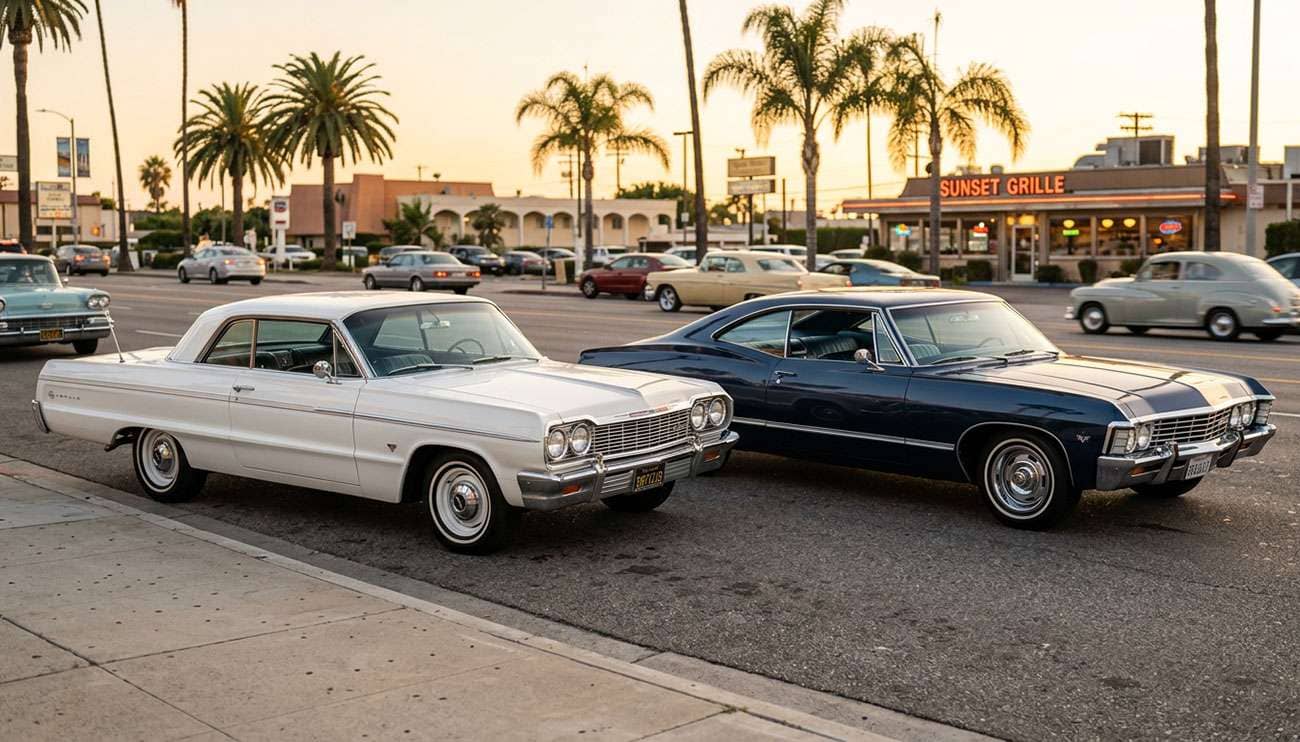
Every 1958-70 Impala bolts to the same 5-on-4-3/4 pattern with 7/16-inch studs, so the bolt pattern is the easy part. The year decides everything else. A 1967-70 car with front disc brakes needs at least a 15-inch wheel, and the 1970 owner's manual lists nothing smaller than a 15. The new 1965 frame spread the rear tires about 3 inches farther apart, which changes how much rubber fits in back. And the correct whitewall shrank from about 2-1/4 inches through 1961 to 1 inch in 1962, then got narrower still. Most charts hand you the bolt pattern and stop there.
Find your year in this table first. Everything else in this guide hangs off it.
Years |
Frame and Rear Track |
Factory Wheel |
Smallest Wheel That Clears the Brakes |
Correct Whitewall |
|---|---|---|---|---|
1958 |
X-frame, one-year body, 58.9 in. track |
14-inch |
14-inch (drums) |
Wide, about 2-1/4 in. |
1959-61 |
X-frame, 119 in. wheelbase |
14x5; 14x6 on wagons |
14-inch (drums) |
Wide, about 2-1/4 in. |
1962-64 |
X-frame, 59.3 in. rear track (1963-64 spec) |
14x5; wider wheel on wagons |
14-inch (drums) |
1 in. |
1965-66 |
Perimeter frame, 62.4 in. rear track |
14x5; 14x6 on wagons and with 8.25-14 tires |
14-inch (drums) |
About 1 in. |
1967-68 |
Perimeter frame, 62.4 in. |
14-inch with drums; 15x5 or 15x6 Rally with optional discs |
15-inch on disc cars |
1 in. or narrower |
1969 |
Perimeter frame, 62.4 in. |
14-inch with drums; 15-inch with discs |
15-inch on disc cars |
Narrow stripe |
1970 |
Perimeter frame, 62.4 in. |
15-inch (the only size the owner's manual lists) |
15-inch |
Narrow stripe |
I've had Impalas rolling through our bays in Long Beach since we opened the doors in 1971. Lowriders, wagons, numbers-matching SS cars, grandpa's four-door. The question is always the same: "What fits?" The honest answer always starts with "What year is it?"
Here is what owners run on stock-suspension cars without cutting anything. The early X-frame cars and the later perimeter-frame cars get their own columns because the rear axle got wider in 1965. These are combinations owners report, not factory numbers, so measure your own car before you order. The steps are at the end of this guide.
Wheel Diameter |
1958-64 (X-Frame) |
1965-70 (Perimeter Frame) |
Watch For |
|---|---|---|---|
14-inch |
14x6 with 205/75R14 (26.1 in.) or 215/75R14 (26.7 in.) |
14x6 with 215/75R14 or 225/75R14 (27.3 in.) |
Will not clear factory front discs or most disc conversions |
15-inch |
15x6 or 15x7 with 225/70R15 (27.4 in.); 235/70R15 (28.0 in.) on a 15x7; 15x8 rear at about 4.5 in. backspacing |
15x7 front with 225/70R15; 15x8 rear at 4.5 in. with 255/70R15 or 275/60R15 (28.0 in.) |
On X-frame cars the inside (frame rail) runs out first |
17-inch |
Few owner reports; one air-ride 1964 runs 245/45R17 on 8- to 9-inch wheels |
17x8 front at 4.5 in. with 245/45R17 (25.7 in.) |
A 25.7-inch tire leaves a big gap in a full-size wheel opening |
18-inch |
No reliable owner data; measure first |
18x9 rear at 4.5 in. with 275/40R18; or 18x10 rear at 6.5 in. with 275/45R18 (27.7 in.) |
Owners run backspacing anywhere from 4.5 to 6.5 in., so measure |
Fifteen inches is the sweet spot for these cars, and the market agrees. About 4 in 10 of the 5x4.75 wheels on the market today are 15s, and only about 1 in 80 is a 14. Most 15x7s in this pattern carry 3-3/4 to 4-1/4 inches of backspacing, and most 15x8s carry 3-3/4 to 4-1/2. That's right in the window these cars like. Go to a 17x9.5 or 18x9.5 and the picture changes: most carry 5-1/4 to 7-1/2 inches of backspacing. Deep backspacing has worked on 1965-70 cars, but nobody has published numbers for the X-frame cars, so measure first.
Every 1958-70 Impala, Bel Air, Biscayne, and Caprice runs 5 on 4-3/4 inches, which is the same thing as 5x120.65 mm. The studs are 7/16-20 all the way through, and the hub measures about 70.3 mm. That's the same pattern as a 1955-57 Tri-Five, a Chevelle, a Camaro, and a Nova. Our 5x4.75 bolt pattern guide lists everything else that shares it.
Here's what bites people. The bolt pattern stops matching right after this era. Most references, including period wheel-interchange lists, put the 1971-76 full-size Chevrolet on 5x5 with 1/2-inch studs, and later wagons and police cars ran 5x5 too. A 5x5 wheel is about a quarter-inch bigger across the circle than 5x4.75. That's close enough to fool your eye at a swap meet, and not close enough to bolt on. So an "Impala wheel" is only a 1958-70 wheel if it measures 5 on 4-3/4.
Two more things to check on any aftermarket wheel:
Every one of these cars left the plant on bias-ply tires. Through 1966 they all rode on 14-inch wheels, except the police and taxi cars, which got 15s. Here's the factory spec by year, with the modern radial that comes closest in height.
Years |
Factory Tires |
Closest Modern Radial (Height) |
|---|---|---|
1958 |
7.50-14; 8.00-14 on wagons and as an option |
205/75R14 (26.1 in.); 215/75R14 (26.7 in.) |
1959-61 |
7.50-14; 8.00-14 on wagons |
205/75R14; 215/75R14 |
1962-64 |
7.00-14 or 7.50-14 by engine and body; 8.00-14 on wagons and, in 1964, on 409 cars |
195/75R14 (25.5 in.); 205/75R14; 215/75R14 |
1965-66 |
7.35-14 or 7.75-14; 8.25-14 on 14x6 wheels; 8.55-14 optional |
195/75R14 through 225/75R14 (27.3 in.) |
1967-68 |
14-inch sizes above with drums; 8.15-15, 8.45-15, or G70-15 with disc brakes |
205/75R15 (27.1 in.); 215/75R15 (27.7 in.); 225/70R15 (27.4 in.) |
1969 |
8.25-14 class with drums; 15-inch with discs |
215/75R14; 215/75R15 |
1970 |
F78-15 or G78-15; G78-15 on the Impala V8; H78-15 with the 400 and 454; G70-15 optional |
205/75R15; 215/75R15; 225/75R15 (28.3 in.); 225/70R15 |
Those old numeric sizes don't carry an aspect ratio, which is why they confuse people. The conversion that holds up in the shop goes like this: a 7.50-14 or 7.75-14 becomes a 205/75R14, an 8.00-14 or 8.25-14 becomes a 215/75R14, and an 8.50-14 or 8.55-14 becomes a 225/75R14. On 15s, a G78-15 becomes a 215/75R15 and an H78-15 becomes a 225/75R15. The G70-15 Wide Oval, which Chevrolet offered on the full-size cars from 1967 through 1970, lands closest to a 225/70R15.
Wagons are the exception you can't ignore. Starting in 1959, Chevrolet put the wagons on a 6-inch wheel and the bigger tire size. If you're shoeing a Nomad, Kingswood, or Impala wagon, start from the wagon size, not the coupe size.
Yes, on almost every disc-brake Impala. This is the year question that actually breaks parts.
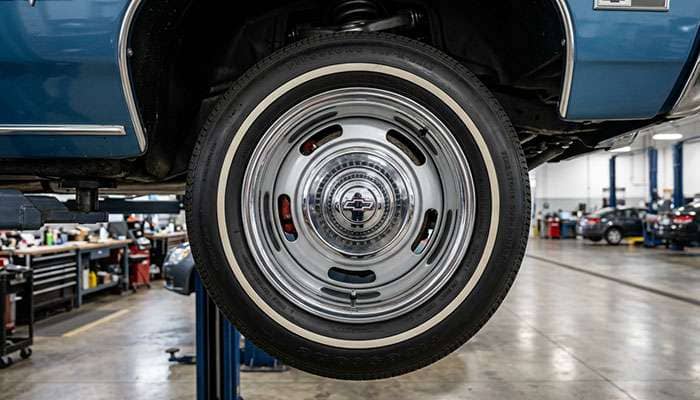
1967-68: Front disc brakes were an option, and ordering them got you 15-inch Rally wheels. The 15x5 (code DB) carried an 8.15-15. The 15x6 (code DC) went on wagons with 8.45-15s or on cars with the G70-15 Wide Oval. Drum-brake cars stayed on 14s.
1969: Same deal. Drum cars came on 14-inch wheels. Disc cars needed 15s, because a 14 hits the caliper. If a previous owner swapped 1969 disc brakes onto a drum car, the original 14s won't go back on.
1970: Chevrolet's 1970 owner's manual lists only 15-inch tires for the full-size line, from F78-15 up to H78-15. Plan on 15s or bigger for a 1970.
Disc conversions on older cars. Most bolt-on front disc kits for 1955-68 full-size Chevys call for a 15-inch wheel, or a 14 built specifically to clear discs. Most of them also push each front wheel out. A popular 1965-68 kit adds 11/16 inch per side, and a kit for 1955-57 and 1959-64 cars adds 7/8 inch per side. That changes your fender clearance up front, so measure after the brakes go on, not before. Our disc brake conversion wheel fitment guide walks through rotor size against wheel size.
If you're keeping drums and want the stock look, a 14-inch steel wheel is still the right call. Our Hot Rod Hanks OE steel wheel comes in a 14x6 with about 4 inches of backspacing, plus 15x5, 15x6, and 15x7. Just remember the market for 14s is thin. If a disc swap is anywhere in your future, buy 15s now and buy them once.
The X-frame cars are tighter in back than most people expect. The 1958 is a one-year body on a 117.5-inch wheelbase with a 58.9-inch track. The 1963-64 cars measure 60.3 inches up front and 59.3 inches in back. Both run coil springs at all four corners, so there's no leaf spring to dodge. The frame rail is the problem.
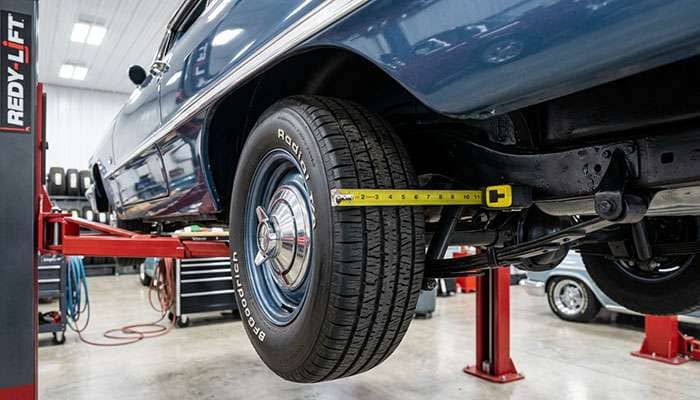
Here's what owners report on 1962-64 cars:
Two more traps on these cars. If your exhaust runs over the rear axle, that's where a lot of wheel and tire packages run into trouble, so check the pipe as well as the frame. And if your car wears fender skirts, the skirt, not the fender lip, is your outer limit. Reproduction steel skirts are sold for 1962, 1963, and 1964, so plenty of these cars still wear them. Measure with the skirt on.
The 1958 has the narrowest track of the bunch, and almost nobody publishes numbers for it. Treat the 1962-64 sizes as a ceiling, not a promise.
The 1965 Impala was all new, on a new perimeter frame. The 1967 and 1969 cars got new bodies on that same frame. Track went to 62.5 inches up front and 62.4 in back, about 3 inches wider in the rear than a 1964. And these cars take rubber.
Here's what owners run on stock-suspension cars:
Look at the backspacing spread in those last three: 4-1/2 inches on one car, 6-1/2 on another, both on 18s. That's not a typo. The wheel width changes where the tire sits, and so does how hard you push the inner versus outer edge. That's why measuring beats copying a forum post.
The other thing these cars teach you is height. A big Impala wheel opening swallows a 25.7-inch tire like a 245/45R17. The factory G78-15 stood about 28 inches tall. One owner went hunting for a 28-inch 17 and couldn't find one in a decent width. A 275/45R18 at 27.7 inches or a 295/45R18 at 28.5 inches gets you back close to stock height. On 15s, a 215/75R15 or 225/75R15 does it without trying.
This is the question I get most from Impala owners, and the year answers it.
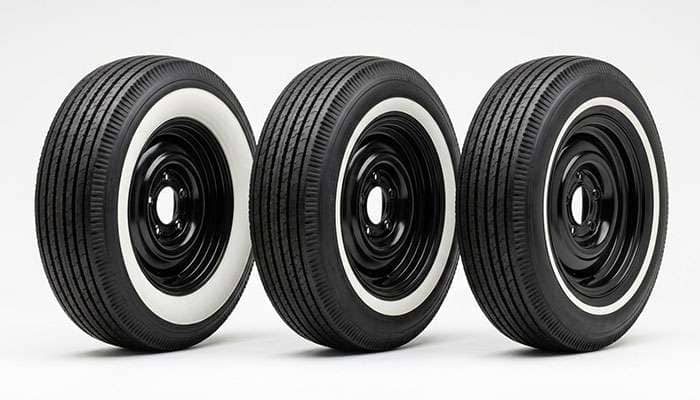
1958-61: wide, about 2-1/4 inches. Goodyear-pattern reproduction bias tires for these years are made with a 2-1/4-inch band. The radial versions sold for 1958-61 Chevys run from 2-3/8 to 3 inches. A 1961 bubbletop on 2-1/4-inch whites looks exactly right.
1962-64: 1 inch. The whole industry switched to the narrow stripe for 1962. Goodyear's 1-inch Custom Super Cushion came out that year and rolled under Impalas. Put wide whites on a 1963 and the judges will notice.
1965-70: 1 inch, getting narrower. The stripe kept shrinking through the late '60s, toward 3/4 inch and then a thin pinstripe by 1969-70. From 1967 through 1970 the full-size line also offered the G70-15 Wide Oval, and performance cars of the era often ran redlines, white letters, or blackwalls instead of whitewalls. Our era-by-era whitewall width guide has the full timeline.
Here's the catch nobody puts in front of you. In 215/75R15 and 225/75R15, the radial sizes that match a 1967-70 car's factory 15s, most classic-brand whitewall radials carry a band 2-1/2 inches or wider. That's correct for a 1958 and wrong for a 1968. The narrow versions in those sizes run about 1-1/4 to 1-5/8 inches. A true 1-inch band is easiest to find in the 14-inch radial sizes, 205/75R14 and 215/75R14, and in bias-ply.
Our Kontio WhitePaw Classic covers both ends. It comes in a wide band of 2-1/2 to 3-1/4 inches, depending on size, and in a narrow 40 mm band (about 1-1/2 inches) in sizes including 215/75R15 and 235/75R15. Kontio is part of Lucas Classic Tires, and Lucas is part of our family now. That's a lot of whitewall under one roof.
This is the part most guides skip, and it matters more on an Impala than on a Camaro. These are heavy cars. A 1958 Impala sport coupe weighs about 3,460 pounds, a 1965 V8 sport coupe about 3,525, and a 1962 Impala wagon about 3,900. The factory G78-15 was rated to carry 1,620 pounds at 32 psi. A lot of popular 17- and 18-inch front sizes carry less than that in standard load.
Tire Size |
Standard Load Rating |
Extra Load (XL) Rating |
Against the Factory G78-15 (1,620 lb) |
|---|---|---|---|
215/75R15 |
100 (1,764 lb) |
Rarely needed |
More |
275/60R15 |
107 (2,149 lb) |
Rarely needed |
More |
245/45R17 |
95 (1,521 lb) |
99 (1,709 lb) |
Standard load is less; XL is more |
245/40R18 |
93 (1,433 lb) |
97 (1,609 lb) |
Both are less |
245/45R18 |
96 (1,565 lb) |
100 (1,764 lb) |
Standard load is less; XL is more |
275/40R18 |
99 (1,709 lb) |
103 (1,929 lb) |
More |
The tire industry's rule here is simple. Bridgestone's replacement manual says never to pick a tire with less load-carrying capacity than the tire the vehicle was specified with. The U.S. Tire Manufacturers Association and the Tire Industry Association say the same thing in their own guidance. Most of these cars predate today's tire placard rules, so the factory tire is your benchmark.
The good news: in 245/45R17, 245/40R18, and 225/45R18, more than half the tires on the market are XL. One catch: an XL tire only reaches its higher rating at its higher pressure, about 41 psi against 35 for standard load. Run it at a 1960s pressure and you've paid for capacity you aren't using. Our article on running a lower load index tire goes deeper on the math.
Wheels have a rating too. Most 5x4.75 wheels on the market are rated 1,500 to 1,600 pounds, which is plenty. But about 1 in 14 of the 18-inch wheels in this pattern rate under 1,300 pounds. On a wagon or a loaded big-block car, check the number on the wheel before you buy it.
None of this shows up in the driveway. It shows up a few hundred miles later, and it gets more expensive at every step.
Every step on that list costs more than buying the right wheel and tire the first time.
Fifteen minutes with a straightedge saves you a set of wheels you can't return. Here's how we do it.
The bolt pattern on a 1958-70 Impala never changes, and that's exactly why people get burned. The year decides three things that do change: the smallest wheel that clears your brakes, how much tire the wheelhouse will take, and how wide the whitewall should be. Get those three right, check the load rating on anything shorter than about 27 inches, and an Impala will wear almost anything you want to put on it.
When you're ready to pick the rubber, start with our whitewall tire selection, and match the band to your year. Call us if you get stuck. We've been answering Impala questions in Long Beach for more than 50 years, and I still like hearing about them.
Every 1958-70 Impala uses 5 on 4-3/4 inches (5x120.65 mm) with 7/16-20 lug studs. It's the same pattern as a Tri-Five, Chevelle, Camaro, and Nova. Most references list the 1971-76 full-size cars as 5x5, so measure any later wheel before you buy it.
A 1964 Impala came on 14-inch wheels with 7.00-14 or 7.50-14 tires, and 8.00-14 on wagons and 409 cars. The closest modern radials are 195/75R14, 205/75R14, and 215/75R14.
Yes. Police and taxi versions came on 15s from the factory. Owners run 15x6 and 15x7 wheels with 225/70R15 or 235/70R15 tires, and a 15x8 with about 4-1/2 inches of backspacing in back. The frame rail is the limit on these cars, so measure before going wider.
One inch. 1962 is the year the industry switched from wide whitewalls to the narrow stripe. A 1958-61 Impala should wear wide whitewalls of about 2-1/4 inches, and 1965-70 cars run 1 inch or narrower.
Stick with 15 inches or larger. Chevrolet's 1970 owner's manual lists only 15-inch tire sizes for the full-size cars, and on a car with front disc brakes a 14-inch wheel hits the caliper.
Owners fit a 275/60R15 on a 15x8 with 4-1/2 inches of backspacing without cutting anything. On 18s, owners report a 295/45R18 on an 18x9. Check the backspacing against your own car first.