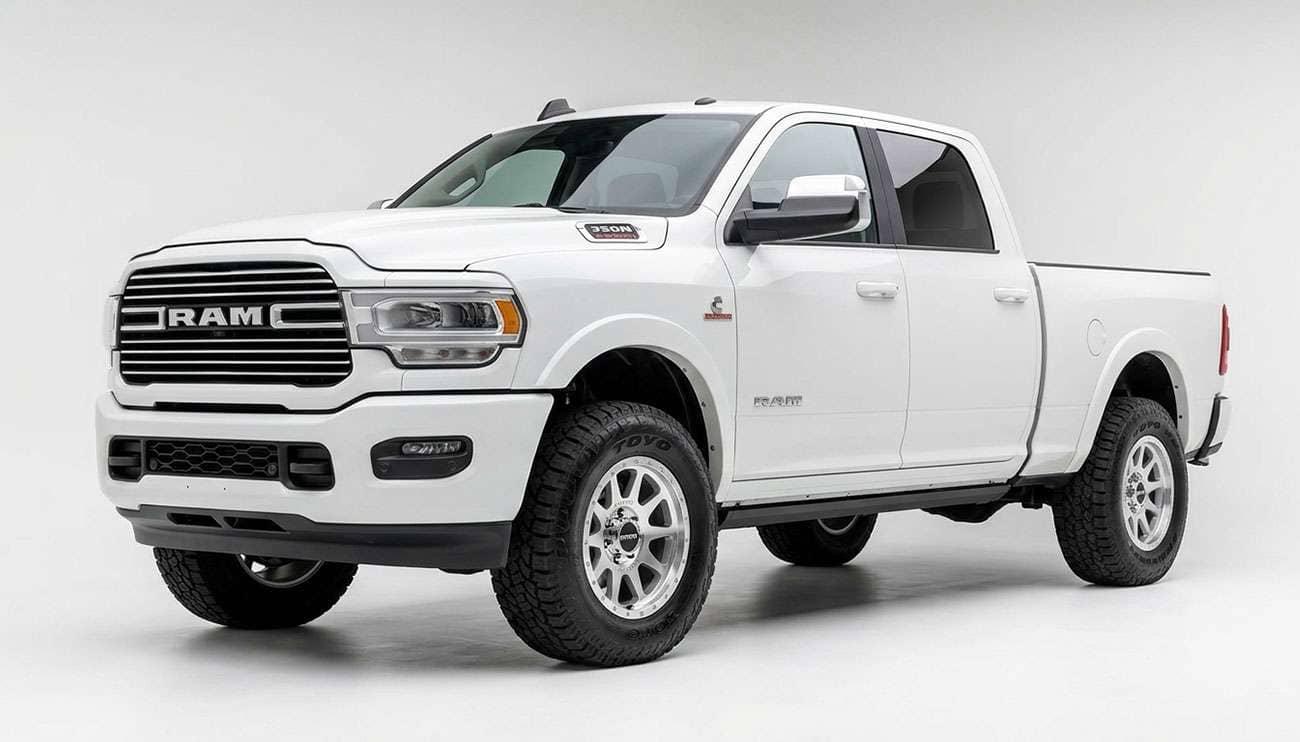
Most do. Not all, and the margin is thinner than most folks think. Here's the math nobody puts on the product page: take the rear axle rating (GAWR) off your door-jamb label and divide it by two. That's the minimum load rating each rear wheel needs. On a Ram 2500, that's about 3,000 lb. On Ford and GM 1-ton single-rear-wheel pickups, published rear axle ratings run up to about 7,230 to 7,250 lb, which asks roughly 3,615 to 3,625 lb from each wheel. The most common aftermarket 8-lug rating, 3,640 lb, clears that by 15 to 25 lb. And about 1 in 4 popular-size 8-lug off-road wheels is rated under 3,500 lb.
I'm Hank Feldman. We've been mounting wheels on work trucks in Long Beach since 1971, and I've seen what happens when a pretty wheel meets a loaded gooseneck. Here's how to check yours, which wheels carry the load, and the tire trap that catches more 3/4-ton owners than the wheels do.
Minimum wheel load rating by truck (rear axle governs)
Truck |
Published Rear GAWR |
Minimum Per Wheel |
Common Ratings That Clear |
|---|---|---|---|
2019+ Ram 2500 |
About 6,000 lb |
About 3,000 lb |
3,200 lb and up |
2023+ Ford F-250 |
About 6,340 lb |
About 3,170 lb |
3,200 lb and up (barely) |
2020+ Chevy and GMC 2500HD |
About 6,390 to 7,250 lb |
About 3,195 to 3,625 lb |
3,640 lb and up to be safe |
2019+ Ram 3500 SRW |
About 7,000 lb |
About 3,500 lb |
3,500 lb and up |
2023+ Ford F-350 SRW |
About 6,780 to 7,230 lb |
About 3,390 to 3,615 lb |
3,640 lb and up |
2020+ Chevy and GMC 3500HD SRW |
About 7,250 lb |
About 3,625 lb |
3,640 lb and up |
Published ratings vary by cab, drivetrain, engine, and model year, and the sources don't always agree. The number on your own door-jamb certification label is the one that counts.
Every truck leaves the factory with a certification label on the driver's door jamb. It lists the gross vehicle weight rating (GVWR) and a gross axle weight rating (GAWR) for the front and rear axles. The GAWR is the most weight the manufacturer rates that axle to carry, wheels and tires included. Split it between two wheels and you have the load each wheel has to be rated for.
On these pickups, the rear axle almost always sets the bar. Published front axle ratings on these trucks run about 4,400 to 6,000 lb, or 2,200 to 3,000 lb per wheel. Rear ratings run higher, and that's the axle carrying your bed load, your fifth-wheel pin weight, or your bumper-pull tongue weight.
Here's a detail that surprises people: federal safety standards don't set a load rating for the wheel. NHTSA's FMVSS No. 110, which covers vehicles rated 10,000 lb GVWR and under, and FMVSS No. 120, which covers heavier vehicles, both require the tires on each axle to add up to at least that axle's GAWR. Neither one tells an aftermarket wheel maker how much its wheel has to carry. That number comes from the wheel maker, validated by testing such as SAE J2530 for aftermarket wheels. Which means checking it is on you. Our wheel load rating guide covers where to find it and what the testing involves.
The weight class matters too. Plenty of 3/4-ton trucks are rated right around 10,000 lb GVWR, while every 1-ton SRW pickup in this table is rated above it. That puts the 1-tons under FMVSS No. 120, and it's also where the per-wheel number climbs past 3,600 lb.
I went through the 8-lug off-road wheels on the market in the sizes most trucks run, 17 through 22 inches, across the Ford, GM, and Ram bolt patterns. Here's how the load ratings shake out.
Load Rating |
Share of 17 to 22-Inch 8-Lug Off-Road Wheels |
What It Covers |
|---|---|---|
Under 3,000 lb |
About 1 in 17 |
Short of every truck in the table above |
Under 3,500 lb |
About 1 in 4 |
Fine for most 3/4-tons; short of Ford and GM 1-ton rear axles |
Under 3,640 lb |
About 1 in 3 |
Check your label carefully on any 1-ton |
4,000 lb and up |
About 1 in 50 |
Real margin on any SRW pickup |
The pattern matters a little, too. In the Ram 8x6.5 pattern, about 4 in 10 wheels in those sizes are rated under 3,640 lb. In Ford's 8x170, it's about 1 in 3. In GM's 8x180, about 1 in 4. And the two ratings you'll see most are 3,640 and 3,700 lb. That's fine for a 3/4-ton. On a Ford or GM 1-ton, it's a 15 to 85-lb cushion per wheel.
Here's how that looks on four popular 20x10 wheels in Ford's 8x170 pattern, all at -18 to -24 mm offset:
Wheel (20x10, 8x170) |
Load Rating |
Price Each |
Covers a 1-Ton Rear Axle? |
|---|---|---|---|
3,200 lb |
$329.00 |
No; fits an F-250 with about 30 lb to spare |
|
3,500 lb |
$525.00 |
Short of an F-350 SRW at 7,230 lb rear |
|
3,640 lb |
$339.09 |
Yes, by about 25 lb |
|
3,700 lb |
$424.00 |
Yes, by about 85 lb |
Notice the price column. The $339 Moto Metal carries 140 lb more per wheel than the $525 Fuel Triton. Price tells you about the finish and the design work, not the load rating. You have to read the spec.
A wheel's load rating isn't a measure of how tough it looks. It's the load the wheel maker designs to and then proves in fatigue and impact testing. Under SAE J2530, a wheel gets run through cornering-fatigue and radial-fatigue tests at loads derived from the rating its maker claims, plus an impact test. Claim a higher rating and the wheel has to survive harder tests. So the rating is really a design decision.
That decision shows up in the metal. A wheel built for 4,500 lb carries thicker spokes, a beefier lug pad, and more material where the spokes meet the barrel. A wheel built for looks at 3,200 lb can run thinner spoke sections, deeper pockets, and a lighter barrel. Same bolt pattern, same diameter, very different jobs.
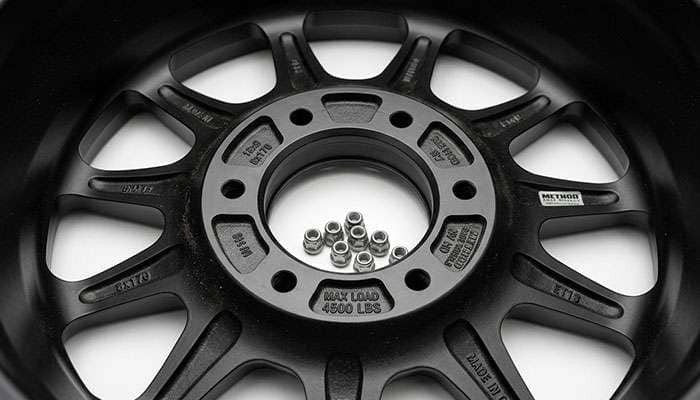
Size and shape push the number around, too. Deep negative offset and wide widths move the tire's load farther from the hub, which bends the wheel harder. That's part of why ratings slide in the big show sizes: among 8-lug wheels at 28 and 30 inches, about 9 in 10 are rated under 3,500 lb. And two-piece 8-lug wheels have a median rating of about 3,500 lb in the 17 to 22-inch sizes, where one-piece cast wheels sit at 3,640.
Not automatically. This one gets people every week. Forging makes aluminum stronger for its weight, so the maker can either build a lighter wheel at the same rating or a stronger wheel at the same weight. Plenty of forged truck wheels take the first path.
In the 17 to 22-inch, 8-lug sizes, one-piece forged off-road wheels have a median rating of 3,200 lb. One-piece cast wheels in the same sizes have a median of 3,640. Forged monoblock wheels built for heavy-duty work flip that again, with a median of 4,000 lb. So a forged wheel can be the strongest wheel on the rack or a show-truck wheel rated below a $300 casting. The word "forged" doesn't tell you which. The load rating does. Our cast vs. forged vs. flow-formed breakdown covers the construction side.
They can, and this is the trap that catches more 3/4-ton owners than the wheels do. Your truck came with Load Range E tires like an LT275/70R18 rated 125, or 3,640 lb per tire at maximum inflation. The most popular 35-inch upgrade, a 35x12.50R20, comes in two versions, and the market splits roughly half and half between them.
Tire |
Load Index |
Max Load Per Tire |
Two Tires on the Rear Axle |
|---|---|---|---|
LT275/70R18 Load Range E (factory) |
125 |
3,640 lb |
7,280 lb |
35x12.50R20LT Load Range E |
121 |
3,195 lb |
6,390 lb |
35x12.50R20LT Load Range F |
125 |
3,640 lb |
7,280 lb |
LT295/65R20 Load Range E |
129 |
4,080 lb |
8,160 lb |
Look at the Load Range E 35. It carries 445 lb less per tire than the factory tire it replaces. Put two on the rear of an F-350 SRW or a 3500HD SRW with a rear rating around 7,230 to 7,250 lb, and the pair adds up to 6,390 lb. That's short of the axle rating the federal standard holds the tires to. The Load Range F version restores the factory 3,640 lb.
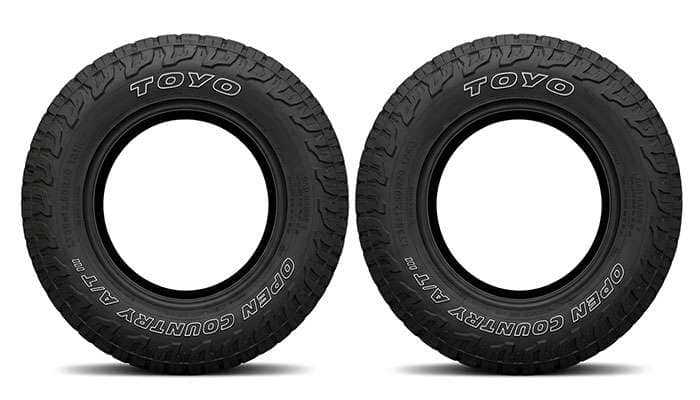
The fix doesn't cost much. In the Toyo Open Country A/T III, the 35x12.50R20 Load Range F lists at $538.56 against $495.40 for the Load Range E, about $43 more per tire for 445 more pounds. Or skip the flotation size: the Toyo Open Country A/T III LT295/65R20 stands about 35.1 inches tall, stays Load Range E, and carries 4,080 lb at $471.51. One caution on all of these: a light-truck tire only reaches its rated load at its maximum inflation, so run the pressure your load requires, not a number off a forum. Here's more on what a Load Range E rating means and how 10-ply and 12-ply tires compare.
Once you're on Load Range F 35s or LT295/65R20s, the tire can out-carry most wheels. A 3,640-lb wheel under a 4,080-lb tire means the wheel is now the weak link in that corner, which is exactly why the wheel rating deserves the same attention.
If you tow heavy, haul heavy, or drive a 1-ton, these are the wheels I'd look at first. Each one carries 4,000 lb or more per wheel, comes in the factory 8-lug patterns, and is verified at the prices below at publication.
Wheel |
Size, Offset, Pattern |
Center Bore |
Load Rating |
Price Each |
|---|---|---|---|---|
Method 305 NV HD, Matte Black |
18x9, +18 mm, 8x170 |
130.8 mm |
4,500 lb |
$479.00 |
Method 701 HD Trail, Matte Black |
18x9, +18 mm, 8x170 |
130.8 mm |
4,500 lb |
$489.00 |
Method MR709 HD Bead Grip, Matte Black |
18x9, +12 mm, 8x180 |
124.1 mm |
4,500 lb |
$509.00 |
Method MR709 HD Bead Grip, Machined Silver |
20x9, +12 mm, 8x6.5 |
121.3 mm |
4,500 lb |
$499.00 |
KMC KM451 Mesa Forged Monoblock, Black |
18x9, 0 mm, 8x180 |
124.2 mm |
4,000 lb |
$820.00 |


Method's HD lines are rated 4,500 lb per wheel, which gives a 1-ton's rear axle nearly 900 lb of cushion per wheel instead of 25. The Method 305 NV HD 18x9 8x170 at $479.00 and the Method 701 HD Trail 18x9 8x170 at $489.00 both run +18 mm offset. Both have a 130.8 mm center bore, larger than the Super Duty's roughly 125 mm hub, so ask us about hub-centric rings when you order. Both also come in 8x180 and 8x6.5.

The MR709 HD is bored to match each truck's hub: 124.1 mm on the 18x9 8x180 for GM HD trucks at $509.00, and 121.3 mm on the 20x9 8x6.5 for Ram HD trucks at $499.00. Both carry 4,500 lb at +12 mm. The 20x9 is approved for the 35x12.50R20 Load Range F above, so it makes a complete heavy-duty 35-inch setup. Method's Bead Grip design helps hold the tire bead at lower pressures on the trail, which our beadlock vs. bead grip article explains.

If you want forged, buy forged that's rated for the job. The KMC KM451 Mesa Forged Monoblock 18x9 8x180 carries 4,000 lb at 0 mm offset with a 124.2 mm bore for GM HD trucks. At $820.00 each, it's the premium pick here. You're paying for lighter weight at a real HD rating, not for a forged badge on a show wheel. Shop the full lineups by pattern: 8x170, 8x180, and 8x6.5, or browse Method and KMC.
An under-rated wheel rarely fails on day one. It fails slowly, under the loads it was never designed to repeat. Here's how that usually goes:
Every rung on that ladder costs more than buying the wheel with the right number in the first place. A wheel rated for your axle often costs about the same as one that isn't.
When you're ready, build your set on our wheel and tire packages page, or call the shop and we'll match the wheel and tire ratings to your door-jamb label before anything ships.
Here's what fifty-some years of mounting truck wheels taught me: the load rating is the one spec nobody brags about and everybody should read. On most 3/4-ton trucks, the common 3,640 and 3,700-lb wheels have room to spare. On a 1-ton, they clear the rear axle by a few dozen pounds, and about 1 in 4 popular-size 8-lug wheels doesn't clear it at all.
So do the math before you fall for a design. Door-jamb rear GAWR, divided by two. Then check the tires, because a Load Range E 35 can quietly cut your rear axle capacity below the factory number. Get both right and your truck carries what it was built to carry, with the look you wanted.
Divide the rear GAWR on your door-jamb label by two. Published rear ratings put a Ram 2500 at about 6,000 lb, or 3,000 lb per wheel, and a 2023-and-newer F-250 at about 6,340 lb, or 3,170 lb per wheel. Chevy and GMC 2500HD trucks vary more, from about 6,390 to 7,250 lb, so check your label. A 3,640-lb wheel covers every 3/4-ton in that range.
On a single-rear-wheel 1-ton, usually yes, but barely. Ford and GM 1-ton SRW rear axles are published around 7,230 to 7,250 lb, which asks about 3,615 to 3,625 lb per wheel. A 3,640-lb wheel clears that by 15 to 25 lb. If you tow or haul near your ratings, a 4,000 to 4,500-lb HD-rated wheel gives you real margin.
Not necessarily. Among 17 to 22-inch 8-lug off-road wheels, one-piece forged wheels have a median load rating of 3,200 lb, while one-piece cast wheels sit at 3,640 lb. Forged monoblock wheels built for heavy-duty work run higher, around 4,000 lb. Always read the rating instead of assuming.
A Load Range E 35x12.50R20 does. It's rated 121, or 3,195 lb per tire, versus 3,640 lb for a factory LT275/70R18 Load Range E. Two on the rear add up to 6,390 lb, short of a 1-ton SRW rear axle rated around 7,230 to 7,250 lb. A Load Range F 35x12.50R20 or an LT295/65R20 Load Range E keeps or beats the factory capacity.
On the product page specs, where every wheel we sell lists its load rating, and usually cast or stamped on the back of the wheel near the hub. If you can't find a rating anywhere, ask the seller before you buy.
The minimum doesn't change, because your rear GAWR already assumes a fully loaded axle, including tongue or pin weight. What towing changes is how often you live near that limit. If you regularly tow heavy, choose a wheel with a few hundred pounds of margin over half your rear GAWR rather than one that just clears it.