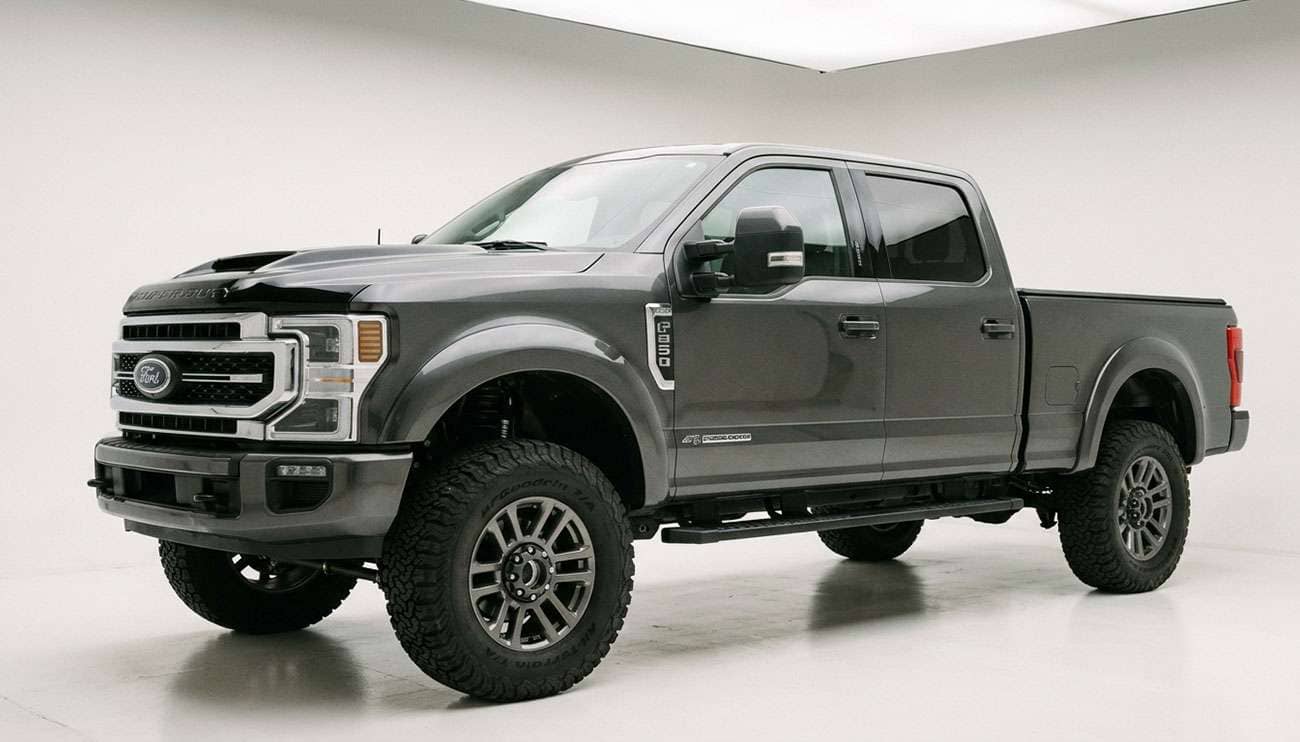
Yes. A 4x4 F-250 with a 2- to 2.5-inch leveling kit clears a 35-inch tire in most setups. Most guides stop at "it depends on your wheels" without telling you what it depends on. Here is the part nobody puts in front of you: on a 2017-2022 truck, the stock +45mm-offset wheels let a 35x12.50 rub the radius arm and sway bar at full lock, and a Load Range E 35x12.50R20 is rated for 3,197 lb per tire. The LT275/65R20 it replaces on a King Ranch or Platinum is rated for 3,748 lb. The tire can fit perfectly and still carry 551 lb less than the one Ford put on the truck.
Clearance gets all the attention. Capacity is what matters once the trailer is hooked up. Below, both are keyed to the variables that change the answer: drivetrain, generation, wheel offset, and load index.
Your F-250 Setup |
Do 35s Fit? |
What to Expect |
|---|---|---|
4x4, 2023+, 2-2.5 in. level, stock wheels, 35x12.50 |
Yes, usually |
Redesigned radius arm and sway bar leave more room; possible light liner or valance contact at full lock |
4x4, 2017-2022, 2-2.5 in. level, stock wheels, 35x12.50 |
At ride height, yes |
Tire contacts the radius arm and sway bar at full steering lock |
4x4, any year, 8-9 in. wide wheel at +12 to +18mm, 35x12.50 |
Yes, cleanly |
No trimming, or minor plastic trimming of the inner fender liner |
4x4, any year, 0mm offset (4.75-5 in. backspacing), 35x12.50 |
Yes, with trimming |
Clears suspension; tire moves toward bumper valance and fender liner at full lock |
4x4, any year, stock wheels, narrow metric 35 (285/75R18, 295/65R20) |
Yes, easiest route |
Narrower section keeps the inner sidewall off the suspension; higher load index |
Tremor (factory 35s) |
Already on 35s |
Ships on LT285/75R18 from Ford; a level changes stance, not clearance for the stock size |
4x2 (twin I-beam front) |
Possible, different job |
Leveling changes camber as the beams swing; alignment with camber correction is mandatory |
The second table sorts common 35-inch sizes by the number that decides whether a tire belongs on a three-quarter-ton truck: maximum load per tire. Heights are calculated from the size; loads are the most common Load Range E rating in each size.
Tire Size |
Height (in.) |
Typical Load Index (Load Range E) |
Max Load per Tire (lb) |
Where It Shows Up |
|---|---|---|---|---|
LT245/75R17 |
31.5 |
121 |
3,197 |
2025 XL stock |
LT275/65R18 |
32.1 |
123 |
3,417 |
2025 XLT stock |
LT275/70R18 |
33.2 |
125 |
3,638 |
2025 Lariat stock |
LT275/65R20 |
34.1 |
126 |
3,748 |
2025 King Ranch and Platinum stock |
LT285/75R18 |
34.8 |
129 |
4,079 |
2025 Tremor stock; narrow 35 on stock wheels |
LT295/70R18 |
34.3 |
129 |
4,079 |
Near-35 upgrade for 18-inch trucks |
LT295/65R20 |
35.1 |
129 |
4,079 |
True 35 for 20-inch trucks |
LT325/60R20 |
35.4 |
126 |
3,748 |
Wide metric 35 for 20-inch trucks |
LT35x12.50R18 |
35.0 |
123 (Load Range F: 128) |
3,417 (F: 3,968) |
Flotation 35 for 18-inch trucks |
LT35x12.50R20 |
35.0 |
121 (Load Range F: 125) |
3,197 (F: 3,638) |
The most common "35" on 20-inch trucks |
Read those last rows twice. The 35x12.50R20 Load Range E, the size most people picture when they say "35s," carries exactly what the XL's 17-inch tires carry and less than the factory tire on an XLT, Lariat, King Ranch, Platinum, or Tremor. If you tow, the size you pick matters more than the kit you bolt in.
For a 4x4 F-250, a 2- to 2.5-inch front leveling kit is the standard pairing with 35s. That range exists because Ford builds the Super Duty with roughly 2 to 3 inches of nose-down rake. The rake is intentional: hitch weight squats the rear and the truck settles closer to level. Leveling the front takes most of that rake out and gives a 35 the extra wheel-well height it needs when the suspension compresses.
The 4x4 F-250 uses what Ford calls a mono-beam front: a solid front axle on coil springs, located fore-aft by radius arms and side to side by a track bar, with a stabilizer bar tying it to the frame. A leveling kit is usually a spacer on top of the coil spring that raises the frame off the axle. Spring rate and ride quality barely change, which makes it the least invasive way to find room for a 35.
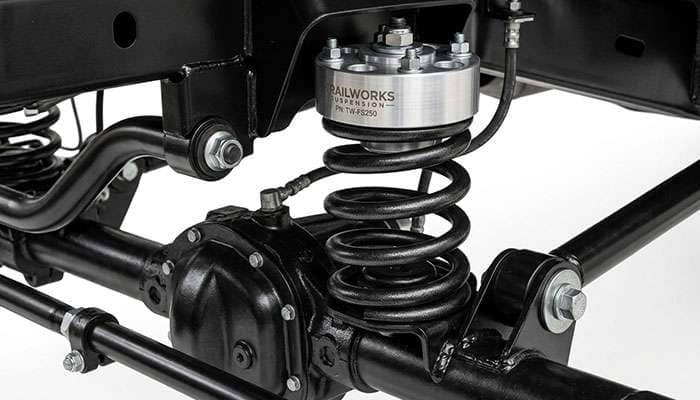
The track bar is a fixed-length link that runs from the frame on one side to the axle on the other. When you raise the frame, the bar's angle steepens, and a fixed-length bar at a steeper angle pulls the axle sideways toward the frame mount. Past about 2.5 inches the shift becomes visible: the axle sits off center and one tire rubs first. That is why the better 2.5-inch Super Duty kits include a track bar relocation bracket that restores the bar's angle. Above 2.5 inches, treat the bracket or an adjustable track bar as part of the job, not an upgrade.
A Power Stroke diesel puts more weight over the front axle than the gas V8s, so two trucks with the same spacer can finish at different fender heights. Measure hub center to fender lip, front and rear, and order the spacer that closes the gap you actually measured.
It depends on your F-250's generation and which 35 you choose. This is the variable that splits owner reports into "fits fine" and "rubs everywhere."
Factory Super Duty wheels sit at roughly +45mm offset. That pulls the wheel inboard, close to the suspension. With a 12.50-inch-wide tire mounted, the inner sidewall runs close to the radius arm and the sway bar end. Driving straight at ride height, it clears. Turn to full lock in a parking lot and the tire contacts the radius arm and sway bar. A leveling kit does not fix this, because the contact is lateral, not vertical: lift moves the fender away from the tire, not the radius arm away from the sidewall.
The current-generation Super Duty got a revised radius arm and sway bar layout, and it leaves more room at full lock. A 35x12.50 on stock wheels on a 2023+ truck is a far more livable combination than on a 2017-2022 truck. You may still see light contact with the plastic inner liner or the lower bumper valance at full lock, depending on the exact tire.
Ford's own answer to "35s on stock wheels" is the Tremor. According to Ford's technical specifications, the 2025 F-250 Tremor rolls on LT285/75R18 Load Range E tires, a 34.8-inch tire with a section width of about 11.2 inches. The 12.50 in a 35x12.50 is 12.5 inches of section width, about 1.3 inches wider. Split that across both sides of the tire and you gain roughly two-thirds of an inch of inboard clearance before you change anything else. On a 20-inch truck, the LT295/65R20 does the same job at 35.1 inches tall and about 11.6 inches wide. If you want to keep your factory wheels, a narrow metric 35 is the cleanest fit, and as the load table shows, it also carries more weight.
For a 35x12.50 on a leveled 4x4 F-250, the sweet spot is an 8- to 9-inch-wide wheel at +12 to +18mm offset. That combination moves the tire far enough outboard to clear the radius arm and sway bar at full lock, while keeping it tucked enough that it does not hit the bumper valance or chew up the fender liner. A 0mm wheel with 4.75 to 5 inches of backspacing also works, but expect some minor plastic trimming at the inner fender liner.
All F-250 Super Duty trucks from 2005 forward use the 8x170 bolt pattern, so you are shopping in a well-supported wheel pattern. The offset is where fitment is won or lost. To see how far you can move offset before steering feel and bearing load become a problem, read how much you can change wheel offset.
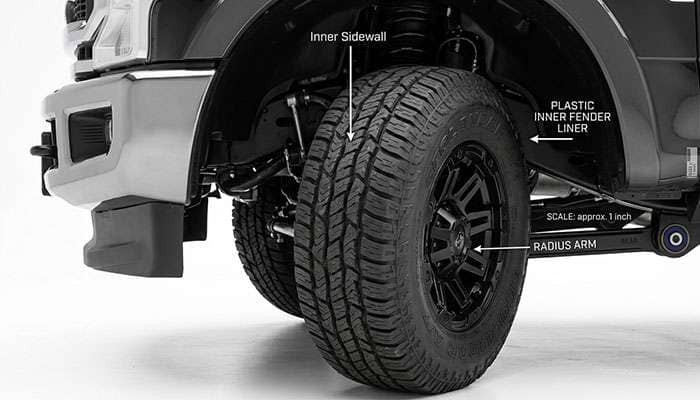
Offset is the distance from the wheel's mounting face to its centerline. Lower offset pushes the whole tire outboard. That opens space on the inside, where the radius arm, sway bar, and steering components live. It closes space on the outside, where the bumper valance, fender liner, and fender lip live. At full lock, the front of the tire swings forward and outward, so an aggressive negative-offset wheel on a 35x12.50 tends to find the valance and the front of the liner. The +12 to +18mm window is where the two rub zones are both clear on a leveled truck.
Pushing the tire outboard increases scrub radius, the distance between where the steering axis meets the ground and the center of the contact patch. More scrub radius means more leverage on the steering damper, track bar bushings, tie rod ends, and ball joints. Deep-dish wheels at -12mm or beyond look great and ask more of every front-end part.
You can, but it is a different job. Ford's technical specifications list the 4x2 F-250 front suspension as independent twin I-beam with coil springs. The 4x4 is the solid mono-beam.
The difference matters because of geometry. Each twin I-beam pivots from a point near the opposite side of the frame. When a spacer raises the frame, each beam swings through an arc, and the wheel at the end of that arc tilts. That tilt is camber. A solid axle keeps camber put when the frame rises; a twin I-beam does not, and uncorrected camber wears the tire's inner or outer shoulder fast.
Plan on an alignment with camber correction, and expect fewer kit choices, since most Super Duty leveling products are built around the 4x4 front end.
Some do. Many of the most popular ones carry less than the tire Ford installed, which is why I start every Super Duty 35 conversation with the door sticker instead of the leveling kit.
Federal tire-selection rules, FMVSS No. 110 for trucks at or under 10,000 lb GVWR and FMVSS No. 120 above it, require the factory tires to carry the loads the truck is rated for. Ford lists 2025 F-250 GVWR between 10,000 and 11,400 lb depending on configuration, so your truck falls under one standard or the other. Either way, Ford sized the original tires against the gross axle weight ratings (GAWR) printed on the certification label in the driver's door jamb. On single-rear-wheel Super Duty trucks, owners commonly report front GAWR figures in the 5,200 to 6,000 lb range, depending on engine and package. NHTSA's consumer guidance for replacement tires is to match or exceed the original tire's load capacity, and the Tire Industry Association trains tire technicians to the same rule.
Run the math on a front axle rated at 6,000 lb. Two LT35x12.50R20 Load Range E tires at 3,197 lb each total 6,394 lb, a margin of 394 lb, about 6.5 percent, and only at the maximum pressure molded on the sidewall. Two LT295/65R20 Load Range E tires at 4,079 lb each total 8,158 lb. Same height, same load range letter, almost 1,800 lb more capacity across the axle.
Load range tells you the maximum inflation pressure a tire's construction is built to hold. It does not tell you how much weight the tire carries at that pressure. That number is the load index, and it comes from the load-inflation table for that specific size. Flotation sizes like 35x12.50R20 are standardized on their own load tables, built around the off-road flotation job the format was designed for. Metric LT sizes like 295/65R20 use tables that credit more load at the same pressure. The result is two tires of the same height and same load range letter separated by 882 lb of rated capacity per tire. For the full breakdown of the two ratings, read load range vs. load index.
You can see it inside a single product line. The Falken Wildpeak A/T4W is rated load index 129 in LT295/65R20 Load Range E, and load index 125 in LT35x12.50R20, even though that 35x12.50 is built to Load Range F. The metric size carries 441 lb more per tire at a lower load range.
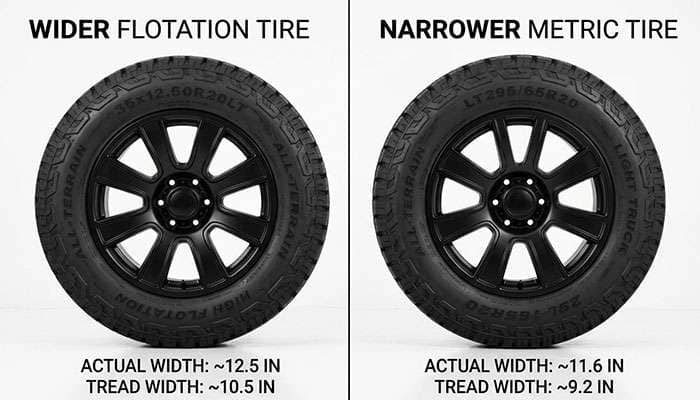
That 3,197 lb rating on a Load Range E 35x12.50R20 applies only at the tire's maximum rated pressure. LT load tables are the same curve for a given size regardless of load range; a higher load range simply extends the curve to a higher pressure. So a Load Range E tire run at 50 psi carries roughly what a Load Range C tire of the same size carries at 50 psi. Owners who air down for ride comfort cut an already thin margin further.
If you tow heavy or run a slide-in camper, look at Load Range F. The typical 35x12.50R18 Load Range F is load index 128, rated at 3,968 lb per tire, which clears every factory F-250 tire except the Tremor's. On 20-inch wheels, most Load Range F 35x12.50s are load index 125, at 3,638 lb, which matches the Lariat but still falls short of the King Ranch and Platinum. We cover the heavier construction in detail in Load Range F tires for three-quarter-ton trucks, and the same capacity logic applies to Chevy and GMC HD owners in will 35s fit a 2500HD with a leveling kit.
It depends on which trim you started from, because Ford ships the F-250 on factory tires that range from 31.5 to 34.8 inches tall. A 35 is a big jump on an XL and almost nothing on a Tremor. Ford's current trim-by-trim tire lineup appears in our F-250 and F-350 aftermarket tire guide, and here is what a nominal 35.0-inch tire does to each.
Starting Trim and Tire |
Stock Height (in.) |
Speedometer Error With a 35 |
Actual Speed at an Indicated 65 mph |
|---|---|---|---|
XL, LT245/75R17 |
31.5 |
11.2% slow |
72.3 mph |
XL off-road package, LT285/70R17 |
32.7 |
7.0% slow |
69.6 mph |
XLT, LT275/65R18 |
32.1 |
9.1% slow |
70.9 mph |
Lariat, LT275/70R18 |
33.2 |
5.5% slow |
68.6 mph |
King Ranch or Platinum, LT275/65R20 |
34.1 |
2.7% slow |
66.8 mph |
Tremor, LT285/75R18 |
34.8 |
0.5% slow |
65.3 mph |
A 20-inch King Ranch owner can nearly ignore the speedometer. An XL owner going from 31.5 to 35 inches is reading 65 while doing 72. Ford stores tire size in the truck's module configuration, so a dealer or a quality programmer can correct it; the details are in how bigger tires affect your speedometer.
The same percentages apply to effective gearing: an 11 percent taller tire makes your axle ratio behave about 11 percent taller. The 6.7L Power Stroke shrugs that off unloaded; a gas truck towing near its rating feels it on grades. If you are the XL or XLT owner towing heavy, read when to regear after bigger tires before you decide the 35s are free.
A 35 that is almost right costs you in stages, each more expensive than the last.
Every step is avoidable with the right size, load index, and wheel offset, chosen before the truck goes up on the lift. Start from the 2025 Ford F-250 Super Duty wheel and tire fitment page to see sizes and wheels matched to your trim.
A 4x4 F-250 with a 2- to 2.5-inch leveling kit will take a 35. Whether it takes one cleanly depends on your generation and your wheel offset: 2017-2022 trucks on stock +45mm wheels rub the radius arm and sway bar at full lock with a 35x12.50, while 2023+ trucks have more room, and +12 to +18mm aftermarket wheels clear either one. A 2WD truck needs camber correction as part of the job.
The variable that matters most once the truck is working is load capacity. The popular 35x12.50R20 Load Range E carries 3,197 lb per tire, less than most factory F-250 tires. A same-height metric size like LT295/65R20 or Ford's own Tremor size, LT285/75R18, carries 4,079 lb. Pick the 35 that carries your door sticker first, then pick the wheel that makes it fit.
Often, yes, on a 4x4 F-250 with the right wheel offset, especially a narrow metric 35 like LT285/75R18 or LT295/65R20. Ford's Tremor runs 35s from the factory. A leveling kit removes the factory nose-down rake and adds front clearance when the suspension compresses, which is why most owners pair 35x12.50s with a 2- to 2.5-inch level.
A 2- to 2.5-inch front leveling kit is the standard choice for 35s on a 4x4 F-250. Measure hub center to fender lip at all four corners first, because diesel trucks carry more front weight and can sit lower than gas trucks. Above 2.5 inches, add a track bar relocation bracket or adjustable track bar to keep the axle centered.
At ride height, usually not. At full steering lock, a 35x12.50 on stock +45mm wheels on a 2017-2022 F-250 contacts the radius arm and sway bar. With an 8- to 9-inch wheel at +12 to +18mm offset, rubbing is typically limited to minor plastic inner fender liner contact, and many setups clear completely.
A narrow metric 35 such as LT285/75R18 or LT295/65R20 fits stock F-250 wheels well. A 35x12.50 on stock wheels fits much better on a 2023+ truck than on a 2017-2022 truck, where the wider tire contacts the radius arm and sway bar at full lock.
Most F-250 owners do not need to regear for 35s, especially on diesel trucks or trucks that started on 20-inch wheels, where a 35 is less than 3 percent taller than stock. Gas trucks that started on 17-inch or 18-inch tires and tow near their rating are the strongest candidates, since a 35 can make the gearing behave up to 11 percent taller.
Choose by load index, not just load range. Match or beat the load index of the factory tire on your door placard. A 35x12.50R20 Load Range E is typically load index 121 at 3,197 lb, which is below most factory F-250 tires. Metric 35s like LT295/65R20 Load Range E reach load index 129 at 4,079 lb, and Load Range F flotation sizes close most of the gap.