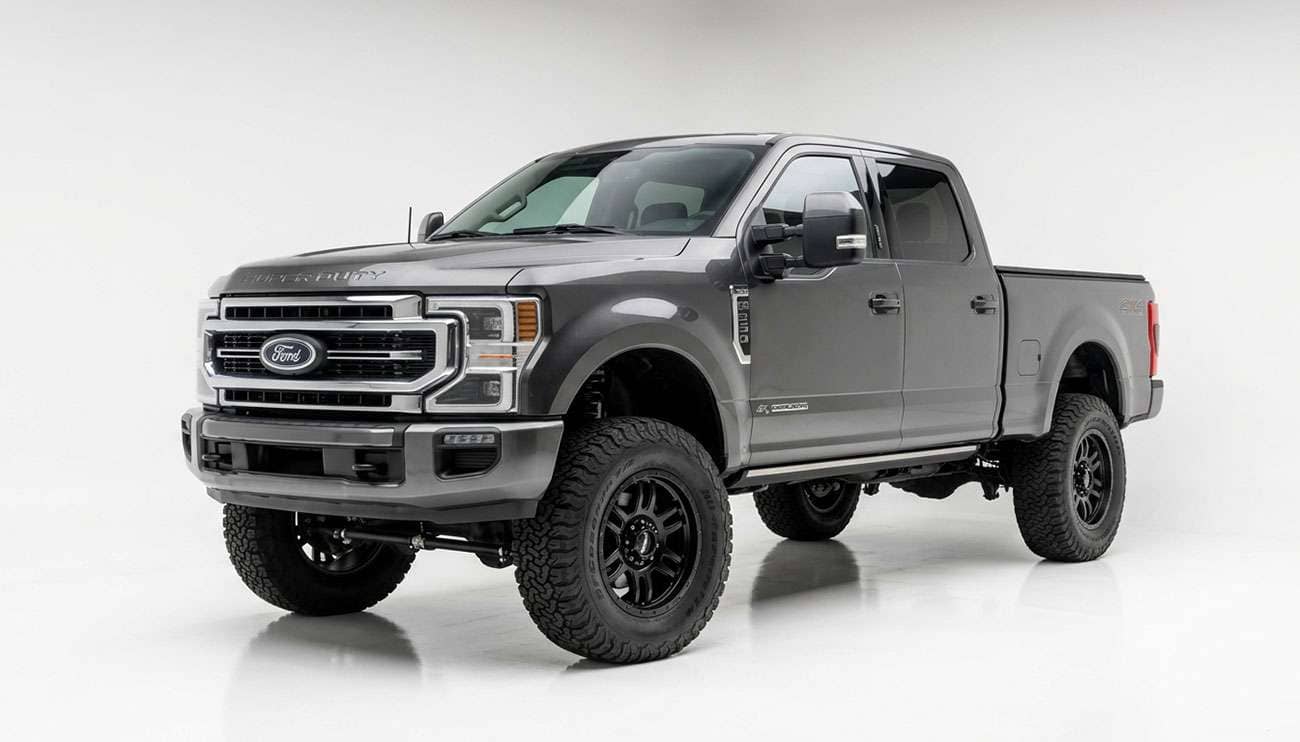
Short answer: usually yes on clearance, and that is the easy half. A 2500HD levels through torsion keys, not strut spacers, so 1.5 to 2.5 inches is the realistic window before ball joint and CV angles start costing you. The part most fitment guides leave out is capacity. A 35x12.50R20 in Load Range E carries 3,197 pounds. The factory LT275/65R20 it replaces carries 3,748. That is five load index steps down on a truck whose whole job is carrying weight.
Ask whether 35s fit a three-quarter-ton and you will get a lot of answers about fender liners. Almost all of them are about geometry: how much lift, how much trimming, how much offset. Geometry is real, and this article covers it. But a 2500HD is not a 1500 with a bigger badge. It is a truck rated to haul, and the tire is the part that does the hauling. Most guides stop at whether the tire touches sheet metal and never mention whether it still carries the load the truck was sold to carry.
Those are two different questions, and on an HD truck the second one is the one that bites.
This is the fork in the road, and it is worth getting straight before you buy anything.
A Silverado 1500 uses a coil-over strut up front. You level it with a spacer that sits on top of the strut assembly, which pushes the whole strut down and raises the truck. Simple, mechanical, and the part you buy is literally a puck of aluminum or steel.
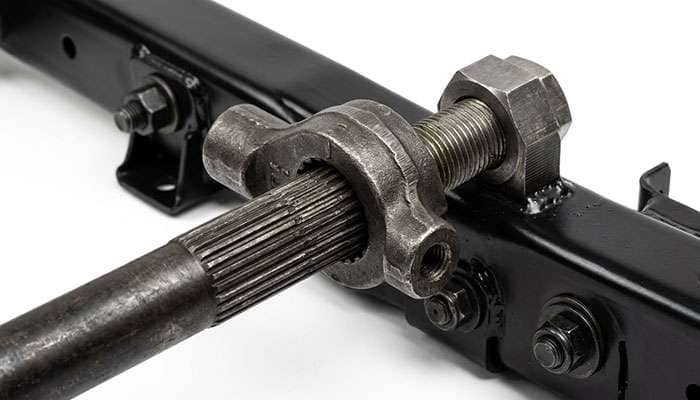
A Silverado 2500HD does not have a strut. From the 2001 model year through the current trucks, every Chevrolet and GMC three-quarter-ton and one-ton has used a torsion bar front suspension. Instead of a coil spring, a long steel bar runs back along the frame. One end is splined into the lower control arm, the other into an adjustable key mounted to a frame crossmember. Twisting that bar is what holds the front of your truck up.
That means you do not level a 2500HD with a spacer. You level it by re-indexing or replacing the torsion keys, then turning an adjuster bolt that puts more twist into the bar. The suspension has not grown. You have preloaded the spring.
If you have read our companion piece on running 35s on a leveled Silverado 1500, nearly all of the clearance discussion there still applies. The hardware discussion does not. A strut spacer sold for a 1500 has no application on an HD, and the two trucks do not share a bolt pattern either. The 1500 is a six-lug. The 2011 and newer HD runs the eight-lug pattern covered in our 8x180 bolt pattern fitment guide, on a hub bore right around 124.2 mm.
Here is the mechanism nobody explains, and it is the reason experienced HD owners tell you not to crank the keys too far.
Your front suspension has a fixed amount of total travel: compression (up) and droop (down). Preloading the torsion bar does not add travel. It moves the truck's resting position higher within the travel it already has. Every inch of lift you gain is an inch of droop travel you spend. The upper control arm now sits closer to the frame stop at rest, so the suspension has less room to extend when a wheel drops into a dip.
Three things follow from that, and they all scale with how far you crank:
Factory keys typically have about an inch of adjustment in them. Aftermarket leveling keys are generally sold in the 1.5 to 2.5 inch range. Past roughly 2.5 inches, you are into territory where a proper lift kit with a differential drop, extended shocks and upper control arms is the honest answer, and the cost changes accordingly. Our lift kit and tire size chart is a useful sanity check on what each lift height realistically buys you in tire diameter.
Worth noting: when Chevrolet decided to put 35s on a 2500HD from the factory with the HD ZR2, it did not simply crank the keys. That truck got about 1.5 inches of lift plus unique upper and lower control arms, revised steering knuckles and Multimatic DSSV dampers. That is what the engineering answer to this question looks like, and it tells you which parts of the front end the factory considered load-bearing in this conversation.
On clearance alone, a 2 inch level plus a 35 is a common and workable combination on an HD. The HD front end has more room in the wheel well than a half-ton does, and the truck sits higher to begin with.
What decides whether you rub is almost never straight-ahead clearance. It is the turn. At full steering lock, especially backing up with the wheel cranked, the leading edge of the tire swings into the plastic fender liner and the lower section of the front bumper air dam. That is where HD owners report contact, and that is what gets trimmed.
The variables that decide how much trimming, in order of how much they matter:
Setup |
Clearance Outcome |
Typical Work Required |
|---|---|---|
Stock height, factory offset wheel |
Rubs at full lock |
Not recommended on a 35; go to a 34-inch class metric size instead |
2 inch level, factory offset wheel |
Light contact at full lock |
Trim front edge of fender liner, remove or trim lower air dam |
2 inch level, wheel around +18 offset |
Usually clears |
Minor liner trim; mud flap removal common |
2 inch level, zero or negative offset wheel |
Clears the liner, loads the bearing |
Little trimming, but scrub radius and wheel bearing load increase |
2.5 inch level plus upper control arms |
Clears |
Alignment with cam bolt adjustment; verify CV angle at full droop |
So the geometry answer is: yes, with a 2 inch level, a sensible offset and a modest amount of liner trimming, a 35 fits a 2500HD. If that were the whole question, this article would end here. It is not, because a 2500HD is a truck you load.
This is the part that gets skipped, and it is the part that matters most on an HD.
Your truck has a tire and loading information placard inside the driver's door jamb. Under Federal Motor Vehicle Safety Standards, that placard lists the original tire size, the cold inflation pressure, and the load rating the vehicle was certified with. The size on that placard is not a suggestion about looks. It is the tire the truck's payload, towing and axle ratings were calculated around.
Here is what the factory sizes actually carry, and what a 35x12.50 in the same Load Range E carries next to them:
Wheel Diameter |
Factory Size and Load Index |
35x12.50 Load Range E Equivalent |
Capacity Change Per Tire |
|---|---|---|---|
17 inch |
LT265/70R17, index 121, 3,197 lbs |
35x12.50R17, index 121, 3,197 lbs |
No change |
18 inch |
LT275/70R18, index 125, 3,638 lbs |
35x12.50R18, index 123, 3,417 lbs |
Down 221 lbs |
20 inch |
LT275/65R20, index 126, 3,748 lbs |
35x12.50R20, index 121, 3,197 lbs |
Down 551 lbs |
Read the bottom row again. If your 2500HD came on 20s, which describes most LT, LTZ and High Country trucks, the popular flotation 35 in the same load range gives up 551 pounds of capacity per tire. Across the rear axle that is 1,102 pounds of margin gone. The truck's GVWR did not change. Its payload sticker did not change. Only the tires underneath it did.
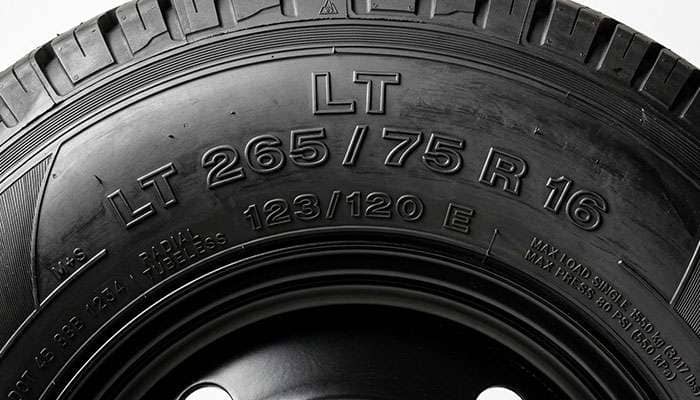
The reason is geometry working against you in a way that is easy to miss. Load Range E is a pressure and construction standard, not a capacity figure. It tells you the tire is built for 80 psi. How much weight that tire carries at 80 psi depends on the air volume inside it, and a 35x12.50 on a 20-inch wheel has a shorter sidewall and less air volume than the same nominal load range on a taller-sidewall size. Same letter, different capacity. That is why two tires can both say Load Range E and be five load index steps apart. Our explainer on load range versus load index walks through why the letter alone never answers the question.
For owners who tow near the truck's ratings, this is exactly the case where moving up to Load Range F is worth the ride penalty. We covered that decision in detail in our guide to Load Range F tires on a three-quarter-ton. A 35x12.50R18 in Load Range F comes back at index 128 and 3,968 pounds, which is actually above the factory 18-inch figure.
There is a way to run a 35 on a 2500HD without giving up capacity, and it is the route the factory took.
The HD ZR2 does not wear a 35x12.50. It wears an LT305/70R18, which measures about 34.8 inches tall and is marketed as a 35. In Load Range E that size carries 3,748 pounds, matching the strongest factory tire on the truck. Chevrolet put a 35 on a three-quarter-ton by choosing a metric light truck size with a taller sidewall rather than a flotation size, and it kept the capacity by doing so.
You can use the same logic. These are the metric sizes in the 34 to 35 inch class and what they carry in Load Range E:
Size |
Approximate Diameter |
Load Range E Index and Capacity |
Versus Factory Tire on That Wheel |
|---|---|---|---|
LT305/70R18 |
34.8 inches |
126, 3,748 lbs |
Up 110 lbs; the factory ZR2 size |
LT285/75R18 |
34.8 inches |
129, 4,079 lbs |
Up 441 lbs; narrower, easiest to fit |
LT295/65R20 |
35.1 inches |
129, 4,079 lbs |
Up 331 lbs; a true 35 for 20-inch trucks |
LT295/70R18 |
34.3 inches |
129, 4,079 lbs |
Up 441 lbs; slightly under a true 35 |
35x12.50R20 |
35.0 inches |
121, 3,197 lbs |
Down 551 lbs; widest stance, most trimming |
If you have 20-inch wheels and you want a genuine 35 without losing a pound of capacity, the LT295/65R20 is the size to know about. It measures slightly over 35 inches, it is available in Load Range E at index 129, and it carries 331 pounds more per tire than the factory 20-inch tire does. It is narrower than a 35x12.50, which means less trimming, not more.
The tradeoff is honest and worth stating: a 12.50-wide flotation tire gives you a wider footprint and the squared-off look a lot of owners are after. A metric size gives you capacity and easier fitment. If the truck is mostly a truck, take the metric size. If the truck is mostly a statement and it rarely sees a trailer, the flotation size is a reasonable choice as long as you know what you traded for it.
Factory HD wheels run around +44 mm offset on 17s and 18s and about +47 mm on 20s. Aftermarket eight-lug wheels commonly land at +18, zero, or negative figures in the -12 to -24 range.
Moving to a lower offset pushes the wheel and tire outward. That buys you clearance from the fender liner at full lock, which is why it works. It also moves the tire's centerline further from the wheel bearing, which increases the leverage on that bearing and changes the scrub radius, so the steering picks up more feedback over ruts. On a truck that already carries a heavy front axle and a diesel up front, that leverage is not free.
The practical range most HD owners land in:
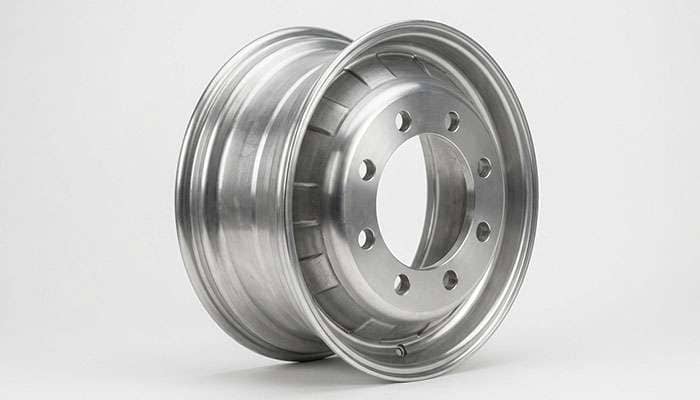
One capacity check people forget: the wheel has a load rating too, stamped or published by the manufacturer. Most aftermarket eight-lug wheels in this pattern are rated somewhere between 3,200 and 3,700 pounds per wheel. That clears a 2500HD's per-corner axle load comfortably, but it is below what the factory 20-inch tire carries, and a few budget wheels sit well under it. If you are loading the truck, check the wheel rating as carefully as you check the tire's. Our guide to offset, backspacing and bolt patterns covers how to measure what you have before you order.
None of this fails on the day you install it. It fails in a sequence, and each stage makes the next one more likely.
Stage one: the liner wears the tire. Contact at full lock is not gentle. The plastic edge of a fender liner acts like a coarse file against the tire's upper sidewall and shoulder. You will see it as scuffing before you feel it as anything.
Stage two: the sidewall gets compromised. The sidewall is the flexing part of the tire and the part with the least rubber over the carcass. Abrasion there is not cosmetic the way a tread scuff is. Once the casing under it is disturbed, the tire is on a clock. This is the single most important thing to catch early, and our guide on whether sidewall damage is safe to drive on covers how to tell a cosmetic scuff from a structural one.
Stage three: the underrated tire runs hot. This is where the capacity numbers come back. A tire carrying closer to its maximum deflects more with every rotation, and deflection is heat. NHTSA's work on tire failure has consistently pointed at underinflation and overload as the conditions behind heat-driven failures, and the failure mode at highway speed on a loaded truck is belt separation, not a slow leak. A 35x12.50R20 at index 121 under a truck loaded to a rear axle rating near 6,200 pounds is running with a fraction of the margin the factory tire had.
Stage four: the front end pays for the lift. Meanwhile, the torsion keys you cranked have been running the ball joints and CV joints at a steeper angle every mile. Play shows up in the steering, then a click on turns, then a joint that needs replacing far earlier than the maintenance schedule suggested.
Stage five: the truck is no longer the truck you bought. Speedometer and odometer read low with a taller tire, which throws off your trailer brake controller's calibration and your service intervals. Payload margin is down. Braking distances with a load are longer on a heavier, taller tire. Individually each of these is manageable. Together they describe a truck that has quietly lost the capability you paid for.
The fix at every stage is the same and it is cheap compared to the alternative: put the right size and load index under it, set the level conservatively, and align it.
Ten minutes with a flashlight and a tape measure answers this for your specific truck better than any general guide can.
Once you know your wheel diameter and the load index on your placard, matching a tire to it is straightforward. You can see the sizes and load ratings that fit your specific truck on our Silverado 2500 HD wheel and tire fitment page.
Will 35s fit a Silverado 2500HD with a leveling kit? On clearance, yes: 2 inches of level from torsion keys, a wheel somewhere around +18 offset, and some trimming of the front fender liner and lower air dam gets most owners there.
But clearance was never the interesting part of this question on a three-quarter-ton. The interesting part is that the most popular way to do it, a 35x12.50 in Load Range E on a 20-inch wheel, quietly takes 551 pounds per tire off a truck that was engineered and rated around a different number. Nobody tells you that when they tell you it fits.
The good news is that the fix costs nothing extra. A metric light truck size in the same 34 to 35 inch class, like the LT295/65R20 on 20s or the LT305/70R18 the factory ZR2 uses, gives you the height you wanted and keeps or improves the capacity. Chevrolet reached that conclusion when it engineered a 35-inch HD, and the reasoning holds up for the rest of us too.
For a 35x12.50, practically speaking yes. A 2 inch level plus modest fender liner trimming is the common combination. A narrower metric size in the 34 to 35 inch class, such as an LT285/75R18, can sometimes work at stock height with trimming, because the extra width of a flotation tire is what drives most of the contact at full steering lock rather than the extra height.
Factory keys usually have about an inch of adjustment available. Aftermarket leveling keys are typically sold for 1.5 to 2.5 inches. Going beyond about 2.5 inches consumes enough droop travel that ball joint and CV angles become a real maintenance issue, and at that point a full lift kit with a differential drop and upper control arms is the more honest solution.
Load Range E is the minimum, but the load range letter alone does not answer the question. Compare load index instead. Your door jamb placard lists the load index the truck was certified with, and your replacement tire should meet or beat it. On a 20-inch truck that figure is 126, which most 35x12.50R20 tires in Load Range E do not reach. Load Range F or a metric size will.
They can, depending on the size you choose. Your tires have to support the load at each axle, so fitting tires with a lower load index than the original reduces the margin the truck was rated with even though the sticker in the door does not change. A taller tire also alters your effective gearing and speedometer reading, which affects trailer brake controller calibration. Choosing a size that meets or beats the placard load index avoids the capacity part of this entirely.
An 18 inch wheel is the sweet spot for a 35 on an HD. It gives you more sidewall than a 20, which means more air volume, more load capacity at the same load range, and a better ride on a truck that already rides firm. It is also the diameter the factory chose for the HD ZR2. Trucks that came on 20s can keep them and run an LT295/65R20 instead, which is a true 35 and carries more than the factory tire.
Usually a small amount. The common work is trimming the leading edge of the front fender liner and either trimming or removing the lower air dam under the front bumper, plus removing the front mud flaps. How much depends heavily on wheel offset: a wheel closer to factory offset needs more trimming, while a lower offset pushes the tire outboard and needs less at the cost of additional wheel bearing load.