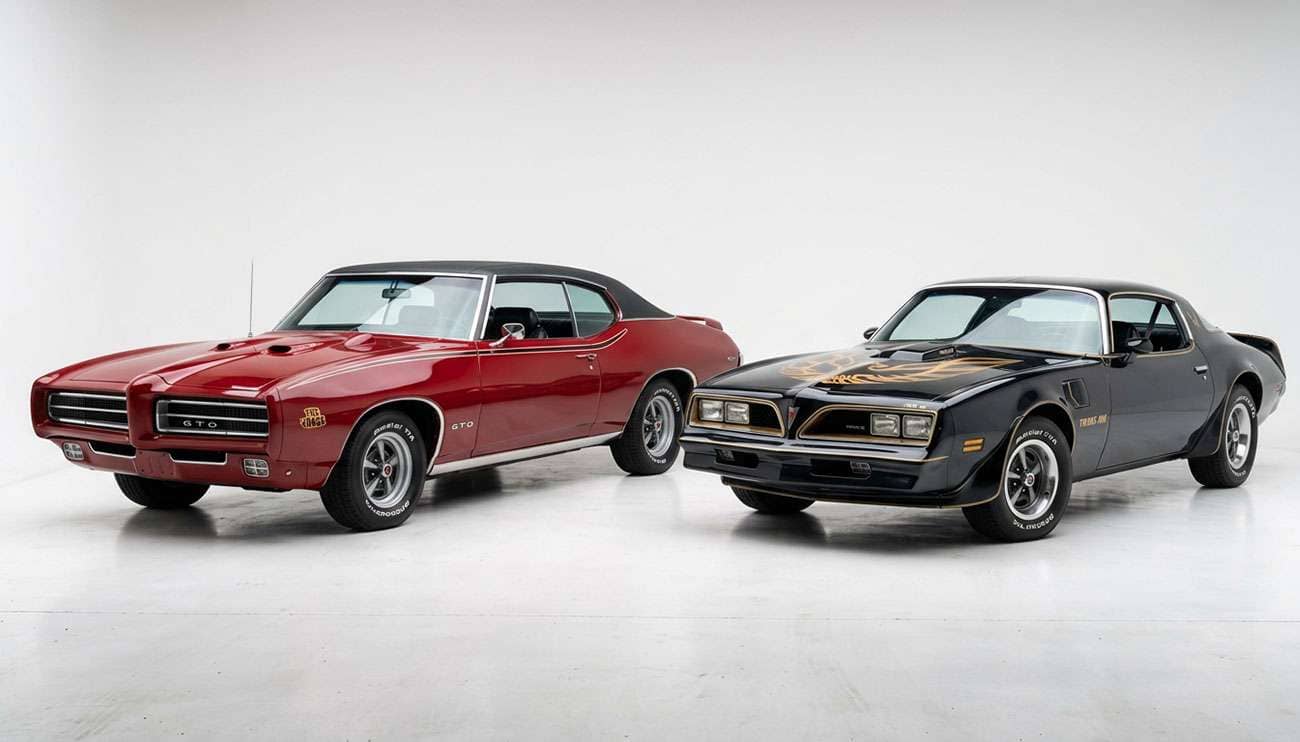
A stock classic GTO or Firebird takes a 15x7 Rally II-style wheel with about 4 inches of backspacing and a 235/60R15 at all four corners. Every one of them, 1964 through 1981, bolts up on the same 5x4.75 pattern with 7/16-inch studs. Past that, the right answer depends on which GM body sits under the Pontiac sheet metal. A 1964-72 GTO is an A-body, a Firebird is an F-body, and the 1974 GTO is a Nova underneath.
You'll hear "it depends" a lot when you ask about these cars. Here's what it depends on: the body, the model year, and the two-letter code stamped on the Rally II you're about to bolt on. Most guides stop at the bolt pattern and give you one tire size for "the GTO." The rear limit moves with the body, and on a 1966-69 GTO it's tighter than the Chevelle numbers everybody borrows.
I've been fitting these cars in Long Beach since 1971, and the Pontiac that rubs almost never has the wrong bolt pattern. It has the wrong backspacing, or a wheel built for a different Pontiac.
This table is the short answer, keyed to the car. "Stock" means factory wheelhouses, no tubs, no cut inner panels, and springs at factory height in decent shape. These are combinations owners run without cutting metal. Every car came off the line a little different, so treat them as a starting point and measure before you buy.
Car and Years |
Shares a Chassis With |
15-Inch Front |
15-Inch Rear |
17-Inch Front |
17-Inch Rear |
Watch For |
|---|---|---|---|---|---|---|
1964-67 GTO |
Chevelle, Tempest, LeMans (A-body, 115-in. wheelbase) |
15x7, 4.25 to 4.5 in.; 235/60R15 (26.1 in. tall) |
15x7, about 4.5 in.; 235/60R15 or 245/60R15 (26.6 in.) |
17x8, 4.5 to 5 in.; 245/45R17 (25.7 in.) |
17x9, 5.5 to 5.75 in.; 255/45R17 (26.0 in.) |
Takes less rear tire than a same-year Chevelle; skip anything under 4 in. of backspacing |
1968-69 GTO |
Chevelle, LeMans, Cutlass (A-body, 112-in. wheelbase) |
15x7, 4 to 4.25 in.; 235/60R15 |
15x8, 4.5 to 5 in.; 245/60R15 |
17x8, 4.5 to 5 in.; 245/45R17 |
17x9, 5.5 in.; 255/45R17, or 275/40R17 (25.7 in.) on a car that measures well |
Rear opening curls in at the trailing edge; plan on close to an inch less than a Chevelle |
1970-72 GTO |
Chevelle, LeMans, Cutlass (A-body, 112-in. wheelbase) |
15x7, 4 to 4.25 in.; 235/60R15 or 245/60R15 |
15x7 or 15x8, 4.5 to 5 in.; 255/60R15 (27.0 in.), or 275/60R15 (28.0 in.) on healthy springs |
17x8, 4.5 to 5 in.; 245/45R17 |
17x9.5, 5.5 in.; 275/40R17 |
Frame rail is the inner limit, same as a 1970-72 Chevelle |
1974 GTO |
Nova, Ventura (X-body) |
15x7, about 4.25 in.; 235/60R15 |
15x8, about 4.5 in.; 255/60R15 |
17x7, about 4 in.; 245/45R17 |
17x8, about 4.75 in.; 255/45R17 |
Leaf-spring rear; use Nova numbers, not A-body numbers |
1967-69 Firebird |
1967-69 Camaro (F-body) |
15x7, 4 to 4.5 in.; 225/60R15 (25.6 in.) |
15x7 or 15x8, about 4.5 in.; 235/60R15 |
17x8, about 4.75 in.; 245/45R17 |
17x9.5, 5.5 in.; 255/45R17, or 275/40R17 with lips rolled |
Tightest box in this guide: leaf spring inside, quarter lip outside |
1970-81 Firebird |
1970-81 Camaro (F-body) |
15x7, 4 to 4.25 in.; 225/70R15 (27.4 in.) or 235/60R15 |
15x8, about 4.5 in.; 255/60R15 |
17x8, 4.5 to 5 in.; 245/45R17 or 255/45R17 |
17x9.5, 5.5 in.; 275/40R17, or 285/40R17 (26.0 in.) on many cars |
Factory aluminum wheels need longer studs on cars that came on steel wheels |
Read the table by body first. The GTO and Firebird generations don't share a wheelhouse, even though they share a bolt pattern. If your car is lowered, sits on tired springs, or has a non-stock rear axle, the rear numbers move.
The last classic GTO was an option package on the compact Ventura, which shares its chassis with the 1968-74 Chevy Nova. That means a leaf-spring rear, a different track width than the A-body cars, and a front subframe related to the first-gen F-body. Don't shop it with A-body numbers. Our Nova wheel and tire guide covers that chassis in detail, and the numbers in it carry over to a 1974 GTO.
Every classic GTO and Firebird left the plant on bias-ply tires, and most rolled on 14-inch wheels until the 15-inch Rally II showed up for 1970. Here's what the factory literature and restoration records list for selected years.
Car and Years |
Standard Tire |
Notable Option |
Factory Wheel |
|---|---|---|---|
1964 GTO |
7.50-14 redline |
Redline tires made their debut on this car |
14-in. steel |
1965 GTO |
7.75-14 redline or whitewall |
Rally I wheel |
14-in. steel |
1967 GTO |
F70-14 |
Rally I or the new Rally II |
14-in. steel |
1968 Firebird |
E70-14 Wide Oval (base) |
F70-14 on Sprint, 350 and 400; redline on the 400 |
14-in.; Rally II code JC |
1968-72 GTO |
G78-14 class bias-ply |
G70-14 wide tread, redline early, white letter later |
14-in. steel or Rally II; 15x7 Rally II from 1970 |
1970-71 Trans Am |
F60-15 raised white letter |
Honeycomb wheel (1971) |
15x7 Rally II, code JW |
1971 Firebird (base) |
E78-14 |
F70-14 raised white letter |
14-in. steel |
1973-78 Firebird and Trans Am |
GR70-15 raised white letter (performance models) |
15x8 Snowflake with WS6 (1978) |
15x7 Rally II or cast aluminum |
1974 GTO |
E70-14 |
Rally II wheels came with the GTO package |
14-in. Rally II |
1979-81 Trans Am |
P225/70R15 radial |
15x8 Snowflake or Turbo aluminum |
15x7 Rally II or cast aluminum |
Two cautions on that table. Options changed by engine, by package, and sometimes in the middle of a model year, so your Pontiac Historic Services documents and the build sheet beat any chart, this one included. And the letter in an old tire code tells you more than the width. An E70, F70 or G70 is a 70-series bias-ply whose letter sets its load capacity and its height, so a G70-14 stands taller and wider than an F70-14 on the same wheel.
If you want a modern radial that matches the original height, a G70-14 lands close to a 225/70R14, and an F60-15 runs close to a 245/60R15. Our guide to muscle car tire sizes decoded walks through every letter-and-number conversion from that era.
If you're restoring to original, the period sizes are still made in redline, white letter and blackwall. Since Lucas Classic Tires joined our family, those reproductions cross our counter every day.
Every 1964-74 GTO and every 1967-2002 Firebird uses 5x4.75, which is the same circle as 5x120.65 mm. That's the classic GM car pattern, shared with the Chevelle, Camaro, Nova, Cutlass and Skylark. The circle never changed on these cars. The hardware did.
Classic Pontiacs from 1964 through 1981 use 7/16-20 wheel studs with 60-degree conical-seat lug nuts. The 1982-up Firebird went to metric M12x1.5 studs. The wheel doesn't care which thread is on the car, but the nuts have to match the studs, and the seat has to match the wheel. The classic hub pilot runs about 70.3 mm, and most aftermarket wheels in this pattern are bored to clear it. These cars center the wheel on the cone-shaped nuts, not on the hub.
The Australian-built 2004-06 GTO uses 5x120 mm, not 5x120.65. That's a 0.65 mm difference, small enough that a wheel will sometimes start onto the studs and big enough that the nuts never seat evenly. Its factory wheels were 17x8 and 18x8 at about +48 mm offset, on M12x1.5 studs with a hub just under 70 mm. Nothing in the classic tables applies to that car, and a Rally II won't go on one.
Catalina, Bonneville and the other big Pontiacs used a 5-inch bolt circle, and some of them wore Rally II wheels that look identical from 10 feet. In 1970, the same 15-inch Rally II design offered on the Trans Am was also offered on the Catalina, Executive and Bonneville. A quarter inch of bolt circle separates them, so check before you hand over cash at a swap meet. Our guide to the 5x4.75 bolt pattern shows how to measure a five-lug circle and how to tell 5x4.75 apart from 5x5 and 5x120.
Here's the part nobody puts in front of you. A Rally II is not one wheel. Pontiac built it from 1967 through 1981 in somewhere between 30 and 40 versions, and they differ in width, center hole and offset. The only reliable ID is the two-letter wheel code stamped on the outside of the rim near the valve stem. A code stamped inside the rim identifies the rim blank only, not the finished wheel.
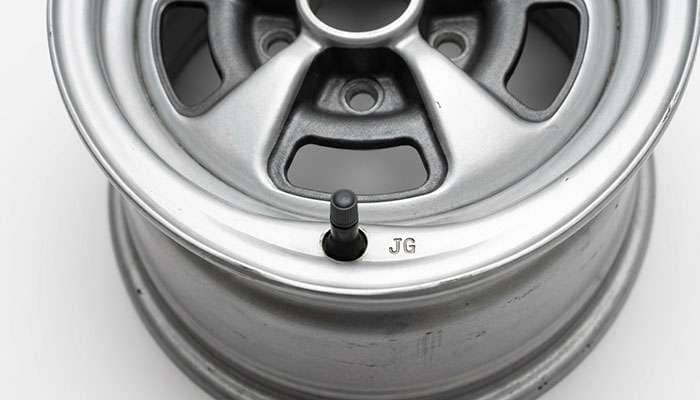
In 1968, the GTO, LeMans and Tempest Rally II carried the code JA, while the Firebird got JC, the same wheel whether the car had drum or disc brakes. The 14x7 Firebird wheels for 1969 through 1972 (JK, JM, JS and KS) changed center holes while keeping the same offset, and the 1971-74 Ventura II wheels ran different offsets again. The larger early center hole is no problem, since caps fit either way. The offset is the problem. Put a wheel coded for one body on another and the bolt pattern won't stop you. The quarter lip might.
Owners who measure original Rally IIs find backspacing anywhere from about 4 to 4-1/2 inches depending on the code, and one measured 1978 Trans Am Rally II came in at 4-1/4. Most reproduction 15x7 Rally IIs are built at 4 inches, with 15x8s at 4 or 4-1/2. So a reproduction can sit up to half an inch farther out than the original it replaces. On a 1970-72 GTO that rarely matters. On a 1968-69 GTO, that half inch can be the difference between clearing the lip and rubbing it.
Across wheels drilled 5x4.75, about three in four 15x7s sit between 3-3/4 and 4-1/4 inches of backspacing, and most 15x8s land at 4-1/2. If you want the Rally II look on a 17, the Cragar 380S Rally II comes in 17x8 at about 4-1/2 inches and 17x9 at about 5, which lines up with the A-body and second-gen Firebird numbers in the first table.
Wheel |
Where It Came From |
Sizes |
Backspacing or Offset |
Bolts On a Classic GTO or Firebird? |
|---|---|---|---|---|
Rally I |
1965-68 Tempest and GTO; 1967-68 Firebird |
14x6, 14x7 |
About 4-1/4 in. on reproductions |
Yes |
Rally II, A-body codes |
1967-72 GTO, LeMans, Tempest (JA in 1968) |
14x6, 14x7; 15x7 from 1970 |
About 4 to 4-1/2 in., by code |
Yes; read the code first |
Rally II, F-body codes |
1967-81 Firebird (JC in 1968, JW on the 1970 Trans Am) |
14x6, 14x7, 15x7 |
About 4-1/4 in. measured on a late 15x7 |
Yes; read the code first |
Rally II, full-size Pontiac |
Catalina, Bonneville, Executive |
14 and 15 in. |
Built for a 5-inch bolt circle |
No. It's 5x5. |
Honeycomb, Snowflake, Turbo |
1971-81 Firebird cast aluminum |
14x7, 15x7, 15x8 |
About 4-1/4 to 4-1/2 in. |
Yes, but the thick pad needs longer studs on steel-wheel cars |
Reproduction Rally II |
Current production |
15x7, 15x8, 15x10; 17 and 18 in. styled versions |
15x7 at 4 in.; 15x8 at 4 or 4-1/2 in. |
Yes; often sits farther out than the original |
1993-2002 Firebird |
Factory and replica |
16x8, 17x9; replicas in 17x9.5 |
+50 to +56 mm; about 7 to 7.5 in. |
Bolts on, but sits far too inboard |
2004-06 GTO |
Factory |
17x8, 18x8 |
About +48 mm |
No. It's 5x120 mm. |
A GTO and a Chevelle share a frame, and that's exactly why owners get burned. The frame is common. The rear axle and the sheet metal aren't always. Here's how it breaks down by year.
Pontiac sold Wide-Track as a feature, and its A-body cars rode on Buick-Olds-Pontiac rear axles, not Chevrolet units. Owners who have measured report that Pontiac's A-body axle went about an inch wider for 1967, a year before Chevrolet's did, which puts a 1967 GTO's rear about an inch wider than a 1967 Chevelle's 60-inch drum-to-drum width. An inch more axle moves each tire half an inch closer to its quarter lip. Add the 1966-67 GTO's curvy rear quarters, which tuck in at the opening, and you get a complaint I hear from these owners all the time: a 15x7 that looked great on a 1967 Malibu rubs on a 1967 GTO at factory height.
Owners who've measured 1966-67 GTOs report a front 18x8 at 5 inches of backspacing with a 245/40R18, and a rear 18x9 at 5-3/4 inches with a 255/45R18, as the comfortable ceiling. A 275 on an 18x9.5 wouldn't go. On 15s, a 235/60R15 front and a 245/60R15 rear on 7-inch wheels is the combination longtime Pontiac people recommend, and a 15x7 with only 3-3/4 inches of backspacing is a poor match for a 1967.
By 1968 every A-body runs the same axle width. Replacement housings for the 1968-72 Chevelle, GTO, LeMans and Cutlass are all built at about 61-1/4 inches. So the axle stops being the difference, and the sheet metal takes over. The 1968-69 GTO's rear opening curls in at its trailing edge, where the Chevrolet opening sweeps away. Pontiac owners figure that costs close to an inch of usable width. A 17x9.5 at 5-1/2 inches that works on a 1969 Chevelle can catch the back edge of a 1969 GTO's opening on a hard bump.
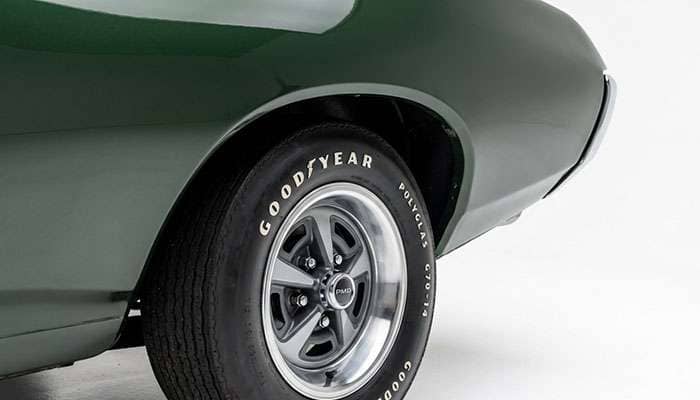
On 1970-72 cars, GTO owners run the same combinations Chevelle owners do, and the frame rail becomes the inner limit. A 275/60R15 fits the rear on a 15-inch Rally II, a 275/40R17 works on a 17x9.5 at 5-1/2 inches, and one 1972 A-body owner runs a 295/35R18 on an 18x10 at 5-3/4 inches with no rubbing. Our Chevelle wheel and tire guide explains why the frame rail is the hard stop on these cars and what it takes to get past it.
Backspacing is the distance from the wheel's mounting face to its inner edge. On these cars it decides whether the tire hits something on the inside, like the leaf spring on a Firebird or the frame rail on an A-body GTO, or the quarter lip on the outside.
Pre-1982 GM cars, Pontiacs included, were built around wheels close to zero offset. On a 7-inch wheel, which measures about 8 inches across the flanges, zero offset works out to about 4 inches of backspacing. On an 8-inch wheel it's about 4-1/2. The factory wheels lived right there. A measured 15x8 Snowflake came in at 4-1/2 inches and zero offset, and a 15x7 Rally II off a 1978 Trans Am measured 4-1/4, a quarter inch from zero.
To keep a wider wheel centered where the narrower one sat, add half the extra width to the backspacing. An 8-inch wheel at 4-1/2 becomes a 9-inch at 5, or a 9-1/2-inch at 5-1/4. On a 1966-69 GTO, I'd go another quarter inch past that to pull the tread away from the lip, then check the inside clearance before you mount four.
Here's the trap in the 5x4.75 market. Most wide 17s and 18s in this pattern are built for 1993-2002 Camaros and Firebirds or for Corvettes, not for a classic. About six in ten 17x9.5 wheels drilled 5x4.75 carry 6 inches of backspacing or more, and factory-style replicas for the 1993-2002 Firebird run +54 to +56 mm offset, about 7.4 inches of backspacing. Bolt one on a GTO and the tire lands in the frame or the control arm. The bolt pattern matches. Nothing else does.
Yes. The 1967-69 Firebird is a Camaro underneath, rear leaf springs and all, and it has the narrowest rear wheelhouse in this guide. Firebird owners put the biggest practical 15-inch tire on an unaltered car at about a 235/60R15, and some report a 245 on an 8-inch wheel as too big. Car Craft's March 2000 numbers for the 1967-69 Camaro and Firebird run 15x8 at 4-1/2 inches front and rear, and 17x9 at 5-1/2 inches with 245 to 255 tires, with a warning about lower control arm contact with some steering boxes.
If yours is a first gen, our first-gen Camaro wheel and tire guide applies almost number for number.
The 1970-81 Firebird rides a larger body with a roomier rear wheelhouse. Owners run a 17x8 at 4-1/2 inches with a 245/45R17 up front and a 17x9.5 at 5-1/2 inches with a 285/40R17 in back without trouble. Reproduction 17x9 Snowflakes are built at 5-1/8 inches of backspacing, and their makers pair them with a 255/45R17 front and a 285/40R17 rear. Owners report that early second gens have a bit more rear room than late ones, so measure a late car carefully.
The 1970 Trans Am came standard on a 15x7 Rally II stamped JW, wearing F60-15 raised white letter tires. Pontiac built that wheel by welding an extra inch of rim onto a 14-inch-style center, which is why it didn't take a trim ring at first. For 1971, trim rings came standard with the 15-inch wheel, and the cast Honeycomb became an option.
The Honeycomb, Snowflake and Turbo wheels are cast aluminum, and their mounting pads are much thicker than the stamped center of a steel Rally II. Owners who move them to a first-gen car, or to any Pontiac that came on steel wheels, find the factory studs too short. The rule of thumb in the trade is thread engagement at least equal to the stud diameter. On a 7/16-20 stud, that's about 9 full turns of the nut. Count them before you drive.
A rub on a classic Pontiac doesn't stay a noise. It climbs a ladder, and every rung costs more than the one below it.
Every rung has the same fix: the right wheel, measured to your car, with a tire sized for the box it lives in. When you do mount new wheels, re-torque the lug nuts after the first 50 to 100 miles, which has been standard practice across the tire industry for decades. On any aftermarket wheel, look for testing to SAE J2530, the industry standard for aftermarket passenger-car wheels.
Ten minutes with a tape measure beats a set of wheels you can't use. Here's the order I'd do it in.
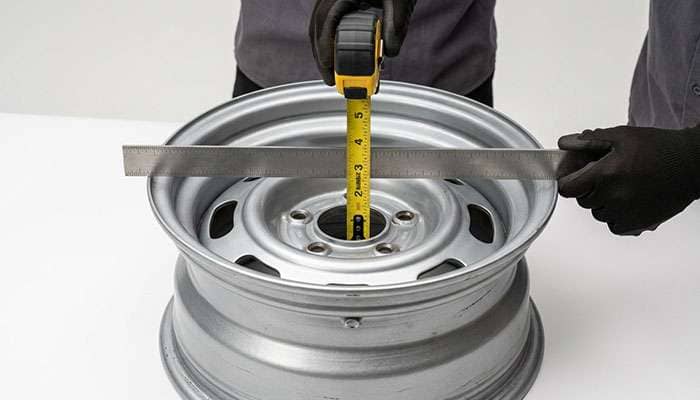
Once you have your numbers, shop wheels and tires for your Pontiac by model and year.
A classic GTO or Firebird is easy to fit once you stop treating it as one car. The bolt pattern is the same 5x4.75 from 1964 through 1981. The box the tire lives in isn't.
Start with a 15x7 at about 4 inches and a 235/60R15 if you want a combination that works on all of them. Go wider by adding backspacing, not by guessing, and give a 1966-69 GTO a little more inboard room than a Chevelle. Read the code on any Rally II you buy used, skip full-size and late-model wheels, and count your threads on aluminum. If you want a second set of eyes on your numbers, call the shop.
Here's the short version for your notes.
A 1964-74 GTO uses 5x4.75, the same as 5x120.65 mm, with 7/16-20 wheel studs. The 2004-06 GTO uses 5x120 mm with M12x1.5 studs. The two are not interchangeable.
Yes, within the same generation. A 1967-69 Camaro and Firebird share the same bolt pattern, hubs and rear wheelhouse, and so do the 1970-81 cars. A wheel from a 1993-2002 Camaro or Firebird will bolt onto a classic, but it carries far too much backspacing to fit properly.
They bolt on, since both use 5x4.75 with 7/16-20 studs. Whether the tire clears depends on the year. A 1970-72 GTO takes Chevelle numbers. A 1968-69 GTO loses close to an inch at the rear opening, and a 1966-67 GTO takes less rear tire than a same-year Chevelle, so add backspacing on those cars.
Factory Rally IIs came in 14x6 and 14x7 starting in 1967, with a 15x7 added for 1970 that ran through 1981. Backspacing ran about 4 to 4-1/2 inches depending on the two-letter code. Reproductions come in 15x7, 15x8 and 15x10, plus styled 17- and 18-inch versions.
On a 1970-72 GTO, owners fit a 275/60R15 on a 15-inch Rally II, a 275/40R17 on a 17x9.5 at 5-1/2 inches, or a 295/35R18 on an 18x10 at 5-3/4 inches. A 1966-69 GTO takes less, usually a 255 or a careful 275 on a 9-inch wheel. Measure your own car before ordering.
No. The 2004-06 GTO uses a 5x120 mm bolt pattern and wheels at about +48 mm offset. A 1969 GTO uses 5x4.75, or 5x120.65 mm, and wants wheels near zero offset. Even if the nuts start, the wheel won't seat correctly.