
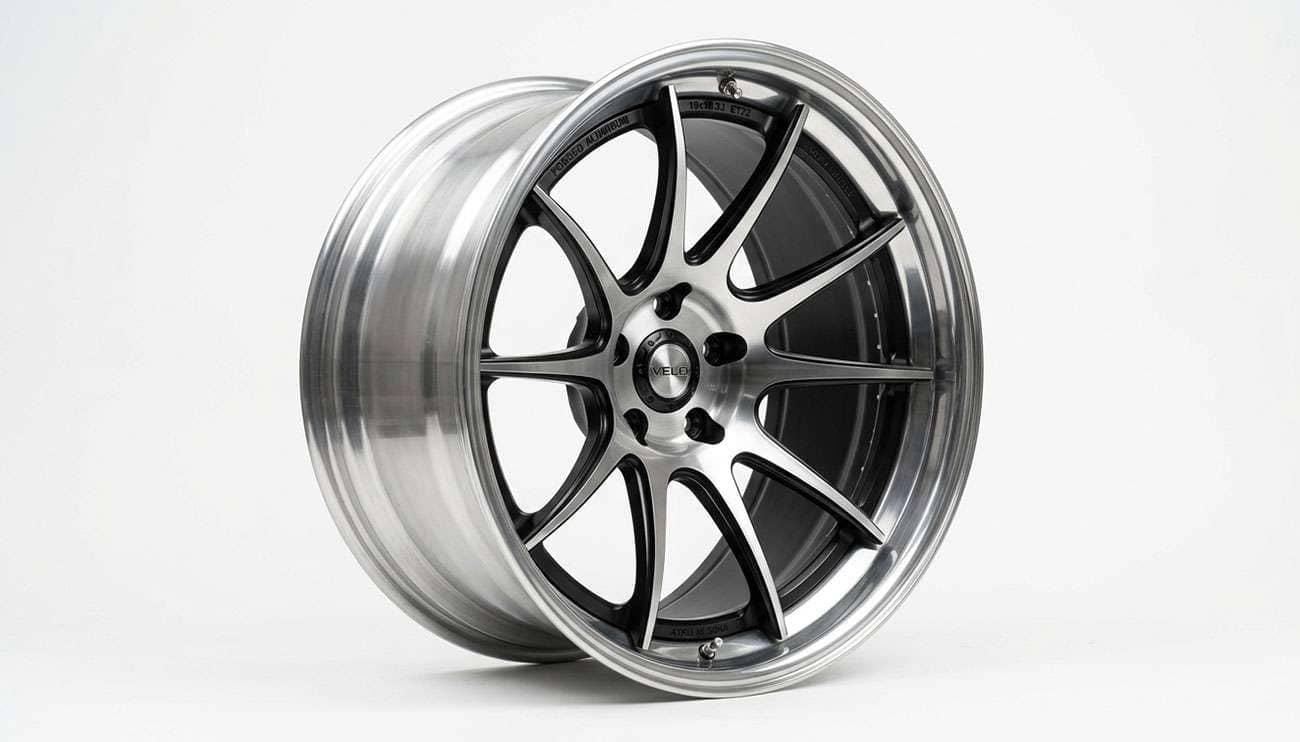
"Concave" is one of the most-used words in the modern wheel world and one of the least precisely understood. People shop for it like a finish, the way they'd ask for gloss black or polished. But concavity isn't a color or a brand line. It's a geometric relationship between where the spokes leave the mounting face and where they meet the lip, and that relationship quietly decides how wide the wheel looks, how much room sits behind the spokes for a brake caliper, and how the wheel has to be built to survive. Get the concavity right and you get aggressive stance plus caliper clearance in the same package. Get it wrong and you get a wheel that either looks flat and underwhelming or won't clear the brakes you're trying to run.
This is the part of fitment nobody publishes on a spec sheet. Diameter, width, offset, and bolt pattern all get printed. Concavity almost never does, and it changes the result more than buyers expect. Here's how the geometry actually works, what shallow versus deep really means, and where the brake-clearance payoff comes from.
Start with the two surfaces that define every wheel: the mounting face (the flat pad that bolts against your hub) and the outer lip (the edge of the rim where the tire bead seats). A spoke has to travel from one to the other. The shape of that travel is what concavity describes.
On a flat-faced wheel, the spokes run nearly straight out from the mounting face to the lip, sitting close to a single plane. On a concave wheel, the spokes dip inward toward the center of the barrel before sweeping back out to the lip, carving a recessed bowl into the face. Picture the difference between a dinner plate and a shallow soup bowl: same diameter, very different profile. The deeper that inward curve, the more "concave" the wheel is said to be.
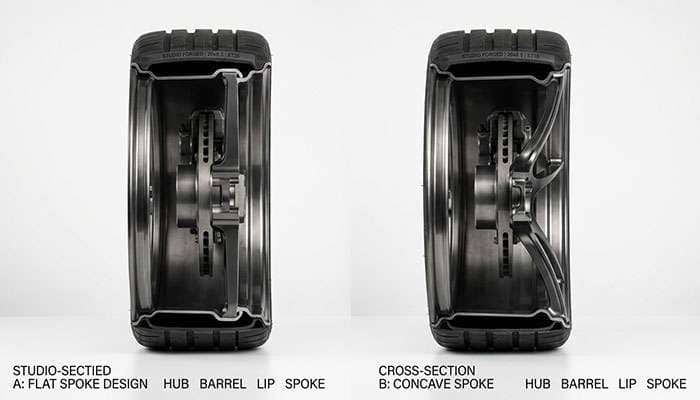
That's the whole concept, but the consequences run deep. The recessed pocket behind the spokes is empty space, and empty space behind the face is exactly what a brake caliper needs to live in. The outward sweep at the lip is what reads as visual width and dish. So a single shape choice is doing aesthetic work and functional work at the same time, which is why concavity deserves more attention than it usually gets when people are clicking through wheel options.
Concavity isn't a yes-or-no trait. It's a sliding scale, and manufacturers build to different points along it on purpose. You can think of it in four broad tiers:
Profile |
Spoke Behavior |
Typical Use |
|---|---|---|
Flat |
Spokes run straight out, minimal inward dip |
OE replicas, EV aero wheels, luxury sedans |
Shallow Concave |
Gentle inward curve, subtle pocket |
Daily-driven sport sedans and coupes |
Deep Concave |
Pronounced inward bow, large recessed pocket |
Aggressive street builds, wider rear fitments |
Deep Dish |
Extreme inward curvature with a tall outer lip |
Show stance, rear-axle setups, classic builds |
The clearest real-world proof that concavity is a deliberate spec lives in our own catalog. Several wheel families are offered in matched depth pairs: the Billet Specialties two-piece lineup, for instance, sells models like the Gran Sport and the Sprint in both Concave Deep and Concave Shallow variants of the same base design. The bolt pattern and diameter can be identical; the only thing that changes is how far the face is recessed. That's not marketing language. That's two different sets of geometry built off one design language so the buyer can dial the stance and the clearance to the build.
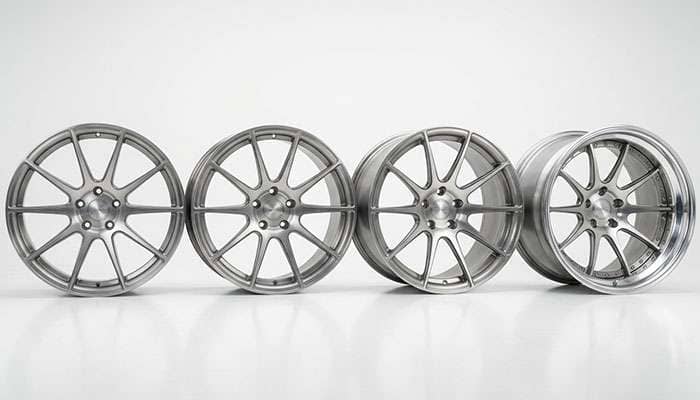
Concave wheels aren't just a styling fad. The shape earns its place for three separate reasons, and most concave wheels are chasing more than one of them.
Perceived width and stance. The outward sweep of a concave face fills the wheel well and pushes the visual mass toward the fender edge. Two wheels with the same measured width can look very different: the concave one reads wider and more planted because the eye follows the curve out to the lip. For a lot of buyers this is the entire reason concave exists, and it's a legitimate one.
Brake caliper clearance. This is the functional payoff that gets overlooked. The recessed pocket behind a concave face is volume that a large caliper can occupy. Run a big brake kit and a flat-faced wheel and the back of the spokes can sit right on top of the caliper; the same diameter and width in a concave profile opens a pocket the caliper tucks into. It's not automatic, and we'll get to the limits, but the inward curve genuinely buys room that a flat face doesn't have.
Structure, when it's built right. A curved spoke can be engineered to manage load along its length rather than as a flat cantilever. Done in the right material, concavity and strength aren't enemies. Done in the wrong material, deep concavity forces compromises in spoke thickness, which is the whole reason construction method matters so much on these wheels.
Here's the mechanical reality that surprises people: how concave a given wheel looks once it's mounted depends heavily on its width and its offset, not just on the casting shape. Two factors set it up.
Width gives the spokes room to curve. A wide barrel creates more distance between the mounting face and the lip, and that distance is the canvas the inward curve is painted on. A narrow wheel simply doesn't have the depth to develop a dramatic pocket no matter how the spokes are shaped. This is why aggressively concave wheels tend to be the wider sizes in a lineup.
Offset positions the face inside that barrel. Offset is the distance from the mounting face to the wheel's centerline, and it decides how deep into the barrel the face sits. Lower (or more negative) offset pulls the face outward and pushes more of the barrel behind it, which deepens the apparent concavity and the dish at the lip. Higher positive offset does the opposite, pulling the face out toward the lip and flattening the look. If you want to understand how that number drives everything downstream, our breakdown of wheel offset explained: how to get the perfect fit every time lays out the full geometry, and the companion piece on how much can you change offset covers how far you can safely deviate from the factory spec before fitment breaks.
The practical takeaway: concavity is partly a manufacturing choice and partly a fitment choice. The same model in a wider width with a lower offset will present as far more concave on the car than the narrow, high-offset version of the identical wheel.
This is where concave geometry stops being cosmetic and starts being a fitment decision. The recessed pocket behind a concave face is the single best friend a big brake kit has, but the benefit comes with hard limits that catch people off guard.
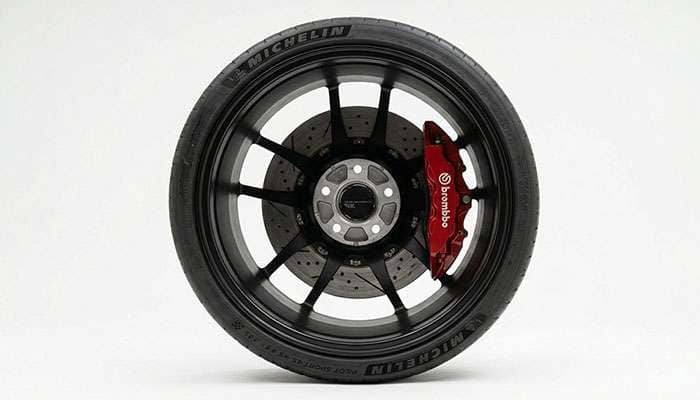
The benefit is real. A deeply concave spoke bows away from the brake assembly, opening space where a tall, multi-piston caliper can sit. This is exactly why two wheels with identical diameter, width, and offset can produce completely different results: one with concave spokes clears a big caliper cleanly while the flat-spoke version interferes by several millimeters at the same caliper. The spec sheet won't show you this. Only the spoke profile does.
The limit is just as real, and it runs in two directions. First, concavity is not a guarantee: a deep face can clear the caliper while the barrel itself, or a step-down in the inner surface, still contacts the top of a tall caliper or a large-diameter rotor. Second, you can over-chase it. The same low offset that deepens concavity also pushes the wheel outward, and too much poke means fender rubbing under suspension travel. The fix for one problem creates the other, which is why brake clearance and fender clearance have to be solved together, not separately.
None of this should be eyeballed. The only reliable method is to measure the gap between the back of the spokes and the caliper, account for the barrel, and verify against the actual brake hardware. We walk through the minimum gaps, the template method, and the variables that decide the outcome in our dedicated big brake kit wheel clearance guide. If your concave wheels are going on a car that's also getting a brake conversion, the sequencing matters too, and disc brake conversion wheel fitment covers how the two upgrades interact.
The deeper you push the curve, the more the spoke is asked to carry load through a shape that isn't a straight line. That puts a premium on material strength, and it's the reason most genuinely deep concave wheels are forged or flow-formed rather than cast.
Cast wheels can absolutely be concave, and plenty of good ones are. But a cast spoke achieving a deep profile usually has to be made thicker or beefier to stay rigid, which adds weight and can blunt the very look the buyer wanted. Forging produces a denser, stronger grain structure, so a forged spoke can hold a deep, thin, sculpted curve without giving up rigidity. That's why the most aggressive concave designs in any catalog tend to cluster in the forged and multi-piece families, and why a wide two-piece wheel can run a deeper face than a comparable cast unit. If you want the full comparison of how the construction methods differ in strength, weight, and cost, see cast vs. forged vs. flow-formed wheels.
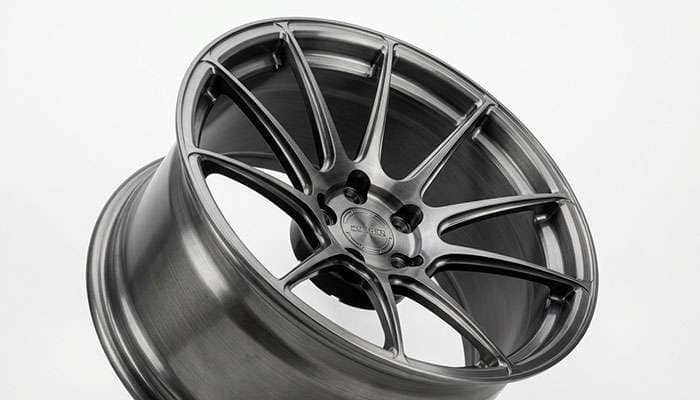
The practical signal: if you're shopping for a deeply concave wheel and the price looks too good, check the construction. Real deep concavity built to last almost always carries the cost of forging.
These two terms get used interchangeably, and they shouldn't be. They describe different parts of the wheel doing different jobs, even though they often appear together.
Concave refers to the spoke face curving inward toward the barrel. Deep dish refers to a tall outer lip, the band of bare barrel between the edge of the spokes and the rim edge. A wheel can be concave with almost no lip, it can have a big lip with a fairly flat face, or, at the extreme end, it can do both at once. Deep dish is essentially the far end of the same spectrum: pronounced inward curvature paired with a pronounced lip.
The functional difference matters when you choose. Concave profiles tend to balance stance with brake clearance, which makes them workable on both axles. Big-dish setups push more of their effect into outward extension, so they're more commonly run at the rear where steering geometry isn't a factor and there's room to let the wheel sit proud. That's part of why aggressive builds often run a wider, deeper setup in back, the logic our square vs. staggered setup guide gets into. If the lip specifically is what you're after, deep dish rims and their purpose covers that side in detail.
Concavity is a tuning knob, not a single right answer. The depth that's perfect for a show car would be wrong for a track car, and the profile that clears one brake kit won't clear another. A short decision framework keeps it honest:
Start with the brakes. If you're running or planning a big brake kit, your minimum concavity is set by caliper clearance, not by looks. Measure first, then shop the profiles that fit. The wheel has to clear the hardware before anything else matters.
Set the depth with offset and width, not wishful thinking. Decide how much poke your fenders can take, work backward to an offset, and choose a width that gives the spokes room to curve. The stance you want is the product of those numbers, not a single line on the listing.
Match construction to depth. Shallow concave is comfortable territory for quality cast wheels. Deep concave that has to stay strong and light is forged territory. Don't pay cast money expecting forged geometry.
Our full custom wheels selection runs the whole spectrum, from subtle shallow-concave daily wheels to the deep two-piece and forged designs. Brands like Billet Specialties, with its matched shallow and deep variants, and Schott, with its concave Apex and C10 designs, make it easy to see the geometry as a real, orderable choice rather than an abstract idea. If you're unsure where your brakes and fenders leave you, that's exactly the kind of thing our fitment team sorts out before you buy.
Concave isn't a style you bolt on; it's a geometry you specify. The inward curve of the spokes sets how wide the wheel reads, how much room sits behind the face for a caliper, and how the wheel has to be built to hold that shape. Width and offset turn the curve into the stance you actually see on the car, and brakes set the floor under how shallow you can go. Treat concavity as the engineering variable it is, measure your brake clearance instead of guessing it, and match the construction to the depth, and you get the look and the fit in the same wheel. Skip that work and you get one or the other, never both.
Concave wheels have spokes that curve inward from the mounting face toward the center of the barrel before sweeping back out to the lip, creating a recessed, bowl-like face. The opposite is a flat-faced wheel, where the spokes run nearly straight out. The deeper the inward curve, the more concave the wheel.
Often, yes. The recessed pocket behind a concave face opens space for a large caliper that a flat-faced wheel doesn't have, which is why a concave wheel can clear a big brake kit that an otherwise identical flat wheel won't. It's not guaranteed, though: the barrel and inner-face profile can still contact a tall caliper or large rotor, so you have to measure actual clearance rather than assume it.
Concave describes the spoke face curving inward toward the barrel. Deep dish describes a tall outer lip between the spokes and the rim edge. A wheel can be concave with little lip, have a big lip with a flatter face, or combine both. Deep dish sits at the extreme end of the same spectrum, pairing pronounced inward curvature with a pronounced lip.
It depends on construction. A curved spoke can be engineered to manage load well, but holding a deep concave profile without losing rigidity demands material strength. That's why deep concave designs are usually forged or flow-formed; cast wheels can be concave but often need thicker spokes to stay rigid at depth, which adds weight.
The outward sweep of a concave face carries the eye toward the lip and fills the wheel well, so the visual mass sits closer to the fender edge. Two wheels of the same measured width can look very different because the concave one reads wider and more planted. Lower offset and a wider barrel amplify the effect.



