
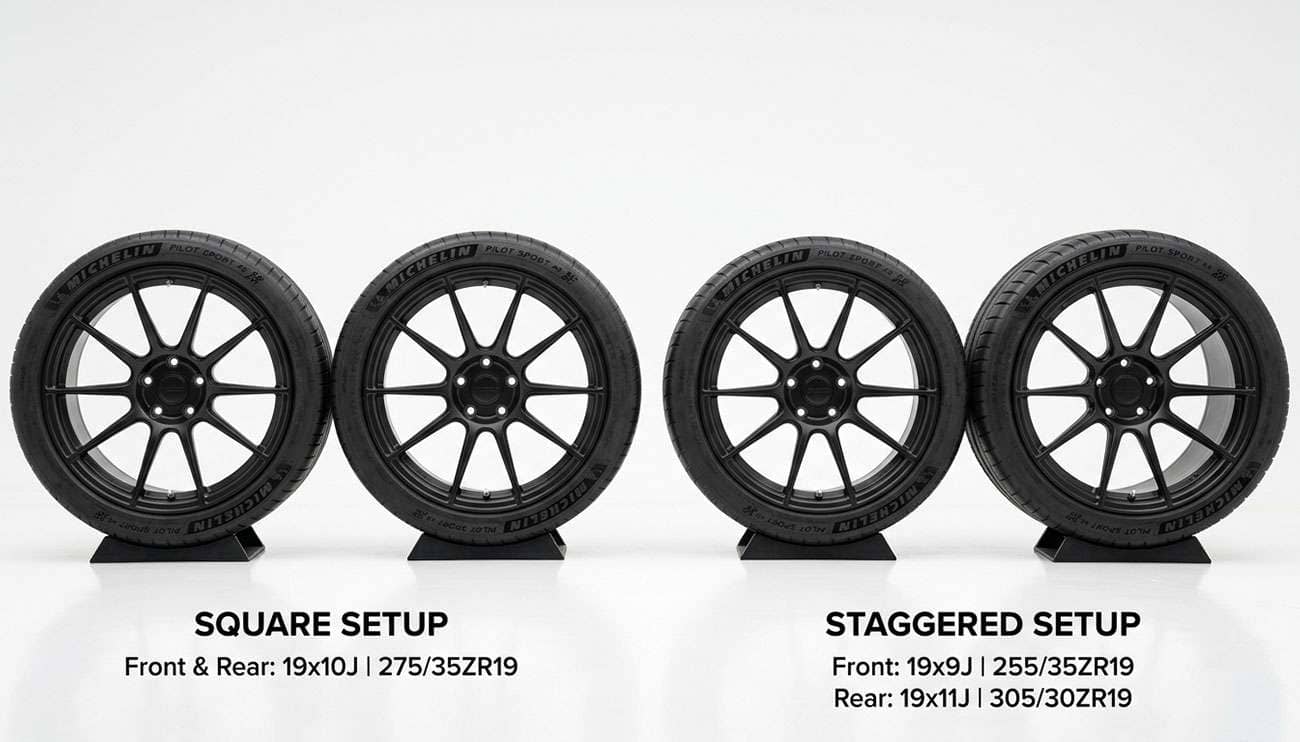
This is one of the most contested questions in wheel fitment, and the answer isn't a slogan — it's a tradeoff. A staggered setup runs wider wheels and tires on one axle (almost always the rear), while a square setup runs identical wheel and tire sizes on all four corners. Both can be the right call. Which one wins depends on your drivetrain, how you actually use the car, and what you're willing to give up. Let's work through it the way I would when spec'ing a package across the counter.
Mechanically, the distinction is simple. A square setup uses the same wheel width, diameter, and tire size at every corner — say 19x9.5 with a 265-section tire all around. A staggered setup keeps the diameter the same front to rear but widens the rear: a common example is 19x9 up front and 19x10.5 in the back, with a wider rear tire to match. That extra rear width is the whole point. A wider tire lays down a larger contact patch, and a larger contact patch is more rubber meeting pavement where the car puts power down.
Diameter staying constant matters. You're changing width, not rolling circumference, so the speedometer and (in most cases) the ABS and traction systems stay happy. If you want a refresher on how section width, aspect ratio, and rim width interact before you commit to numbers, our plus sizing wheels and tires calculator guide lays out the math.
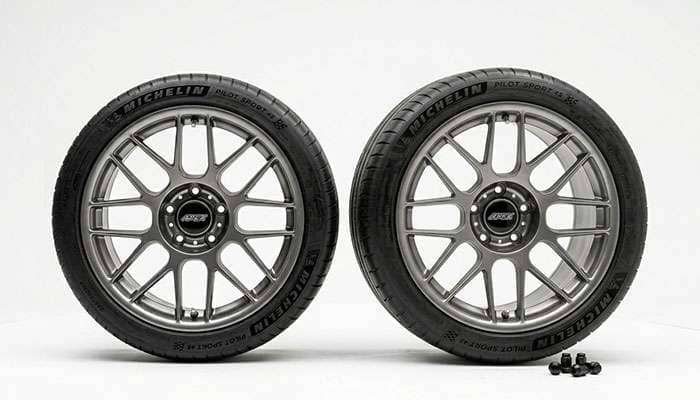
Open up the spec sheet on most front-engine, rear-wheel-drive performance cars — Mustang GT, Camaro SS, a 911, a BMW M car — and you'll find a factory staggered fitment. That's not styling for styling's sake. With the rear axle handling both power delivery and a big chunk of the car's weight transfer under acceleration, the engineers put the wider tire where the traction demand is highest.
There's a stability reason too. A staggered setup biases grip toward the rear, which nudges the car's balance toward understeer rather than oversteer. Understeer is predictable and recoverable for the average driver; snap oversteer in a powerful RWD car is neither. So the factory stagger is partly a safety margin baked into the fitment. Wider rear rubber also changes how offset works front to rear, and getting that wrong is how you end up with rubbing or poke — the custom offset wheels guide is worth reading before you order.
For a high-horsepower RWD street car, staggered is hard to beat. The wider rear contact patch translates directly into better straight-line traction off the line and better drive off corner exit. If your priority is putting power down — drag strip launches, roll racing, spirited canyon driving in a torquey rear-drive car — the rear bias does real work.
It also retains the handling character the chassis was tuned around. A factory-staggered car was developed with that grip balance in mind, so staying staggered (and upgrading to a genuine performance wheel and tire) keeps the car behaving the way its engineers intended. And yes, the aggressive look of a wide rear sitting flush in the fender is a legitimate reason people choose it — there's no shame in that as long as you understand the costs. For the wheel-and-tire selection itself, see our staggered wheels guide and the muscle car staggered setup breakdown.
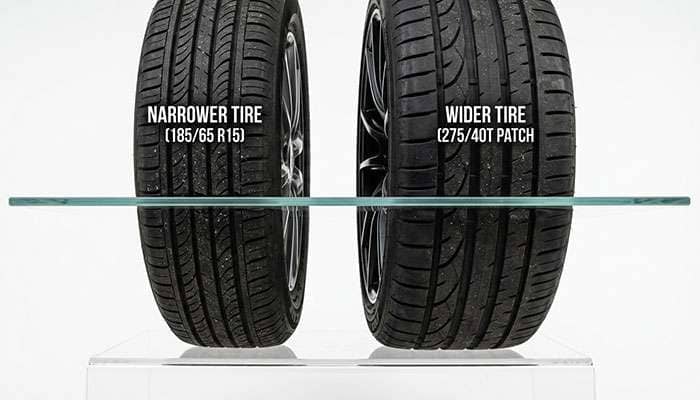
Square has a quiet list of advantages that matter more than enthusiasts give it credit for. The biggest is tire rotation. With identical tires at all four corners you can rotate front to rear, even out wear, and stretch tire life meaningfully. A staggered car can only rotate side to side at best — and with directional tires, often not at all — so you replace tires sooner and pay more over the life of the car. The relationship between fitment and wear is covered in how does wheel offset affect tire wear.
On a track-focused build, square is frequently the faster choice. Equalizing front grip to match the rear gives you a more neutral, balanced car through corners, and many drivers find a square setup easier to rotate and trail-brake at the limit. You also get flexibility — one tire size to stock, one spare logic, simpler decisions. For FWD and most AWD cars, square is simply the correct default; there's no driven rear axle begging for extra width. If your build is about lap times rather than launches, look at our 8 best track day tires roundup.
Feature |
Square |
Staggered |
|---|---|---|
Straight-line traction (RWD) |
Good |
Better — wider rear patch |
Cornering balance |
More neutral |
Rear-biased (understeer) |
Tire rotation |
Full front-to-rear |
Limited or none |
Tire life / cost |
Longer, lower cost |
Shorter, higher cost |
Best drivetrain fit |
FWD, AWD, track RWD |
High-power street RWD |
There's a third configuration worth naming: reverse stagger, where the wider wheels and tires go up front. You will almost never see this on the street, and for good reason. It shows up in specific front-wheel-drive motorsport applications, where the front tires handle steering and power delivery at the same time and benefit from the extra contact patch. For a normal FWD daily or even a spirited FWD build, a square setup is the right answer — reverse stagger is a purpose-built race solution, not a street upgrade. Mention it mostly so you recognize it when someone brings it up.
Here's how I'd call it. High-power RWD street car, priority on traction and stance: stay staggered, and accept the tire-rotation penalty as the cost of doing business. RWD track or autocross build: strongly consider square for balance, rotation, and tunability. FWD or AWD: square, full stop, unless you're chasing a very specific motorsport goal.
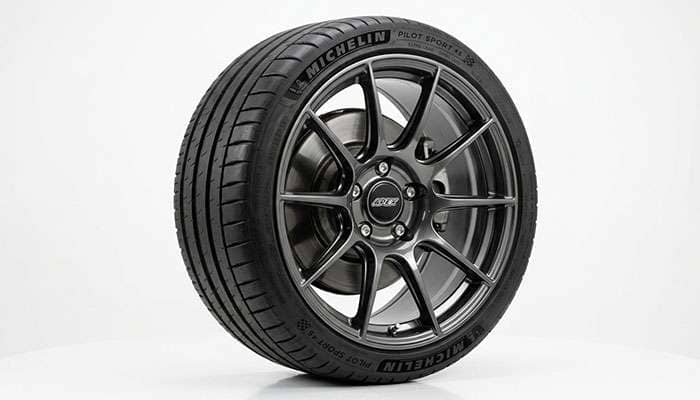
Whichever way you go, the wheel and tire have to earn their place. For staggered RWD builds I'd point you at a true performance wheel offered in staggered widths like the Forgestar CF10 or an Enkei flow-formed design, wrapped in a Michelin Pilot Sport 4S or Continental ExtremeContact DW. Browse the full wheel selection and custom wheels, or match them with the right rubber from our performance tires. If you want to understand how wheel diameter and weight factor into all this, how wheel size affects car performance closes the loop.
There's no universally correct answer, and anyone who tells you otherwise is selling a look, not a setup. Staggered rewards high-power rear-wheel-drive cars with traction and an aggressive stance, at the cost of tire rotation and a rear-biased balance. Square rewards track builds, FWD, and AWD with neutrality, rotation flexibility, and lower long-term cost. Match the setup to your drivetrain and your actual use case, spec the wheel and tire to match, and the car will tell you it was the right call.
It depends on the discipline. For straight-line acceleration in a high-power rear-wheel-drive car, staggered is usually faster thanks to the wider rear contact patch. For road-course lap times, a square setup is often faster because equal front and rear grip produces a more neutral, easier-to-rotate car at the limit.
Only in a limited way. Because the front and rear tires are different sizes, you cannot rotate front to rear. With non-directional tires you can rotate side to side; with directional tires you typically cannot rotate at all. This generally shortens tire life compared to a square setup.
It can be a smart move for a track-focused or autocross build, since square improves balance and lets you rotate tires. For a high-power street car driven hard in a straight line, the factory stagger is usually the better choice. Note that changing from the factory configuration may affect your warranty.
Yes. Many RWD enthusiasts run square specifically for track use because it balances front and rear grip and allows full tire rotation. The tradeoff is slightly less straight-line traction than a staggered setup with a wider rear tire.



