
The honest answer is that it depends on your vehicle, your wheel width, and your tire size, not on a single magic number. But there is a working range that holds up across most cars and trucks: stay within about 5mm of factory and you almost never have a problem, push 5 to 15mm and you start trading clearance for stance, and go beyond 15mm and you are usually into fender rolling, spacers, or suspension changes. That is the short version. The rest of this guide explains why that range exists, how wheel width quietly moves the goalposts, and how to pin down the exact safe window for your own car instead of guessing.
Offset is a small spec with big consequences. A 10mm change is barely the thickness of a few coins, yet it can be the difference between a clean flush fitment and a tire that chews through your fender liner at full steering lock. If you understand what is actually moving when you change that number, the decision gets a lot easier. For a full primer on the spec itself, our wheel offset explained guide covers the fundamentals.
Offset is the distance, in millimeters, from the wheel's mounting surface (the flat pad that bolts to your hub) to the true centerline of the wheel. Positive offset means the mounting pad sits toward the street-facing side, which pulls the wheel inward toward your suspension. Negative offset means the pad sits toward the brake side, which pushes the wheel outward toward the fender. Zero offset puts the pad dead center.
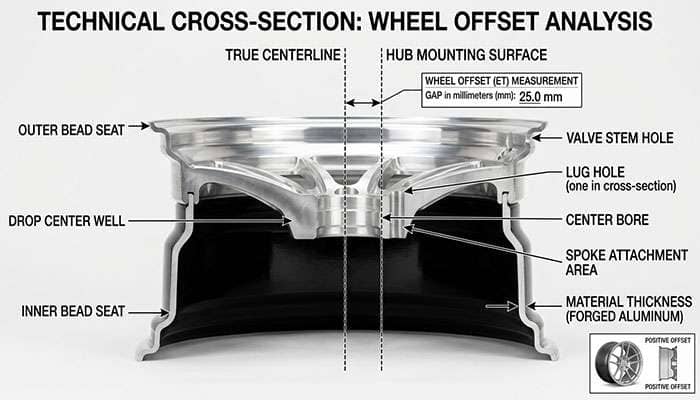
Here is the part most people miss: when you lower your offset number, the entire wheel and tire assembly moves outward by that exact amount, in a near one-to-one relationship. Drop from a factory +45 to a +30, and each wheel sits roughly 15mm farther out toward the fender than stock. Raise the number instead, say from +45 to +55, and the wheel tucks 10mm deeper into the well, toward the strut and brake caliper. Nothing about the wheel's diameter or your tire size has to change for this to happen. You are simply relocating the same assembly inward or outward across the wheel well.
That single fact is why offset matters so much for fitment. Both edges of the wheel are now in new territory. The outer lip is closer to the fender, and the inner barrel is closer to your suspension components. Push too far in either direction and one of those two edges runs out of room first.
Across most street vehicles, a practical safe window for offset change looks like this: 5mm or less is essentially invisible, 5 to 15mm is the enthusiast sweet spot where you get a noticeably better stance without major modifications, and anything past 15mm usually demands fender work, spacers, or alignment adjustments to stay rub-free. This is the same range professional fitment shops and wheel forums converge on after thousands of real installs.
The reason it is a range and not a fixed number is that every platform has different built-in slack. A truck with generous wheel wells might happily swallow a 25mm offset change, while a tightly packaged compact car starts rubbing at 10mm. The 5 to 15mm guideline is the band where you are statistically safe on the majority of vehicles, but it is a starting point for research, not a guarantee. Here is how those changes typically play out:
Offset Change From Stock |
What to Expect |
Typical Action Needed |
|---|---|---|
0 to 5mm |
No visible difference, no clearance concerns |
None; safe direct swap |
5 to 15mm |
Filled fender gap, mild stance change, slightly heavier steering |
Verify with a calculator and test fit |
15 to 25mm |
Aggressive look; rubbing at full lock or over bumps is likely |
Fender roll, smaller tire, or alignment tweaks |
25mm or more |
Noticeable handling change, contact with body or suspension |
Fender mods, suspension changes, or different wheel |
Treat this table as a map of the terrain, not a green light. A 12mm change that is perfectly fine on a full-size SUV can be too much on a lowered sedan with stretched tires. The variable that scrambles all of it is wheel width.
Most people change offset and width at the same time, and that is exactly where fitment math goes sideways. Offset and width are interdependent. A wider wheel adds material to both the inner and outer edges, so even if you keep the offset number identical, a wider wheel sticks out farther and tucks in deeper at the same time.
The clean way to think about it is outer position. The outer edge of your wheel moves out by your offset reduction plus roughly half of any width increase. Add an inch of width (about 25.4mm) and you have added roughly 12.7mm to each side before you even touch the offset number. So a wheel that is one inch wider with a 10mm lower offset has pushed its outer edge out by about 23mm, not 10mm. That is why a spec that reads conservative on paper can rub in the real world.
This is also why two wheels with the same offset can fit completely differently. To keep a wider wheel sitting where the factory wheel did, you generally need to raise the offset to compensate for the extra width. Our breakdown of how to match tire size to wheel width helps you keep the whole package balanced, since the tire's section width stacks on top of all of this. When you are comparing aftermarket options, run the numbers on the complete wheel and tire combination, not the offset spec in isolation.
Lowering your offset is the popular direction because it pushes the wheels out for that filled-fender, planted look. A flush-fit street setup like a Konig Aeris at +42, or an aggressive truck wheel like the Method 101 Beadlock at a deep -24, both chase this stance through a lower offset number. When you go too low, the outer edge of the tire is the first thing to find trouble.
The usual failure points, in the order you tend to hit them, are the inner fender liner at full steering lock, the fender lip itself when the suspension compresses over a bump or with a passenger load, and finally the outer edge of the fender during hard cornering. Front wheels rub sooner than rears on most cars because the front tires turn, sweeping through a much larger arc. You can have a setup that clears perfectly while parked and still rubs the moment you turn into a tight parking spot.
Pushing the track wider also changes how the car behaves. A wider stance can improve cornering grip, but going too far alters your scrub radius and makes the steering noticeably heavier and twitchier over uneven pavement. If you want to understand how offset feeds into your whole alignment picture, our guide to camber, caster, and toe explains how these angles interact. And before you commit, it is worth reading up on the problems that come with the wrong wheel offset so none of them catch you by surprise.
Everyone worries about wheels poking out too far. Far fewer people think about the opposite mistake, which can actually be more dangerous. Raising your offset too much, or fitting a wheel with too much positive offset, drives the inner barrel of the wheel straight toward your suspension and brakes.
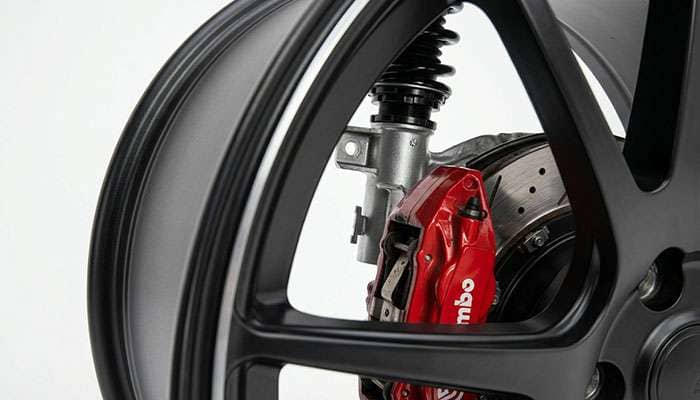
When that happens, the inner wheel barrel can contact the strut, the spring perch, a control arm, or the brake caliper. Unlike a fender rub, which is annoying and cosmetic, contact on the inside can chew into a brake line, gouge a strut, or bind the suspension as it travels. In a worst-case scenario it affects vehicle control. This is why simply grabbing a same-bolt-pattern wheel off another model is risky even within the same brand; the offset is often different, and too much positive offset is genuinely a safety issue, not just a fitment quirk.
There is also a tire-wear angle here. Running an offset far from factory loads your wheel bearings and suspension geometry in ways they were not designed for, which can accelerate uneven wear. We dig into that relationship in our look at how wheel offset affects tire wear. The takeaway is simple: respect the inner clearance just as much as the outer, because the consequences of getting it wrong are worse.
You do not have to guess. Here is the process that takes you from a rule of thumb to a confident decision for your specific vehicle.
Start with your factory spec. Find your exact stock wheel size and offset (it is often stamped on the back of the wheel or printed on a placard, and listed by trim on wheel-size reference sites). This is your baseline, the number every change is measured against.
Run the change through an offset calculator. Plug in your stock width and offset, then your prospective wheel's width and offset. A good calculator shows you the exact inner clearance change toward the suspension and the outer position change toward the fender, in millimeters. This is where the width math from earlier gets done for you automatically.
Check real-world fitments for your platform. Owner galleries, forums, and fitment groups show what people are actually running on your exact year and model, and crucially, what modifications they needed. A spec that is documented across dozens of clean installs is a far safer bet than one nobody has tried.
Test fit before you commit when you can. A physical mock-up with the wheel bolted on and the suspension cycled through its travel is still the most reliable confirmation. If the new wheels land a few millimeters shy of perfect, a thin spacer can fine-tune the outward position; our guide to the benefits of wheel spacers and adapters covers when that is a smart move. When you are ready to shop verified fitments across hundreds of brands, browse our selection of wheels or our custom wheels lineup, where staggered and aggressive offsets like the American Racing AR105 at +28 are filtered by what fits your vehicle.
How much can you change wheel offset from stock? Roughly 5 to 15mm is the safe enthusiast window on most vehicles, with 5mm or less being a no-brainer and anything past 15mm demanding real planning. But the number that actually matters is the one you calculate for your specific wheel width, tire size, and platform, because width can add more outward position than the offset change itself. Stay close to factory when in doubt, respect the inner clearance as much as the outer, and verify with a calculator and a test fit. Do that, and you get the stance you want without the rubbing, the bump steer, or the safety compromises. For the bigger picture on building an aggressive setup the right way, our guide to custom offset wheels ties it all together.
Yes, both visually and in feel. A 10mm lower offset moves each wheel about 10mm farther toward the fender, which visibly fills the gap and gives a more planted stance. It also slightly increases track width and steering effort. On most vehicles 10mm is well within the safe range, but on tightly packaged cars it can be enough to start rubbing at full steering lock.
For a more aggressive, flush look, you lower the offset to push the wheels outward. For a more conservative, factory-tucked appearance, you keep it at or slightly above stock. Lower offset risks fender rub, while higher offset risks contact with suspension and brake components. Neither direction is inherently better; it depends on your goal and how much clearance your specific vehicle has.
A matching bolt pattern only means the wheel will bolt on, not that it will fit safely. Offset and width still have to be within your vehicle's clearance limits. A same-bolt-pattern wheel from another model often has a meaningfully different offset, so always check the actual numbers and run them through a calculator before assuming it works.
Changing offset alters scrub radius and suspension geometry, which can affect steering feel and tire wear, so it is worth having an alignment checked after a significant change. Large offset deviations can also stress wheel bearings over time. For any warranty concerns tied to your specific vehicle, check with your manufacturer, since policies vary.



