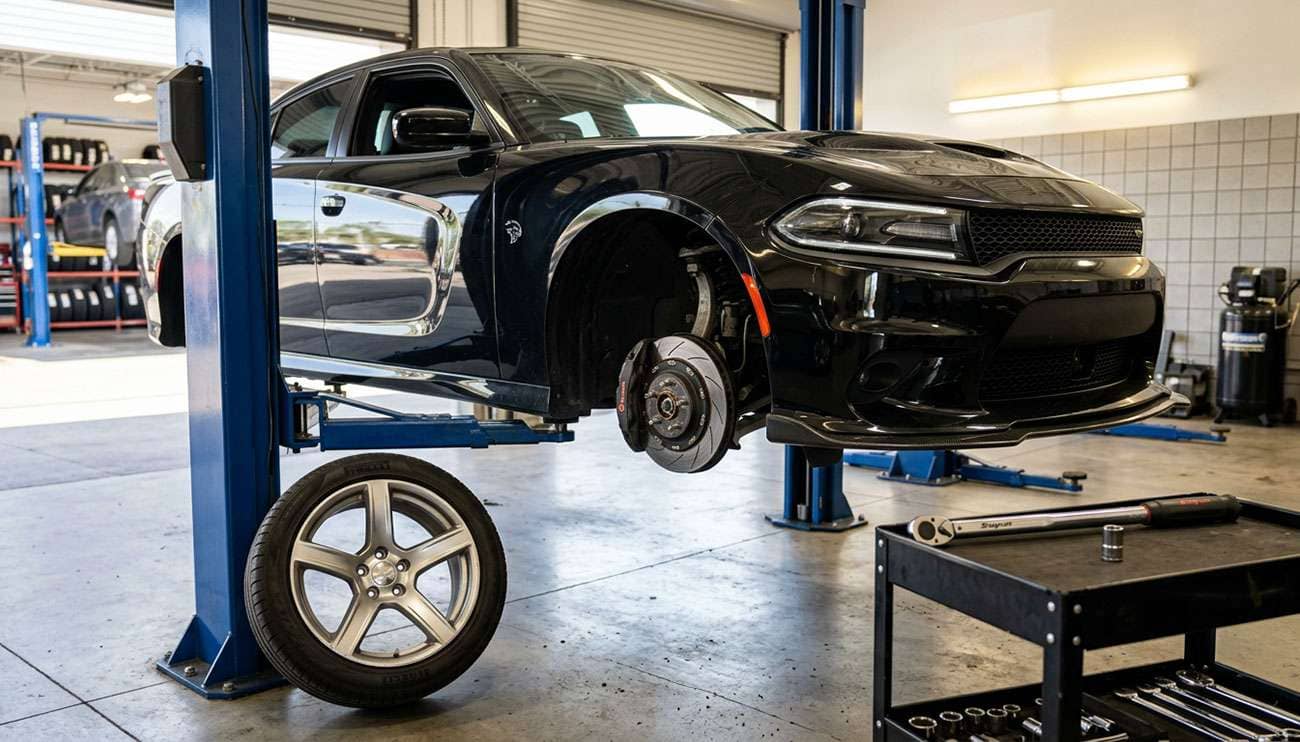
No, they don't. Every Charger built from 2006 through 2023 rides on a 5x115 bolt pattern. The 2024-and-up Charger Daytona sits on Stellantis' new STLA Large platform and moved to 5x127, which is the same 5x5-inch circle the Durango SRT and Jeep Trackhawk use. Most answers stop at that line. The part nobody puts in front of you is the other two numbers that changed: offset jumped from the low 20s to roughly +50 mm, and the car gained more than 1,000 pounds. Those two variables decide what you can actually bolt on, and they rule out the "just run adapters" shortcut before you ever get to the lug nuts.
I'm Dennis Feldman, and I spend most of my week on fitment data. This is one of those questions where "it depends" is technically true and completely useless. So here's exactly what it depends on, which old wheel you're holding, and what it takes to put the right one on the new car.
Wheel You Have |
Bolt Pattern |
Hub Bore |
Typical Offset |
Bolts On a Charger Daytona? |
|---|---|---|---|---|
2006-2023 Charger, Challenger, 300 (factory) |
5x115 |
71.5 mm |
+18 to +25 mm |
No. Wrong bolt circle, and offset is about 30 mm too low |
Aftermarket 5x115 muscle-car wheel |
5x115 |
71.5 to 74.1 mm |
+15 to +24 mm |
No. Same problem as the factory LX wheel |
1966-1978 classic Charger |
5x114.3 (5x4.5 in) |
Varies by wheel |
Near zero |
No. Wrong pattern, wrong offset, too small for the brakes |
Durango SRT, Grand Cherokee SRT, Trackhawk style |
5x127 |
71.5 mm |
About +50 mm |
Closest match. Verify width, load rating, and caliper clearance |
Generic 5x127 truck or Jeep wheel |
5x127 |
Usually 78.1 mm or larger |
0 mm or negative |
No. Pattern matches, but hub centering and offset don't |
The 2024-and-up Charger Daytona uses a 5x127 mm bolt pattern, also written 5x5 inches. The hub bore is 71.6 mm, and aftermarket wheels built for the car land in the +45 to +50 mm offset range. That combination is not a coincidence. It's the same hub geometry the Durango SRT and the Jeep Grand Cherokee SRT and Trackhawk have used for years, which tells you where Stellantis' engineers were pulling from when they sized the new car's corners.
If you want the full background on that circle and what else shares it, we cover it in our 5x5 bolt pattern guide. For this question, the thing to hold onto is this: the new Charger shares its bolt pattern with heavy, high-powered SUVs, not with the Charger that came before it.
Here's the trap. The old LX-platform Charger used a 71.5 mm hub bore. The new car is 71.6 mm. On a spec sheet, that looks like "same hub, different pattern," and a lot of owners assume the fix is a bolt-pattern adapter and nothing else. The hub is the one number that barely moved. The bolt circle, the offset, the curb weight, and the brake package all moved a lot. That's why the hub bore is the least useful number in this conversation.
The gas-powered Sixpack models ride on the same STLA Large platform as the Daytona EV, so the hub architecture is shared. What changes between trims is the brake package and the factory wheel diameter, which we break down in the trim section below. Always confirm against your specific trim before you order, because the brake package, not the powertrain, sets your minimum wheel size.
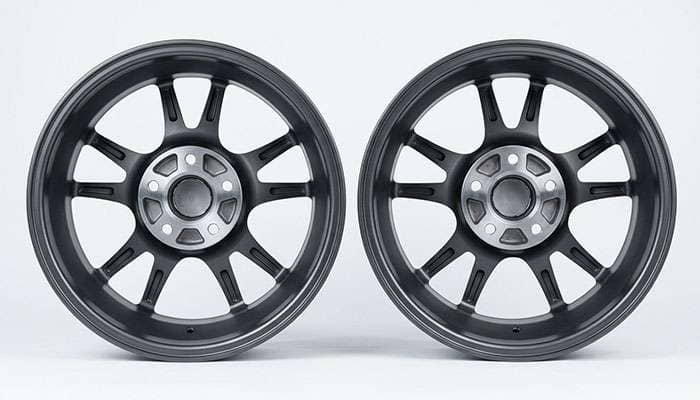
No. Every seventh-generation LX Charger, plus the Challenger, Chrysler 300, and Magnum that share its platform, uses 5x115. We cover that full family in the 5x115 bolt pattern guide. That includes the Hellcat, the Widebody, the Scat Pack, and the 2006-2009 cars that wore the Daytona badge as a trim package. The Daytona name carried over. The bolt pattern did not.
LX owners have been running 5x114.3 wheels on 5x115 hubs for years using offset-shank "wobble" bolts or floating-seat lug nuts. That works because the two circles differ by only 0.7 mm in diameter. The fastener's floating seat absorbs a fraction of a millimeter per stud.
The jump from 5x115 to 5x127 is 12 mm in diameter, or 6 mm of radial shift at every stud. No floating-seat fastener covers that. The studs on the new hub physically sit outside the holes drilled in the old wheel. There's no clamping trick that makes this safe.
Even if the bolt pattern matched, the offset wouldn't. Factory LX Charger wheels generally run between +18 and +25 mm. Across the aftermarket, the median 20-inch 5x115 wheel sits at +20 mm, and fewer than 1 in 100 run +45 mm or higher. The Charger Daytona wants roughly +50 mm.
That 25 to 30 mm difference means the old wheel's mounting face sits in the wrong place relative to the barrel. Every millimeter of lost offset pushes the wheel's centerline outboard by the same millimeter. A 30 mm gap moves the tire's centerline about 1.2 inches toward the fender on each side. Our guide to how much you can change offset covers the general limits, and 30 mm is well past the point where scrub radius, steering feel, and fender clearance start changing in ways you'll notice.
Same answer. Challenger wheels are LX-platform 5x115 wheels with the same hub, the same fasteners, and the same offset family as the old Charger. The only difference is that some Challenger Widebody wheels are wider, which makes the offset problem worse, not better. A wider wheel at the same low offset puts even more tire outboard of where the new car expects it.
Technically, a 5x127-to-5x115 bolt-pattern adapter exists. Practically, it makes the offset problem dramatically worse. This is the math most forum threads skip.
A bolt-pattern adapter is a thick, hub-centric plate. It bolts to the car's 5x127 studs and carries its own set of 5x115 studs. Because it has to hold two sets of fasteners without them colliding, these adapters generally start around 1 inch thick. Every millimeter of adapter thickness subtracts directly from effective offset.
Setup |
Wheel Offset |
Adapter Thickness |
Effective Offset |
Outboard Shift vs. +50 mm |
|---|---|---|---|---|
Correct Charger Daytona wheel |
+50 mm |
None |
+50 mm |
0 in |
LX wheel, no adapter (won't mount) |
+20 mm |
None |
+20 mm |
1.2 in |
LX wheel on 1-inch adapter |
+20 mm |
25.4 mm |
-5.4 mm |
2.2 in |
LX wheel on 1.25-inch adapter |
+20 mm |
31.75 mm |
-11.75 mm |
2.4 in |
On a 1-inch adapter, an LX wheel ends up more than 2 inches further out than the car was engineered for, per side. That's over 4 inches of added track width. On a car that already runs a 305-section tire from the factory, that tire is now well outside the fender line.
The wheel bearing is designed to carry the vehicle's load at a specific distance from its center. Push the tire's contact patch outboard and you lengthen the lever arm acting on that bearing. The load itself doesn't change, but the bending moment the bearing and hub have to resist goes up with every inch. On a 5,800-pound car that can launch hard enough to load the rear tires well past static weight, you're multiplying stress on a component that was sized for a very different geometry.
We cover the broader tradeoffs in do wheel spacers hurt your car. The short version for this case: a thin, quality hub-centric spacer to fine-tune a correct-pattern wheel is one conversation. A thick bolt-pattern adapter used to force a 30-mm-wrong wheel onto a 670-horsepower car is a different one entirely.
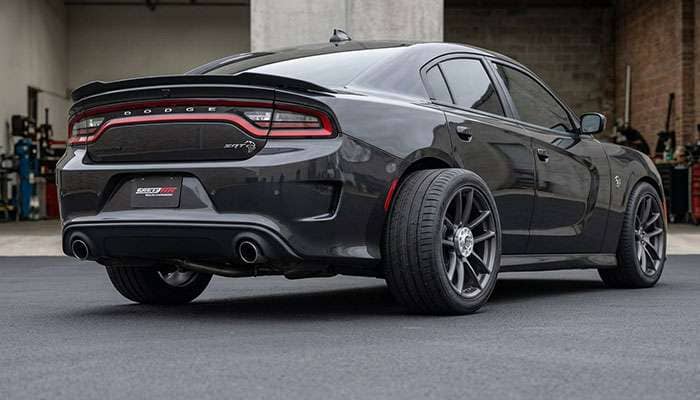
This is the variable almost nobody puts in a Charger fitment answer, and it's the one I'd put first. The 2006-2023 Charger weighed roughly 3,900 to 4,600 pounds depending on trim. The Charger Daytona Scat Pack weighs about 5,838 pounds. That's 1,200 to 1,900 pounds more pressing down on the same four corners.
Divide 5,838 by four and you get about 1,460 pounds per wheel at rest, before you account for weight distribution, a passenger, or dynamic load. Braking, cornering, and launch transfer weight to one end or one side, and the loaded wheel sees far more than its static share.
Here's where the old-wheel question stops being theoretical. Across 20-inch 5x115 wheels on the market, the median load rating is 1,800 pounds, and only about 1 in 7 is rated at 2,000 pounds or more. Those wheels were engineered for a car 1,000-plus pounds lighter. Across 20-inch 5x127 wheels, the median rating is 2,500 pounds, because that pattern lives mostly under trucks and SUVs.
SAE J2530 is the industry test standard aftermarket wheels are validated against, and it includes load-based fatigue testing sized to the wheel's rated capacity. A wheel that passed at 1,800 pounds passed at 1,800 pounds. It was never tested for what a heavier car puts through it. Our wheel load rating guide walks through how to calculate the minimum rating for any vehicle.
Open the driver's door and read the placard. You're looking for the Gross Axle Weight Rating (GAWR) for front and rear. Take the higher of the two, divide by two, and that's the minimum load rating each wheel should carry. That's the same logic FMVSS 110 applies to tire selection, and it's the right floor for wheels too.
Tires follow the same rule. A 305/35ZR20 in extra-load construction commonly carries a load index of 104, which is 1,984 pounds per tire. That's why the factory Scat Pack tire is XL. Don't downgrade to a standard-load tire in the same size to save money on a replacement set.
No, and not by a small margin. If "old Charger" means the classic B-body, including the 1969 Charger Daytona with the nose cone and the wing, those cars used a 5x4.5-inch (5x114.3 mm) bolt pattern with 1/2-20 studs. The factory wheels were 14 and 15 inches in diameter with near-zero offset by modern standards.
That wheel fails on the new car four different ways:
If you have a set of classic Rallyes or Magnums you love, the right home for them is a classic car. The look, however, transfers well. Reproduction-style designs in modern sizes and 5x127 fitments are the route there, and if you're building the other car in the garage, our classic Mopar wheels and tires builder's guide covers what those wheels actually need.
These are the closest bolt-on match, and the reason is the hub. Durango SRT, Grand Cherokee SRT, and Trackhawk-style wheels use 5x127 with a 71.5 mm bore, and the popular 20x10 sizes run around +50 mm offset. That lines up with what the new Charger wants. It's also the fitment that aftermarket wheel sellers have been listing for the car.
How rare is that combination? Across 20-inch 5x127 wheels, the median offset is 0 mm, and only about 1 in 100 run +45 mm or higher. Most 5x127 wheels are built for trucks and Jeeps with a 78.1 mm or larger hub bore. So "5x127" on a listing is not enough. You're specifically looking for the SUV-performance slice of that pattern.
Don't assume sensors carry over, whether you're moving them from an LX Charger wheel or an SUV wheel. FMVSS 138 requires a working tire pressure monitoring system, and the new car has to recognize the sensors. Confirm sensor compatibility for your model year before you pay to have tires mounted.
Once you're shopping the correct pattern, the trim and brake package set the rest. Here's what the factory runs and where the minimums come from.
Trim |
Factory Wheel |
Factory Tire |
Smallest Practical Diameter |
What to Shop |
|---|---|---|---|---|
Daytona R/T |
18x8.5 |
245/55R18 |
18 in |
5x127, 71.5-71.6 mm bore, high positive offset, 18-20 in |
Daytona Scat Pack |
20x11 |
305/35ZR20 |
20 in |
5x127, 20x10 to 20x11, +45 to +50 mm, high load rating |
Scat Pack with Track Package |
20x11 front, 20x11.5 rear |
305/35ZR20 front, 325/35ZR20 rear |
20 in (16-in Brembo rotors) |
Staggered 5x127 set, verified six-piston caliper clearance |
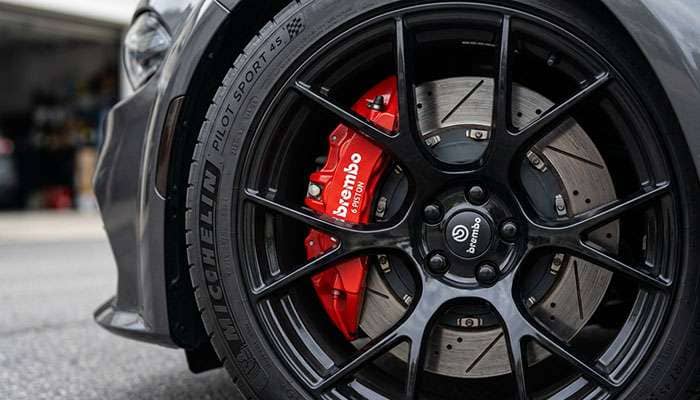
Not if it has the Track Package. The 16-inch Brembo rotors and six-piston front calipers don't leave room inside an 18-inch barrel. Some owners of non-Track Package Scat Packs ask about 19s or 18s for a drag setup. That only works if the specific wheel's inner barrel and spoke profile clear the caliper you actually have. Test-fit a bare wheel on the hub before tires go on. Don't guess.
The standard Scat Pack runs a square 305 setup. The Track Package is staggered at 305 front and 325 rear, the largest factory tires ever fitted to a Charger. A square setup lets you rotate front to rear. A staggered setup puts more rubber on the axle doing the heavy lifting. Match your replacement to what the car's stability and traction systems were calibrated on, unless you have a specific reason to change it.
Forcing an old wheel onto the new car doesn't fail all at once. It fails in stages, and each stage costs more than the last.
Here's the checklist I run before any wheel goes on a new Charger.
The fastest way to skip most of that list is to start from fitment data built for the car. You can shop wheels and tires filtered for your exact year and trim on our 2025 Dodge Charger Daytona fitment page, which narrows the field to the pattern, bore, and sizes that match the car.
Old Charger wheels don't fit the Charger Daytona, and it isn't close. The bolt pattern moved from 5x115 to 5x127. Offset moved from the low 20s to roughly +50 mm. The car gained well over 1,000 pounds, which pushes past what most wheels built for the old Charger were rated to carry. Adapters can bridge the bolt circle, but they move the wheel in exactly the wrong direction on offset and add a second joint to a heavy, high-torque car.
The good news is that the new Charger borrowed its hub from Stellantis' performance SUVs, so a real aftermarket already exists for it. Shop 5x127, a 71.5 to 71.6 mm bore, offset near +50 mm, and a load rating that matches the car's weight, and you'll get a wheel that fits the way the engineers intended.
The 2025 Dodge Charger Daytona uses a 5x127 mm (5x5-inch) bolt pattern with a 71.6 mm hub bore. That's a change from the 5x115 pattern every 2006-2023 Charger used, so LX-era wheels do not bolt on.
No. Challenger wheels are 5x115 LX-platform wheels with offsets in the +18 to +25 mm range. The 2025 Charger Daytona needs 5x127 and roughly +50 mm offset, so Challenger wheels miss on both bolt pattern and offset.
Trackhawk-style wheels are the closest bolt-on match because they share the 5x127 pattern, 71.5 mm hub bore, and roughly +50 mm offset. Before mounting, confirm the wheel width suits your tire, the load rating covers the car's weight, and the spokes clear your brake calipers.
Not with the Track Package. Its 16-inch Brembo rotors and six-piston front calipers require a 20-inch wheel. On other Scat Pack builds, a smaller wheel only works if that specific wheel physically clears the caliper, which you should confirm with a bare test-fit.
Adapters exist, but they typically start around 1 inch thick. On an LX wheel with +20 mm offset, that produces an effective offset near -5 mm, which puts the wheel more than 2 inches further out than the car was designed for and adds a second clamped joint to a heavy, high-torque car.
No. The new wheels are 5x127 and won't bolt to a 5x115 hub. Even with an adapter, a +50 mm offset wheel sits much further inboard than an LX Charger was designed for, which creates suspension and brake clearance problems on the older car.