
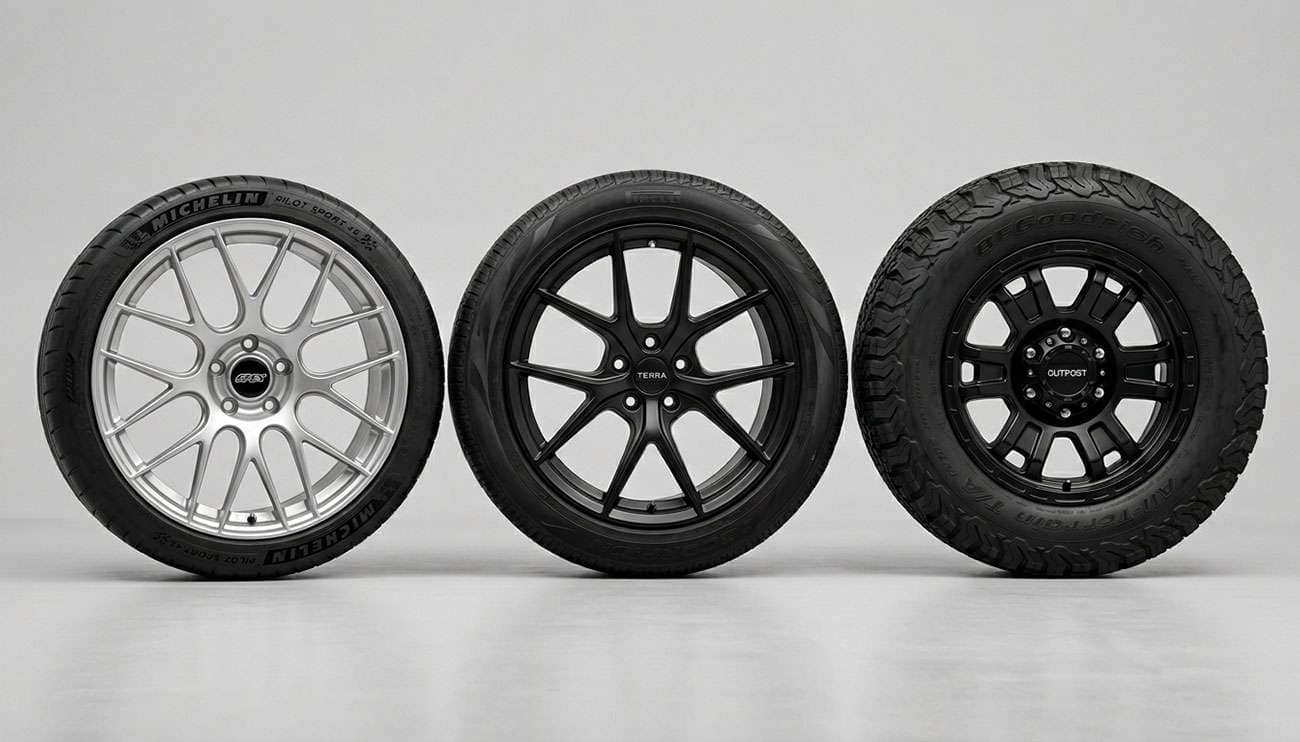
I get this question every week. Somebody picks up a great deal on a set of wheels — usually online, usually because they liked the look — and they want to know if those Mustang wheels will fit their F-150, or if they can throw their Tahoe wheels on their Camry to save money. The short answer is almost always no, and the reason isn't just the bolt pattern. There are four variables that have to line up, and getting any one of them wrong turns a wheel from a piece of safety equipment into a liability.
Cars, trucks, and SUVs each get wheels engineered for completely different jobs. A car wheel is optimized for weight reduction and handling response. A truck wheel is built to carry payload and absorb impacts the car wheel would crack on. SUV wheels split the difference depending on whether the SUV is built like a car or built like a truck. Once you understand what each category is actually designed to do, the fitment rules stop feeling arbitrary and start making sense.
Four things have to match for a wheel to fit your vehicle safely: bolt pattern, centerbore, offset, and load rating. Bolt pattern gets all the attention because it's the most obvious — you can count the lugs and measure the circle. But the other three matter just as much, and they're where most fitment mistakes happen.
Bolt pattern is the count of lugs and the diameter of the imaginary circle they form, written like 5x114.3 (five lugs on a 114.3mm circle). Centerbore is the size of the hole in the middle of the wheel that fits over the hub — too big and the wheel rides on the lug bolts instead of the hub, which causes vibration and eventually shears bolts. Offset is the distance from the wheel's mounting face to its centerline, measured in millimeters, and it controls how far in or out the wheel sits in the fender. Load rating is the maximum static weight each wheel can support, and it's the spec most people ignore until they shouldn't have. For a deeper look at how all the parts fit together, see our breakdown of the parts of a wheel.
Each vehicle category gets these four specs tuned for what it's expected to do. That tuning is the whole reason you can't grab the cheapest set with the right number of lugs and call it good.
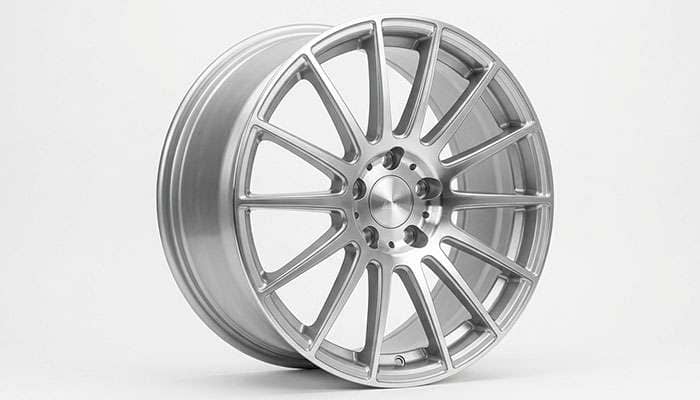
Passenger car wheels are designed around one core priority: keep unsprung weight as low as possible. Every pound you cut from a wheel is a pound the suspension doesn't have to fight with on every bump and corner. That's why most modern car wheels run 18 to 25 pounds bare, why aluminum alloy is the default material, and why the spoke designs tend to be thin and elaborate rather than thick and chunky.
The fitment numbers reflect that. Most cars use 4-lug or 5-lug bolt patterns with relatively small bolt circles — 4x100 on compacts like the Civic, 5x100 on Subarus and some VWs, 5x114.3 on a huge swath of Hondas, Mazdas, and Fords, and 5x120 on most BMWs. Diameters typically run 15 to 20 inches, with 17 and 18 being the sweet spot for most modern sedans and coupes. Load ratings sit between roughly 1,400 and 2,200 pounds per wheel, which covers everything from a Miata to a fully-loaded Charger.
What you don't get on a car wheel is reinforced construction for impact loads. The bead seat is typically thinner. The spoke roots aren't beefed up the way they are on truck wheels. That's all by design — the car isn't expected to haul 1,200 pounds of gravel or land off a curb at speed. For a deeper dive into picking car-specific wheels, see our guide on choosing custom car wheels.
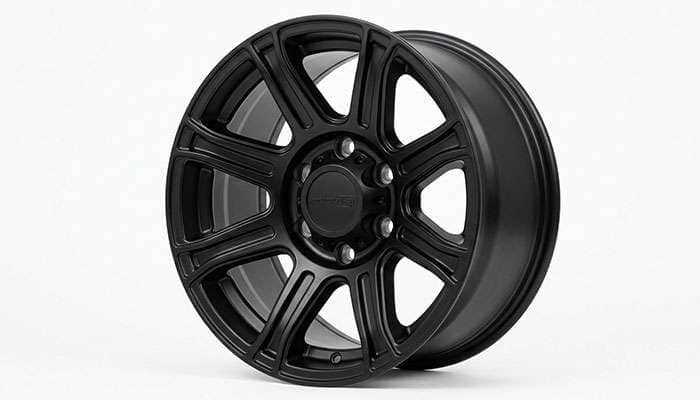
Truck wheels are a different animal. They're engineered to carry payload, tow trailers, hit potholes that would crack a car wheel, and survive the kind of curb strikes a sedan never sees. That mission shows up in every spec.
Bolt patterns get bigger and beefier. Half-ton trucks like the F-150 and Silverado 1500 use 6-lug patterns — 6x135 on Fords, 6x139.7 (also written as 6x5.5) on Chevy, GMC, and Toyota. Three-quarter and one-ton heavy-duty trucks step up to 8-lug patterns like 8x165.1 (8x6.5) on older Chevy HDs and 8x170 on Ford Super Duty. The lug count goes up because the load each lug has to carry goes up — more lugs spread the force more places. Older half-tons used 5-lug patterns like 5x139.7 and 5x150, which still show up on some platforms today.
Load ratings on truck wheels start around 2,500 pounds per wheel for half-tons and climb to 3,640 to 4,500 pounds on heavy-duty applications. Construction is reinforced at every stress point — thicker bead areas, beefier spoke roots, deeper drop centers. Diameters range from 16 to 24 inches in the aftermarket, with 17 and 18 being the most common for both factory and aftermarket on capable trucks. The wheels themselves typically weigh 30 to 45 pounds bare, which is 50% to 100% more than a comparable car wheel.
For dual-rear-wheel applications, you're in a whole different category — see our dually wheels buying guide for the specifics. For half and three-quarter ton applications, the custom truck wheels guide covers what to look for.
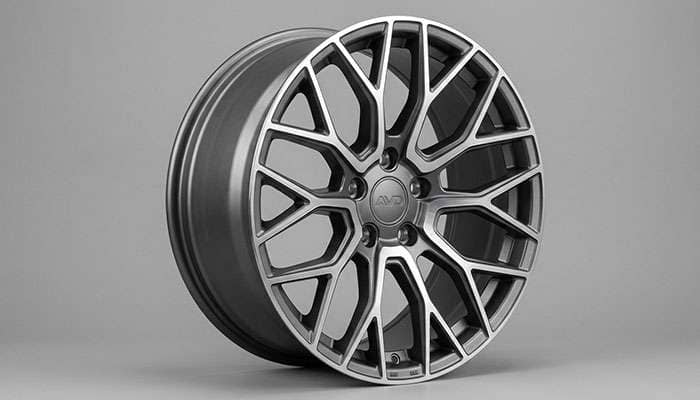
SUV wheels are where most of the confusion lives, because "SUV" covers two completely different vehicle types that share the name and almost nothing else. Body-on-frame SUVs — Tahoe, Suburban, 4Runner, Sequoia, Wrangler, full-size Bronco — are basically trucks with enclosed beds. They use truck wheels: 6-lug bolt patterns, 2,500-plus pound load ratings, reinforced construction. A wheel that fits a Silverado will often fit a Tahoe because they share the same 6x139.7 platform underneath.
Unibody crossovers — RAV4, CR-V, Highlander, Pilot, Explorer, Murano — are passenger cars with extra ground clearance and AWD. They use car-grade wheels with slightly elevated load ratings to handle the extra weight. You'll see 5-lug patterns like 5x114.3 dominating this segment, the same pattern that fits everything from a Civic to an Accord. Load ratings typically run 1,800 to 2,400 pounds per wheel — higher than a sedan but well below a real truck.
The trap people fall into is treating "SUV wheel" like a single category. A wheel marketed as "fits SUVs" might fit a CR-V perfectly and be totally wrong for a Suburban, or vice versa. The bolt pattern is your first sort: if your SUV uses 5x114.3, you're shopping car-grade wheels with the right load rating. If it uses 6x135 or 6x139.7, you're shopping truck wheels. Our complete SUV wheels guide walks through this in more detail.
Here's how the three categories compare across the specs that actually drive fitment:
Spec |
Car |
Truck |
SUV |
|---|---|---|---|
Typical load rating per wheel |
1,400–2,200 lbs |
2,500–4,500 lbs |
1,800–4,500 lbs (split by platform) |
Common bolt patterns |
4x100, 5x100, 5x114.3, 5x120 |
5x139.7, 6x135, 6x139.7, 8x165.1, 8x170 |
5x114.3 (crossovers); 6x135, 6x139.7 (body-on-frame) |
Diameter range |
15–20 inches |
16–24 inches |
17–22 inches |
Typical bare weight |
18–25 lbs |
30–45 lbs |
22–40 lbs (split by platform) |
Construction priority |
Weight reduction, handling response |
Load capacity, impact resistance |
Mixed — depends on platform |
Common material |
Cast or flow-formed aluminum |
Cast aluminum, steel, forged for HD |
Cast aluminum across the board |
Centerbore mounting |
Often lug-centric (uses hub rings) |
Almost always hub-centric |
Hub-centric on body-on-frame; mixed on crossovers |
Aftermarket price per wheel (cast) |
$120–$350 |
$180–$500 |
$150–$450 |
I've watched customers learn this lesson the expensive way. Somebody sees a set of nice 5x114.3 truck wheels online, notices their Mustang also uses 5x114.3, and figures the deal is too good to pass up. Then they try to mount them and the wheel sits a half-inch too far out because the offset is wrong. Or it mounts but vibrates because the centerbore is bigger than the Mustang's hub. Or — worst case — it mounts and drives fine, until the wheel cracks on a normal pothole because the construction was tuned for a 4,000-pound truck and now it's bouncing around under a 3,500-pound car at car speeds.
Going the other direction is even riskier. Putting passenger car wheels on a truck means the load rating probably isn't high enough to support the truck's weight, especially loaded. A wheel rated for 1,800 pounds on a truck that loads each corner to 2,200 pounds is a structural failure waiting to happen. The wheel may not fail today, may not fail next month, but it will fail — usually under a load that exceeds the design spec, like a heavy hitch tongue weight or a hard cornering moment with passengers and cargo. That's a wheel that comes apart at speed, and it's not worth saving a few hundred dollars on the front end.
The four-variable rule applies every time. Bolt pattern matching gets you in the door. Centerbore, offset, and load rating decide whether the wheel is actually safe on your vehicle. Skip any of those checks and you're guessing.
That said, some wheels genuinely fit across categories — and the most common case is 5x114.3. That bolt pattern shows up on a huge range of vehicles: Honda Accords, Toyota Camrys, most Ford Mustangs since 1994, RAV4s, CR-Vs, Highlanders, older Tacomas, and others. A wheel built for that pattern can physically mount on any of those vehicles, but you still have to verify the other three specs match.
Among trucks, the 6x139.7 (6x5.5) pattern is everywhere — Silverado 1500, Sierra 1500, Tacoma, Tundra, 4Runner, GMC Yukon, Chevy Tahoe, Suburban. A wheel built for a Silverado will physically bolt to a 4Runner, and because they share roughly similar load ratings and centerbores, the cross-fitment is often genuine. This is why brands like Method, Fuel, and KMC sell the same wheel in 6x139.7 to truck and body-on-frame SUV buyers.
The 5x114.3 pattern is also where car-and-SUV crossover happens — same wheel design might be offered in the same bolt pattern with different load ratings depending on the target vehicle. Always check the load rating on the specific wheel, not just the bolt pattern. If you're confused about your bolt pattern, our complete bolt pattern guide walks through how to measure and identify yours.
Here's a detail most buyers don't think about until something goes wrong. A hub-centric wheel has a centerbore machined to match the vehicle's hub diameter exactly, so the hub itself centers the wheel. A lug-centric wheel has a larger centerbore and relies on the lug bolts to center the wheel during installation. Most factory wheels are hub-centric. Most aftermarket truck wheels are hub-centric or come with hub-centric rings.
Many aftermarket car wheels — especially budget-oriented ones — are lug-centric, designed to fit a wide range of vehicles by leaving the centerbore oversized. They work fine if you install them carefully with the lugs torqued evenly. Skip steps and they vibrate, sometimes badly enough to feel like a bent wheel even when it's straight. Truck wheels almost always need to be hub-centric because the loads are higher and the consequences of any centering error get worse fast. If you're buying aftermarket truck wheels, confirm hub-centric fitment for your specific hub size or buy hub-centric rings.
For a closer look at the truck-specific wheel categories, see our breakdown on the different types of truck wheels.
Cars, trucks, and SUVs each get wheels tuned for the job they actually do. Car wheels prioritize light weight and handling. Truck wheels prioritize load capacity and durability. SUV wheels split the difference based on whether the SUV is built like a car or like a truck — that's the part that confuses most buyers. Match all four fitment specs (bolt pattern, centerbore, offset, load rating) to your specific vehicle, not just one or two of them, and you'll avoid the kind of mistake that turns a wheel deal into a safety problem.
Physically, sometimes — if the bolt pattern matches (5x114.3 is shared between many cars and trucks). Practically, usually not. Truck wheels are heavier, which hurts car ride quality and acceleration. Offset and centerbore are typically wrong for car suspension geometry. Even when the wheel fits, the increased rotational mass changes how the car drives. There are better-targeted options at any price point.
No, and this is the dangerous direction. Car wheels are typically rated for 1,400 to 2,200 pounds per wheel. A half-ton truck loads each wheel to roughly 2,000 to 2,400 pounds empty, and significantly more with passengers and cargo. The load rating is below what the truck demands. Wheel failure under load is the kind of accident you don't want to be in.
Sometimes yes, sometimes no — depends on the SUV. Unibody crossovers like the RAV4 and CR-V use car-platform wheels with bumped load ratings. Body-on-frame SUVs like the Tahoe, 4Runner, and Sequoia use truck wheels because they sit on truck platforms. Identify whether your SUV is unibody or body-on-frame first; that determines which category of wheels actually fits.
Take your vehicle's GVWR (gross vehicle weight rating) — listed on the door jamb sticker — and divide by four. That's the minimum load rating per wheel. Most experienced shops add a 10 to 15 percent safety margin on top of that, so a vehicle with a 7,200-pound GVWR works out to 1,800 pounds per wheel divided, plus margin, equals a 2,000-plus pound minimum wheel rating.
Yes, often. The seat shape (conical vs. spherical vs. mag-style flat washer) and the thread pitch can both differ between vehicle classes. Aftermarket wheels frequently require different lug nuts than the factory ones, even when the bolt pattern is identical. Always confirm lug seat compatibility with the wheel manufacturer or your installer before mounting. Wrong lug seats cause loose wheels, and loose wheels come off.
More lugs spread the load across more contact points, so each lug carries a smaller share of the total clamping force. That matters when the loads get high — half-ton trucks at 6,500 to 7,000 pounds GVWR and three-quarter or one-ton trucks pushing 10,000 pounds-plus need that distribution. Five-lug patterns work fine on lighter trucks and SUVs, but the heavy-duty world is firmly 8-lug for a reason.



