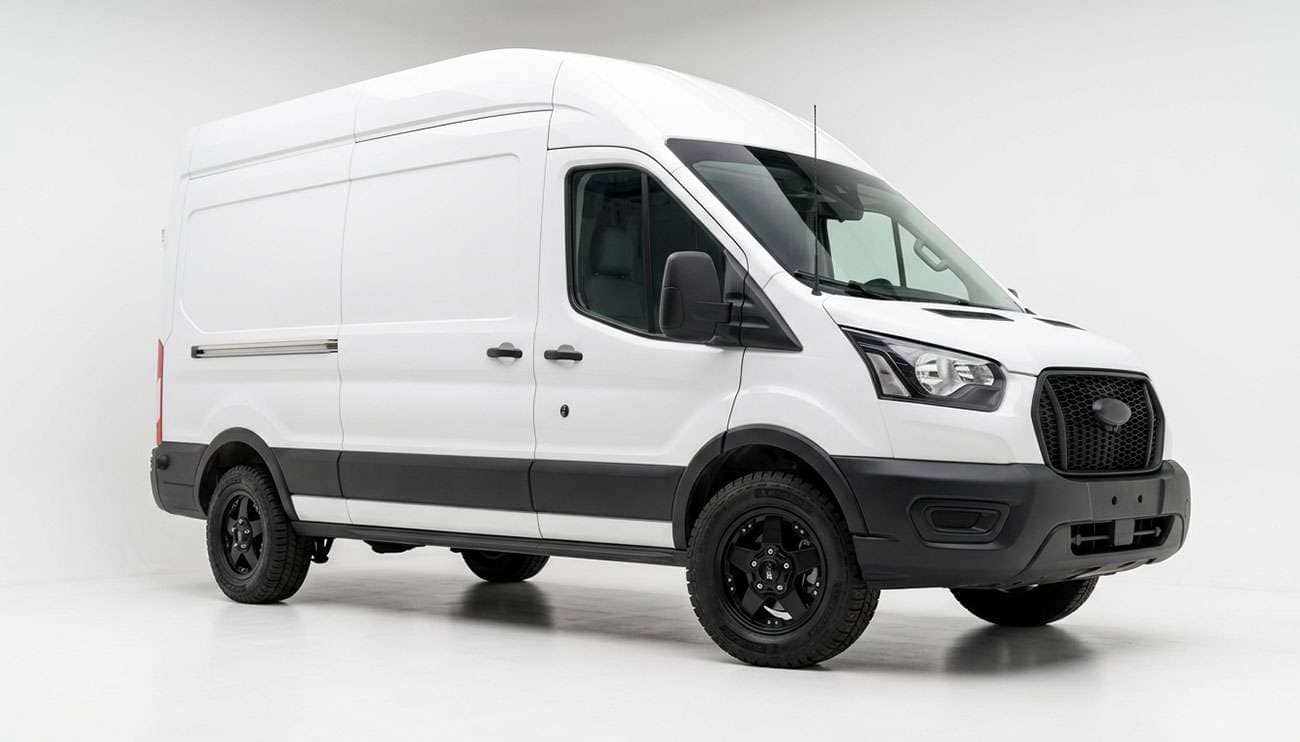
In the US, 5x160 belongs to one van family: the rear-wheel-drive, single-rear-wheel Ford Transit 150, 250, and 350 from 2015 on, plus the E-Transit. The detail most lists skip is the drivetrain. Order that same Transit with AWD or dual rear wheels and it moves to 6x180 on a 138.8 mm hub, and no 5x160 wheel will go on. So count your lugs first. Then check hub bore, lug seat, and load rating, because the right pattern still leaves room for the wrong wheel.
5x160 means five studs on a 160 mm circle. Ford brought it to the US with the full-size Transit for 2015, and no other vehicle sold new for US roads uses it. The table sorts the Ford van lineup by the one question that decides fitment: how many studs sit on your hub?
Van |
Years |
Bolt Pattern |
Hub Bore |
Factory Wheel |
|---|---|---|---|---|
Transit 150, 250, 350 (RWD, single rear wheel) |
2015-present |
5x160 |
65.1 mm |
16x6.5, +60 offset |
E-Transit (RWD) |
2022-present |
5x160 |
65.1 mm |
16x6.5, +60 offset |
Transit 150, 250, 350 (AWD) |
2020-present |
6x180 |
138.8 mm |
16x6.5, offset of +90 or higher |
Transit 350 HD (dual rear wheel) |
2015-present |
6x180 |
138.8 mm |
16-inch dually set, 5.5 to 6 inches wide |
Transit Connect |
2010-2023 |
5x10⁸ |
63.4 mm |
A smaller van on a different platform |
The badge won't settle this. A T-350 can be a 5-lug RWD van or a 6-lug AWD van, and the door badge reads the same on both. The 350 HD is the other trap. Its name sits one step from the T-350, but its hub is a different part entirely. Go by the studs, not the model name.
The Transit's pattern didn't carry over from the Econoline either. Late-model E-150 vans ran 5x135, and E-250 and E-350 vans ran 8x170. The rival vans don't share it: the Ram ProMaster sits on 5x130, and the Mercedes Sprinter sits on 5x130 or 6x130 depending on configuration. If you run a mixed fleet, your wheels won't cross over between makes.
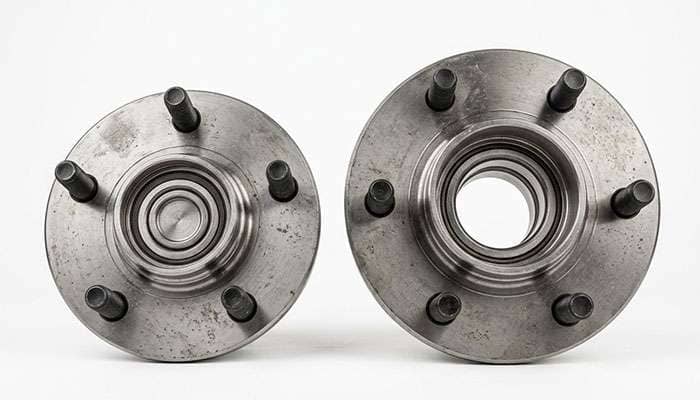
Ford added AWD to the Transit for 2020, and the AWD vans did not inherit the 5-lug hub. They use the same 6x180 layout as the 350 HD dually, with the same 138.8 mm center bore. Ford doesn't explain that choice in print, but its spec sheet points at the reason.
The 2020 Transit weight tables list a 4,130-pound front gross axle weight rating (GAWR) on RWD vans and 4,630 pounds on AWD vans. That's 500 more pounds on the front axle, and an AWD front hub also carries drive torque that a RWD front hub never sees. A larger hub with six studs on a wider circle fits that job.
The dually needs the same hub for a different reason: load. Rear GAWR climbs to 6,835 pounds on the 9,950-pound GVWR van and 7,275 pounds on the 10,360-pound and 11,000-pound packages. Dually wheels also run extreme offsets, around +110 up front and -130 out back, so nothing about that wheel resembles a 5x160 part. Our guide to dually bolt patterns covers how those front and rear sets differ.
Here is what that split means when you shop. A 5x160 wheel cannot mount on a 6x180 hub. The stud count is wrong, the circle is wrong, and the 65.1 mm bore is 73.7 mm too small for the hub behind it. No ring, adapter, or drill bit turns one into the other. The 6-lug aftermarket is also a much shorter list, mostly 16-inch wheels built for this exact van, so AWD owners should start from the hub spec instead of a style they saw on a RWD build.
160 mm converts to 6.299 inches, so some listings write the same pattern as 5x6.3. There is only one 5x160 pattern. The two labels describe the same 160 mm circle.
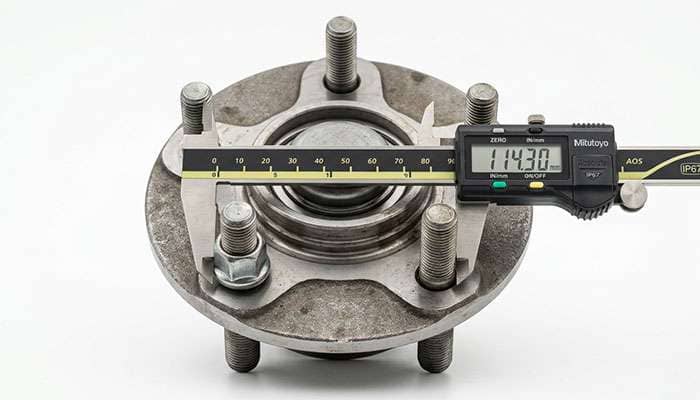
Measuring it takes a little care, because no stud on a 5-lug hub sits directly across from another. You can't lay a tape across the middle and read 160. Use one of these instead:
Use calipers, not a tape. The neighboring pattern is close: a 5x150 hub reads 88 mm stud to stud, and a 5x165.1 hub reads 97 mm. Three millimeters is the whole gap between 5x160 and 5x165.1, and that's easy to miss with a tape held against a rusty hub. On a 6-lug hub the job is simpler, because opposite studs line up. Center to center straight across a 6x180 hub reads 180 mm.
These are the numbers to keep on hand before you order for a RWD Transit. Each one can stop a wheel that matches on bolt pattern.
Specification |
5x160 Transit Value |
Why It Matters |
|---|---|---|
Bolt pattern |
5x160 mm (5x6.3 inches) |
Does not interchange with 5x150, 5x165.1, or 6x180 |
Hub bore |
65.1 mm |
Centers the wheel on the hub so the studs only have to clamp it |
Lug thread |
M14 x 1.5 |
Any replacement nut has to match thread and seat |
Lug torque |
148 lb-ft (200 Nm) in the 2015 owner's manual |
Confirm your year's manual, then retighten within 100 miles |
Factory wheel |
16x6.5, +60 offset |
The baseline for all offset math |
Factory tire |
235/65R16C 121/119R |
Load index 121 carries about 3,195 pounds per tire |
The hub bore is 65.1 mm on every RWD Transit and E-Transit. Nearly every wheel built for this van matches that number, which makes this the easiest check on the list. It still deserves a look, because the failure runs in two directions.
A bore under 65.1 mm will not seat on the hub, so the wheel never reaches the mounting face. A bore over 65.1 mm will bolt up, but now the wheel hangs on its lug nuts with nothing centering it. On a sedan that might mean a faint shake. On a van carrying close to 3,000 pounds at a rear corner, the same gap can show up as highway vibration and put side load on studs that were meant to clamp.
If a listing shows a larger bore on a 5x160 wheel, confirm that number with the wheel maker before you order. If it holds up, plan on a hub-centric ring sized 65.1 mm on the inside. Our breakdown of hub-centric vs. lug-centric wheels explains what the ring does and what it can't do.
The thread stays M14 x 1.5. The seat is where things change. The factory Transit nut is a flat-washer-style nut sold for factory wheels. Many aftermarket van wheels want a cone seat nut instead, and a thick mounting pad can call for a longer nut to reach enough thread. Some van wheels reuse the factory nut and others do not, so read the install sheet for the exact wheel you're buying.
The mechanism here is simple. A nut holds a wheel by clamping it, and clamp load depends on full contact at the seat. Put a flat nut in a cone seat and contact shrinks to a thin ring. That ring wears, clamp load drops, and the nuts work loose. Ford's own manual warns that poor metal-to-metal contact at the mounting surfaces can let wheel nuts loosen. We walk through the failure in our guide to lug nut seat type mismatches.
One detail catches van owners after the install. The standard Transit spare is a full-size tire on a factory wheel. If you switch to cone seat nuts on the road wheels, that spare still needs factory nuts. Keep a set of five in the van.
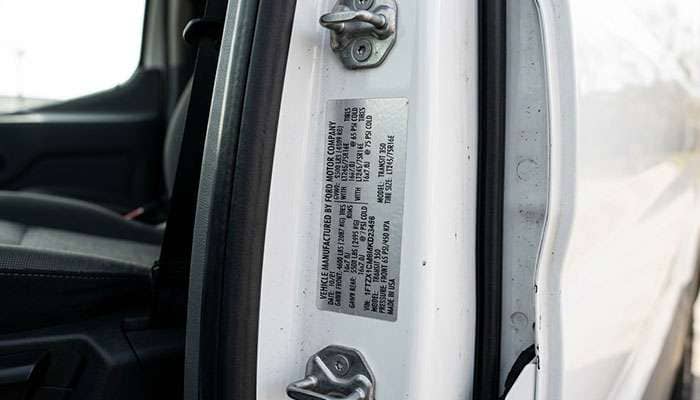
Here's the number most bolt pattern lists leave out. Every wheel carries a maximum load, and a Transit asks more of a wheel than most half-ton pickups do. Take the rear GAWR from your door label and divide by two. That result is the floor for every wheel on the van, since wheels rotate front to rear.
RWD Transit |
GVWR |
Rear GAWR |
Minimum Per Wheel |
Ratings That Fall Short |
|---|---|---|---|---|
T-150 |
8,670 lbs |
5,070 lbs |
2,535 lbs |
2,500 lbs |
T-250 |
9,070 lbs |
5,515 lbs |
2,758 lbs |
2,500 and 2,700 lbs |
T-350 |
9,500 lbs |
5,750 lbs |
2,875 lbs |
2,500, 2,700, and 2,800 lbs |
Those figures come from Ford's 2020 Transit weight tables. Ratings shift by model year and package, so the label on your door wins. Treat an E-Transit, with its 9,500-pound GVWR, like a T-350 until you've read its label.
Aftermarket 5x160 wheels run from about 2,500 to 3,860 pounds per wheel, and most land near 3,300. That spread is the trap. A 2,500-pound wheel fits the hub and sits 35 pounds under even a T-150's rear axle. A 2,800-pound wheel clears a T-250 and misses a T-350 by 75 pounds. Neither wheel gives you any warning when you bolt it on.
Treat those minimums as a floor, not a target. Dividing by two assumes an even split, and a camper build with the water tank and battery bank on one side doesn't have one. A good target is the factory tire itself: at load index 121, it carries about 3,195 pounds, so a wheel rated 3,300 pounds or higher won't be the weak link. The Vision 355 Overland sits at the top of the range at 3,860 pounds, which suits a heavy build.
Federal rules won't catch a mistake here. FMVSS 110 covers the tires and rims a vehicle leaves the factory on, for vehicles of 10,000 pounds GVWR or less, and that includes every 5x160 Transit. Once you change wheels, matching that capacity is on you. Ask for a maker's published rating, and favor wheels tested to SAE J2530, the aftermarket wheel standard. Our wheel load rating guide covers how to read those numbers. The tire side follows the same math, and our piece on LT tires on cargo vans covers what changes when you leave the factory C-type tire.
The factory wheel is a 16x6.5 at +60. Aftermarket 5x160 wheels cluster at +45 to +50, and a few run as low as +35. Every one of them sits farther out than stock. The question is how much, and the math is short: half the wheel width minus the offset gives you the outer lip position.
Wheel |
Offset |
Outer Lip vs. Stock |
Inner Lip vs. Stock |
|---|---|---|---|
16x6.5 |
+45 |
0.6 inch farther out |
0.6 inch away from the suspension |
17x7.5 |
+50 |
0.9 inch farther out |
0.1 inch closer to the suspension |
16x8 |
+38 |
1.6 inches farther out |
0.1 inch away from the suspension |
The third row shows why offset matters on a van. That 16x8 moves its centerline 22 mm outboard of stock, which lengthens the lever acting on the hub bearing every time the van hits a bump or leans into a turn. Add a loaded rear axle and you've raised bearing load on the exact parts the factory sized around +60. You also push the tire toward the fender lip, where a full-width van has little room to spare.
For a loaded work van or a camper, +45 is a sensible floor. Lower offsets can work on a light build, but they're a trade you should make on purpose. Our guide to how much you can change offset shows how to run that calculation for your own setup.
No. Close patterns are the ones that tempt people, and they're the ones that do damage. A 5x165.1 wheel, the pattern on older Land Rovers, has a circle only 5.1 mm larger than 5x160. That puts each stud about 2.5 mm off its hole. The nuts might start, but they can't seat square, and the wheel ends up clamped under side load. A 5x150 wheel, the pattern on the 2007-2021 Tundra, misses by twice that.
Don't let anyone slot or redrill the lug holes to close the gap. That removes material from the highest-stress part of the wheel, and it leaves the seats out of round.
Adapters and spacers are a separate question. You can buy 5x160 spacers with a 65.1 mm bore and M14 x 1.5 hardware, and bolt-on adapters exist for some patterns. Both add a joint and push the wheel outboard, which runs into the same bearing math as a low offset wheel. With 2,875 pounds allowed at each rear corner of a T-350, we'd buy a wheel built for the van instead.
The pattern travels farther overseas. Ford uses it on the Transit Custom, Tourneo Custom, and Tourneo, and on export versions of the Transit going back decades. Global fitment listings also show some commercial models from Force, Mahindra, Tata, Foton, and JMC, along with the Kia Bongo, on this circle.
None of those were sold new for US roads, so most American buyers will never run into one. If you've imported a van or truck, measure the hub yourself and confirm the bore. Those vehicles share a stud circle with the Transit, and that's all you can assume about them.
The name to watch closer to home is the Transit Connect. Same badge, smaller van, and a 5x10⁸ pattern on a 63.4 mm hub. Nothing on a 5x160 page fits it.
The mistakes here get more expensive as they get harder to see. They run in this order:
Every step on that ladder ends the same way: you buy a second set of wheels. On a van that earns money, the downtime often hurts more than the parts. Getting the first set right costs you ten minutes with a door label and a pair of calipers.
5x160 is a Ford Transit pattern, but it's only half the Transit lineup. RWD single-rear-wheel vans and the E-Transit run it. AWD vans and 350 HD duallies don't. Once you've confirmed five studs on your hub, the job shifts to a 65.1 mm bore, the right lug seat, a sensible offset, and a load rating that clears your rear axle with room to spare.
When you know your numbers, browse our full selection of 5x160 bolt pattern wheels. If you'd like a second set of eyes, call us at 888-926-2689 with your year, drivetrain, and door label ratings, and we'll check the wheel against your van before it ships.
In the US, the 5x160 bolt pattern fits the 2015-and-newer rear-wheel-drive, single-rear-wheel Ford Transit 150, 250, and 350, plus the E-Transit. Overseas, it also appears on the Ford Transit Custom, Tourneo, and some commercial models from other makers. AWD Transits and Transit 350 HD duallies use 6x180 instead.
5x160 converts to 5x6.3 inches, since 160 mm equals 6.299 inches. Both labels describe the same pattern: five studs on a 160 mm circle.
No. RWD single-rear-wheel Transits and the E-Transit use 5x160. AWD Transits from 2020 on and Transit 350 HD dual-rear-wheel vans use 6x180 with a 138.8 mm hub. The Transit Connect uses 5x10⁸. Count the studs on your hub to confirm which one you have.
The hub bore on a 5x160 Ford Transit is 65.1 mm, and nearly every wheel built for this van matches it. A wheel with a larger bore needs a hub-centric ring. A wheel with a smaller bore won't seat on the hub.
No. RWD Transit wheels are 5x160 with a 65.1 mm bore, and AWD Transit hubs are 6x180 with a 138.8 mm bore. Neither the bolt pattern nor the hub bore matches, so the wheels will not swap in either direction.
Divide the rear GAWR on your door label by two for the minimum rating per wheel. Using Ford's 2020 figures, that comes to 2,535 pounds on a T-150, 2,758 pounds on a T-250, and 2,875 pounds on a T-350. For a loaded van or camper build, aim for 3,300 pounds or more.