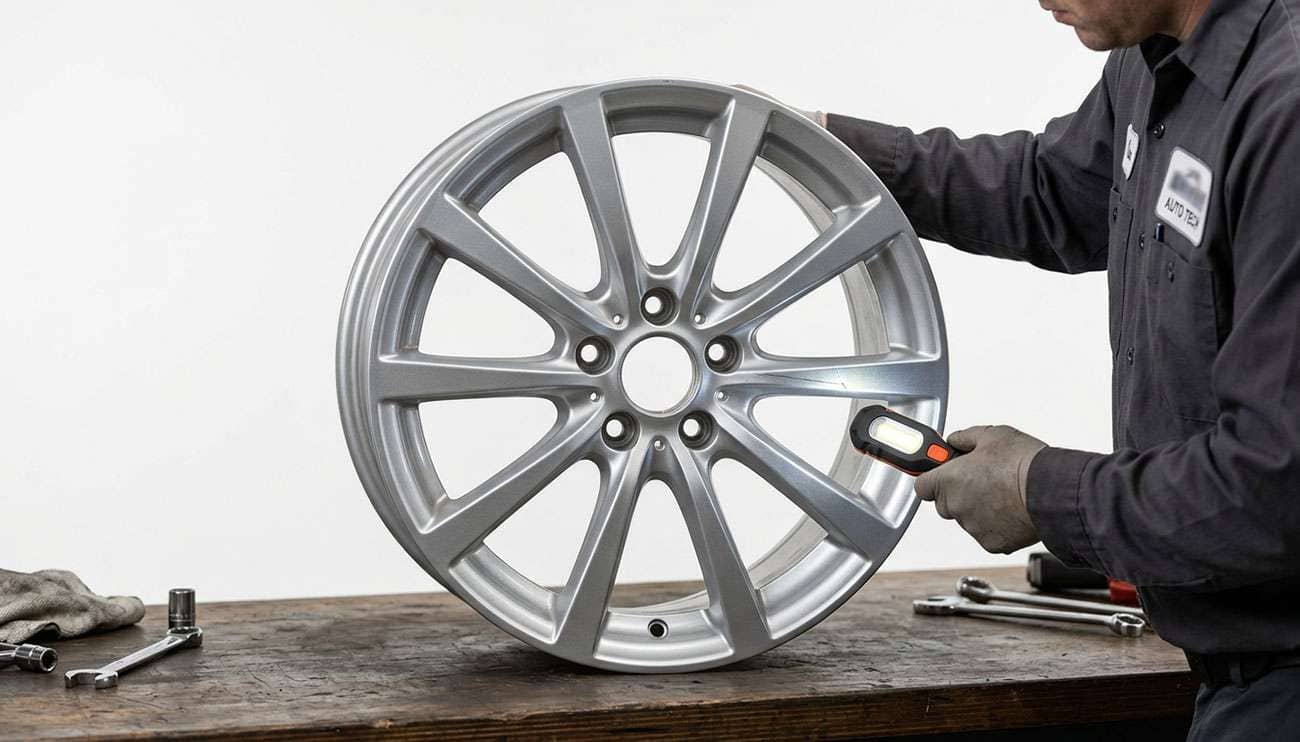
Almost every article you will find on this subject gives you the same answer: do not drive on a cracked rim, call a professional. That is not wrong, exactly. It is just useless, because it does not tell you the one thing you actually need to know, which is whether the wheel sitting in your garage is a two hundred dollar repair, a six hundred dollar replacement, or a wheel you should not roll another mile on.
Here is what nobody tells you. A wheel is not one part. It is six or seven distinct structural regions, and each one carries a completely different share of the load. A two inch crack in one region is a routine repair that shops perform every week. A half inch crack in another region means the wheel is finished and you should not drive the car to the shop, you should have it towed. Same metal, same crack, opposite verdict.
The variable is location. Not length, not width, not how scary it looks. Below is the map, zone by zone, with the reasoning behind each call so you can make the decision yourself instead of taking a repair shop's word for it.
Find the crack on your wheel, locate that zone in the left column, and read across. "Limp" means low speed, smooth pavement, direct route to a shop, and nothing else. "Tow it" means exactly that.
Crack Zone |
Can You Drive? |
Weldable? |
Why |
|---|---|---|---|
Outer lip and rim flange |
Limp only |
Often yes |
Impact zone, moderate stress, but it holds the bead and will leak |
Outer barrel |
Limp only |
Usually yes |
Moderate stress region, isolated cracks respond well to repair |
Inner barrel |
Limp only |
Best candidate |
Lowest bending stress on the wheel, most common successful repair |
Bead seat |
No |
No |
Sealing and retention surface, welding distorts it and the bead can unseat |
Spoke or spoke root |
Tow it |
Never |
Highest cyclic bending stress on the entire wheel, this is a fatigue crack |
Hub face or mounting pad |
Tow it |
Never |
Clamp load surface, this is what actually holds the wheel on the car |
Lug seat or bolt hole |
Tow it |
Never |
Torque retention is already compromised, failure mode is wheel separation |
Multiple or branching cracks, anywhere |
Tow it |
Never |
Branching means the material itself is fatigued, not just damaged |
If you cannot confidently identify which zone the crack is in, treat it as the worst case and do not drive the vehicle. That is not caution for its own sake. Cracks that look like they are in the barrel frequently turn out to originate at a spoke root once the tire comes off and the wheel gets cleaned.
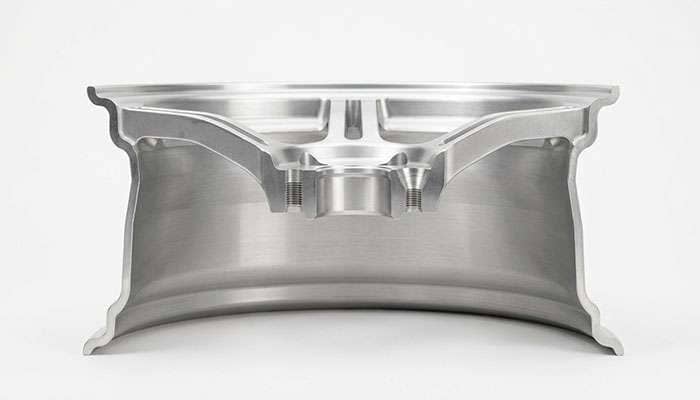
Aftermarket wheels sold in the United States are validated against a recommended practice developed by SEMA and its Wheel and Tire Council together with SAE International. That document, SAE J2530, covers performance requirements and test procedures for aftermarket wheels used on passenger cars, light trucks and multipurpose vehicles. Its original equipment counterpart is SAE J328. Both certify a wheel through three separate physical tests: radial fatigue, cornering fatigue, and impact.
Those three tests exist because a wheel does not see one load. It sees three, and they travel through different parts of the casting.
The radial fatigue test loads the wheel through its centerline and works the metal in the rim flanges, the section that retains the tire. The cornering fatigue test bends the wheel the way a hard corner does, and that load runs from the hub through the center disc, out through the spokes, and into the barrel. The impact test simulates a pothole or curb strike. With every single revolution, the material under the tire footprint compresses and then relaxes as the load point passes.
Now overlay a crack onto that. If the crack sits in the inner barrel, it sits in a region that sees mostly membrane stress and very little bending. If the crack sits at a spoke root, it sits directly in the cornering fatigue path, in the highest cyclic bending stress concentration on the whole part. The crack is the same crack. The load it is being asked to survive is not remotely the same.
This is also why "it is only a small crack" is exactly the wrong instinct. Fatigue cracks grow a microscopic amount per load cycle, and the growth rate accelerates as the crack gets longer, because a longer crack concentrates more stress at its tip. Small does not mean stable. Small means early.
Put a number on the cycles. A typical 27 inch tall tire rotates around 810 times per minute at 65 mph. That is roughly 48,000 load cycles per hour of highway driving. When people ask how long they can drive on a cracked wheel, they are thinking in miles. The metal is counting cycles, and it counts them fast.
The outer lip is the visible outermost edge of the wheel, the rim that curb rash lands on. The flange is the raised wall immediately inboard of it that the tire bead presses against.
This zone takes the most direct abuse of any part of the wheel. Potholes, curbs, parking blocks and road debris all land here first. Most cracks in this region start as deep curb damage that was ground down or filled cosmetically without anyone checking whether metal had actually separated underneath. If this wheel has had curb rash repaired before, look here first and look carefully.
The verdict is genuinely conditional. A single, short, non branching crack confined to the lip and not running inboard into the bead seat is one of the more routine repairs a qualified wheel shop performs. The metal here carries radial load but comparatively little bending, and there is enough material thickness at the flange to support a proper weld preparation.
What disqualifies it: the crack runs inboard toward or across the bead seat, there is more than one crack, the crack branches, or the lip is also bent. A lip crack combined with a bend is a different problem entirely, and you should read our breakdown of whether a bent rim is safe to drive alongside this one, because straightening and welding the same area stacks two heat and stress events on the same metal.
Driving: short distance, low speed, direct to a shop. This crack will leak air, and the rate is unpredictable.
The outer barrel is the cylindrical section between the outer flange and the drop center, on the show side of the wheel. It is under the tire, so you will not see a crack here without pulling the tire or looking through the spokes with a light.
Stress in this region is moderate. It carries the radial load path but is not in the primary bending path from the hub. Isolated cracks here, particularly ones caused by a single identifiable impact, generally respond well to repair, assuming the wheel passes the rest of the inspection.
One thing to watch for specifically on cast wheels: a crack that runs along a casting seam or that follows a change in wall thickness. That pattern suggests porosity in the casting rather than pure impact damage, and porous metal welds badly. The weld looks fine on the surface and has poor fusion underneath.
Driving: same as Zone 1. Short, slow, straight to the shop. Expect air loss.
The inner barrel is the back half, between the drop center and the inner flange. It is completely hidden behind the wheel when the car is on the ground, which is why inner barrel cracks are so often diagnosed as something else for weeks or months.
This is the best case scenario. Bending stress here is the lowest anywhere on the wheel, the section is usually a simple curved wall without stress risers, and there is no sealing surface or fastener interface to distort. When a wheel shop tells you a crack is a good repair candidate, this is almost always where it is.
The reason so many drivers end up here is that inner barrel cracks are a classic pothole signature. The tire compresses, the rim flange contacts the pavement edge, and the shock travels into the inner barrel where the wall is thinnest. The car drives fine. The only symptom is a tire that needs air more often than it used to.
If you have been topping off one tire every week or two and nobody has found a puncture, pull that wheel. Our guide on how long you can drive on a slow tire leak covers the diagnostic sequence, and a hairline inner barrel crack is one of the causes that gets missed most often, because the tech checks the tread and the valve stem and never looks at the back of the wheel.
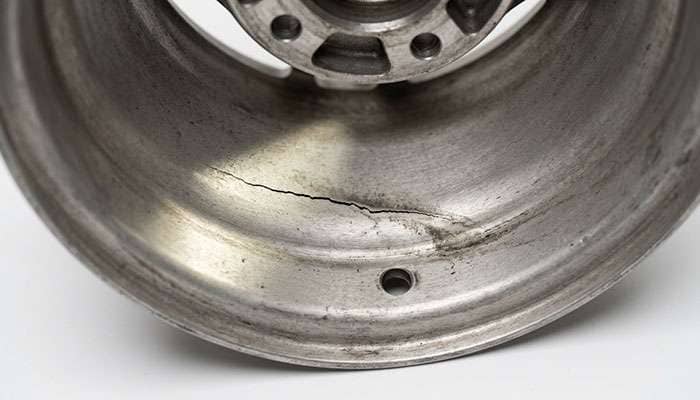
The bead seat is the machined surface, just inboard of the flange, that the tire bead sits against and seals to. Its diameter and surface finish are held to tight tolerances for a reason.
This zone is a hard no, and the reason is not strength. It is geometry. Welding puts localized heat into the part, and localized heat in a thin machined section causes distortion. Even a small amount of distortion at the bead seat means the tire either will not seal or, far worse, seals well enough to hold air at rest and then unseats under lateral load in a corner.
A bead unseating at speed is a sudden and total loss of air pressure, not a slow leak. The failure sequence and the handling consequences are similar to what happens with serious tire sidewall damage, and the vehicle response is the same: an immediate pull toward the failed corner and a sharp drop in steering authority.
Some shops will weld a bead seat and then re machine the surface true. In principle that is a legitimate approach. In practice it requires a lathe setup, a technician who knows the original specification, and a willingness to reject the wheel if the finished dimension is out. Ask directly whether the seat will be re machined after welding and how the diameter will be verified. If there is no clear answer, replace the wheel.
Driving: no. Not to the shop, not around the block.
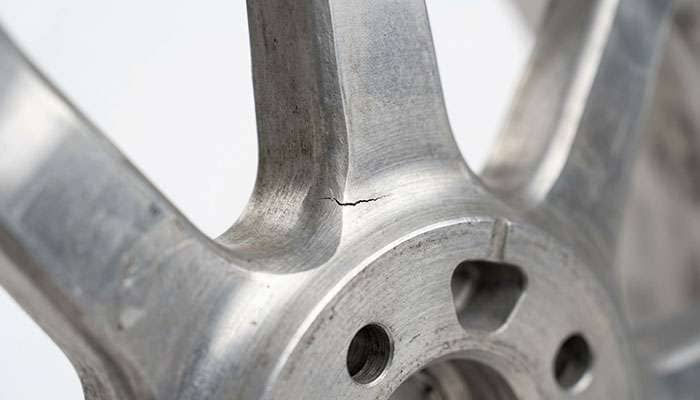
The spoke root is where a spoke transitions into the center disc or meets the barrel. It is the single highest stress location on a wheel and it is where the cornering fatigue load concentrates.
Understand what a crack here actually means. Spoke roots do not crack from a single impact very often, because the geometry is thick and well supported. They crack from accumulated cycles. By the time a crack is visible at a spoke root, that wheel has already run enough load cycles for a fatigue crack to nucleate and propagate to a visible length. The remaining life is not a fresh clock. It is whatever is left of a clock that has already run down most of the way, and the rate is accelerating.
Welding does not help. It makes it worse in a specific and predictable way. Cast wheels are typically A356 aluminum in a T6 heat treated condition, and forged wheels are commonly 6061 in T6. That T6 designation is the whole point, it is a solution heat treatment plus artificial aging that gives the alloy its strength. Welding re melts the metal locally and anneals the ring of material around the weld, called the heat affected zone. Unless the wheel is fully re heat treated afterward, and essentially nobody does that because it distorts the part, the metal immediately adjacent to a "successful" weld is now softer and has lower fatigue strength than the parent metal it replaced. In the highest stress location on the wheel, that is precisely the wrong trade. Our breakdown of wheel aluminum alloys and heat treatment goes deeper on why the temper matters more than the alloy number.
Driving: do not. Have the car towed or, at minimum, install the spare and take the cracked wheel off the vehicle entirely.
The hub face is the flat annular surface on the back of the center disc that clamps against the vehicle hub. It is unglamorous, it is invisible once installed, and it is the most important surface on the wheel.
Here is the part most drivers have backwards. Lug nuts and studs do not hold a wheel on by shear strength. They generate clamp load, and clamp load creates friction between the hub face and the hub. That friction is what transmits drive and braking torque and what keeps the wheel located. The fasteners are a clamping mechanism, not a set of pins.
A crack or any distortion at the hub face means clamp load is no longer distributed the way the design intended. Localized clamp load means localized fretting, fretting means the joint works loose, and a loose joint means the fasteners begin taking load in shear that they were never sized for. That is the mechanism behind most wheel separation events, and it is the same failure logic that governs any compromised wheel fastening joint.
There is no repair. Welding a hub face guarantees distortion of the exact surface that must be flat, and there is no way to verify the finished result short of re machining, which removes material from a surface that has a specified thickness.
Driving: no. Tow it.
Cracks radiating outward from a bolt hole, or cracking in the conical or radiused lug seat itself, are the clearest stop signal on this entire list.
The causes are usually identifiable and usually preventable. Over torquing with an impact gun. The wrong lug nut seat type against the wheel, a conical nut in a radius seat or the reverse, which concentrates load on a knife edge instead of distributing it across the full seat area. Running with fasteners under torque so the joint moves and frets. Corrosion between dissimilar metals in the seat.
Whatever the cause, once the seat is cracked, that fastener location can no longer generate or hold reliable clamp load. You are down a fastener in the way that matters, and the load it was carrying redistributes to the remaining ones, which accelerates the same failure at the next seat.
No repair exists that restores a certified lug seat. Replace the wheel, and while you are at it, verify that your lug nut seat type actually matches the wheel and that the torque specification is being followed with a torque wrench rather than an impact gun.
Zone tells you most of the story. Construction tells you the rest, and it also determines what replacement actually costs you. Our comparison of cast, forged and flow formed wheels covers the manufacturing side in full, but here is what matters specifically for crack repair.
Construction |
Typical Alloy |
Crack Repair Outlook |
Replacement Note |
|---|---|---|---|
1-piece cast |
A356-T6 |
Most repairable in barrel zones, watch for casting porosity |
Lowest replacement cost, often cheaper than a quality repair |
Flow formed |
A356-T6 with spun barrel |
Barrel is thinner and work hardened, less material to weld into |
Mid range cost, strong value per pound |
1-piece forged |
6061-T6 |
Weldable metallurgically, but T6 temper is lost in the heat affected zone |
Highest cost, strongest argument for professional assessment first |
2-piece and 3-piece |
Forged center, forged or spun barrel halves |
Usually not welded, because you do not need to |
Replace the damaged section only, keep the center |
Steel |
Stamped and welded steel |
Ductile and weldable, but cracks signal fatigue or corrosion |
Replacement cost is low enough that repair rarely makes sense |
That multi piece row deserves emphasis, because almost nobody mentions it. On a two piece or three piece wheel, the outer lip, the barrel halves and the center section are separate components bolted together and sealed. If you crack an outer lip on a three piece wheel, you are not looking at a welded repair or a full wheel replacement. You order a replacement outer section from the manufacturer and have the wheel rebuilt and resealed around your existing center. These sections are built to order rather than stocked, so lead time is real, but the cost delta versus a complete forged wheel is substantial.
Flow formed construction deserves a caution in the other direction. The spinning process that forms the barrel makes it thinner and stronger than a cast barrel of the same weight, which is the entire point. It also means there is less material for a welder to work with, and the grain structure that gives the barrel its strength is exactly what the heat input disrupts.
The escalation from a cracked wheel is not a single event. It is a ladder, and each rung costs more than the one before it.
Rung one, air loss. A cracked barrel or flange leaks. The rate varies with crack length and with temperature, which is why the leak often seems to appear and disappear. Your TPMS light comes on, you add air, the light goes off, and you conclude it was nothing.
Rung two, tire damage. A tire running chronically underinflated builds heat in the sidewall and wears the shoulders. By the time the wheel gets diagnosed, the tire has often accumulated internal damage that is not visible from outside. That is a tire you replace, not a tire you remount.
Rung three, vibration and driveline wear. As the crack opens, the wheel loses roundness and balance stability. It will not stay balanced, because the geometry is changing. If you have chased a vibration through two balance jobs and it keeps returning, that is diagnostic. Our guide on whether steering wheel vibration is coming from your tires or your wheels covers how to separate the two, and "will not hold a balance" points hard at the wheel.
Rung four, bead unseat. The crack reaches or undermines the bead seat and the tire loses its seal under cornering load. This is sudden, not gradual.
Rung five, section separation. The crack propagates through the flange or across a spoke and a piece of the wheel departs. At this point you are dealing with an uncontrolled vehicle at whatever speed you happened to be traveling.
Most people never get past rung two, because the leak forces the issue. But rungs four and five are what the spoke and hub face zones skip straight to, without passing through the polite warning stages first. That is the entire reason those zones are on the tow list.
If your crack is in a repairable zone, you still need to know what a real repair looks like, because the gap between a proper wheel repair and a cosmetic fill is enormous and both cost money.
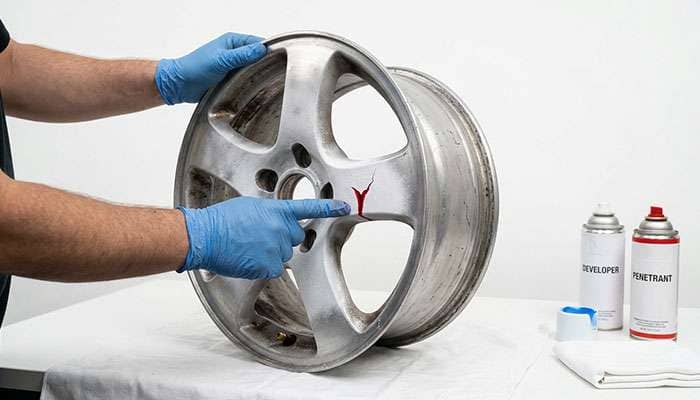
A legitimate process runs roughly like this. The tire comes off. Coatings are stripped from the repair area so the technician can see bare metal. The full extent of the crack is established with dye penetrant inspection, which reveals the portions that do not show to the naked eye, and cracks are almost always longer than they look. A V groove is prepared along the crack to allow full penetration. The weld is made with TIG using a filler compatible with the base alloy, in controlled passes with the heat input managed deliberately. The weld is dressed back to the original profile. The area is re inspected with dye penetrant, and any indication means rework or rejection. The wheel is pressure tested for leaks, checked for run out, balanced, and refinished.
Note what is not on that list: brazing, epoxy, cold stitching, and cosmetic filler. If a shop proposes any of those on a structural crack, walk.
There is one more thing to be clear eyed about. No federal standard governs the repair of a road wheel. SAE J2530 and J328 test new wheels as manufactured. Federal Motor Vehicle Safety Standards address the vehicle as built. A wheel that has been welded is, strictly speaking, no longer a certified part, because the certification applied to a specific piece of metal in a specific condition and the weld changed that condition. This is why many track day and club racing tech inspections reject welded wheels outright regardless of who performed the work.
None of that means a good repair is unsafe. It means the responsibility for the outcome shifted from a manufacturer's test program to the individual technician's skill. Weigh that accordingly, especially against the cost. Our breakdown of whether it is cheaper to repair or replace a rim runs the actual numbers, and for a lot of cast wheels the honest answer is that a proper repair costs enough that a new wheel is the better purchase.
Before you call anyone, get real information. This takes about twenty minutes per wheel.
Step one. Get the wheel off the car and, if you can, get the tire off the wheel. Roughly half of all wheel cracks are behind the tire where you physically cannot see them mounted. If dismounting is not an option, at least get the wheel off the vehicle and inspect the back side.
Step two. Clean it properly. Degreaser, brush, dry it completely. Brake dust and road film hide hairline cracks, and a wet wheel hides them even better.
Step three. Bright directional light and a magnifier. Work systematically through the zones in the order listed in this article rather than wandering. A crack presents as a fine dark line that does not follow a casting seam or a machining mark, and it often has a faint dirt or soap streak trailing from it where air has been escaping.
Step four. Soapy water. Inflate the mounted tire to placard pressure and brush soapy water over the suspect area, inside and out. Bubbles find leaks that eyes miss.
Step five. Mark both ends of the crack with a paint pen and write the date. If you have to move the vehicle, re inspect afterward. A crack that grew measurably in a short distance tells you everything about how much life is left.
Step six. Get dye penetrant inspection before authorizing any weld. Every crack is longer than it appears, and the decision about which zone it occupies depends on where it actually ends, not where you can see it ending.
If the verdict came back as replacement, here are current in stock options across the construction types discussed above. Prices are per wheel.
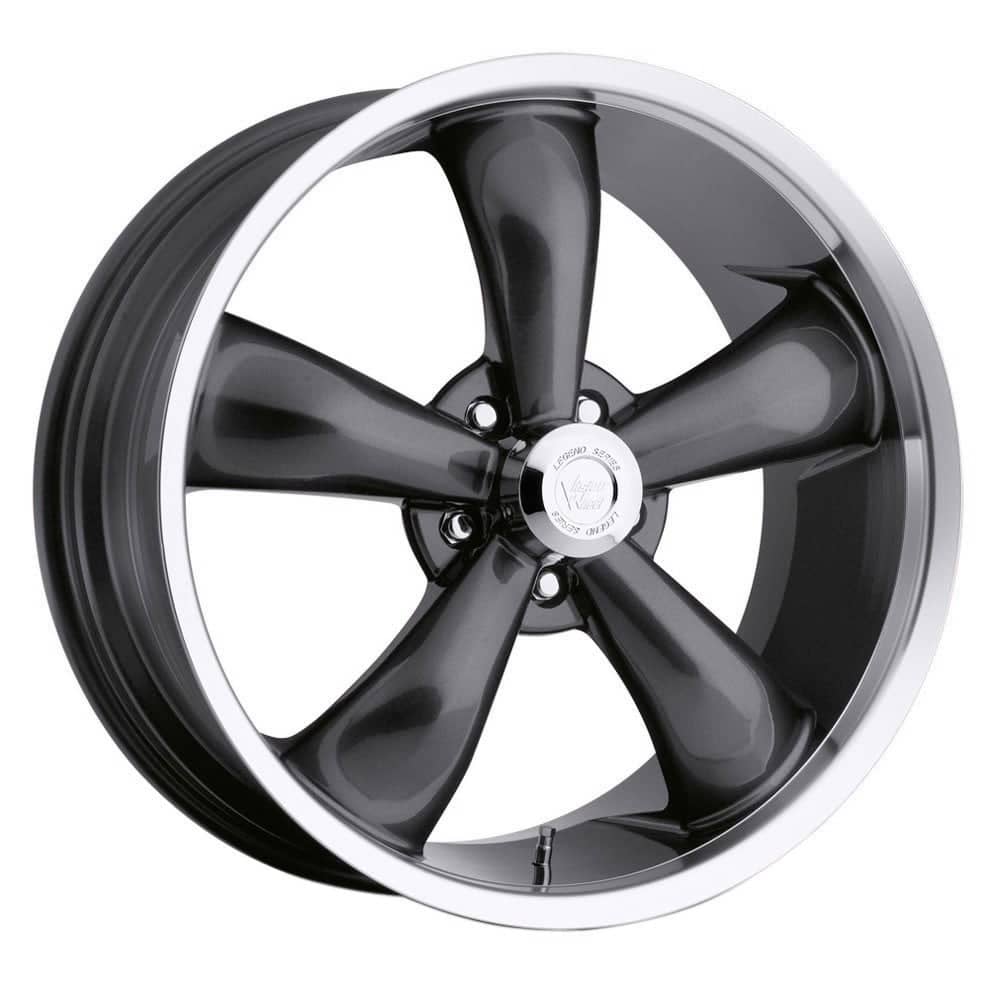
Vision 142 Legend 5, 18x8.5, 5x114.3, Gunmetal Machined Lip, around 238 dollars. A one piece cast wheel and the clearest example of why repair economics often fail. A thorough weld repair with inspection and refinishing can approach this number on its own. Broad fitment coverage in the 5x114.3 bolt pattern.
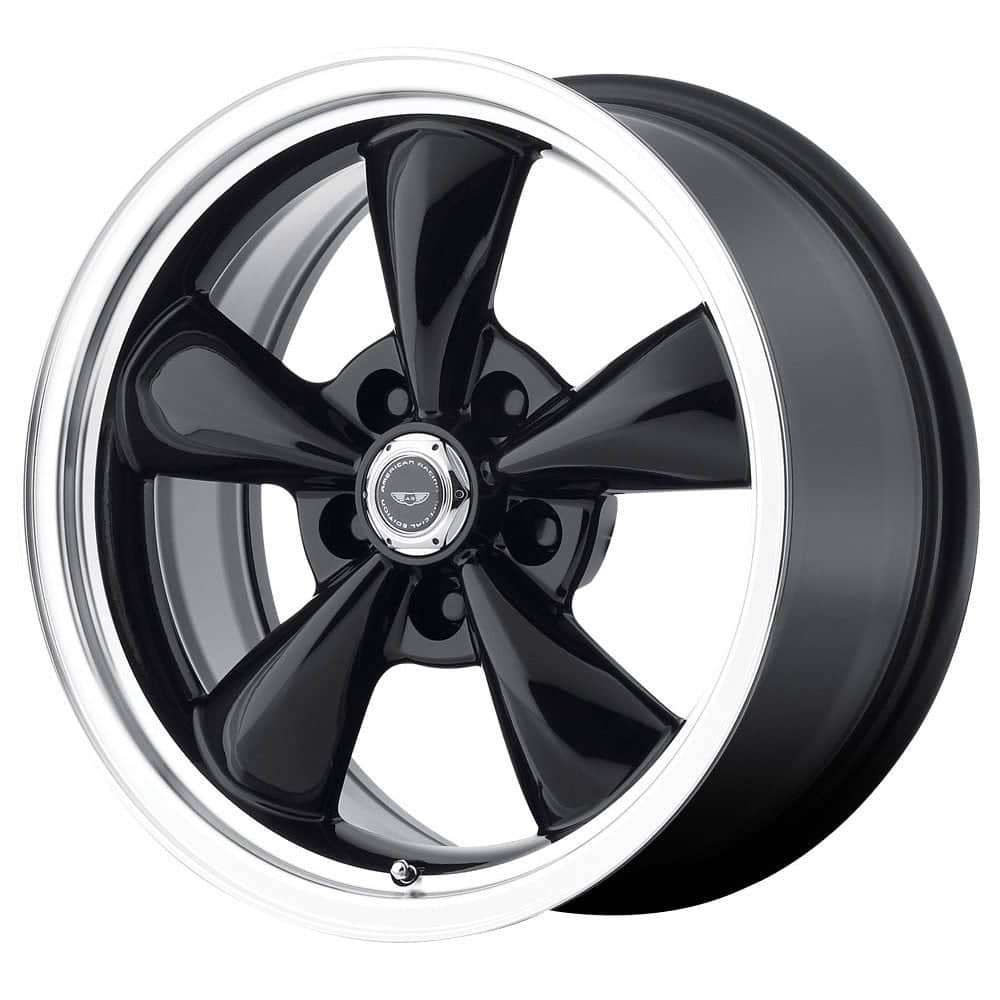
American Racing AR105M Torq Thrust M, 18x8, 5x127, Gloss Black with Machined Lip, around 298 dollars. One piece cast, and available across enough bolt patterns that matching a single damaged wheel on a set is usually possible rather than replacing all four.
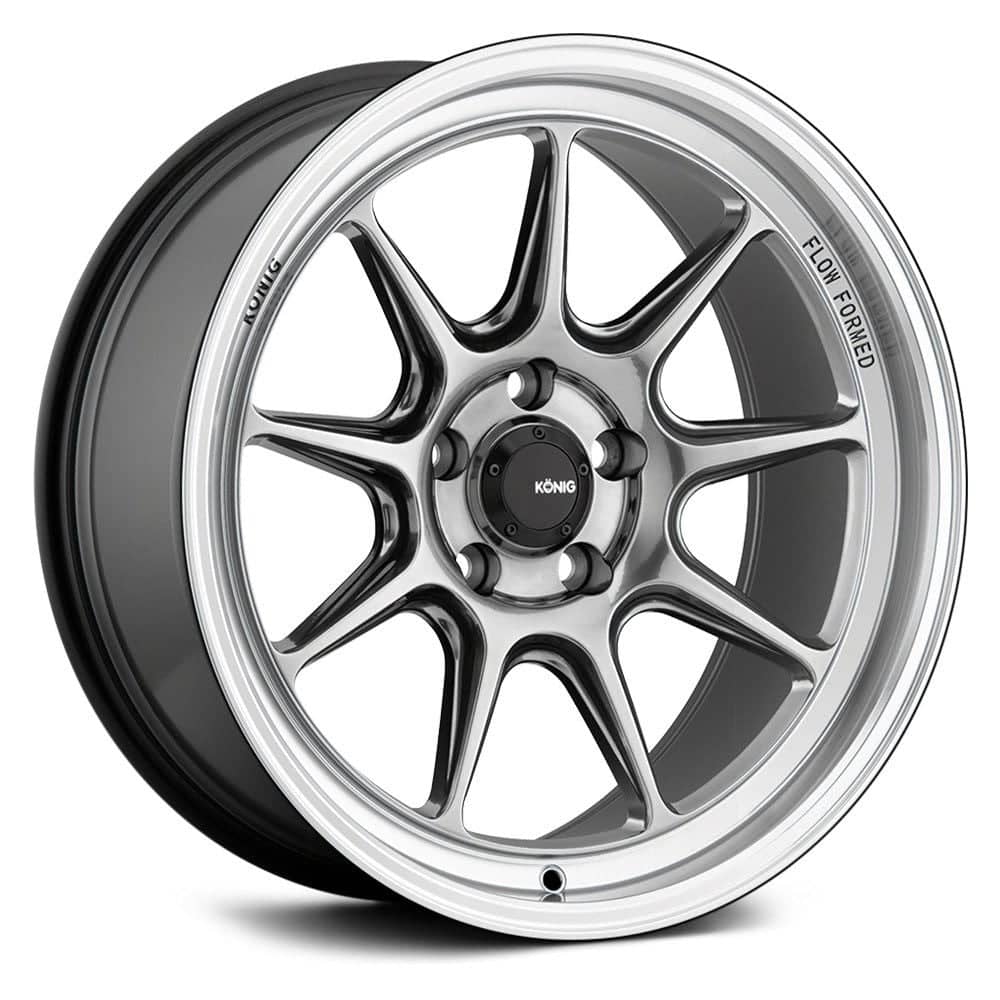
Konig Countergram, 18x8.5, 5x114.3, Hyper Chrome with Machined Lip, around 356 dollars. Flow formed construction, which gets you a stronger barrel at lower weight than an equivalent cast wheel. Deep inventory across widths and offsets.
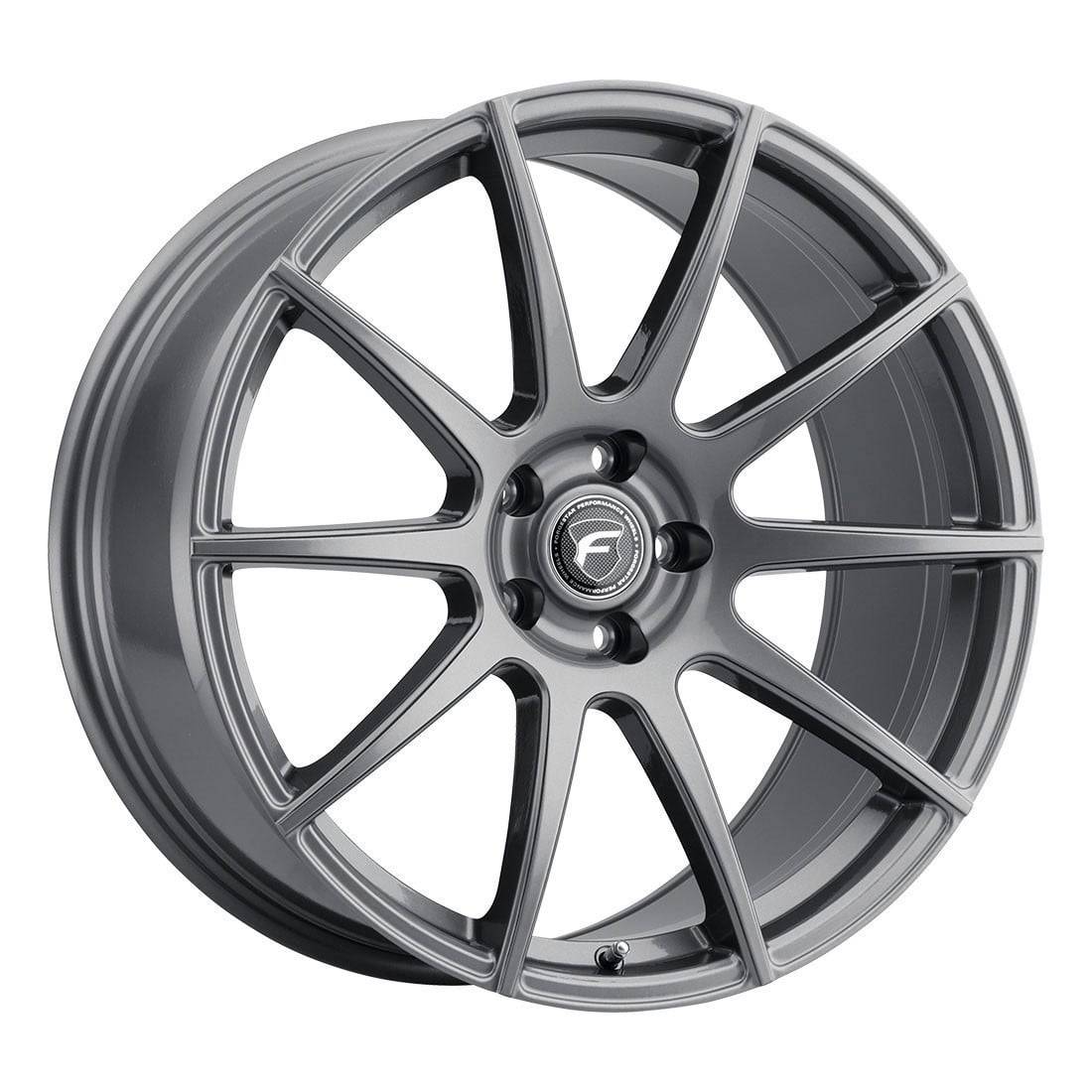
Forgestar CF10, 20x10.5, 5x114.3, Gloss Anthracite, around 550 dollars. Flow formed in aggressive widths and offsets, aimed at performance applications where the wheel is going to see real cornering load.
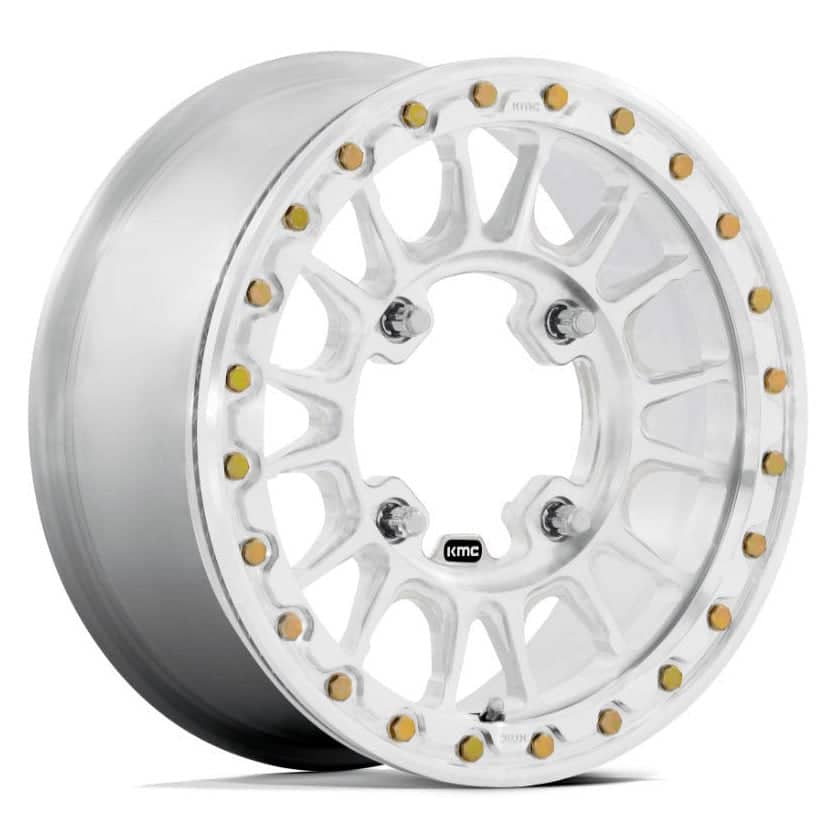
KMC KM446 Mesa Forged Monoblock, 18x9, 6x135, Raw, around 594 dollars. A forged monoblock for truck applications. If you cracked a cast wheel on an impact your truck should have shrugged off, forged construction is the structural answer rather than a repeated repair cycle.
You can browse the full catalog by size, bolt pattern and finish at our aftermarket wheels section. If you are replacing one wheel out of a set, have your bolt pattern, diameter, width, offset and center bore ready, because a visual match is not a fitment match.
The question is not whether your wheel has a crack. It is which of seven structural zones the crack occupies, and how the wheel was built.
Cracks in the inner barrel, outer barrel, and outer lip sit in regions with enough material and low enough bending stress that a properly executed TIG repair with dye penetrant verification is a defensible decision. Cracks at the bead seat, the spokes, the hub face, or a lug seat are in load paths where welding either distorts a critical surface or anneals the metal exactly where the wheel needs its strength most. Those wheels get replaced, and the vehicle should not be driven in the meantime.
The only genuinely wrong move is deciding based on how long the crack is. Length tells you how far the failure has already progressed. Location tells you how fast it is going to progress from here.
It depends entirely on where the crack is. A crack confined to the inner or outer barrel is generally a limp to the shop situation at low speed on smooth pavement. A crack at the bead seat, a spoke root, the hub face, or a lug seat is not drivable at all, and the vehicle should be towed or the spare installed. If you cannot confidently identify the zone, assume the worst case and do not drive.
Distance is the wrong unit. Fatigue cracks grow per load cycle, and a wheel on a 27 inch tall tire turns roughly 810 times per minute at 65 mph, which is about 48,000 cycles per hour. Crack growth also accelerates as the crack lengthens, because a longer crack concentrates more stress at its tip. For a barrel crack, think in terms of the shortest possible trip to a shop. For a spoke or hub face crack, the answer is zero.
Sometimes. A single, non branching crack in the inner barrel, outer barrel, or outer lip of an otherwise sound wheel can be repaired with TIG welding, full V groove preparation, dye penetrant verification, and pressure and run out testing afterward. Cracks at the bead seat, spokes, hub face, or lug seats should never be welded, because welding either distorts a critical sealing or clamping surface or anneals the metal in the highest stress region of the wheel.
A proper structural weld repair with inspection, testing and refinishing typically lands in a range that overlaps heavily with the cost of a new one piece cast wheel. That is the reason so many cast wheel repairs do not make financial sense, and why the calculation changes for forged and multi piece wheels where replacement costs considerably more. On a multi piece wheel, replacing just the damaged section is usually the least expensive path.
Often, but not always, and usually not right away. The more telling symptom is a wheel that will not hold a balance. As a crack opens under load, the wheel loses dimensional stability, so a balance that was correct last month is no longer correct. If a vibration has returned after two balance jobs on the same corner, inspect the wheel itself rather than rebalancing a third time.
No, and that is what makes the dangerous zones dangerous. Cracks in the barrel and flange generally do leak, which gives you a warning. Cracks at a spoke root, the hub face, or a lug seat are outside the pressure boundary entirely and will hold air perfectly right up until the wheel fails structurally. A wheel that holds pressure has told you nothing about whether it is safe.