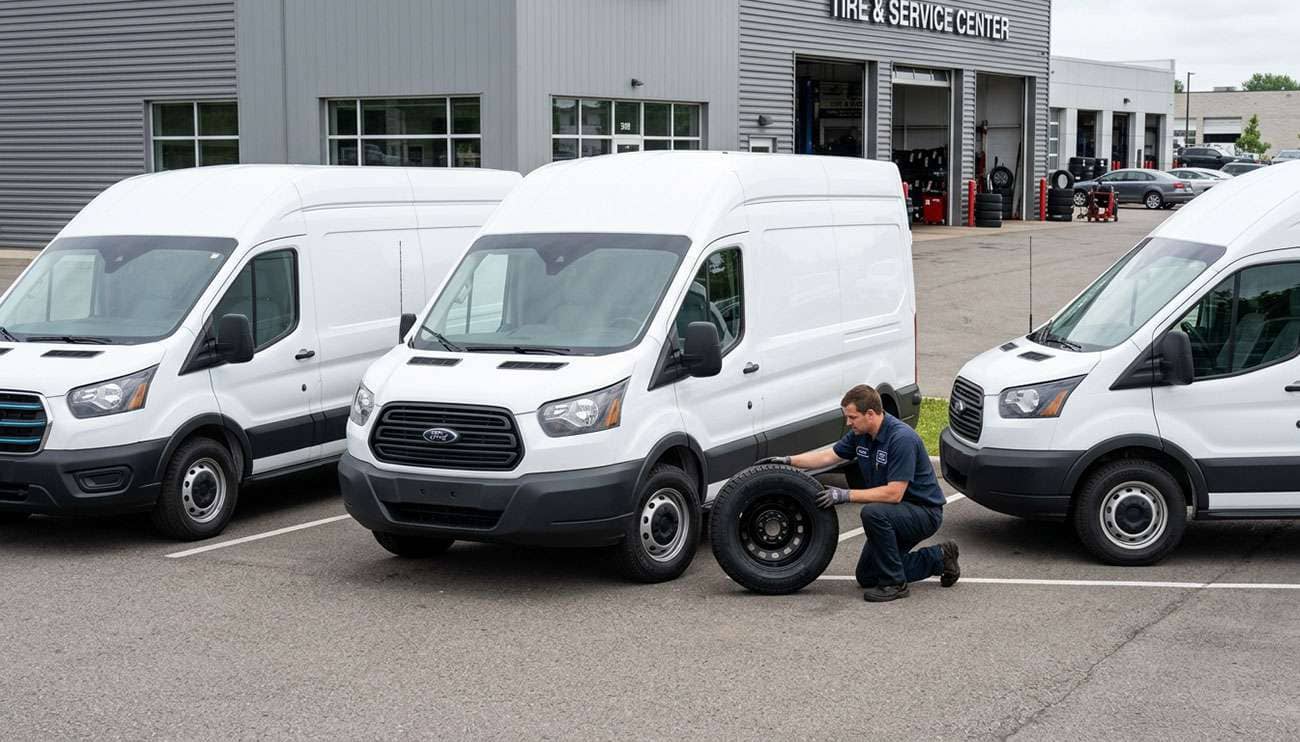
Short answer: yes, and two of the three already ride on them. Every Sprinter 2500 and every dual-rear-wheel Sprinter leaves the factory on LT Load Range E tires, and the ProMaster comes standard on LT225/75R16 E. The Ford Transit is the exception: it rides on European C-type tires, 235/65R16C 121/119. The variable that decides the swap isn't LT versus C. It's the load index. In the same 225/75R16 size, a C-type tire carries about 515 pounds more than an LT tire, and both are Load Range E. Most answers stop at "LT tires are stronger." On a van, that isn't always true.
I'm Dennis Feldman, and van fitment is where I see the most tires that fit perfectly and still don't belong. The size matches, the tire mounts, the van drives off, and the load index never got checked. Here's how to read what your van came with and what can replace it.
Van |
Factory Tire |
Construction |
Can You Run LT? |
|---|---|---|---|
Sprinter 2500 (2007-2026) |
LT245/75R16 120/116, Load Range E |
LT |
Yes, it's the factory tire; match 120/116 |
Sprinter 3500, 3500XD, 4500 dual rear wheel |
LT215/85R16 115/112, Load Range E |
LT |
Yes; the dual number, 112, has to match |
Sprinter 3500, 3500XD Super Single |
225/75R16C front, 285/65R16C rear |
C-type |
Only at the same load index; stay C-type |
Transit 150, 250, 350, 350 HD single rear wheel, E-Transit |
235/65R16C 121/119 |
C-type |
Buy 121/119; often listed as LT235/65R16 |
Transit 350 HD dual rear wheel |
195/75R16C 107/105 or 205/75R16C 113/111 |
C-type |
Only at the same single and dual index |
Transit Trail (2023-2024) |
LT245/75R16 120/116, recalled to 235/65R16C |
LT, then C-type |
Follow the updated placard |
ProMaster 1500, 2500, 3500, EV |
LT225/75R16 115/112 standard; 225/75R16C 121/120 optional |
LT or C-type |
Yes; the C-type option carries more |
Find your van, then read the second table. It shows why the size on the sidewall isn't enough: each common van size comes in up to three constructions, and they carry very different loads.
Size |
Passenger Version |
LT Load Range E |
C-Type |
|---|---|---|---|
235/65R16 |
103: 1,929 lb |
Sold as LT, but the 121/119 is the C-type tire |
121/119: 3,195 lb |
225/75R16 |
104: 1,984 lb |
115/112: 2,680 lb |
121/120: 3,195 lb |
245/75R16 |
109 to 111: 2,271 to 2,403 lb |
120/116: 3,045 lb |
Rare in this size |
215/85R16 |
Rare in this size |
115/112: 2,680 lb single, 2,470 lb dual |
Rare in this size |
Both are light truck tires. They come from two different rulebooks. An LT tire, with the LT in front of the size, is built to the North American load tables published by the Tire and Rim Association. A C-type tire, with the C after the size, is a European commercial tire built to the ETRTO tables, the European equivalent. Both carry a load range letter on the sidewall, and both are meant for vans and trucks that work for a living.
Where they differ is how much weight they carry at a given size and pressure. A C-type tire in the same dimensions is usually rated for more. The clearest example comes from a 2018 Michelin North America service bulletin on European-designed vans, filed with NHTSA. It compares an LT225/75R16 and a 225/75R16C, same dimensions and both Load Range E. The LT tire carries a 115/112 load index, about 2,680 pounds on a single wheel. The C-type carries 121/120, about 3,195 pounds. That is about 515 pounds per tire, from two tires you'd never tell apart from across the shop. The bulletin's own wording is short: an LT225/75R16 is not the same as a 225/75R16C.
This trips up a lot of counter staff. The C after the size marks the tire as European commercial construction. It does not mean Load Range C. A 235/65R16C is usually a heavy-duty tire, and its load range is printed separately on the sidewall. Read the load index, not the letter.
Retail listings blur it further. Many sellers list C-type van tires with an LT prefix, so an online listing for "LT225/75R16" can be a true 115/112 LT tire or a 121/120 C-type, side by side on the same page. The two numbers in the load index tell you which one you're looking at. The prefix on a listing doesn't.
The two families come from different load tables, so they reach their rated loads at different pressures. Your door placard was set for the tire the van was built with. Change the construction and the placard number no longer tells you what the tire carries.
Yes, because nearly every U.S. Sprinter already rides on them. The Sprinter 2500, from the 2007 generation through today's van, comes on LT245/75R16 Load Range E, 120/116, on 16-inch wheels. The dual-rear-wheel 3500, 3500XD, and 4500 come on LT215/85R16 Load Range E, 115/112. Mercedes' owner's manuals spell out the two families: an LT in front of the size means a U.S.-standard light truck tire, a C behind it means a European commercial tire.
The 2500 is where the margin lives. Its rear GAWR is 5,359 pounds, which puts 2,680 pounds on each rear tire. The LT245/75R16 E carries 3,045 pounds at its 80 psi maximum, but it drops to 2,625 at 65 psi, under the axle rating. Fitment data lists the rear placard at 70 psi, where the tire carries 2,765. A replacement LT245/75R16 has to be the 120/116 Load Range E, and it has to run at the placard.
The one Sprinter that comes on C-type tires is the factory Super Single option for the 3500 and 3500XD, which replaces the rear duals with one wide tire per side: 285/65R16C in the rear and 225/75R16C up front. Those wide rear tires carry a very high single load index, and true LT equivalents in that size are scarce. On a Super Single van, replace C-type with C-type at the same load index.
The Transit is the C-type van. Ford's order guides list 235/65R16C 121/119R on every Transit 150, 250, 350, and 350 HD single-rear-wheel van, every roof height, and the E-Transit. A 121 is 3,195 pounds on a single wheel. Against a T-350's 5,750-pound rear GAWR, a pair carries 6,390 pounds, a comfortable margin.
Ford's owner's manual is direct about replacements: use tires of the same size, load index, speed rating and type, and it names P-metric versus LT-metric as an example of a different type. So the answer for a Transit is to keep the 121/119. In practice that's easier than it sounds, because there's essentially no separate LT-metric 235/65R16 on the market. The tires sold online as "LT235/65R16 121/119R" are the same van tires with a different label. The index is what you're checking, and it should read 121/119.
The one Transit that left the factory on a true LT tire is the lesson. The 2023-2024 Transit Trail came on LT245/75R16 Load Range E, 120/116S, a taller all-terrain. In April 2024 Ford recalled 1,902 of them (NHTSA 24V-226). With the van loaded near its front GAWR, braking, and turned partway, the front tire could contact the wheel arch liner and body flange, and repeated contact could cause rapid air loss or tread separation. The remedy was to replace the LT tires with 235/65R16C and update the placard and the van's calibration. That's not an argument against LT tires. It's an argument against changing size on a van without the engineering behind it, from the company that builds the van.
The ProMaster already rides on LT tires. Current ProMaster 1500, 2500, 3500, and EV vans come standard on LT225/75R16 Load Range E, 115/112R, on a 16-inch steel wheel. Ram's fleet guide lists a C-type 225/75R16C 121/120R as an option, included on the SLT trims. So the answer for a ProMaster is yes, an LT tire is the factory tire. The question is which of the two factory tires your van has.
Here's the number nobody puts in front of you. The ProMaster 2500 and 3500 carry a 5,291-pound rear GAWR. Two LT225/75R16 E tires carry 2,680 pounds each at their 80 psi maximum, 5,360 pounds together. That's 69 pounds of margin, and it only exists at 80 psi, which is why the LT placard calls for 80 in the rear. Run them at 65 and the pair carries about 4,670 pounds, well under the axle rating. The optional C-type tires carry 3,195 pounds each, 6,390 together, at a lower 72 to 73 psi placard. If your ProMaster works heavy, the C-type is the tire with room to spare. Our guide to vehicles that use 225/75R16 tires shows how many other vans and trucks share the size, and why the load index varies so much within it.
At least the load index your van left the factory with, on both numbers. Every axle has a gross axle weight rating, the most it's allowed to carry, printed on the certification label on the driver's door pillar. With single rear wheels, each rear tire carries half the rear GAWR. With dual rear wheels, each of the four rear tires carries a quarter, and the tire's dual rating, the second number, is the one that applies.
The van makers sized the factory tires to those numbers, and on the 2500-class vans they cut it close. The Sprinter 2500 and the ProMaster both run their rear LT tires near their limit at the placard pressure. So the factory load index isn't a suggestion with room above it. It's the margin, and any replacement has to equal it or beat it. Our guide to load range vs. load index explains why the letter and the number tell you different things.
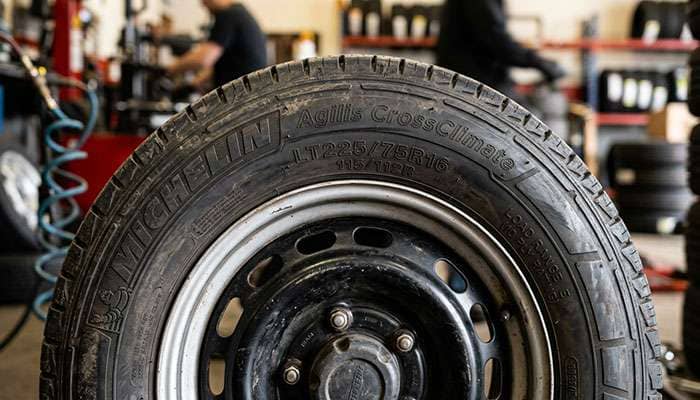
They need the right second number. A dual-rear-wheel van carries its rear axle on four tires, and a tire mounted in a pair is rated lower than the same tire alone, because the pair shares the load unevenly over a crowned road or a pothole. On an LT215/85R16 115/112, the 115 is 2,680 pounds on a single wheel and the 112 is 2,470 pounds per tire in a dual pair.
Sprinter 3500, 3500XD, and 4500 duallies run LT215/85R16 E 115/112. A 3500XD's 7,721-pound rear GAWR puts about 1,930 pounds on each rear tire, comfortably under the 2,470 dual rating. Transit 350 HD duallies run C-type 195/75R16C 107/105 or 205/75R16C 113/111, depending on drivetrain and front axle, against a 7,275-pound rear GAWR, about 1,820 pounds per tire. Check both numbers on any replacement, and never mix constructions or sizes inside a dual pair. A stiffer or taller tire beside a softer one carries more than its share. Our article on why dually wheels exist covers what the second pair of tires is doing.
No, and this is the swap that does real damage, because the size on the sidewall can match exactly. The 235/65R16 is the clearest case. As a passenger tire, the market is full of standard-load 235/65R16s at a 103 load index, 1,929 pounds at 36 psi. Even the Extra Load versions top out around 107, 2,149 pounds. The van-rated 235/65R16C carries 121, 3,195 pounds. Put the passenger tire on a van that came on the commercial one and each tire gives up about 1,266 pounds of capacity, roughly 40 percent.
It gets worse on paper. Under FMVSS 120, a P-metric passenger tire used on a truck, van, or other multipurpose vehicle has its rated load divided by 1.10 before it counts. That 1,929-pound tire counts for about 1,754 on a van.
The same trap exists in 245/75R16 and 225/75R16. Passenger 245/75R16s usually carry a 109 or 111 index, 2,271 to 2,403 pounds, against 3,045 for the LT Load Range E. Passenger 225/75R16s usually carry a 104, 1,984 pounds, against 2,680 for the LT and 3,195 for the C-type. The tire will mount, hold air, and drive fine empty. Load it with shelving, a crew, or a camper build and it is working past its rating on every trip. Our guide to P-metric vs. LT tires explains what changes inside the casing.
The pressure that carries your axle load on the new tire's own table, never below the placard and never above the sidewall maximum. Van placards run high because the tires are working. The ProMaster's LT rear placard is 80 psi, the tire's maximum. C-type van tires commonly carry maximums of 83 to 90 psi and reach their rated loads at different pressures than LT tires.
That's why a placard pressure doesn't transfer between constructions. Take a ProMaster that came on the optional C-type tires, with a 72 psi rear placard, and put the standard LT225/75R16 E on it. At 72 psi, each LT tire carries about 2,490 pounds, about 4,980 for the pair, roughly 315 pounds under the 5,291-pound rear GAWR. The LT tire needs its full 80 psi to carry that axle, and even then the margin is 69 pounds. Same van, same size on the door, different tire, different answer.
Check pressure cold, before the first drive of the day, at least once a week on a working van. Your TPMS won't catch a construction mismatch. NHTSA's TPMS rule, FMVSS 138, requires a warning only at 25 percent below the placard pressure.
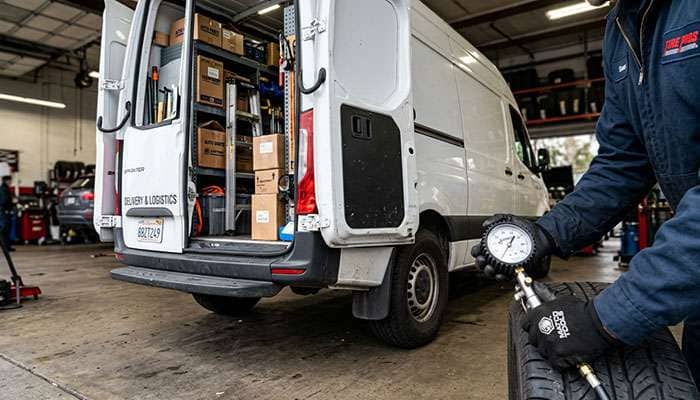
They need the right tires more than a cargo van does, because a camper build runs heavy all the time. A cargo van is loaded and unloaded through the day. A conversion carries cabinets, water, batteries, a fridge, and two people's gear on every mile, and much of that weight sits behind the rear axle. Plenty of builds roll within a few hundred pounds of the van's GVWR, and some go over it.
The tire answer is the same as for a work van, done with real numbers. Weigh the finished van at a certified truck scale, one axle at a time, loaded the way you travel. Divide each axle weight by two (or by four on a dual rear axle) and compare it to the tire's load at the pressure you run. If the rear axle weight is over its GAWR, no tire fixes that, and our article on what an overloaded rear axle does to your tires is the next read. If you're still planning the build, our look at whether you can live in a van covers the practical side.
Many camper owners want an LT all-terrain for gravel and campground roads. That works when the tire carries what the scale says, and on a 225/75R16 van that often means a 121/120 rather than the 115/112.
The wrong tire on a van rarely fails on the first day. It fails on the hot day with the full load, and it gets there in this order.
1. A van that wanders and leans. An underrated or underinflated tire squirms under a high-roof van's weight, and most owners blame the alignment.
2. Fast shoulder wear. A tire carrying more than its rated load at its pressure runs on its edges. The shoulders go first, often on the rear.
3. Heat. Every revolution flexes an overloaded sidewall further than it was built for, and long loaded highway miles turn that flex into heat.
4. Casing damage you can't see. Heat breaks down the rubber between the plies from the inside, and by the time a bulge shows, the damage is done. If you find one, read our guide on tire sidewall damage and whether it is safe to drive before the next run.
5. A tread separation or blowout. On a loaded van, a rear blowout at highway speed is a control problem, not just a tire problem. That is the end of the ladder, and it is not a cost measured in dollars.
6. The tires you should have bought first. Every rung above ends with buying a tire that carries the load. Buying it first is the cheapest point on the list.
Step 1: Read the placard and the old sidewall. Write down the size exactly as printed, including any LT in front or C behind, the full load index with both numbers, the load range, and the cold pressures front and rear. If the placard and the tires on the van disagree, the placard wins.
Step 2: Write down your GAWRs. They're on the certification label on the driver's door pillar. Divide the rear GAWR by two for single rear wheels, or by four using the dual rating for a dually.
Step 3: Match the load index, not the prefix. The replacement's single index has to meet or beat the factory tire's, and on a dually so does the dual index. Treat a retail listing's LT or C label as a hint. The load index printed on the sidewall is the fact.
Step 4: Keep the size. Stay with the factory size unless the van maker lists an alternative. Size changes move the speedometer and stability control calibration, and rarely buy capacity the factory size can't.
Step 5: Set pressure from the new tire's table. Find the pressure where the new tire carries your per-tire axle load, never below the placard and never above the sidewall maximum.
Step 6: Weigh the van if it's built out. A camper or upfit van should go across a scale, axle by axle, before you trust any number in this list. Then re-check pressure cold, before the day's first drive, every week the van works.
Not sure which index your van needs? Our tire load index calculator turns your weights into a minimum load index, so you can shop by the number that matters.
Two of the three vans already ride on LT tires. The Sprinter 2500 and every Sprinter dually come on LT Load Range E, and the ProMaster comes standard on LT225/75R16 E. The Transit rides on C-type 235/65R16C 121/119, and Ford tells owners to replace like with like. The Transit Trail recall shows what happens when a van's size changes without the engineering behind it.
Across all three, the deciding number is the load index, both halves of it. A C-type and an LT tire in the same size can differ by more than 500 pounds, a passenger tire in a van size can be short by more than 1,200, and the listing prefix won't warn you. Match the index, keep the size, and set the pressure from the tire you actually bought.
Yes. The Sprinter 2500 comes from the factory on LT245/75R16 Load Range E 120/116 tires, and dual-rear-wheel Sprinters come on LT215/85R16 Load Range E 115/112. Replace them with the same size and at least the same load index. Only the Super Single option uses C-type tires.
Ford specifies 235/65R16C 121/119 tires on single-rear-wheel Transits and tells owners to replace tires with the same size, load index, speed rating, and type. Tires sold as LT235/65R16 121/119 are the same van tires with a different label, so match the 121/119.
Current ProMaster 1500, 2500, 3500, and EV vans come standard on LT225/75R16 Load Range E 115/112 tires. A C-type 225/75R16C 121/120 is optional and carries about 515 pounds more per tire.
No. The C after the size marks a European commercial tire. Most C-type van tires are Load Range E, and the load range is printed separately on the sidewall.
In the same size, a C-type van tire usually carries more. A 225/75R16C 121/120 carries about 3,195 pounds, against about 2,680 for an LT225/75R16 115/112, even though both are Load Range E.
It isn't recommended. Ford put LT245/75R16 tires on the 2023-2024 Transit Trail, then recalled the vans because the front tires could contact the wheel arch liner, and replaced them with 235/65R16C.