
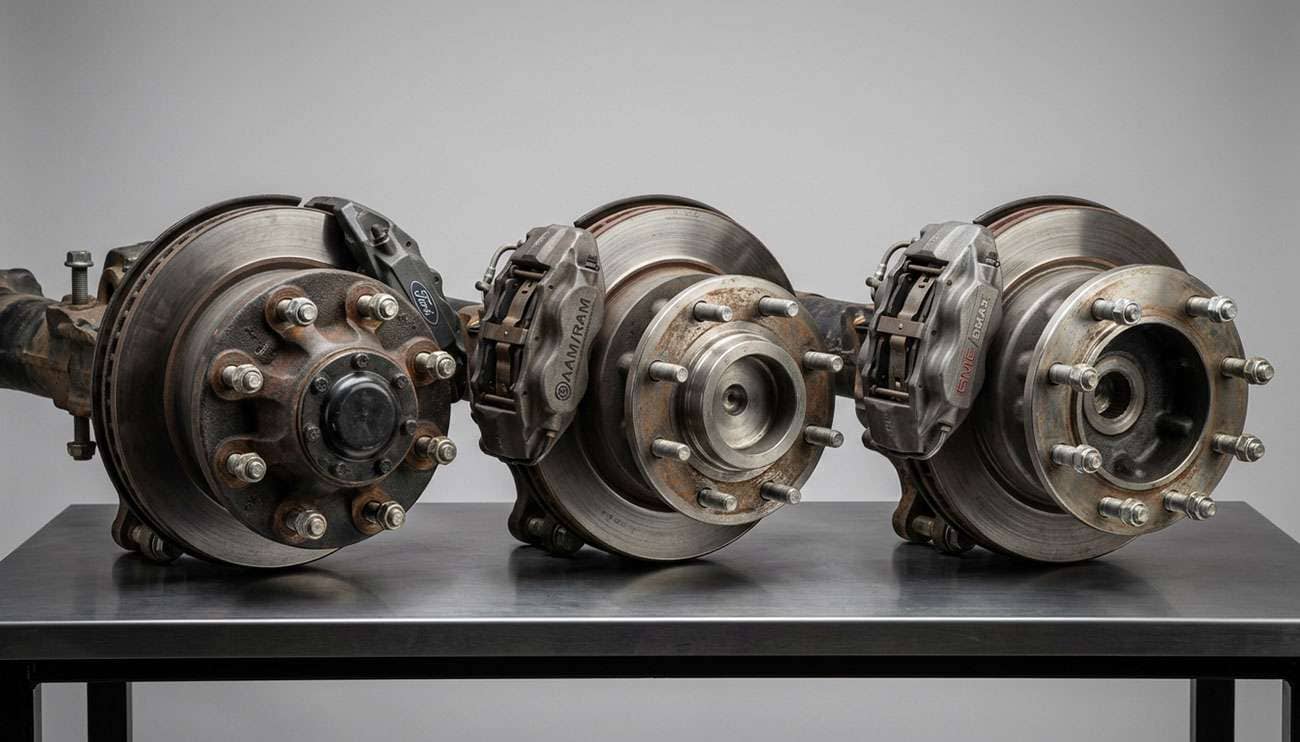
Guy walks into the shop. Says he needs new dually wheels. I ask him what he's driving. He says it's a one-ton, 8-lug, that's all he knows. I ask him what year and what brand. He gives me a confused look. "Why's that matter? Eight-lug is eight-lug, right?"
This is the conversation I have at least once a week, and the answer matters more than most truck owners realize. There are six different 8-lug bolt patterns out there on dually trucks today, and they're not interchangeable. Some of them differ by less than 5mm. Close enough that you can almost line them up. Far enough that the wheel doesn't sit flat on the hub, the studs don't pull straight, and the lug nuts don't torque properly. You can drive a few miles like that. You can't drive a thousand.
This is the guide to which pattern fits which truck, why they're different, and what happens when you get it wrong.
Here's the lineup. Six different patterns covering every modern dually pickup on the road, plus the F-450/F-550 cab-and-chassis trucks that run 19.5-inch commercial wheels with 10 lugs instead of 8.
Bolt Pattern |
Vehicles |
Years |
Common Confusion |
|---|---|---|---|
8x6.5" / 8x165.1mm |
Older GM 2500/3500, older Ford F-350, Ram 2500/3500 dually |
GM through 2010; Ford pre-1999; Ram dually through 2018 |
Looks almost identical to 8x170mm |
8x170mm |
Ford F-250 SRW, F-350 SRW, F-350 DRW (1999-2004 only), Excursion |
1999 to current (SRW); 1999-2004 only (DRW) |
Only 4.9mm larger than 8x6.5 |
8x180mm |
GM 2500HD and 3500HD single rear wheel only |
2011 to current |
Replaced 8x6.5 on GM HD trucks |
8x200mm |
Ford F-350 DRW, F-450 DRW, Ram 3500 DRW |
Ford 2005 to current; Ram 2019 to current |
Different from F-250/F-350 SRW pattern (8x170) |
8x210mm |
Chevy Silverado 3500HD DRW, GMC Sierra 3500HD DRW |
2011 to current |
Different from GM SRW pattern (8x180) |
10x225mm / 10x285.75mm |
Ford F-450, F-550 with 19.5-inch wheels |
Various, depending on chassis configuration |
10 lugs, not 8 — easy to overlook |
Notice what's not on this list: any pattern that crosses brands. A Ford dually wheel does not fit a Chevy dually. A Ram dually wheel doesn't fit either. Even within the same brand, the dually pattern often differs from the single-rear-wheel pattern. Get it wrong and you're returning wheels — or worse, you've already drilled holes you can't undrill.
The 8x6.5" pattern is the granddaddy. It dates back to the 1960s, and for about 40 years it was the standard on every American heavy-duty truck — Ford, Chevy, GMC, Dodge. If you've got an old work truck sitting in the back of the property, odds are it's running 8x6.5.
The 6.5 is inches between bolts measured corner to corner. The 165.1 is that same distance in millimeters. Same pattern, two ways of writing it. You'll see both in catalogs and on wheel descriptions. They mean the exact same thing.
Vehicles still on 8x6.5 today are limited mostly to the Ram 2500 and Ram 3500 single-rear-wheel models, plus older trucks across all three brands. Chevy and GMC moved off this pattern in 2011 when they redesigned the heavy-duty platform. Ram kept 8x6.5 on its 2500/3500 lineup through 2018, and the 3500 dually held the pattern through that same year before switching to 8x200 in 2019.
If you've got a pre-2011 Chevy or GMC 3500 dually, a pre-1999 Ford F-350 dually, or a pre-2019 Ram 3500 dually, this is your pattern. PPT carries dually wheels in 8x6.5 from American Racing AR204 Baja Dually, Cali Off-Road Invader, and several others.
When Ford redesigned the Super Duty for 1999 — splitting it from the F-150 and giving it a heavier chassis — they introduced a new bolt pattern: 8x170mm. Just 4.9mm bigger than the old 8x6.5. Why the change? Ford was building a heavier truck and wanted a slightly bigger pattern to spread the load across larger studs and a stronger hub. The 4.9mm difference was deliberate. It also made the new wheels incompatible with anything that came before, which Ford may have considered a feature rather than a bug.
The 8x170 pattern lives on every Ford F-250 Super Duty and F-350 Super Duty single-rear-wheel truck from 1999 through current production. It also appears on the Ford Excursion (1999-2005), which shares the Super Duty chassis.
Here's the part that catches people. From 1999 through 2004, the F-350 dually also used 8x170. Same as the SRW. You could pull a wheel off the front axle of a single-wheel F-350 and run it on the front of a dually F-350 from those years. In 2005, Ford changed the dually pattern to 8x200 (more on that next), but kept the SRW Super Duty trucks on 8x170. So a 1999-2004 dually owner shopping for replacements gets 8x170 wheels. A 2005-and-up dually owner needs 8x200 wheels. Same truck name. Same factory. Different pattern.
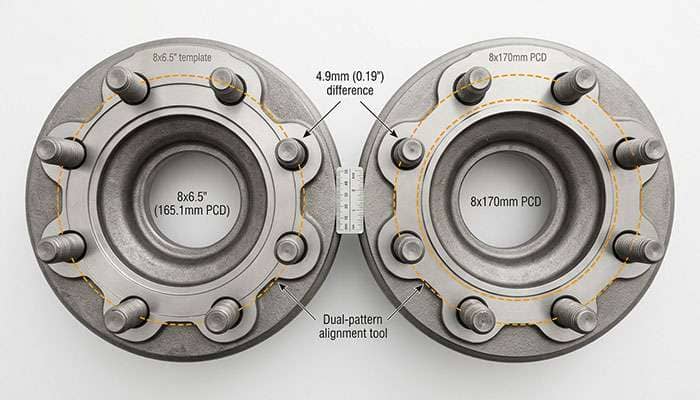
The 4.9mm gap between 8x6.5 and 8x170 is small enough that the patterns look almost identical at a glance. They're not. Trying to bolt an 8x170 wheel onto an 8x6.5 hub leaves the studs sitting in the wrong spots — the wheel either won't seat flat on the hub face or won't pull tight when you torque the lug nuts. People have tried to make it work by drilling out the lug holes a bit. Don't do that. The wheel was engineered with specific stress paths through the lug seats, and oversized holes change the load distribution in ways the wheel was never designed for. You're risking a wheel separation under load.
In 2011, GM redesigned the Silverado and Sierra heavy-duty trucks. Part of that redesign was a new bolt pattern: 8x180mm. It's exclusive to the 2500HD and 3500HD single-rear-wheel trucks from that point forward. The 1500 light-duty pickups stayed on the same 6-lug pattern they've used for years, and the 3500HD dually went a different direction (we'll cover that in a minute).
Why a new pattern? Same reasoning Ford used a decade earlier. Heavier trucks, heavier loads, bigger hubs, bigger studs. The 8x180 pattern serves only the SRW HD trucks. If you've got a 2011-or-newer Chevy 2500HD, GMC Sierra 2500HD, or 3500HD with a single rear wheel, this is your pattern.
It is not a dually pattern. If you've got a 3500HD dually from 2011 or later, your bolt pattern is 8x210, not 8x180. The two patterns are different by 30mm, which is more than enough to be obviously incompatible — but in shop conversations, people frequently confuse them because both are "GM HD trucks from 2011."
This is the dominant dually pattern on new trucks today. Ford moved its F-350 and F-450 dual-rear-wheel trucks to 8x200mm starting in 2005, and the pattern has stayed in place ever since. Ram followed suit in 2019, switching its 3500 dually from 8x6.5 to 8x200 to match Ford and simplify the aftermarket wheel landscape.
The hub bore on 8x200 dually wheels is 142.2mm — larger than the SRW versions because the dually hub itself is bigger to accommodate the dual-wheel mounting setup. When shopping aftermarket, you want a wheel that's both 8x200 and hub-centric to that 142.2mm bore. A wheel that's the right bolt pattern but the wrong hub bore won't seat properly and can cause vibration even when the lugs are torqued correctly.
If you've got a 2005-or-later Ford F-350 DRW, a 2005-or-later Ford F-450 DRW, or a 2019-or-later Ram 3500 DRW, your wheel pattern is 8x200. PPT stocks this pattern across multiple brands — the Vision 181Z Van Dually, Mayhem 8107 Cogent, Weld Off-Road Scorch Dually, Arena Dually Mission, and the American Racing AR204 Baja Dually all come in 8x200 fitments.
When GM moved its single-rear-wheel HD trucks to 8x180 in 2011, they sent the dually 3500HD a different direction: 8x210mm. Why split the patterns? Same logic as Ford. The dually carries more weight, has a wider rear track, and uses a bigger hub. A bigger pattern lets the wheel mount more securely on a heavier hub.
The result is that GM's HD lineup runs three different 8-lug patterns simultaneously: pre-2011 trucks on 8x6.5, post-2011 SRW on 8x180, and post-2011 DRW on 8x210. If you walk into a tire shop with a 2014 Silverado 3500HD dually and ask for "GM HD wheels," the answer depends entirely on which truck you've got and what year.
The 8x210 hub bore is 154.2mm — even bigger than the Ford 8x200 dually's 142.2mm, because GM uses a different hub architecture. PPT stocks 8x210 dually wheels from Ion Alloy 167, Fuel Cleaver D574, American Racing AR204 Baja Dually, and the Arena Dually Mission and Rival lines.
Step up to an F-450 pickup or an F-450/F-550 cab-and-chassis with 19.5-inch wheels and the bolt pattern changes again. These are commercial-grade wheels, closer in spec to a semi-truck wheel than a pickup wheel. They use 10 lugs instead of 8, in either a 10x225mm or 10x285.75mm pattern depending on the chassis configuration and year.
The 10-lug 19.5-inch wheels are popular among heavy haulers, RV owners pulling fifth-wheel toy haulers, and folks running gooseneck trailers at the upper end of weight capacity. The wheel itself is rated for higher load than any 17-inch dually wheel, the tires last 50,000 to 100,000 miles or more thanks to the harder commercial compound, and the bigger wheel gives you better brake cooling.
The trade-offs are real. Tire selection is narrower than 17 or 22-inch sizes, ride quality is firmer because of the stiffer commercial sidewalls, and brand-new 19.5 tires are slick in light rain for the first few thousand miles until the release agents wear off. You also need a wheel that fits your specific chassis — F-450 pickup wheels and F-450/F-550 cab-and-chassis wheels often use different patterns even though both are "19.5-inch."
PPT stocks 10x225 19.5-inch dually wheels in the Arena Dually Tactic, Rival, and Thunder lines. If you're considering this size, the upgrade-from-17 question is worth thinking through carefully — these aren't appearance wheels, they're a different category of equipment for a specific kind of work.
You'd think that within the same brand, the same model, and the same year, the bolt pattern would be identical between the single-wheel and dual-wheel versions. Sometimes it is. Often it isn't. Here's why.
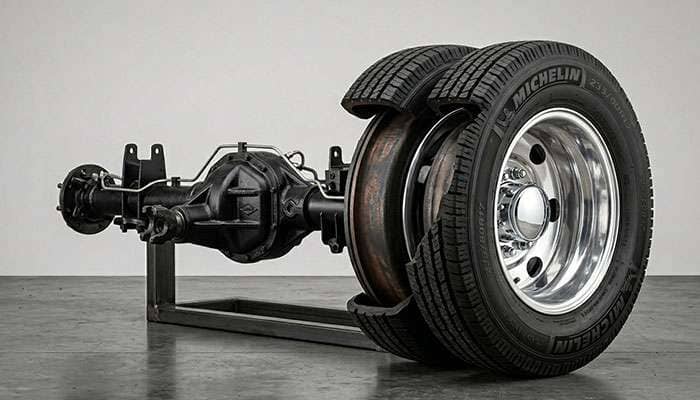
The dually rear axle is a different piece of hardware than the SRW rear axle. It's a heavier casting, with a longer wheel-mounting flange to accommodate two wheels stacked on each side. The hub itself is bigger in diameter, both because it has to fit a larger ring of brake rotor and because the lug studs are mounted on a wider circle to handle the dually's higher loads. When the engineers design the dually rear axle from scratch, they're not constrained to match the SRW pattern — they're building a heavier-duty hub that needs a bigger pattern to do its job.
So you end up with situations like Ford's: 1999-2004, the F-350 dually used the same 8x170 pattern as the SRW because the engineering team chose to keep them compatible. In 2005, when Ford redesigned the dually rear axle to a heavier spec, they bumped the pattern to 8x200 and let the SRW stay on 8x170. Same year, same truck name, two different wheels. The factory's reasoning is engineering. The owner's reaction is usually frustration.
GM did something similar in 2011. SRW HD trucks got 8x180, DRW HD trucks got 8x210. Ram held both SRW and DRW on 8x6.5 through 2018, then moved the dually only to 8x200 in 2019 — keeping the SRW on 8x6.5 to this day. None of these decisions were made to confuse anyone. They were made because dually hubs are different than single-wheel hubs, and bigger patterns serve bigger hubs.
Three mistakes I see over and over, none of them with a happy ending.
Buying the wrong pattern because the truck looks the same. You see a 2005 F-350 SRW and a 2005 F-350 DRW parked next to each other and they look like the same truck with a wider back end. They're not running the same wheels. The SRW is 8x170, the DRW is 8x200. Buying SRW wheels for a DRW truck means the wheels show up and don't fit. Best case, you're paying return shipping. Worst case, you've already opened the boxes and the seller calls them used.
Drilling out lug holes to make the wheel "fit." The 8x6.5 and 8x170 patterns are close enough — 4.9mm apart — that someone with a drill press and an unwarranted dose of confidence will think they can open up the lug holes a bit and bolt the wheel on. They can. The wheel will rotate. It will probably hold for a while. But the lug seats are now oversized for the studs, the load is no longer distributed across the engineered contact area, and the wheel is now operating outside its design specification. Wheels fail under those conditions. I've seen them come apart on the highway. Don't drill out a wheel.
Trusting an aftermarket adapter without research. Adapters that convert one bolt pattern to another do exist and can work safely when they're correctly engineered, properly torqued, and used within their load rating. They can also fail catastrophically when they're underbuilt, improperly installed, or asked to handle more weight than they're rated for. A dually carrying maximum payload puts more stress on a wheel adapter than a half-ton on a Costco run. Adapter quality matters more, not less, on a working truck.
Here's the lookup table when you need to figure out what pattern your truck runs.
Vehicle |
Years |
Bolt Pattern |
|---|---|---|
Chevy/GMC 3500 Dually |
1977-2010 |
8x6.5" / 8x165.1mm |
Chevy Silverado 3500HD DRW / GMC Sierra 3500HD DRW |
2011 to current |
8x210mm |
Chevy/GMC 2500HD and 3500HD SRW |
2011 to current |
8x180mm |
Ford F-350 Dually |
1999-2004 |
8x170mm |
Ford F-350 / F-450 Dually |
2005 to current |
8x200mm |
Ford F-250 / F-350 Super Duty SRW |
1999 to current |
8x170mm |
Ford Excursion |
1999-2005 |
8x170mm |
Ram 2500 / 3500 Single Rear Wheel |
Through current production |
8x6.5" / 8x165.1mm |
Ram 3500 Dually |
Through 2018 |
8x6.5" / 8x165.1mm |
Ram 3500 Dually |
2019 to current |
8x200mm |
Ford F-450 / F-550 with 19.5-inch wheels |
Various |
10x225mm or 10x285.75mm |
If your truck isn't on this chart, check the door jamb sticker, your owner's manual, or measure the pattern yourself before buying anything. Measure center-to-center across opposite lugs on an even-numbered pattern. The number of lugs is obvious; the diameter takes a tape measure and a steady hand.
Adapters that convert one dually bolt pattern to another are commercially available. The most common conversion is a 10-lug-to-8-lug adapter that lets you fit an F-450 19.5-inch wheel to a more standard truck, or vice versa. There are also 8x6.5-to-8x200 adapters, and others. The question isn't whether they exist. The question is whether you should run them.
Honest answer from someone who's seen plenty of working trucks come through the shop: a quality adapter, properly torqued, on a truck that's not constantly running at maximum load, will probably hold up fine. Pipeline welders with custom welder rigs run adapter setups all over the country and put hundreds of thousands of miles on them. So do hot shot haulers and folks who've built one-off dually conversions on platforms that didn't come from the factory with dual rear wheels.
The risks scale with the load. An adapter is one more failure point in the wheel mounting system. Every time you torque the wheels, you're putting force on both the wheel-to-adapter interface and the adapter-to-hub interface. Both have to be flat, both have to be properly torqued, both have to handle the dynamic loads of a moving truck. If you're running near the truck's load capacity regularly, the margin for error in adapters is thinner than a stock setup gives you.
If you're considering an adapter, three rules. Buy from a known manufacturer with documented load ratings. Confirm the adapter is rated for your truck's actual loaded weight, with safety margin. And re-check torque after the first 50 to 100 miles, and every few thousand miles after that. Adapters need more attention than stock wheel hardware. They earn it back in flexibility, but they don't get to be set-and-forget like a factory wheel mount.
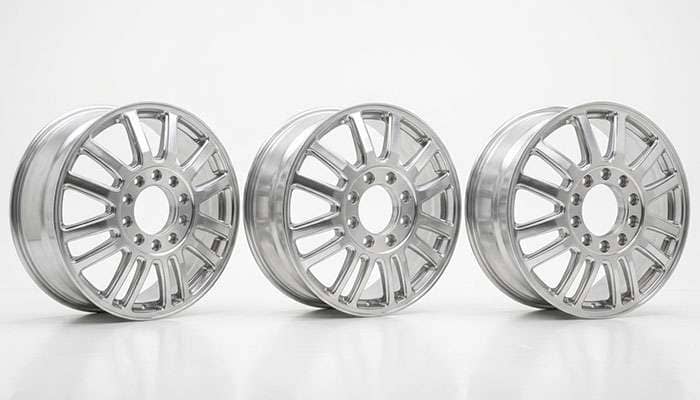
For most dually owners, the better answer is to buy the right pattern wheel for your truck in the first place. The selection of dually wheels in 8x200 and 8x210 patterns has grown enormously over the past decade — every major aftermarket brand makes dually wheels in current Ford, Chevy, and Ram patterns. Adapters made more sense in the days when fewer aftermarket options existed. Today, with brands like Fuel, Mayhem, Vision, Arena, Weld Racing, Ion Alloy, and American Racing all building dually-specific wheels, the case for adapters is narrower than it used to be.
For deeper context on related topics, the dually wheels buying guide covers stock vs. custom selection, forged vs. cast construction, and maintenance issues. The 8x180 bolt pattern guide goes deep on the GM HD SRW pattern specifically, and the 8x170 fitment guide covers the Ford Super Duty SRW pattern. The lug pattern foundational guide walks through how to measure a bolt pattern from scratch, and the wheel offset explainer is essential reading because dually offsets are extreme by passenger-vehicle standards. If you're tackling a wheel installation, the how to change truck dual wheels guide walks through the procedure step by step.
To browse current dually wheel inventory by bolt pattern, the full Dually Wheels catalog covers every major brand and finish. The American Racing Wheels lineup includes the AR204 Baja Dually, which is one of the few designs offered in 8x165.1, 8x170, 8x200, and 8x210 patterns — a single design language that fits across most modern duallies regardless of which 8-lug pattern your truck actually runs.
Yes, 8x6.5" and 8x165.1mm are exactly the same bolt pattern, just expressed in different units. The 6.5 is inches between bolt centers measured corner to corner; 165.1 is the same measurement in millimeters. Catalogs and wheel descriptions use both interchangeably. Any wheel listed as 8x6.5 will fit a hub measured as 8x165.1, and vice versa.
No. Modern Ford F-350/F-450 duallies (2005 and up) use the 8x200mm pattern, while modern Chevy/GMC 3500HD duallies (2011 and up) use 8x210mm. The 10mm difference is enough that the wheels are not interchangeable. Older trucks from both brands shared the 8x6.5 pattern through the early 2000s, but no modern Ford dually wheel will fit a modern GM dually or vice versa without an adapter.
If your F-350 dually is a 1999, 2000, 2001, 2002, 2003, or 2004 model, it's 8x170mm — same as the F-350 single-rear-wheel. If it's a 2005 or newer model, it's 8x200mm. The change happened mid-platform, so the model year matters more than the body style or trim. The same applies to F-450 dually trucks, which have been 8x200mm since 2005.
GM redesigned the heavy-duty Silverado and Sierra platform in 2011 with a heavier chassis, bigger brakes, and revised hub assemblies. The new hubs needed bigger bolt patterns to handle the increased load capacity. SRW trucks got 8x180mm because they share a hub design. DRW trucks got 8x210mm because the dually hub is larger still — wider mounting flange, bigger brake rotor clearance. The two patterns were sized to match the engineering of their respective hubs rather than to maintain backward compatibility.
No. The 4.9mm difference between 8x6.5 and 8x170 is small enough that drilling looks tempting, but it changes the load distribution through the lug seats in ways the wheel was never designed for. Oversized lug holes don't grip the studs the same way, the wheel doesn't pull tight against the hub face properly, and the wheel can fail under load. Wheel manufacturers void all warranties on modified wheels, and for good reason. Always buy the correct pattern.
Hub bore varies by pattern and brand. Ford 8x170 SRW Super Duty trucks use a 124.9mm bore. Ford 8x200 dually trucks use a 142.2mm bore. GM 8x210 dually trucks use a 154.2mm bore. The hub bore must match between the wheel and the truck's hub for proper centering and vibration-free operation. Hub-centric rings can fill the gap between a smaller wheel bore and a larger hub on some applications, but the bolt pattern itself must match exactly.
For heavy haulers running near maximum load capacity regularly, yes. The 19.5-inch wheels carry higher load ratings, the commercial-grade tires last 50,000 to 100,000 miles, and brake cooling is better thanks to the bigger wheel diameter. The trade-offs are firmer ride quality, narrower tire selection, slick tires for the first few thousand miles, and higher cost per tire. For trucks used at lighter loads or for street appearance, the standard 17-inch dually setup remains a better value.



