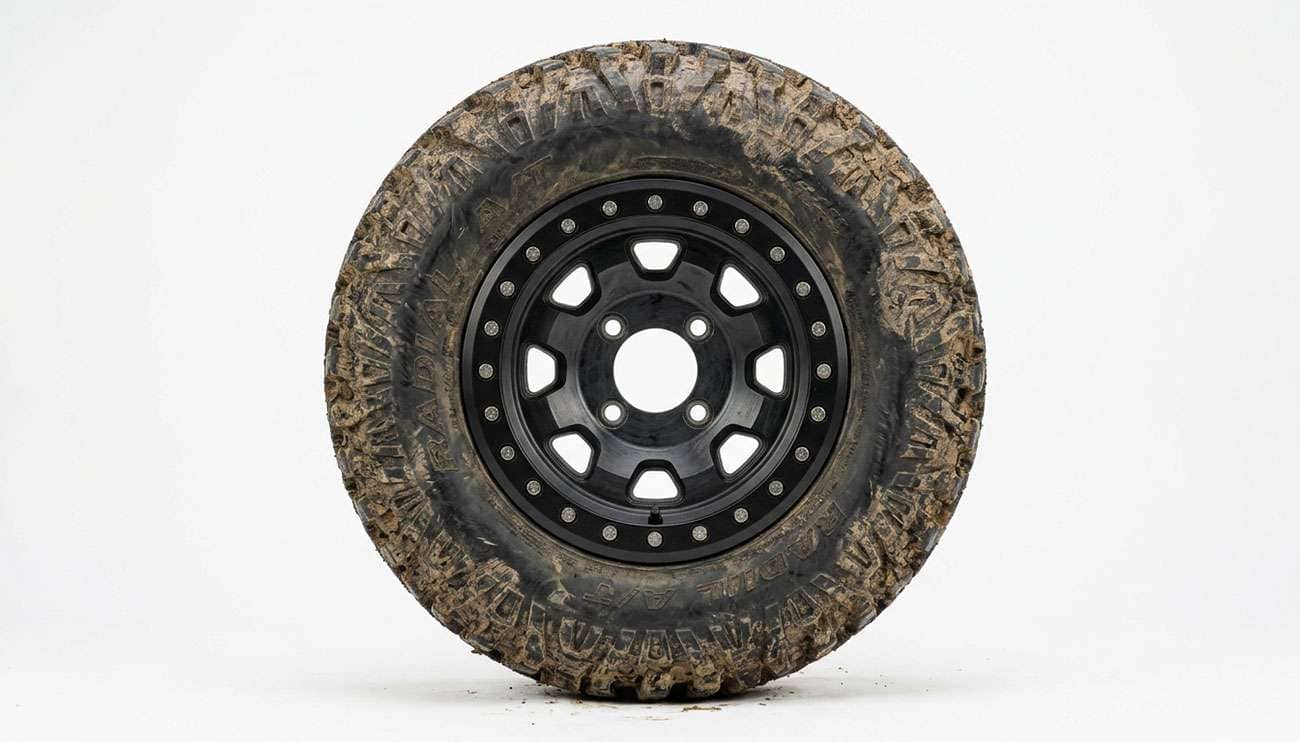
4x137 fits most full-size Can-Am ATVs and side-by-sides, the Honda Talon and Pioneer 1000, Kawasaki Mule and Teryx, solid-rear-axle Kawasaki quads, and a handful of other utility machines. That is the easy answer. The harder one is that 4x137 covers everything from a 12-inch utility quad wheel to a 24-inch street-styled UTV wheel, with offsets spanning nearly 100 millimeters and prices running about twentyfold from one end of the pattern to the other. Matching the four holes gets the wheel on the studs. It tells you nothing about whether that wheel will survive your machine.
I have been putting wheels on things for a long time, and the powersports side of the counter has a problem the car side does not. On a car, a bolt pattern usually implies a rough class of vehicle. A 4x100 wheel is going on something small and light. On 4x137, the same four holes serve a 600-pound utility quad that never sees more than 25 miles an hour and a turbocharged sport UTV that lands from four feet in the air at 70.
Same pattern. Nothing else in common. And the wheel listing tells you the pattern in the title and buries the load rating five bullets down, if it lists it at all.
So here is how I would actually work this. Confirm the pattern, yes. Then figure out which class of machine you have, because that determines the diameter, the offset and the load rating you need. Our broader guide to wheel bolt patterns covers how the whole spec stack fits together.
Machine Class |
Typical Wheel Size |
What the Wheel Has to Survive |
What to Prioritize |
|---|---|---|---|
Utility quad, solid rear axle |
12x7 to 14x7 |
Low speed, heavy racks, mud and roots |
Corrosion resistance and price |
Utility side-by-side |
14x7 to 15x7 |
Payload, towing, long work days |
Load rating and hub bore fit |
Sport and desert side-by-side |
15x7 and up, often beadlock |
High speed impacts, jump landings, low tire pressure |
Load rating, construction, bead retention |
Street-styled UTV build |
18x7 through 24x7 |
Pavement, curbs, mostly cosmetic duty |
Offset and clearance; these are not trail wheels |
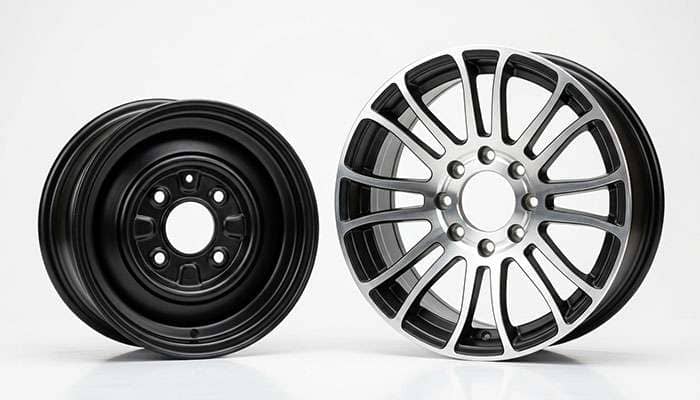
Here is the list, organized by brand, with the exceptions called out because the exceptions are what get people.
Brand |
4x137 Machines |
The Exceptions |
|---|---|---|
Can-Am |
Maverick X3, Maverick Sport and Trail, Commander, Defender, Outlander, Renegade |
Maverick R is 6x139.7, not a four-lug at all |
Honda |
Talon 1000R and 1000X, Pioneer 1000 |
All other Honda ATVs and UTVs are 4x110 |
Kawasaki |
Mule, Teryx, and quads with a solid rear axle |
KRX 1000 is 4x156; independent rear suspension quads are 4x110 |
Arctic Cat and Textron |
Select Wildcat and Prowler models |
Much of the Arctic Cat line runs 4x115; verify by model year |
Polaris |
Not the house pattern |
Polaris is overwhelmingly 4x156 |
Yamaha |
Not the house pattern |
Yamaha runs 4x110 across most of the line |
Two things worth sitting with. First, the exceptions are not obscure edge cases. The Honda Pioneer 1000 and Talon being 4x137 while the rest of Honda is 4x110 catches somebody every week. Second, brands change patterns between models and between model years, and a machine that shares a name with a 4x137 machine is not necessarily a 4x137 machine.
Measure your own hub. It takes two minutes and it is the only source that is never wrong. If your machine turns out to be a Polaris, we have a separate guide to the 4x156 bolt pattern.
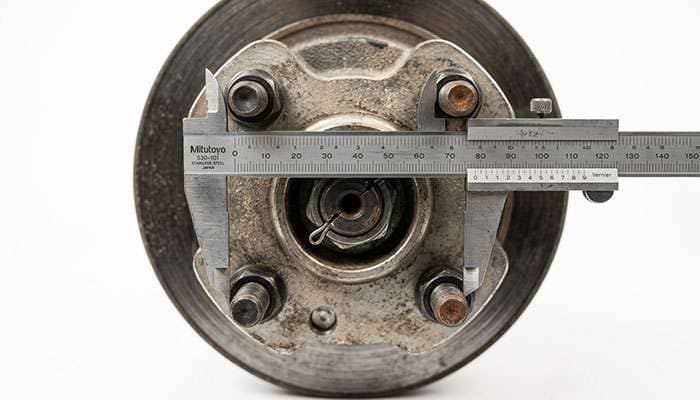
4/137 and 4x137 are the same thing written two ways. The powersports world tends to use a slash, the automotive world tends to use an x, and you will also see it hyphenated as 4-137. All three mean four lug holes spaced evenly around a circle 137 millimeters in diameter.
In inches that circle is 5.394, so you will occasionally see 4x5.39 on a listing. Same pattern, different unit.
The other notation you have to learn on the powersports side is offset, and this is where it gets genuinely different from cars. UTV and ATV wheels are commonly sold with offset written as two numbers, like 4+3 or 5+2. Those are inches of backspacing and frontspacing, and they add up to the wheel width. A 15x7 wheel listed as 4+3 has 4 inches of backspacing behind the mounting pad and 3 inches in front of it.
Notation |
What It Means |
Where the Wheel Sits |
|---|---|---|
5+2 on a 15x7 |
5 in backspacing, 2 in front |
Tucked in toward the machine |
4+3 on a 15x7 |
4 in back, 3 in front |
Near centered; the common utility setting |
3+4 on a 15x7 |
3 in back, 4 in front |
Pushed outward, wider track |
2+5 on a 15x7 |
2 in back, 5 in front |
Aggressive stance, maximum bearing load |
Across the 4x137 pattern, offsets run from roughly negative 47 millimeters all the way to positive 52, with the middle of the market sitting near positive 10. That is close to a hundred millimeters of spread inside one bolt pattern, which tells you how differently these wheels are meant to sit.
No, and the exception is a recent one that has caught a lot of people out.
Most modern full-size Can-Am machines are 4x137. Maverick X3, Maverick Sport, Maverick Trail, Commander, Defender, Outlander, Renegade. If you have any of those, four holes on a 137 millimeter circle is what you are shopping for.
The Can-Am Maverick R is not. It moved to 6x139.7, which is a six-lug truck pattern, and it uses a 12 millimeter stud with 1.5 thread pitch. That is not a small change. It means no 4x137 wheel in existence will go on a Maverick R, and it means Maverick R owners are shopping in a completely different aisle than every other Can-Am owner.
The reason for the change is not mysterious. The Maverick R is a heavier, faster machine, and six fasteners spread the load better than four while giving the wheel a larger mounting face to work with. That is the same reasoning that put six lugs on half-ton trucks. If that is your machine, our 6x139.7 bolt pattern guide is where to look, and yes, it is genuinely the same pattern trucks use.
Older Can-Am and Bombardier machines are also worth checking individually rather than assuming. Model year matters here more than it does on cars.
This one comes up constantly, usually because somebody's owner manual says 4/136 and every wheel they can find says 4/137. Both numbers are real, both appear on spec sheets, and the honest answer has two halves.
On the bolt circle: one millimeter is inside the working clearance of a lug hole. The holes in a wheel are drilled larger than the studs by design, and half a millimeter of radial offset per stud does not consume that clearance. In practice these two patterns are treated as interchangeable across the powersports aftermarket, and hardware labeled 4/137 routinely goes on machines specified as 4/136.
On the hub bore: they are not the same, and this is where people actually get caught. Wheels sold as 4x136 are built around different center bores than wheels sold as 4x137. The 137 pattern clusters around bores near 110 and 112 millimeters, plus a smaller group near 96. The 136 pattern clusters lower, near 106 and 110.5. Those are stocked as genuinely separate wheels by different manufacturers, not as one wheel with two labels.
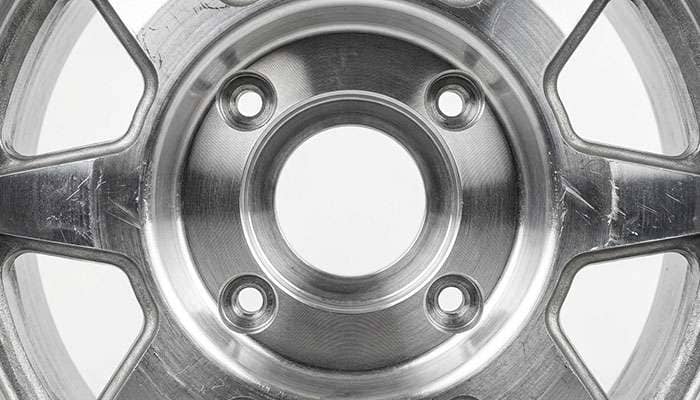
So the practical rule I would give you: do not worry about the one millimeter of bolt circle. Do check that the wheel's center bore is equal to or larger than your machine's hub register. A bore that is too small will not seat, and no amount of persuasion fixes that. A bore that is too large gets a centering ring, which is normal and correct.
If a listing gives you the bolt pattern and not the bore, that is a listing I would skip rather than guess on.
Yamaha is a 4x110 house, and it is one of the more consistent brands in powersports about it. Grizzly, Kodiak, Raptor, Banshee, Wolverine, Viking, Rhino. Non-sport and modern Yamaha ATVs and side-by-sides run four holes on a 110 millimeter circle, which is 4.33 inches.
The exception is the YXZ1000R from 2019 onward, which moved off the house pattern. If you have a YXZ, check the year before you order anything.
4x110 is worth knowing about beyond Yamaha, because it is the single most widely shared pattern in powersports. Honda's non-sport ATVs and UTVs use it, Kawasaki's independent-rear-suspension quads use it, Suzuki uses it, and CFMoto uses it. If you are shopping used wheels at a swap meet, 4x110 is the pattern you will trip over most often, and it is not compatible with 4x137 in any direction.
Here is one that surprises people who came in through the ATV door. 4x130 is not a powersports pattern at all. It is the air-cooled Volkswagen pattern.
Beetle, Karmann Ghia, Type 3, Bus from the late 1960s forward, Thing. Early Porsche 356 and 911 hardware sits in the same family. If you have ever seen a set of deep-dish chrome smoothies or eight-spoke wheels under a lowered Bug, those are 4x130.
I am including this because the search results for four-lug patterns mix powersports and air-cooled VW freely, and the two worlds have nothing to do with each other. A 4x130 wheel will not go on a Can-Am and a 4x137 wheel will not go on a Beetle. The available sizes tell the story too: 4x130 lives almost entirely in 15-inch diameters from 4.5 up to 10 inches wide, with offsets running to deeply negative figures for that classic dished look. Nothing about that lineup is built for a trail.
Great pattern. Completely different hobby.
4x100, by a wide margin, and it is not close.
4x100 has been the default small-car pattern worldwide for decades. Honda Civic, Volkswagen Golf through the Mk4, BMW E30 and E36 four-cylinder cars, Mazda Miata in NA and NB form, Toyota Corolla, Nissan Sentra, Mini, and a long list of Hyundai and Kia compacts. If you count vehicles produced, nothing else in four-lug comes near it.
Within powersports specifically, the most common pattern is 4x110, for the reasons in the Yamaha section above. 4x137 and 4x156 split most of the rest, with 4x156 being the Polaris house pattern and 4x137 covering Can-Am, Kawasaki and the Honda sport machines.
None of these interchange with each other. Four-lug patterns sit close together numerically and far apart mechanically, and there is no dual-drilling in four-lug the way there is in five-lug, because there is no room to place two sets of four holes in one mounting pad.
A 2006 Chevrolet Silverado 1500 is 6x139.7, which is 6x5.5 in inches. Six lugs, not four. Same pattern GM used on half-ton trucks for a very long time, and the same pattern Toyota, Nissan and Ford use on various half-tons.
This question turns up alongside 4x137 searches for two reasons. One is that 137 and 139.7 look similar enough on a screen to cause a double-take. The other is the Can-Am Maverick R, which as noted above runs the truck pattern, so a lot of powersports searching now bumps into 6x139.7 legitimately.
They are not related patterns and nothing crosses over. If you landed here looking for truck wheels, the 6x139.7 guide linked in the Can-Am section above has the full vehicle list.
Now the part I actually care about, and the part nobody puts in a bolt pattern article.
Every UTV wheel worth buying publishes a per-wheel load rating. A typical 15x7 aluminum UTV wheel is rated somewhere around 1,000 pounds. That number is not decoration. A loaded Defender with two people and a bed full of feed, or a Maverick X3 landing from a whoop at speed, generates instantaneous corner loads well above static weight.
Across the 4x137 pattern, wheels range from roughly sixty dollars to well over a thousand. Some of that is finish and brand. A lot of it is construction: cast versus flow-formed versus forged, single-piece versus multi-piece, and how much material is left in the spokes and the barrel. A sixty-dollar wheel and an eight-hundred-dollar wheel in the same size and pattern are not the same object.
If you run a utility machine at working speeds, the value end of the pattern is genuinely fine. If you run a sport machine hard, it is not, and the failure mode is a cracked spoke on the trail rather than a warning light.
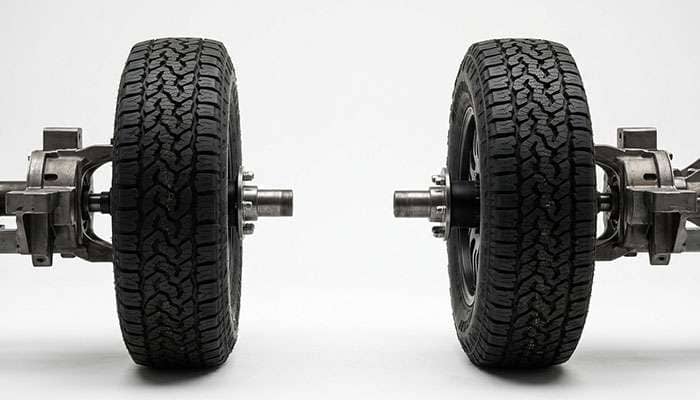
The other one is offset, and this is the mistake I see most often on built machines.
Push the wheel outward with an aggressive offset and you move the tire's centerline further from the wheel bearing. That extra distance is a lever arm, and every bump multiplies through it into the bearing and the hub. Go far enough and you will be replacing bearings on a schedule you did not have before. It is a slow failure that people rarely connect back to the wheel choice, because the wheels look great and the bearings do not fail for months.
Wider track has real benefits, particularly stability on side hills. I am not telling you never to do it. I am telling you it is a trade, and the bill comes later. Our comparison of ATV vs UTV wheels covers how the two categories are built differently for exactly these loads, and our guide to common ATV wheel sizes covers picking diameter and width.
One more, if you air down. Running low pressure for traction is the whole point on many of these machines, and low pressure is exactly when a tire unseats from a standard rim. Beadlock and bead-grip designs exist to solve that, and they solve it in different ways at different price points. We broke down the difference in beadlock vs bead grip.
4x137 fits Can-Am across nearly the whole line, the Honda Talon and Pioneer 1000, Kawasaki Mule and Teryx and solid-axle quads, and select Arctic Cat machines. That list is easy to find and it is where most articles on this stop.
What I would rather you take away is that the pattern is the least discriminating spec on the wheel. Inside 4x137 you have diameters from 12 to 24 inches, offsets spanning a hundred millimeters, and construction quality spanning a twentyfold price range. The four holes are identical across every one of them.
Confirm the pattern in two minutes with a caliper. Then spend your real thinking on hub bore, load rating and offset, because those are the three that decide whether the wheel fits, holds up, and leaves your bearings alone.
When you are ready to look at what is out there, browse the full 4x137 bolt pattern wheel selection.
4x137 fits most full-size Can-Am ATVs and side-by-sides including the Maverick X3, Maverick Sport and Trail, Commander, Defender, Outlander and Renegade. It also fits the Honda Talon 1000R and 1000X and the Pioneer 1000, the Kawasaki Mule and Teryx, Kawasaki quads with a solid rear axle, and select Arctic Cat and Textron models. The Can-Am Maverick R is the main exception in that lineup, running 6x139.7 instead.
Can-Am across nearly the whole line, Honda Talon and Pioneer 1000, Kawasaki Mule and Teryx plus solid-rear-axle Kawasaki quads, and select Arctic Cat Wildcat and Prowler models. Polaris and Yamaha are not 4x137 houses; Polaris runs 4x156 and Yamaha runs 4x110. Verify by model and year, because manufacturers change patterns between generations.
4/137 is four lug holes evenly spaced around a circle 137 millimeters in diameter, or 5.394 inches. It is written as 4/137, 4x137, 4-137 and occasionally 4x5.39 depending on the seller, and all of those describe the same pattern. Measure it center to center between two studs directly opposite each other.
No. Most modern full-size Can-Am machines are 4x137, but the Maverick R uses a 6x139.7 pattern with a 12 millimeter stud at 1.5 thread pitch. That means no 4x137 wheel will fit a Maverick R. Older Can-Am and Bombardier machines should also be checked individually rather than assumed, since model year matters.
Yamaha ATVs and side-by-sides use 4x110, which is 4.33 inches. That covers the Grizzly, Kodiak, Raptor, Banshee, Wolverine, Viking and Rhino. The YXZ1000R from 2019 onward is the exception and moved off the house pattern, so check the year on those. 4x110 is also used by Honda's non-sport machines, Kawasaki's independent-rear-suspension quads, Suzuki and CFMoto.
4x130 is the air-cooled Volkswagen pattern, used on the Beetle, Karmann Ghia, Type 3, later Bus and the Thing, with early Porsche 356 and 911 hardware in the same family. It is not a powersports pattern despite turning up in four-lug searches alongside ATV results. Wheels in 4x130 live almost entirely in 15-inch diameters, often with deeply negative offsets for a dished look.
4x100 by a wide margin, counting vehicles produced. It has been the default small-car pattern worldwide for decades across the Honda Civic, Volkswagen Golf through Mk4, four-cylinder BMW E30 and E36, Mazda Miata NA and NB, Toyota Corolla, Nissan Sentra, Mini and many Hyundai and Kia compacts. Within powersports specifically, the most common four-lug pattern is 4x110.
A 2006 Chevrolet Silverado 1500 uses 6x139.7, which is 6x5.5 in inches. That is six lugs, not four, and it is the long-running GM half-ton truck pattern also used by several Toyota, Nissan and Ford half-tons. It has no relationship to 4x137 and nothing crosses over between them, though the two numbers look similar enough to cause confusion.