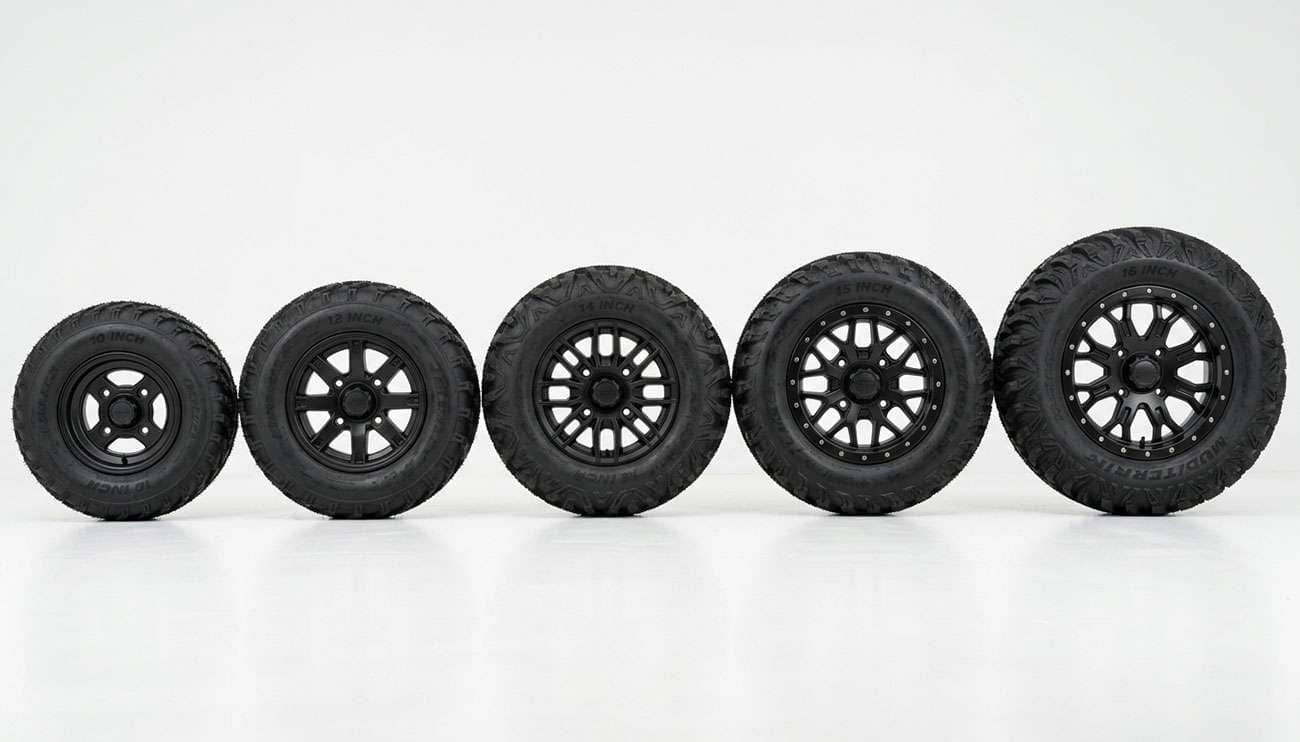
If you're shopping for ATV wheels or tires, the first question you need to answer is what size your machine actually uses. Unlike cars and trucks where most vehicles cluster around 16-20 inch wheels, ATVs span a much wider range — from 8-inch youth quads up to 15-inch UTVs — and the right size depends heavily on what category your machine falls into and how you use it.
I get this question daily at Performance Plus Tire, so let me give you the complete breakdown: the most common size, the sizes by category, the fitment details that matter, and how to figure out exactly what your specific ATV needs.
The most common ATV wheel size is 12 inches in diameter. Across the utility and recreational ATV segment — which represents the vast majority of ATVs on the market — 12-inch wheels are the dominant factory size. Most Honda Rancher, Yamaha Kodiak, Polaris Sportsman, and Can-Am Outlander models use ATV wheels in 12-inch diameter from the factory, typically in widths of 7 inches front and 8-9 inches rear.
For UTVs and side-by-sides, the most common size shifts to 14 inches, though 15 and 16 inches are increasingly popular as the UTV market moves toward larger, more capable machines. The Fuel UTV wheel line is particularly strong in this category. For youth ATVs, 8 and 10-inch wheels dominate. For sport and racing quads, 9 and 10 inches are standard.
That's the quick answer. Now let me break it down category by category because "most common" changes significantly depending on what type of machine you're riding.
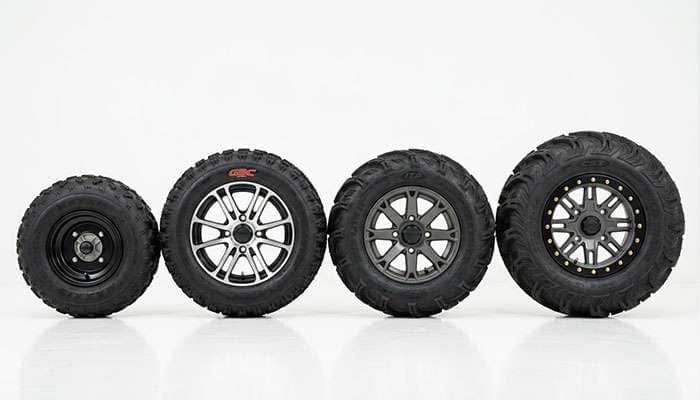
ATV wheel sizes sort cleanly by machine category. Here's what each category typically runs:
Category |
Typical Diameter |
Typical Width |
Example Models |
|---|---|---|---|
Youth ATVs (50cc–125cc) |
8"–10" |
5"–7" |
Honda TRX90, Polaris Outlaw 50, Yamaha Raptor 90 |
Sport/Racing Quads |
9"–10" |
5"–10" |
Yamaha YFZ450R, Honda TRX450R, Can-Am DS450 |
Utility ATVs (300cc–700cc) |
12" |
7"–9" |
Honda Rancher, Yamaha Kodiak, Polaris Sportsman 570 |
Large Utility ATVs (700cc+) |
12"–14" |
7"–10" |
Polaris Sportsman 850, Can-Am Outlander 1000, Kawasaki Brute Force 750 |
UTVs / Side-by-Sides |
14"–15" |
7"–10" |
Polaris RZR, Can-Am Maverick, Honda Pioneer |
High-Performance UTVs |
15"–16" |
8"–10" |
Polaris RZR Pro XP, Can-Am Maverick X3, Kawasaki KRX 1000 |
The key pattern: as you move up in machine size and capability, wheel diameter increases. A youth ATV needs a small wheel for low center of gravity and manageable tire mass. A performance UTV needs a larger wheel to clear bigger brakes and fit taller aggressive tires for real off-road capability.
ATV wheel sizes are expressed in a simple format: diameter × width. A wheel marked "12x7" is 12 inches in diameter and 7 inches wide. Those dimensions are measured bead seat to bead seat — not the outer edge of the rim — which is the standardized measurement point across all wheel manufacturers.
When you buy a matching tire, the third number in the tire size tells you what wheel diameter it fits. A 25x10-12 tire is 25 inches tall, 10 inches wide, and fits a 12-inch wheel. The tire width should typically be 1-4 inches wider than the wheel width — that's the proper matchup that keeps the tire bead seated and prevents slippage. A 10-inch wide tire belongs on a wheel 6-9 inches wide. Too narrow a wheel and the tire bulges; too wide and you compromise the bead seal, especially at low pressures.
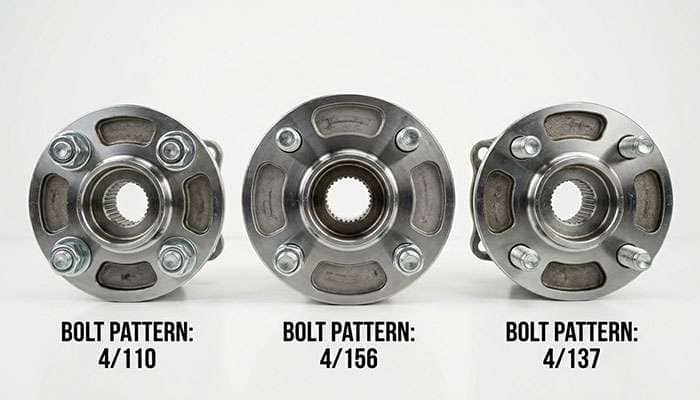
Wheel diameter isn't the only fitment specification that matters. ATV bolt patterns vary significantly by manufacturer, and the wrong bolt pattern makes a wheel physically impossible to install regardless of how perfect the diameter is:
4x110 is by far the most common ATV bolt pattern. Nearly every Honda, Yamaha, Suzuki, and Kawasaki utility ATV uses 4x110. This pattern has four bolt holes arranged in a 110mm diameter circle. If you have a Honda Rancher, Yamaha Kodiak, or similar mid-size utility quad, you're almost certainly on 4x110.
4x156 is the Polaris and Can-Am standard for most utility ATVs. Polaris Sportsman, Can-Am Outlander, and Arctic Cat Alterra models typically use 4x156. This wider spacing accommodates the larger hub diameters on these machines.
4x115 appears on some Arctic Cat and older Suzuki models — less common but worth verifying if you have one of these machines.
4x137 and 4x156 dominate the UTV market, with individual manufacturers standardizing on one or the other. Polaris RZR uses 4x156. Can-Am Maverick uses 4x137. Getting this wrong is the most common fitment mistake.
Always verify your bolt pattern before ordering. It's stamped or cast on the back of your existing wheel, listed in your owner's manual, or easily measured with a ruler — center of one bolt hole to center of the hole directly across.
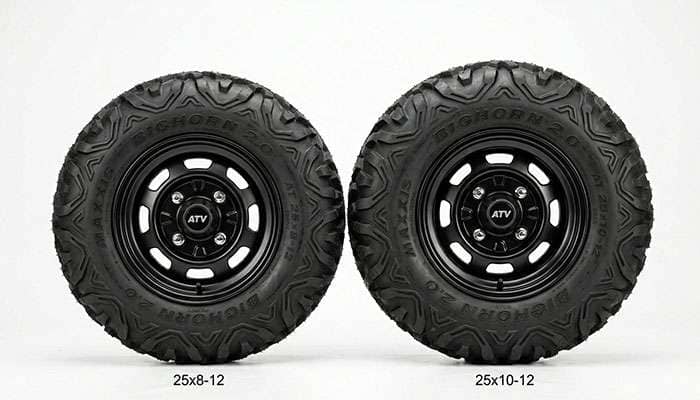
Here's something that surprises first-time ATV buyers: almost all utility and sport ATVs use different wheel widths front and rear. The front wheels are typically 1-2 inches narrower than the rears.
This isn't arbitrary — it's engineered for a reason. The narrower front wheels and tires reduce rolling resistance during steering, making the machine easier to turn and lighter in the hands. The wider rear wheels and tires provide more contact patch for traction, which is critical because ATVs are almost exclusively rear-wheel-drive (with selectable 4WD engaging the front wheels).
Typical factory combinations: Front 12x7 with 25x8-12 tires / Rear 12x8 with 25x10-12 tires. Or Front 14x7 with 27x9-14 tires / Rear 14x8 with 27x11-14 tires. This front-to-rear staggered setup is standard across virtually every utility ATV brand.
When you're upgrading wheels and tires, you can choose to run a "square" setup with matching widths front and rear, but it changes handling characteristics. Most riders stay with the staggered setup because it's what the machine was designed for.
The question after "what size do I have" is usually "how much bigger can I go?" Here's the rule I give customers:
You can typically go up 2 inches in tire diameter without modifications. If your ATV came with 25-inch tires, 27-inch tires usually fit without rubbing at full compression or full steering lock. Going up 1 inch in wheel diameter (e.g., 12 to 14 inch) with shorter sidewall tires works well and improves brake clearance if you're running aftermarket brakes.
Going more than 2 inches taller requires a lift kit. Most ATVs have limited fender clearance, and a 3+ inch taller tire will rub the fender liners at full suspension compression. A 2-3 inch lift kit resolves this and is a common modification for mud-terrain ATV builds.
Wider tires affect 4WD operation. If you upsize only the rear tires or change the front-to-rear diameter ratio significantly, 4WD becomes stressed. The front differential is designed for the stock tire diameter ratio — mismatched tires cause the front and rear driveshafts to rotate at different speeds in 4WD, which grinds the differential. Always change all four tires together and maintain the same ratio between front and rear diameters.
Bigger tires reduce acceleration and increase stress on the drivetrain. A 27-inch tire is significantly heavier than a 25-inch tire. Your clutch, transmission, and axles all work harder. If you're running a small-displacement ATV (under 500cc) and jumping to aggressive 28-29 inch mud tires, expect noticeable loss of low-end power and accelerated drivetrain wear.
Browse our full ATV and UTV wheel and ATV and UTV tire selection. Not sure what fits? Call us at 888-926-2689 — we verify bolt pattern, offset, and clearance before shipping.
The Honda Rancher uses 12-inch wheels front and rear, with a 4x110 bolt pattern. Front wheels are typically 12x7 running 24x8-12 or 25x8-12 tires. Rear wheels are typically 12x8 running 24x10-11 or 25x10-12 tires depending on the specific year and trim. Earlier models (pre-2015) used 11-inch rear wheels in some configurations. Verify your specific year and model in the owner's manual or by measuring your current wheels before ordering replacements.
No. While some wheels are marketed for both ATV and UTV use, they're typically different products. UTVs are heavier and carry more payload, so UTV wheels are built with higher load ratings and reinforced construction. ATVs typically use 10-12 inch wheels while UTVs use 14-15 inches. Bolt patterns also differ: 4x110 is common for ATVs while 4x137 and 4x156 dominate UTVs. Never assume a wheel marketed for ATV use will safely handle UTV loads, and vice versa — always match the wheel to the specific machine category.
You can typically go up 1 inch in wheel diameter (e.g., 12 to 14 inch) or 2 inches in tire diameter (e.g., 25-inch to 27-inch tires) without a lift kit. These modest increases usually fit within factory fender clearance without rubbing at full suspension compression or full steering lock. Going larger than that requires a 2-3 inch lift kit to provide additional clearance. Larger tires also increase drivetrain stress — if you're running a small-displacement ATV (under 500cc), the extra weight of significantly bigger tires noticeably reduces acceleration.
ATV bolt patterns vary by manufacturer. Honda, Yamaha, Suzuki, and Kawasaki utility ATVs typically use 4x110, while Polaris and Can-Am use 4x156 for most models. Arctic Cat often uses 4x115 on older models and 4x156 on newer ones. To verify your specific bolt pattern, measure the distance from the center of one bolt hole to the center of the hole directly across from it on your existing wheel. The number should match one of the standard ATV patterns. If you're unsure, call us with your ATV's year, make, and model at 888-926-2689 — we can confirm the factory specification in seconds.
Most utility ATVs use narrower front wheels and wider rear wheels for engineering reasons. The narrower fronts reduce rolling resistance during steering, which makes the handlebars lighter and turning more responsive. The wider rears increase contact patch for traction, which matters because ATVs deliver power primarily through the rear wheels (with selectable 4WD engaging the fronts when needed). A typical configuration is 12x7 front and 12x8 rear. This staggered setup is standard across virtually every utility ATV brand — it's not a mistake or an inconsistency, it's intentional.
High-performance UTVs like the Polaris RZR Pro XP, Can-Am Maverick X3, and Kawasaki KRX 1000 typically use 15-inch wheels as standard equipment, with some high-end trims running 16-inch wheels. Widths range from 7 to 10 inches depending on front/rear placement and intended use. These larger diameters accommodate the bigger brake rotors and more aggressive 30-32 inch tires that performance UTVs need for serious off-road capability. Bolt patterns are almost always 4x137 (Can-Am) or 4x156 (Polaris, Kawasaki).