
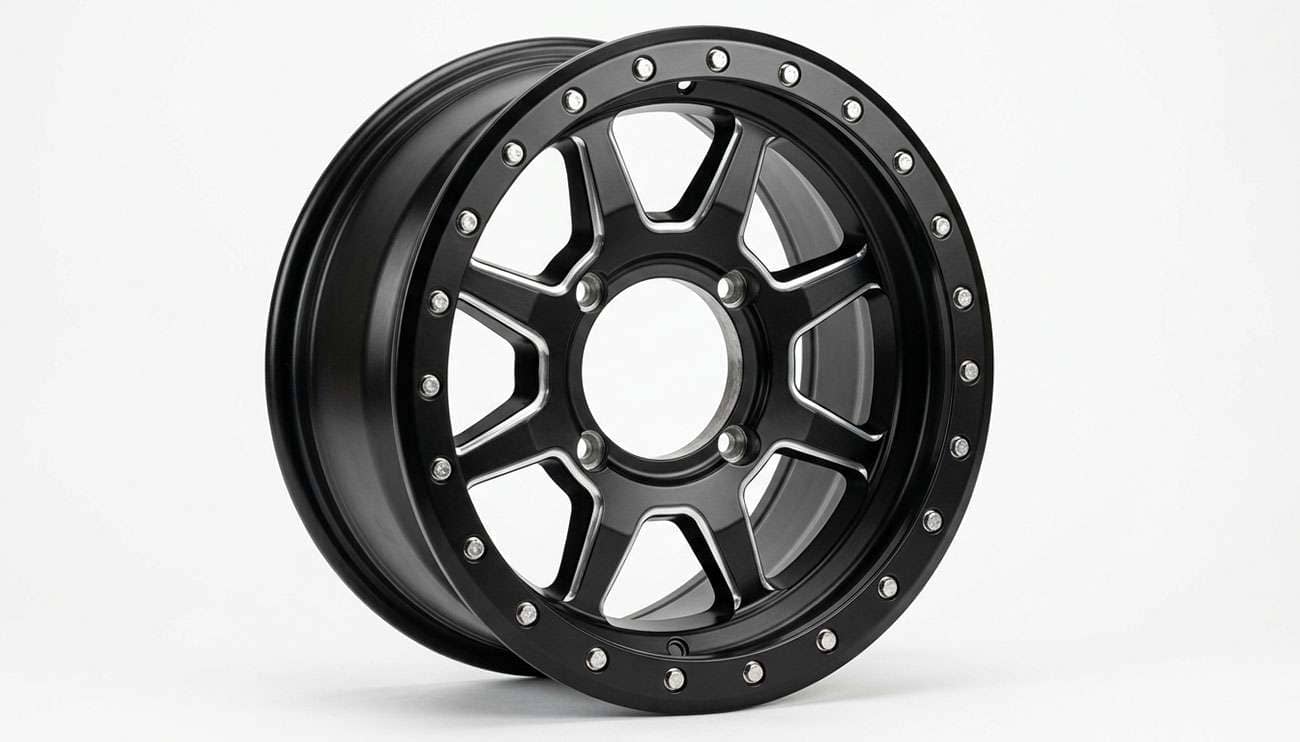
4x156 is overwhelmingly a Polaris pattern. RZR, Ranger, General, Sportsman and Scrambler models make up the bulk of it, with select Arctic Cat and Textron machines and a handful of older utility quads filling out the rest. But the pattern is only the first of three specs that have to line up. Polaris runs one of the largest hub assemblies in powersports at a 132mm center bore, and it has used two different stud threads on the same 4x156 pattern. Match the holes and you can still end up with a wheel that will not seat.
Most 4x156 guides stop at the vehicle list. That is the easy half. The part nobody puts in front of you is that 4x156 wheels on the market ship with center bores ranging from roughly 100mm all the way to 132.5mm, and a wheel bored at 115mm will not slide onto a 132mm Polaris hub no matter how perfectly the four holes line up. It does not go on partway. It does not go on at all.
Three specs. Check all three before you order.
Spec |
What It Is |
Why It Stops You |
How to Check It |
|---|---|---|---|
Bolt pattern |
Four studs on a 156mm circle, about 6.14 inches |
Wrong pattern and the holes never line up |
Measure center to center across opposite studs |
Center bore |
The machined hole that centers the wheel on the hub |
Too small and the wheel will not seat. Too large and the studs carry the load |
Caliper the hub flange, then compare to the wheel spec |
Stud thread |
M12x1.5 on newer Polaris, 3/8-24 on a lot of older machines |
Wrong thread and your lug nuts do not fit the studs |
Read the lug nut you already own, or thread-gauge a stud |
Lug seat type |
Conical or taper seat on most aftermarket 4x156 wheels |
Flat-seat nuts on a conical wheel never clamp properly |
Look at the taper inside the wheel's lug holes |
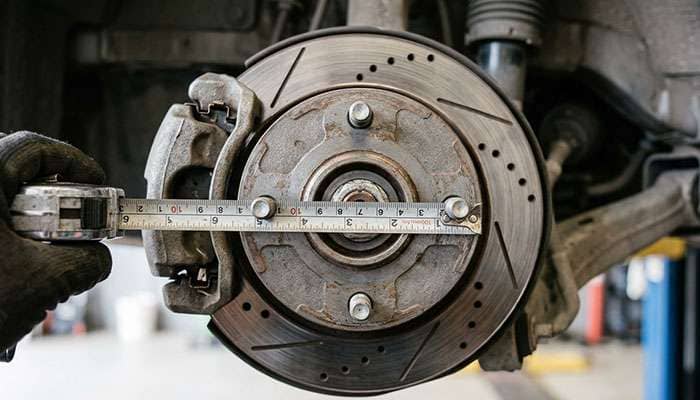
The first number is the lug count. Four studs. The second number is the pitch circle diameter, the diameter of the imaginary circle that passes through the center of all four studs, measured in millimeters. So 4x156 means four studs arranged on a 156mm circle. Converted to inches that is about 6.14 inches, which is why you will occasionally see it written as 4x6.14 in older cross-reference charts. You will also see it written 4/156, which is the same thing.
On a four-lug pattern the measurement is straightforward, because the studs sit directly opposite each other. You measure from the center of one stud straight across to the center of the stud opposite it. That distance is your pitch circle diameter. Five-lug patterns require the offset measurement trick, but four-lug does not, which makes 4x156 one of the easier patterns to verify in your own garage.
What 156mm buys is room. Spreading four studs across a 6.14-inch circle gives the wheel a wide clamping footprint, which matters on machines that put big torque through short wheelbases and land from jumps. Compare that to the 110mm pattern that dominates Japanese quads and you can see the design intent. Polaris built the pattern around bigger hubs, bigger brakes and heavier machines.
If you want the general method for measuring any pattern rather than just this one, our walkthrough on how to measure a lug bolt pattern covers four, five, six and eight-lug arrangements with the math for each.
Here is where 4x156 stops being simple.
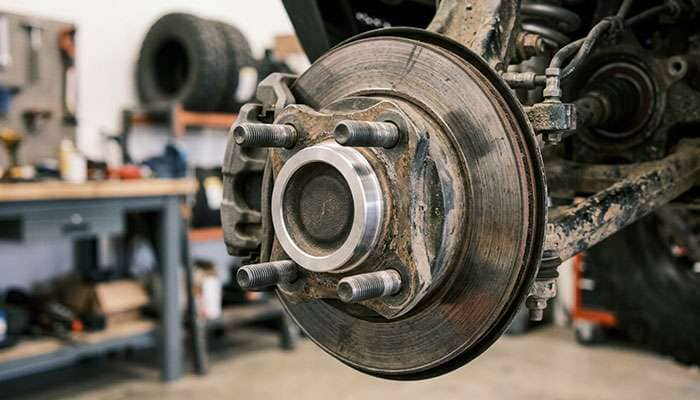
Center bore. The center bore is the machined hole in the back of the wheel that slides over the raised hub flange. When it matches, the wheel is hub-centric, meaning the hub carries the vertical load and the lug nuts only clamp. When it does not match, the wheel is lug-centric, meaning four studs are doing the centering and the load carrying at the same time.
Polaris hub assemblies are among the largest in powersports, and the 4x156 pattern was built around that. The Polaris center bore is 132mm, roughly 5.20 inches. For scale, the 4x110 pattern that Honda and Yamaha use runs an 86mm bore. That is a 46mm difference in hub diameter between two four-lug machines that look, from ten feet away, like they should share wheels.
Across 4x156 wheels available in the aftermarket, center bores cluster at 132mm but also appear at 131.1mm, 115.1mm and smaller. Plenty of listings specify a bore no larger than 131mm, which works on some machines and not others. That range is not a rounding error. It is the difference between a wheel that seats and a wheel that sits in your garage while you argue with a return department.
Stud thread. This one catches experienced riders. Polaris has used two different lug thread sizes on the same 4x156 bolt pattern. A lot of older machines, including the 2008 through 2014 RZR 800 and the Ranger 500 and 800, run 3/8-24 studs. Newer machines from roughly 2013 forward run M12x1.5. Same four holes on the same 156mm circle. Different threads on the studs.
What that means practically is that a set of lug nuts from one Polaris will not necessarily thread onto another Polaris, and a wheel and lug kit sold for the newer machines will not work on the older ones without adapters. Nobody puts that next to the bolt pattern in a product listing, and it is the most common reason a 4x156 order goes sideways.
One more spec worth knowing while you are checking. UTV wheels usually publish offset in the backspacing convention rather than millimeters, written as something like 4+3. On a 14x7 wheel, 4+3 means four inches of backspacing and three inches of front spacing. Across the 4x156 market, offsets range from around 47mm negative to 55mm positive, with the median sitting near 12mm positive. That is a wide spread, and it changes your track width by inches. Our explainer on wheel offset, backspacing and bolt patterns covers how to convert between the two conventions.
The honest answer is that 4x156 is more of a UTV and side-by-side pattern than a true ATV pattern, though it appears on both. Here is how the powersports patterns break down by brand.
Brand |
Typical Pattern |
Representative Machines |
Notes |
|---|---|---|---|
Polaris |
4x156 |
RZR, Ranger, General, Sportsman, Scrambler, Ace |
The dominant 4x156 user. Verify stud thread by year |
Arctic Cat and Textron |
4x156 on many models |
Wildcat and several Prowler variants |
Varies by model and year. Measure before ordering |
Can-Am |
4x137 |
Maverick, Commander, Defender, Outlander |
Not interchangeable with 4x156 |
Kawasaki |
4x137 on most current |
Teryx and Teryx4 |
Some older utility machines used 4x156 |
Yamaha |
4x110 |
Grizzly, Kodiak, Raptor, Viking, Wolverine, YXZ1000R |
Smaller hub and different thread pitch |
Honda |
4x110 |
Rancher, Foreman, Rubicon, Pioneer |
86mm center bore, well under Polaris spec |
Two cautions on that table. First, brands change patterns across model generations, and a 2011 machine and a 2021 machine wearing the same badge can differ. Second, some manufacturers run different patterns on utility and sport lines within the same model year. The table is a starting point for narrowing your search, not a substitute for measuring your own hub.
On the wheel side, 4x156 is well supported in the aftermarket. Diameters run from 12 inches up through 24, with 14x7 and 15x7 carrying most of the volume for trail and utility use, and larger diameters showing up on build-focused machines. MSA Offroad, Method, Raceline, Fuel UTV, KMC UTV and Vision all field lines in the pattern. If you are still deciding on diameter, our reference on common ATV wheel sizes covers what each diameter does to gearing and ground clearance, and our roundup of ATV and UTV wheels by brand goes into construction differences.
Yamaha standardized on 4x110 across essentially its entire ATV line and carried it into the side-by-sides as well. Grizzly, Kodiak, Big Bear, Bruin, Raptor, Warrior, Banshee and YFZ models all use it. So do the Rhino, the Viking, the Wolverine and the YXZ1000R.
That consistency is genuinely useful. A set of wheels off a Grizzly 700 will bolt to a Kodiak 450. What changes between models is not the pattern, it is the offset and the width, and that is what determines whether the wheel clears the brake caliper. Riders swapping wheels between Yamaha machines run into caliper interference far more often than they run into pattern problems.
Yamaha also uses a different lug thread than Polaris. Yamaha machines typically run M12x1.25, while Polaris runs M12x1.5 on newer machines. Those two thread pitches will start to thread together and then bind, which is exactly the failure mode you do not want to discover halfway through torquing a wheel. Check the pitch, not just the diameter.
The practical consequence for anyone shopping is that the Yamaha 4x110 pattern and the Polaris 4x156 pattern have almost nothing in common beyond the lug count. Different circle diameter, different center bore, different thread pitch. Wheel adapters exist to run Polaris-pattern wheels on Yamaha hubs, and they are common enough on YXZ builds specifically because so much of the aftermarket is cut for 4x156. Adapters are a real solution, but they add stack height and put another set of clamped joints in the load path, so torque them on a schedule.
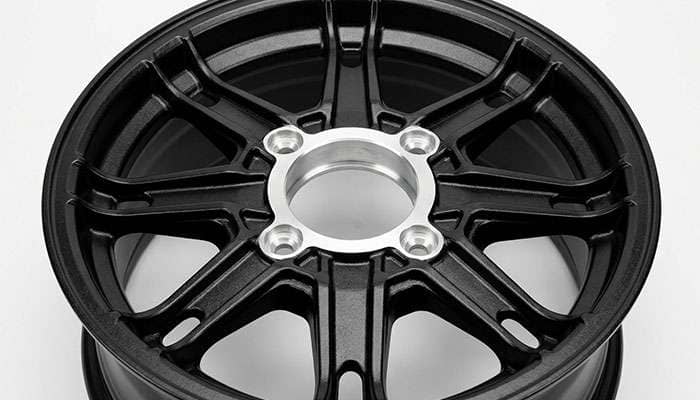
For passenger cars, 4x100. It has been the default small-car pattern for decades and it appears across Honda, Toyota, Mazda, Volkswagen, BMW, Mini, Hyundai, Kia and Nissan compact platforms. If you have a four-lug economy car built in the last thirty years, 4x100 is the first thing to check.
For powersports the answer splits by brand rather than converging on one pattern. 4x110 leads on the Japanese side, 4x156 leads on Polaris machines, and 4x137 covers Can-Am and current Kawasaki. There is no single dominant powersports four-lug the way 4x100 dominates compact cars.
Pattern |
Where You Find It |
Typical Application |
|---|---|---|
4x100 |
Compact and subcompact passenger cars |
Civic, Corolla, Miata, Golf, Mini, Accent |
4x156 |
Polaris side-by-sides and quads |
RZR, Ranger, General, Sportsman |
4x137 |
Can-Am and current Kawasaki side-by-sides |
Maverick, Commander, Defender, Teryx |
4x110 |
Japanese quads and utility side-by-sides |
Grizzly, Rancher, Kodiak, YXZ1000R |
4x114.3 |
Older passenger cars and light imports |
Legacy Nissan, Mazda, Mitsubishi platforms |
One thing worth flagging. 4x114.3 and 4x110 are only 4.3mm apart in pitch circle diameter, and people do try to force one onto the other. The studs will start into the holes and the wheel will look like it is going on. What is actually happening is that each stud is loading against the side of its hole instead of centering in it, and the clamping force never develops correctly. Our breakdown of the 4x114.3 bolt pattern covers which vehicles use it and why the near-miss patterns are a problem rather than a workaround.
Yes, on the half-ton. 6x5.5 is the imperial way of writing 6x139.7, and that has been the Silverado 1500 pattern from 1999 through current model years. If you are looking at wheels listed as 6x5.5, 6x139.7 or 6-lug 5.5 inch, those are all the same specification and they will bolt to a Silverado 1500 hub.
Two caveats before you order. The 2500 and 3500 heavy duty trucks use an eight-lug pattern, not six, so the 6x5.5 answer does not carry across the Silverado range. And bolting up is not the same as fitting. Silverado hub bores run 78.1mm on most model years, and a wheel with a larger bore will need hub-centric rings to sit properly. Offset matters just as much, since half-ton trucks have a fairly narrow window before the tire starts contacting the upper control arm at full lock.
We have the full compatibility list in our guide to the 6x5.5 bolt pattern and which vehicles share it, which covers the GM, Ford, Toyota and Nissan trucks that run the same spec.
A wheel with a bore larger than the hub bolts up and the machine drives away. That is the problem. You do not find out on the first ride. You find out in stages.
Installation. With an oversized bore, nothing centers the wheel except the taper on four lug nuts pulling it into rough alignment as you torque them. Get the torque sequence slightly uneven and the wheel seats slightly off-center. It will look fine.
First rides. A vibration appears at speed that balancing does not fix, because the wheel is not concentric with the axle. Riders usually chase this with wheel weights and then with a new tire before anyone checks the bore.
First season. This is the expensive part. In a properly hub-centric installation, the hub flange carries the vertical and lateral loads and the studs only provide clamping force. Take the hub out of the load path and those four studs now carry shear loads they were never sized for. On a side-by-side working through whoops, that load cycles thousands of times per mile.
Eventually. The lug holes in the wheel elongate from the repeated shear, which lets the joint loosen further, which increases the shear, which accelerates the elongation. Then a stud fatigues and shears. Losing a wheel on a machine at trail speed is a rollover event, and the recreational off-highway vehicle standards published under ANSI and administered through ROHVA exist precisely because rollover is the dominant injury mechanism on these machines.
The fix is not complicated. Match the bore, or use precision hub-centric rings sized to close the gap between your hub diameter and the wheel bore. Rings are a legitimate engineering solution when they are machined to spec and made of a material that will not deform, and they are standard practice throughout the automotive aftermarket. What is not a solution is deciding that the lug nuts will handle it.
The same logic applies to spacers and adapters. They are useful tools, and plenty of good builds use them. But every spacer adds a clamped joint, and every clamped joint needs its torque checked on a schedule rather than once at installation. The Tire Industry Association teaches re-torque intervals for exactly this reason, and the interval matters more on a machine that pounds through rough terrain than it does on a highway vehicle.
Five minutes with a tape measure and a caliper settles all three specs. Do this before you order rather than after the box arrives.
Measure the pattern. On a four-lug hub, measure from the center of one stud straight across to the center of the stud directly opposite. Metric tape is easier here. If you land near 156mm you have 4x156. If you land near 137mm or 110mm you have something else, and those three numbers are far enough apart that you will not confuse them.
Measure the hub flange. Pull a wheel and caliper the outside diameter of the raised circular flange the wheel center sits over. That number is the minimum center bore your new wheel needs. On most Polaris machines you will read something close to 132mm.
Identify the stud thread. The easiest method is to look at a lug nut you already own, since most are marked. If not, a thread pitch gauge costs a few dollars and removes the guesswork. You are looking to distinguish M12x1.5 from M12x1.25 from 3/8-24, and those differences are too fine to eyeball reliably.
Check the lug seat. Look inside the lug holes on your current wheel. A conical or taper seat has a visible chamfer that the nut wedges into. A flat seat does not. Aftermarket 4x156 wheels are typically conical, and running the wrong nut type means the clamping force is applied to a surface that was not designed to receive it.
Write it all down. Pattern, bore, thread, seat type, and your current offset in whichever convention your machine uses. That five-line note is what you check every listing against. If a wheel product page does not publish its center bore, that is your signal to ask before you buy rather than to assume.
If you are also weighing whether an ATV wheel and a UTV wheel are actually different products, our comparison of ATV vs UTV wheels covers the load rating and construction differences that matter once you get past fitment.
4x156 belongs mostly to Polaris, with select Arctic Cat and Textron machines and some older utility quads sharing it. That vehicle list is the easy answer and it is where most guides stop.
The answer that actually gets a wheel onto your machine has three parts. The pattern has to be 4x156. The center bore has to clear your hub, which on Polaris means 132mm rather than the smaller bores common elsewhere in the four-lug world. And the stud thread has to match, which is not a given even between two Polaris machines, because the same bolt pattern has carried both 3/8-24 and M12x1.5 studs across different model years.
Measure your hub, write down all three numbers, and check every listing against them. When you are ready to shop the pattern, browse the 4x156 bolt pattern wheel selection and filter by center bore before anything else.
No. The pitch circle diameters differ by 19mm, which is far too much to force. 4x156 is primarily Polaris while 4x137 covers Can-Am and current Kawasaki side-by-sides. The two patterns also carry different center bores and often different stud threads. Wheel adapters are the only way to run one on the other, and they add stack height that changes your track width.
Polaris machines use a 132mm center bore, roughly 5.20 inches, which is one of the largest in powersports. Many aftermarket 4x156 wheels publish a bore of 131mm or 132mm to suit. Caliper your own hub flange before ordering, because a wheel bored smaller than your hub will not seat at all, and one bored larger needs hub-centric rings to stay concentric.
Only with adapters. The YXZ1000R runs 4x110 with a smaller hub and an M12x1.25 thread, while Polaris wheels are cut for 4x156. Adapters that convert 4x110 hubs to accept 4x156 wheels are common precisely because so much of the UTV aftermarket is built around the Polaris pattern. Expect the adapters to widen your track by several inches, and re-torque them on a schedule.
The pattern is supported from 12 inches up through 24. Most trail and utility riders run 14x7 or 15x7, which is where the majority of the market sits and where tire selection is deepest. Larger diameters appear on build-focused machines, but going up in diameter reduces sidewall, which on a side-by-side means less impact absorption on rocks and roots.
Measure from the center of one stud straight across to the center of the stud directly opposite it. Four-lug patterns place the studs diametrically opposite, so that distance is the pitch circle diameter with no correction needed. This is simpler than five-lug, which requires measuring from one stud to the outer edge of the hole two positions away because no two studs sit directly opposite.
Usually yes. Most aftermarket 4x156 wheels require conical or taper seat lug nuts rather than the flanged nuts some machines ship with, and many wheels limit the outside diameter of the nut and socket so they clear the lug pocket. Confirm the seat type, the thread pitch and the nut diameter against the wheel specification, since factory nuts frequently will not work with aftermarket wheels.



