
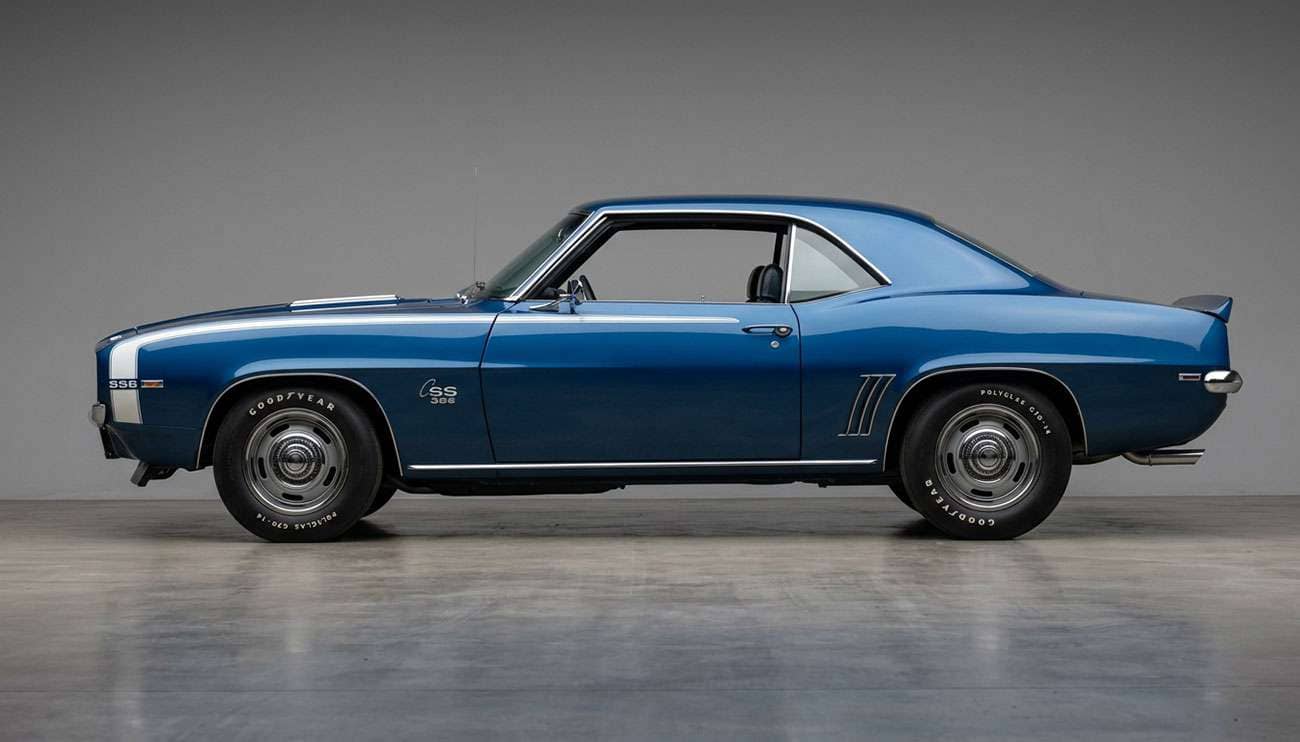
Walk a car show in 2026 and the size difference is striking. A new Camaro rolls on 20-inch wheels with 35-series rubber. The 1969 Camaro parked next to it wears 14s or 15s with tires nearly twice as tall. The common assumption is that classic car proportions came down to a different era's taste — that Detroit just liked small wheels and tall tires.
That assumption is wrong. The 14- and 15-inch wheel specifications that dominated American automotive production from the late 1940s through the late 1970s were the product of six specific engineering constraints, not stylistic preference. Understanding those constraints clarifies a lot — why plus-sizing a classic car is a bigger project than it seems, why original restoration specs matter, and why the industry finally shifted to 16- and 17-inch diameters only after the underlying technology caught up.
Here's the full engineering picture.
By 1965, the American automotive industry had standardized around 14- and 15-inch wheel diameters across nearly every passenger car produced. A 1965 Chevrolet Bel Air, Ford Galaxie, Dodge Polara, and Pontiac Bonneville all rolled on 15-inch steel wheels. Compact cars like the Falcon, Nova, and Valiant used 13- and 14-inch sizes. Full-size luxury cars — Cadillacs, Lincolns, Imperials — used 15-inch wheels even at the top of the market.
This wasn't a marketing decision. It was a convergence point where six separate engineering and manufacturing factors all produced the same answer. Every time an engineer at GM, Ford, Chrysler, or AMC sat down to design a new passenger car in the mid-1960s, the wheel diameter landed in the 14- to 15-inch range because that was where the physics and the economics agreed.
The six factors, in order of how heavily they weighted the decision:
Each one reinforced the others. Changing any single factor wouldn't have moved the industry off 14- and 15-inch wheels. All six had to evolve before the shift to larger diameters became possible.
The single biggest constraint was the drum brake. From the 1920s through the early 1970s, drum brakes were the universal standard on passenger cars. A drum brake consists of a cast-iron drum that rotates with the wheel, with shoes inside that press outward against the drum surface when the brake pedal is applied.
Drum diameters grew with vehicle weight. A 1960s full-size American sedan typically ran 11- to 12-inch diameter rear drums, and 11-inch fronts were common. The drum plus the backing plate, return springs, wheel cylinders, and mounting hardware all had to fit inside the wheel. That consumed rim diameter fast.
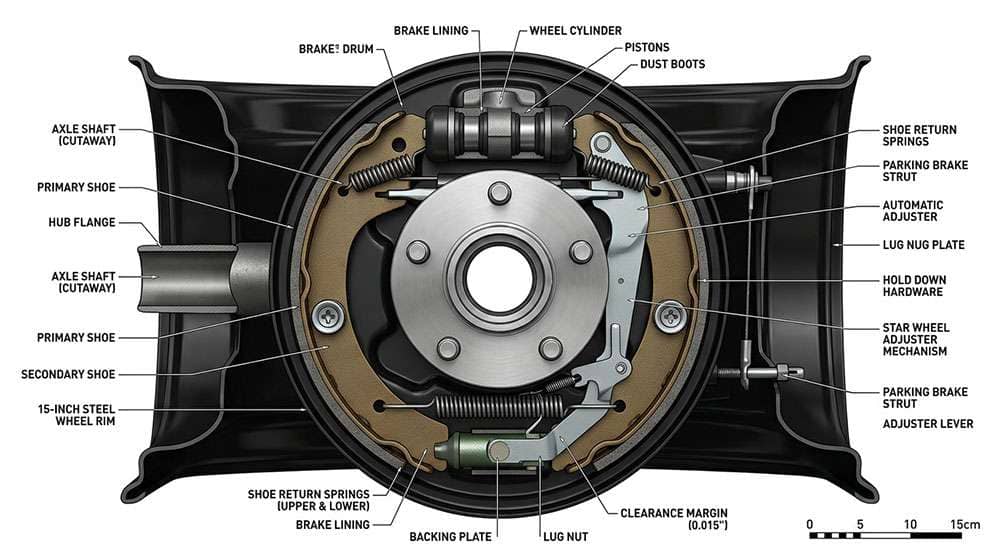
The math was straightforward. A 14-inch wheel could accommodate a 9- or 10-inch drum with acceptable clearance for the brake hardware. A 15-inch wheel cleared 11- and 12-inch drums comfortably. Going to a 13-inch wheel restricted brake capacity to smaller drums — fine for a compact economy car, not acceptable for a full-size or a performance car.
Disc brakes changed the calculus. Disc rotors typically measure 10 to 14 inches in diameter and need less radial clearance than a drum brake with external springs and cylinders. When front disc brakes became standard in the mid-1970s and rear discs followed in the 1980s, the clearance constraint that had locked wheel diameters at 14 to 15 inches finally loosened.
The second constraint was tire technology. Through 1975, the dominant passenger car tire in North America was the bias-ply — a tire constructed with internal cords running diagonally across the tire, layer over layer. Our dedicated breakdown of bias-ply versus radial tires for classic cars covers the construction difference in detail.
Bias-ply construction has a specific limitation: the sidewall and the tread cannot flex independently. The entire tire deforms as a unit. To produce acceptable ride quality, bias-ply tires needed tall sidewalls — typically 70 to 80 percent of the section width, measured as aspect ratio. A 6.70-15 tire (the common 1960s full-size car size) had a roughly 6.5-inch tall sidewall. A G70-15 performance tire of the 1970s still used a 70-series aspect ratio with a 5-plus-inch sidewall.
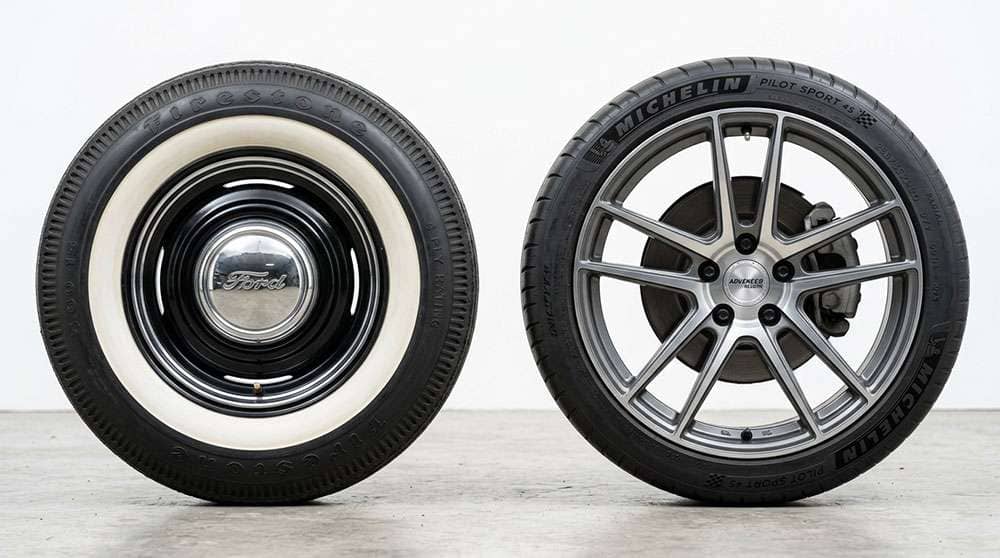
Modern radial tire construction permits much lower aspect ratios — 40, 35, even 30 series — because the radial tire's tread and sidewall flex independently. That technology simply didn't exist at scale until the mid-1970s. For a deeper look at how aspect ratio math works, our article on tire aspect ratio decoded walks through the numbers.
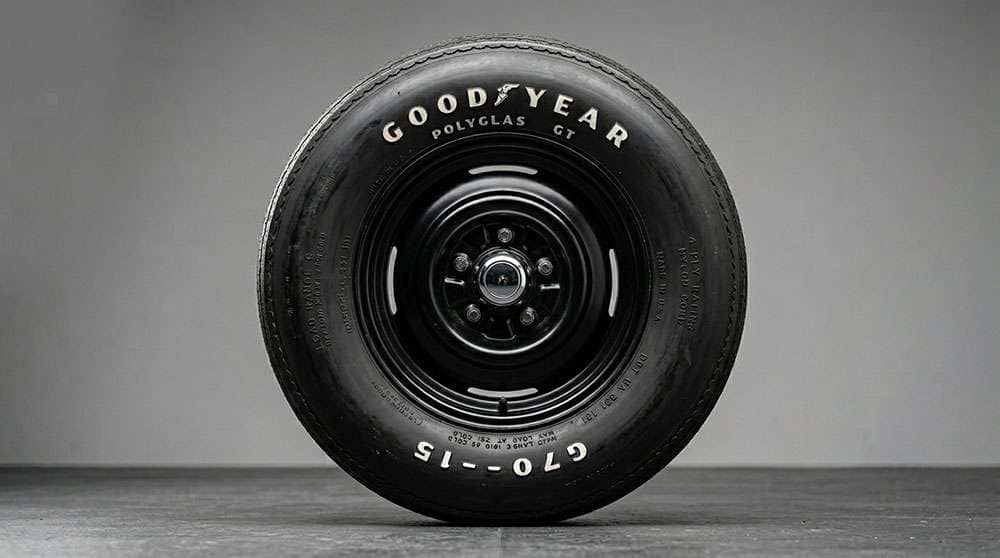
Put those facts together and the result is inevitable. To produce a tire with adequate ride quality, Detroit needed sidewalls between 5 and 7 inches tall. To keep overall rolling diameter in the 26- to 28-inch target range, that meant a 14- or 15-inch wheel. Any larger rim would have required a radial-construction low-profile tire that wouldn't exist commercially for another decade.
Classic American car wheels were stamped steel — two-piece construction with a welded outer rim (the drop-center rim shell) and an inner center section (the spider or disc). The manufacturing process used large mechanical presses to stamp hot steel sheets into the required shapes.
Press capacity and tooling costs scaled with wheel diameter. A 14-inch stamping die needed a certain press tonnage. A 17- or 18-inch die required significantly more — more steel per wheel, bigger presses, more complex drop-center geometry to let the tire mount onto the rim. In the 1950s and 1960s, Detroit's existing press lines and tooling were optimized for 13-, 14-, and 15-inch rim production. The infrastructure was sunk cost, and scaling to larger diameters meant capital expenditure nobody was motivated to make.
Aluminum alloy wheels — cast or forged — were still an expensive aftermarket curiosity through the 1970s. OEM alloy wheels became mainstream only in the 1980s as casting technology matured and weight reduction became an engineering priority. Before that, the practical reality was: if you wanted to build millions of cars per year, you stamped steel, and you stamped it in 14 and 15 inches.
Here's a fact that gets overlooked in modern discussions of classic car wheel sizes: on a 1960s passenger car, the tire sidewall did a significant portion of the suspension work.
Suspension systems of the era were simpler than anything built today. Leaf springs in the rear, coil springs and A-arms up front, telescopic hydraulic shocks, solid rubber bushings. There were no active dampers, no multi-link geometries, no hydraulic bump stops, no elastomeric mounts tuned for specific frequencies. The suspension damped low-frequency body motion. High-frequency impacts — expansion joints, small road irregularities, the edges of potholes — were absorbed by the tires.
A tall bias-ply sidewall has a specific compliance characteristic: it deflects under impact, storing and releasing energy like a spring. That deflection is why 1960s cars rode smoothly over surfaces that would shake a modern 35-series-tire car to pieces. The tire wasn't just holding the wheel to the road — it was acting as the primary vibration isolator between road and passenger.
Modern low-profile tires transmit road texture directly to the suspension, where sophisticated multi-link geometries and hydraulic dampers manage the energy. That works on modern cars because the rest of the suspension architecture evolved to handle the job. A classic car doesn't have that architecture. Put 18-inch wheels and 40-series tires on a 1968 Chevelle and the ride becomes uncomfortable at best, harsh at worst, because the car was engineered around the compliance of tall sidewalls.
Every passenger car has a target overall tire rolling diameter — the outside diameter of the mounted tire — that the drivetrain engineers use to calibrate gear ratios, final drive, and speedometer accuracy. Change the rolling diameter and you change the car's effective gearing.
For American passenger cars from 1950 through 1975, that target diameter lived in a narrow band: roughly 26 to 28 inches for full-size cars, slightly smaller for compacts. This range balanced acceleration, top speed, highway cruising RPM, and speedometer calibration. A full-size car with a 28-inch overall tire and a 3.08 rear axle ratio cruised at 2,700 RPM at 70 mph in top gear — sweet spot for the era's engines.
Holding that rolling diameter constant while increasing the wheel diameter would have required thinner sidewalls. Radial tire technology can do that; bias-ply technology couldn't. The practical result was that 14- and 15-inch wheels were the only sizes that hit the rolling diameter target with the sidewall heights the tire industry could actually produce.
This is also why plus-sizing a classic car requires careful rolling diameter math. If you swap to 17-inch wheels and drop sidewall height to maintain overall diameter, the speedometer and odometer still read correctly. Skip the math and you'll be off by 5 to 10 percent. Our guide on how to plus-size wheels and tires covers the calculation.
The final factor was cost. The American automotive industry in the 1950s and 1960s operated on a volume-per-model-year model that tolerated almost no component variation across platforms. A single-wheel-diameter standard across Chevrolet, Buick, Oldsmobile, and Pontiac meant GM could share wheel tooling, tire inventory, brake drum castings, and axle housings across millions of vehicles per year.
Changing the wheel diameter across a lineup meant retooling stamping dies, recalibrating brake designs, retuning suspensions, and rewriting the parts catalog. For what benefit? With bias-ply tire technology, you couldn't improve rolling diameter math. With drum brakes, you couldn't improve stopping performance significantly. The business case didn't exist.
Radial tires, disc brakes, and CAD-assisted suspension design emerged between roughly 1970 and 1990. Each one weakened one of the constraints that had locked in 14- and 15-inch wheels. By the mid-1990s, all six constraints had been broken or significantly relaxed, and the industry shifted rapidly.
The shift from 14- and 15-inch wheels to 16-, 17-, and 18-inch wheels didn't happen overnight. It rolled through the industry over two decades, triggered by specific technology changes in predictable order.
1975–1980. Michelin's radial tires finally achieved mainstream North American market penetration. Radial construction decoupled sidewall and tread flex, making lower aspect ratios practical. Ford famously championed radials on the 1972 Lincoln, and by 1980 radial construction dominated new-car tire fitments.
For the full story of this construction shift, our article on the hidden engineering behind tire evolution from bias-ply to modern radials covers the transition.
1980–1988. Front disc brakes became universal. Rear discs began appearing on luxury and performance cars. Larger brake components created a practical use for bigger wheels, and 16-inch fitments began appearing on luxury cars — the BMW 6 Series, early Corvettes, and premium Cadillac models.
1988–1995. Performance cars adopted 17-inch wheels. The C4 Corvette ZR-1, the BMW M3, and the Porsche 911 Turbo all specified 17-inch fitments with 40- and 45-series tires. Mainstream sedans followed with 15- and 16-inch standard fitments.
1995 onward. 17-inch wheels became the new baseline for anything sporty. 18-inch fitments proliferated through luxury and performance segments. By 2005, 18s were standard on many mid-range sedans, and 19-, 20-, and 22-inch wheels were optional on SUVs and performance vehicles.
Today, a base-model family crossover ships with 17- or 18-inch wheels. A performance sedan typically wears 19s or 20s. Pickup trucks come with 20-inch wheels standard on many trims. The 14-inch passenger car wheel survives only on certain economy compact cars and on classic restorations.
Four factors drove the shift toward larger wheel diameters once the constraints relaxed:
1. Bigger brakes for heavier, faster cars. Modern passenger cars weigh 600 to 1,500 pounds more than their classic counterparts. Electric vehicles weigh even more. Bigger brake rotors dissipate the increased heat and energy of braking heavier cars from higher speeds. Bigger rotors require bigger wheels to clear them.
2. Handling response. Low-profile tires on large-diameter wheels have stiffer sidewalls, which translates to more immediate steering response and better cornering grip. Performance cars and luxury vehicles prioritizing handling precision drove the adoption of lower profiles.
3. Tire contact patch shape. A wider, lower-profile tire produces a more rectangular contact patch than a narrow, taller bias-ply or early radial. For traction and wear purposes, the rectangular patch is generally preferred in modern handling engineering.
4. Styling and consumer preference. Consumer surveys beginning in the 1990s consistently showed buyers rating larger wheels as more premium, more aggressive, and more desirable. Automakers responded by making larger-diameter wheels available further down the option sheet. The cycle has continued for thirty years.
There are trade-offs. Modern large-diameter wheels with low-profile tires ride worse than older setups over broken pavement. They're more vulnerable to pothole damage. They're heavier (increasing unsprung weight). And they're more expensive to replace. But the market has rewarded the shift nonetheless.
Understanding why classic cars came with 14- and 15-inch wheels informs three practical decisions every classic car owner eventually faces.
Sticking with original diameters. If you're keeping the car in stock configuration, period-correct 14- or 15-inch wheels with appropriate tires are the right answer. The drum brakes, bias-ply-era suspension tuning, and factory rolling diameter calculations were engineered for those sizes. Modern radial tires in classic-style sidewall profiles are widely available — brands like American Classic and Coker make radial-construction tires in period-correct sizes with authentic visual styling.
Plus-sizing to 17 or 18. Upgrading wheel diameter makes sense when it's part of a broader modification package: disc brake conversions (usually four-wheel), upgraded suspension with modern dampers, updated bushings, and often subframe improvements. A plus-size without corresponding upgrades generally hurts ride quality without adding much handling benefit. Our article on whether you can replace 15-inch wheels with 17-inch covers the decision points.
Restomod builds. For a full restomod build with modern drivetrain, brakes, and suspension, 17- and 18-inch wheels can actually perform better than the original 14s and 15s. The key is that the entire chassis has been updated to work with the new wheel size. Our breakdown on whether 17-inch or 18-inch rims are better for muscle cars addresses this use case directly.
Classic cars ran 14- and 15-inch wheels for engineering reasons, not stylistic ones. Drum brake clearance set the lower bound. Bias-ply tire construction set the sidewall height requirement. Steel wheel stamping limits and production tooling economics reinforced the standard. Sidewall compliance did the vibration isolation work that sophisticated modern suspensions handle differently. Rolling diameter math kept the target band narrow. All six constraints pointed at the same answer.
When technology changed — radials, disc brakes, alloy wheels, advanced suspension design — the industry shifted rapidly. But the original cars were purpose-built around the specs they had, and that history matters whenever an owner decides how to wheel and tire a classic today.
For period-correct tires that fit original 14- and 15-inch classic car wheels, or modern radial-construction replacements in the right sizes, visit Performance Plus Tire's classic tire selection. Our full tire catalog covers everything from authentic whitewall radials to modern low-profile performance rubber for restomod builds.
Six engineering constraints converged on those diameters: drum brake clearance, bias-ply tire construction requirements, steel wheel stamping limits, reliance on sidewall compliance for ride quality, rolling diameter targets, and production tooling economics. Each factor reinforced the others, and all six had to evolve before the industry could move to 16-, 17-, and 18-inch sizes.
The shift began in the early 1980s on luxury and performance cars as radial tires matured and disc brakes became standard. 16-inch wheels appeared on the BMW 6 Series and C4 Corvette. 17-inch fitments became common on performance cars by 1990, and 18-inch sizes spread to mainstream vehicles through the 1990s and 2000s.
Yes, but it's usually part of a broader modernization package. Disc brake conversions, updated suspension components, and rolling diameter recalculation all contribute to whether a 17-inch plus-size actually improves the car. A plus-size without corresponding upgrades typically hurts ride quality and changes speedometer accuracy without delivering handling benefits.
Bias-ply tire construction required tall sidewalls (typically 70 to 80 percent aspect ratio) to deliver acceptable ride quality, because the sidewall and tread couldn't flex independently. The sidewall also served as the primary vibration isolation element on classic car suspensions, absorbing high-frequency impacts that modern multi-link suspensions handle differently.
Yes. A strong aftermarket exists for period-correct 14- and 15-inch steel wheels, classic-style alloy wheels (Cragar, American Racing Torq Thrust, and similar designs), and radial-construction tires that fit these sizes while preserving vintage visual styling. Classic car restoration remains a significant market segment, and all major tire manufacturers produce sizes in these fitments.
Classic cars typically ride softer over broken pavement because of their tall tire sidewalls, which isolate high-frequency road impacts. Modern cars with sophisticated suspension architecture and low-profile tires often handle better and ride more consistently on smooth pavement, but transmit sharper impacts over potholes and expansion joints. Ride quality comparisons depend heavily on the specific cars, pavement type, and driver preferences.



