
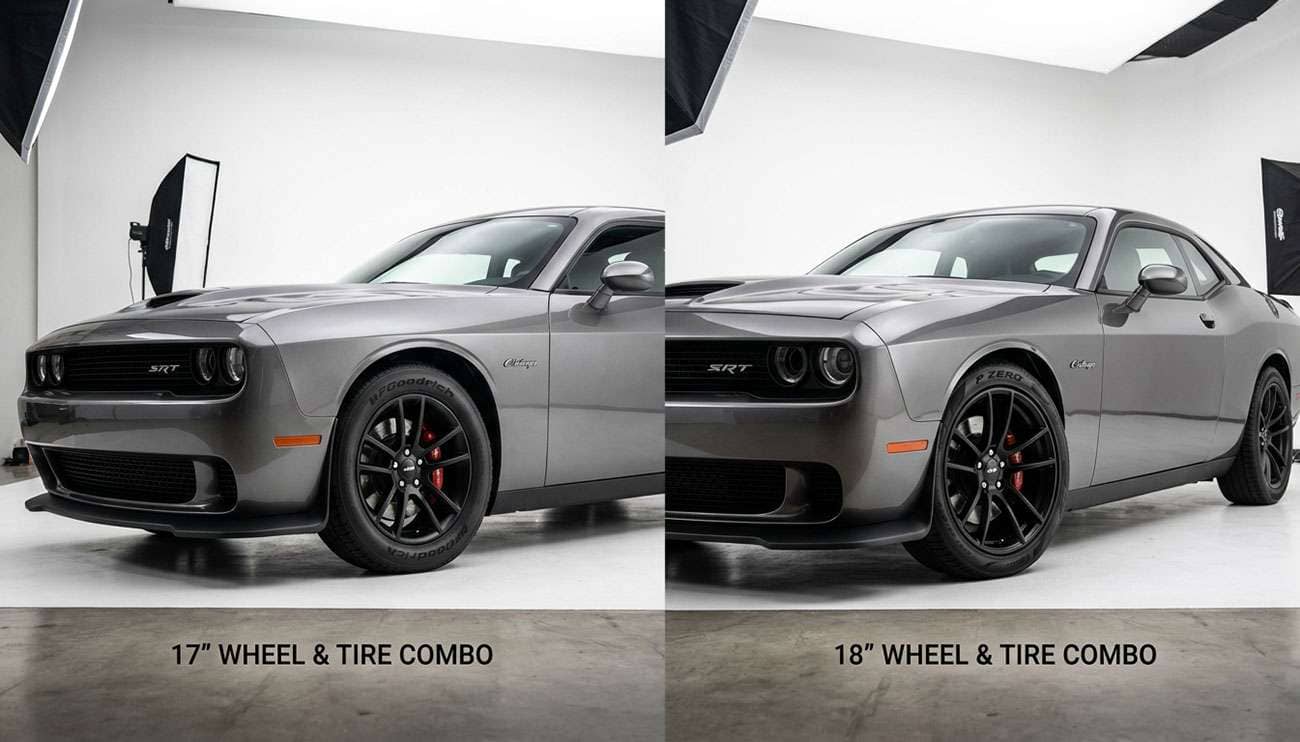
You're staring at your Mustang, Camaro, or Challenger, and you know those factory wheels aren't cutting it anymore. The big question: should you go with 17 inch or 18 inch rims? This isn't just about looks—your wheel diameter directly affects handling, acceleration, ride comfort, and brake clearance. We've helped thousands of muscle car owners navigate this exact decision, and here's the truth: it matters more than most people think.
Both sizes deliver real advantages. But which one works for you depends entirely on how you drive your car. Building a weekend drag monster that needs maximum punch off the line? Carving canyon roads every Sunday? Daily driving with occasional spirited runs? Each scenario demands a different answer. Modern Mustang GTs and Camaro SSs roll off the showroom with 18, 19, or even 20 inch wheels. Classic muscle car restorations typically thrive on 17 or 18 inch setups.
This guide breaks down everything you need to know. You'll understand exactly how 17 and 18 inch wheels affect your muscle car's performance, what tire options you'll have, which fitment challenges you'll face, and which size delivers the best results for your driving style. Whether you're shopping for custom wheels or finalizing your build specifications, you'll have a clear answer by the time you finish reading.
Wheel diameter determines your tire's sidewall height—that's what drives the performance differences you'll feel. The diameter measurement represents the distance across the wheel face from bead seat to bead seat, the inner diameter where your tire mounts. This single specification controls ride quality, handling response, and acceleration characteristics.
Increase wheel diameter by one inch and you typically reduce tire sidewall height to maintain the same overall tire diameter. This keeps your speedometer accurate and prevents clearance problems with fenders or suspension components. A classic Mustang might run a 275/40R17 tire with about 4.3 inches of sidewall. Step up to 18 inch wheels and you'd switch to a 275/35R18 with approximately 3.8 inches of sidewall. That half-inch difference creates measurable changes in how your car drives.
Diameter is just one piece of the puzzle. You also need to understand width, offset, backspacing, and bolt pattern to make a smart choice.
Wheel width determines how wide a tire you can safely mount. Most 17 inch muscle car wheels range from 8 to 10 inches wide. 18 inch wheels typically span 8 to 11 inches. Wider wheels accommodate wider tires, which means more contact patch and better grip. But you need to balance width with proper fitment to avoid rubbing on suspension components or fenders. A 17x9 inch wheel is exceptionally common for rear fitment on classic muscle cars because it perfectly accommodates a 275 or 295 width tire.
Offset and backspacing determine where the wheel sits relative to the mounting surface. Muscle cars typically need specific offset ranges to clear brake calipers and suspension while avoiding fender interference. Modern muscle cars often use positive offset (wheel face toward the outside). Many classic muscle car setups work better with zero or negative offset. Get these measurements wrong and you'll own wheels that simply don't fit—one of the most expensive mistakes you can make.
Bolt pattern must match your vehicle exactly. Most classic muscle cars use 5x4.5 inch (5x114.3mm) bolt patterns, though some GM models use 5x4.75 inch (5x120.65mm). Modern muscle cars predominantly use 5x4.5 inch or 5x115mm patterns. You cannot safely install wheels with the wrong bolt pattern, no matter how close the measurements seem.
The biggest mistake muscle car owners make is choosing diameter based purely on appearance without considering performance implications. Larger wheels look aggressive and fill wheel wells better. But they also add unsprung weight and reduce sidewall flex, which hurts ride quality and acceleration.
Ignoring brake clearance requirements is another expensive error. If you've upgraded to larger brake calipers—and many performance enthusiasts do—you need to verify that your chosen wheel diameter and spoke design provide adequate clearance. Some 17 inch wheels clear modern Brembo brake kits perfectly. Others don't. Some 18 inch wheels with thick spokes actually have less brake clearance than properly designed 17 inch wheels with thin spokes.
Many people fail to calculate total plus-sizing correctly. When you increase wheel diameter, you must decrease tire sidewall proportionally to maintain the same overall rolling diameter. Get this wrong and your speedometer will read incorrectly and you'll experience clearance issues. Use the tire size comparison calculator to verify that your new wheel and tire combination maintains proper diameter.
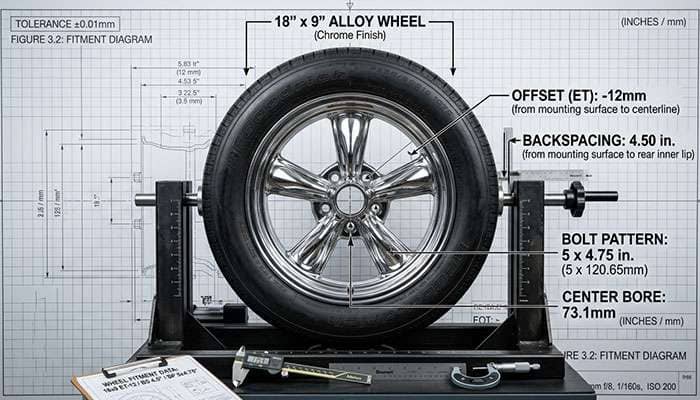
Purchasing wheels without confirming offset and backspacing for your specific vehicle is another costly mistake. Just because a wheel is advertised as fitting a Mustang doesn't mean it fits your generation of Mustang with your suspension setup. Wheel fitment varies significantly between model years, especially if you're running lowered suspension or wider tires than factory specifications.
Let's decode what wheel and tire specifications actually mean for your muscle car's performance. When you see a wheel listed as 18x9.5 +35, that breaks down to 18 inches in diameter, 9.5 inches wide, with a 35mm positive offset. The offset number tells you how far the mounting surface sits from the wheel's centerline—positive offset means the mounting surface is toward the face of the wheel.
For tire sizing, the format 275/40R18 means 275mm section width, 40% aspect ratio (sidewall height is 40% of section width), radial construction, and 18 inch wheel diameter. That 40% aspect ratio on an 18 inch wheel gives you a 4.3 inch sidewall. Compare that to 275/45R17, which delivers a 4.9 inch sidewall. That extra 0.6 inches of sidewall provides more cushion over bumps and slightly better acceleration due to reduced rotational mass.
Unsprung weight matters enormously for muscle cars. This is the weight of components not supported by your suspension—wheels, tires, brakes, and some suspension parts. Every pound of unsprung weight has roughly three times the effect of sprung weight on acceleration and handling. A typical 17 inch wheel weighs 22 to 28 pounds. A comparable 18 inch wheel weighs 24 to 32 pounds. Add the slightly heavier tire that typically goes on an 18 inch wheel, and you're looking at 6 to 10 additional pounds per corner. That's 24 to 40 pounds of total unsprung weight increase—equivalent to 72 to 120 pounds of regular weight in terms of acceleration impact.
Choosing between 17 and 18 inch wheels for your muscle car comes down to balancing vehicle type, driving style, performance goals, and budget. There's no universal "best" answer. But there is a best answer for your specific situation.
Classic muscle cars—1960s and 1970s models—typically perform best on 17 inch wheels. These vehicles weren't designed for massive wheels. The extra sidewall of a 17 inch setup provides crucial cushioning for older suspension designs. The ride quality difference is substantial. Classic muscle cars with original or reproduction suspension systems benefit from that extra sidewall flex to absorb road imperfections. Additionally, 17 inch classic tires offer excellent variety in period-correct tread patterns and sidewall styles, including raised white letters that many enthusiasts prefer.
Modern muscle cars present a different situation. Factory-equipped with sophisticated multi-link suspension, adaptive dampers, and larger brake packages, these vehicles are engineered around larger wheel diameters. A 2024 Mustang GT comes with 19 inch wheels standard. But many owners who prioritize performance over appearance downsize to 18 inch wheels to reduce unsprung weight and improve acceleration. Going to 17 inch wheels on a modern muscle car often creates brake clearance issues unless you're running a base model with smaller brakes.
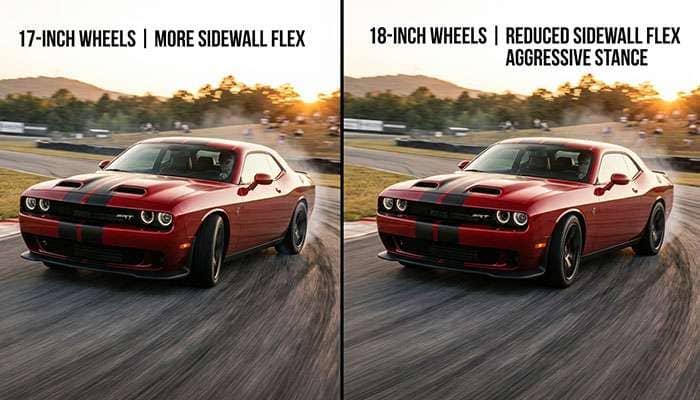
Vehicle weight and power output should influence your wheel size decision. Heavier muscle cars like the Dodge Challenger—especially in Hellcat or Redeye trim—benefit from the lower sidewall stiffness of 18 inch wheels. The reduced sidewall flex helps control the massive torque these cars produce and provides better high-speed stability. When you're pushing 700+ horsepower through the rear wheels, you want minimal sidewall deformation during hard acceleration.
Lighter muscle cars like Fox-body Mustangs or fourth-generation Camaros work exceptionally well with 17 inch wheels. The reduced rotational inertia makes a noticeable difference in acceleration. These cars typically don't have the brake package size that demands 18 inch clearance. A 3,200-pound Fox-body with 17x9 inch wheels and 275/40R17 tires is a fantastic street performance setup that maximizes acceleration while maintaining excellent handling.
Vehicle Type |
Recommended Size |
Typical Width |
Primary Benefit |
|---|---|---|---|
Classic Muscle (1960s-70s) |
17 inch |
8-9 inch front, 9-10 inch rear |
Better ride quality, period-appropriate |
1980s-90s Muscle |
17 inch |
9 inch front, 10 inch rear |
Reduced weight, improved acceleration |
Modern Muscle (2005+) |
18 inch |
9-10 inch front, 10-11 inch rear |
Brake clearance, handling precision |
Supercharged/Turbo Builds |
18 inch |
10-11 inch square setup |
Better grip, reduced sidewall flex |
Drag Racing Focus |
17 inch rear, 15-17 inch front |
Narrow front, 10-15 inch rear |
Weight reduction, taller sidewall for traction |
Brake package requirements cannot be ignored. If you're running Brembo brakes, Wilwood six-piston calipers, or any other large brake upgrade, you need to physically test fit your wheel choice before purchasing. Many 17 inch wheels simply won't clear modern performance brake calipers. Some manufacturers offer 17 inch wheels specifically designed with brake clearance in mind, but selection is more limited than with 18 inch options.
Your actual driving habits should drive this decision more than aesthetic preferences. If you primarily drive your muscle car on the street with occasional spirited driving, 17 inch wheels offer the best compromise. The extra sidewall cushions imperfections in real-world road surfaces—potholes, expansion joints, rough pavement—that can make a harsh ride with low-profile tires absolutely punishing on daily drives.
Track day enthusiasts and autocross competitors typically prefer 18 inch wheels on modern muscle cars. The reduced sidewall height minimizes flex during hard cornering, which improves steering response and cornering precision. When you're pushing a muscle car through technical sections at a road course, that extra sidewall stiffness translates to more predictable handling and faster lap times. You'll sacrifice some ride comfort for that performance gain.
Drag racers have different priorities entirely. Quarter-mile performance favors 17 inch rear wheels with taller sidewall tires. The additional sidewall acts like a spring that helps transfer weight to the rear tires during launch, improving traction. Many serious drag racers run 15 or 17 inch front wheels to minimize rotating mass up front where it matters least, combined with 17 inch rears mounting 28 to 30 inch tall drag radials. If your muscle car is primarily a straight-line weapon, 17 inch wheels—particularly at the rear—deliver better acceleration.
Cost considerations extend beyond just the wheel purchase price. You need to factor in tire costs, which vary significantly between 17 and 18 inch sizes. Generally, 17 inch performance tires cost 10 to 20 percent less than comparable 18 inch tires. Over the life of your muscle car, this adds up to hundreds of dollars in savings if you drive enough to wear through multiple sets of tires.
Wheel selection and availability differ between sizes. The 18 inch wheel market offers significantly more options in terms of styles, finishes, and designs. If you have a specific aesthetic vision for your build, you'll likely find more choices in 18 inch diameter. However, if you're looking for budget-friendly options or specific classic styles, 17 inch wheels often provide better value. Many replica classic designs are only manufactured in 17 inch sizes because that's what fits the proportions of vintage muscle cars correctly.
Performance upgrades should factor into your budget calculation. If you plan to install a big brake kit within the next year or two, buying 17 inch wheels now might be a waste if they won't clear your future brake upgrade. Spend time researching brake clearance requirements for any planned modifications before committing to a wheel diameter. The last thing you want is to buy expensive wheels only to discover they're incompatible with your performance plans.
Based on years of experience fitting wheels to muscle cars, here are specific recommendations for different use cases. These suggestions account for the real-world performance trade-offs we've discussed throughout this article.
If your muscle car is your daily driver, prioritize ride comfort and tire cost over ultimate performance. For this use case, 17 inch wheels deliver the best ownership experience. The extra sidewall height smooths out imperfect roads, reducing fatigue on longer drives and minimizing the harsh impacts that can damage wheels or suspension components over time.
For classic muscle car daily drivers, go with a 17x8 inch wheel in front with a 245/45R17 tire, paired with a 17x9 inch rear wheel running 275/40R17 tires. This setup provides excellent grip for spirited driving while maintaining comfortable daily driving characteristics. The 245 front tire offers adequate grip without excessive tramlining—that annoying tendency to follow road grooves. The 275 rear provides plenty of traction for controlled acceleration.
Modern muscle car daily drivers can successfully run 18 inch wheels if your suspension is in good condition and your roads aren't terrible. But if you live in an area with poor road conditions, downsizing from factory 19 or 20 inch wheels to 18 inch wheels dramatically improves ride quality. A common setup for daily-driven modern Mustangs is 18x9 inch front and 18x10 inch rear wheels with 255/40R18 and 275/40R18 tires respectively. This maintains sporty handling while adding crucial sidewall cushioning compared to factory low-profile tires.
Tire selection matters significantly for daily drivers. Look for all season tires that balance performance with comfort and treadwear. You don't need maximum-performance summer tires for commuting—they'll wear quickly and ride harshly. Quality all-season performance tires provide 85 percent of the dry grip with dramatically better wet traction, longer treadwear, and superior ride comfort.
Performance-focused muscle car owners who regularly attend track days or autocross events should prioritize handling precision and brake clearance over comfort. This typically means 18 inch wheels for modern muscle cars, though classic muscle car track builds can work exceptionally well with 17 inch setups paired with appropriate suspension modifications.
For modern muscle cars at the track, square 18x10 inch wheel setups with 285/35R18 tires all around provide excellent balance and allow for tire rotation to maximize treadwear. The square setup—same size wheels and tires front and rear—simplifies tire management and often produces more neutral handling characteristics compared to staggered setups. Many dedicated track Mustangs and Camaros run this configuration with excellent results.
Classic muscle car road course builds benefit from 17x9 inch wheels all around with 275/40R17 tires. This provides adequate grip while minimizing unsprung weight compared to 18 inch alternatives. The key is pairing appropriate wheels with modern suspension components—coilovers, tubular control arms, and performance bushings. A properly suspended classic muscle car on 17 inch wheels can be remarkably capable on track.
Brake clearance becomes critical for performance applications. Big brake kits dramatically improve stopping power and fade resistance during repeated hard braking on track. Before purchasing wheels, verify clearance with your specific brake setup. Many performance wheel manufacturers provide brake clearance specifications or templates you can use to check fitment. Spending thirty minutes verifying fitment can save you from expensive mistakes.
Budget-conscious muscle car owners can find excellent value in 17 inch wheel and tire packages. The used market offers abundant options in this size. New wheel prices are generally 15 to 25 percent lower than comparable 18 inch wheels. If you're building a muscle car on a tight budget, 17 inch wheels allow you to allocate more money toward suspension, brakes, or power modifications that deliver better performance returns.
For the absolute best value, consider quality replica wheels in 17 inch diameter. These offer classic styling at a fraction of the cost of genuine vintage wheels, with the added benefits of modern construction and lighter weight. A set of 17x8 and 17x9 inch replica Torq Thrust or similar classic five-spoke wheels typically costs $600 to $1,000 for all four corners—excellent value for a complete transformation of your muscle car's appearance.
Tire cost savings with 17 inch sizes compound over time. A quality 275/40R17 performance all-season tire typically costs $180 to $220 each, while a comparable 275/35R18 tire runs $200 to $260 each. That $80 to $160 difference per set might not seem substantial initially. But if you drive enough to replace tires every two years, you'll save hundreds of dollars over a decade of ownership. For budget builds, those savings can fund other important upgrades.
Don't sacrifice safety or quality to save money. Cheap wheels from unknown manufacturers may save you money initially but can fail catastrophically under stress. Stick with reputable wheel brands that meet SAE and JWL safety standards. Similarly, avoid bargain-basement tire brands for muscle car applications. The small savings aren't worth the reduction in grip, handling, and safety. Quality budget brands deliver 90 percent of premium tire performance at 60 to 70 percent of the cost—that's where the smart money goes.
The question of whether 17 or 18 inch rims are better for muscle cars doesn't have a single correct answer. It depends entirely on your specific vehicle, driving style, and priorities. For classic muscle cars and budget-conscious builds prioritizing acceleration and ride comfort, 17 inch wheels deliver the best overall experience. The additional sidewall height cushions imperfect roads, reduces unsprung weight for better acceleration, and provides access to period-correct tire styles at lower costs. If your muscle car is primarily a street machine with occasional spirited driving, 17 inch wheels are almost certainly the right choice.
Modern muscle cars and performance-oriented builds benefit from 18 inch wheels in most scenarios. The reduced sidewall flex improves handling precision during hard driving. The additional diameter provides clearance for modern brake packages. The wider selection of wheel designs allows for more customization options. Track day enthusiasts, autocross competitors, and owners of supercharged or turbocharged builds will appreciate the performance advantages of 18 inch wheels, even if they sacrifice some ride comfort in daily driving.
The best wheel size for your muscle car balances performance needs with real-world practicality. Consider your actual driving habits honestly—not how you imagine driving your car, but how you actually drive it most days. Factor in your local road conditions, planned performance modifications, and budget constraints. Whether you choose 17 or 18 inch wheels, proper fitment matters more than diameter. Verify offset, backspacing, and brake clearance before purchasing. Invest in quality wheels and tires appropriate for your application. At Performance Plus Tire, we specialize in helping muscle car owners find the perfect wheel and tire combination for their specific needs. Browse our selection of custom wheels designed specifically for muscle car applications, or contact our team for personalized fitment advice.
Here are the essential points to remember when choosing between 17 and 18 inch wheels for your muscle car:
• Classic muscle cars favor 17 inch wheels: The additional sidewall height provides better ride comfort on older suspension designs, offers period-correct styling options, and delivers improved acceleration through reduced rotational mass—perfect for 1960s and 1970s models.
• Modern muscle cars work better with 18 inch wheels: Factory-engineered around larger diameters, contemporary Mustangs, Camaros, and Challengers benefit from the reduced sidewall flex and brake clearance that 18 inch wheels provide, especially for performance driving applications.
• Sidewall height significantly impacts ride quality: The difference between 17 and 18 inch wheels typically means 0.5 to 0.7 inches of sidewall height variation, which creates noticeable differences in comfort over imperfect roads and impacts handling response during aggressive driving.
• Brake clearance determines your minimum wheel size: If you've installed or plan to install large brake calipers, verify physical fitment before purchasing wheels—many 17 inch wheels won't clear modern performance brake packages, regardless of spoke design or offset specifications.
• Budget considerations extend beyond initial purchase price: Factor in long-term tire replacement costs when choosing wheel diameter, as 17 inch tires typically cost 10 to 20 percent less than comparable 18 inch tires, creating substantial savings over your ownership period.
Yes, but the difference is typically small for street driving. An 18 inch wheel and tire combination usually weighs 6 to 10 pounds more per corner than a comparable 17 inch setup. This additional unsprung weight can cost you approximately 0.1 to 0.2 seconds in quarter-mile times, though most drivers won't notice this difference in normal driving. For dedicated drag racing, 17 inch wheels provide a measurable advantage. For road course or autocross use, the improved handling from reduced sidewall flex with 18 inch wheels often produces faster lap times despite the weight penalty.
It depends on your specific vehicle and the wheel width and offset you choose. Many classic muscle cars can accommodate 18x8 or 18x9 inch wheels without modifications if you select appropriate offset and tire sizes. However, wider 18 inch wheels—particularly 18x10 or larger—often require inner fender modifications, upgraded suspension components, or rolled fender lips to prevent rubbing. The critical factors are overall wheel and tire width, offset, backspacing, and suspension geometry. Always verify fitment specifications for your exact year, make, and model before purchasing. Clearance varies significantly between different classic muscle car platforms.
This is subjective, but many enthusiasts feel that 17 inch wheels look undersized on modern muscle cars designed around 18, 19, or 20 inch factory wheels. The larger wheel wells on contemporary Mustangs, Camaros, and Challengers create noticeable gap with smaller diameter wheels. However, if you prioritize performance and comfort over appearance, 17 inch wheels can work functionally. The more practical concern is brake clearance—many modern muscle cars have brake packages that physically won't fit inside 17 inch wheels. If you're considering 17 inch wheels on a modern muscle car, verify brake clearance before purchasing. This limitation often makes the decision for you.
Wheel and tire changes can impact fuel economy by 1 to 5 percent depending on size and weight differences. Heavier 18 inch wheel and tire combinations increase rotational mass, which requires more energy to accelerate and maintain speed. However, the low-profile tires typically used with 18 inch wheels often have lower rolling resistance than taller sidewall tires, which can partially offset the weight penalty. In real-world terms, you might see a difference of 0.5 to 1.5 miles per gallon between optimized 17 inch and 18 inch setups. This difference is minimal for most muscle car owners who prioritize performance and appearance over fuel economy. But it's worth considering if you drive significant highway miles.
Not necessarily. While maintaining factory wheel diameter can simplify tire selection and ensure proper speedometer calibration, most muscle cars benefit from modern wheel and tire technology. Classic muscle cars originally came with 14 or 15 inch wheels and bias-ply tires that are dramatically inferior to modern radial tires on 17 or 18 inch wheels. Upgrading to larger wheels with modern radial tires transforms handling, braking, and overall safety. For restoration purists or concours show cars, matching original specifications makes sense. For drivers who actually use their muscle cars, modern 17 or 18 inch wheels with performance tires deliver enormously better real-world performance while maintaining period-appropriate appearance with proper wheel design selection.



