
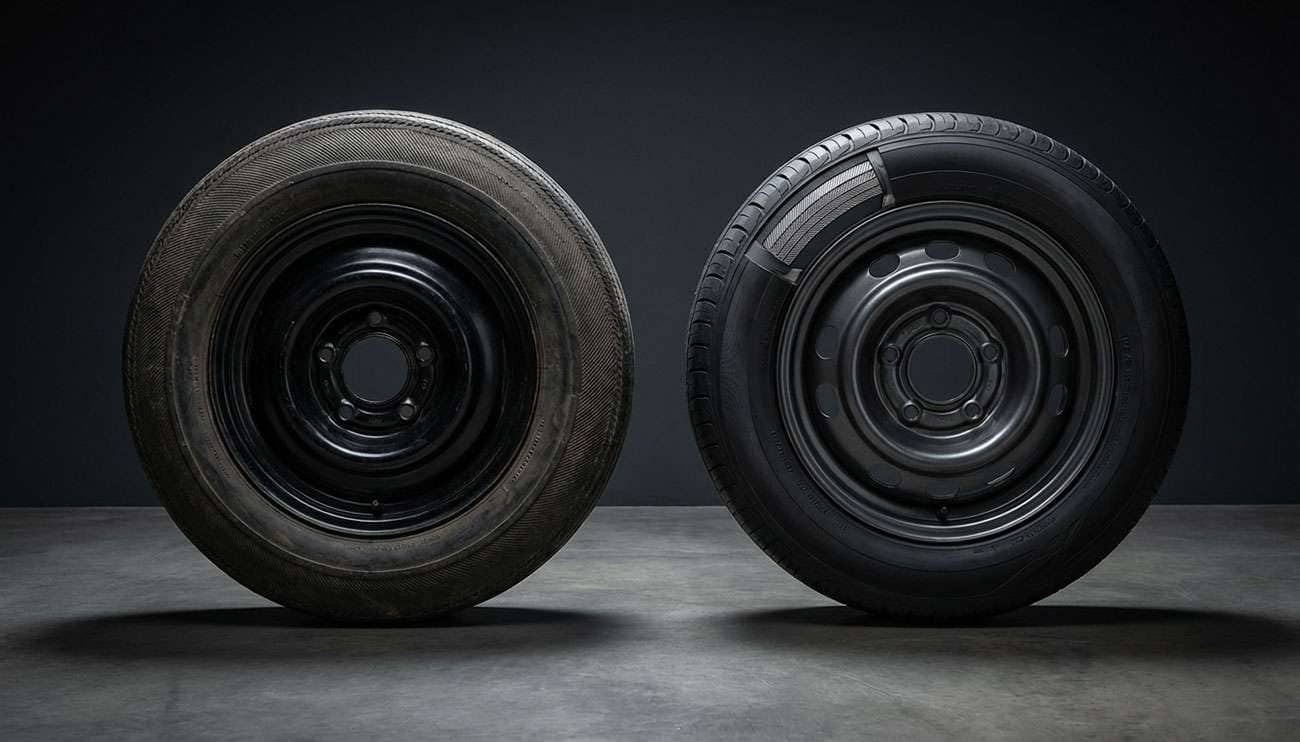
Radial tires deliver 40,000-65,000 miles of service life compared to bias-ply tires at 25,000-40,000 miles - that's a 35-45% improvement in durability. This performance gap represents decades of engineering advances that most drivers never consider when they mount new tires on their vehicles.
The foundation started with Charles Goodyear's vulcanized rubber discovery in 1839, creating the material science basis for all modern tire manufacturing. Robert William Thomson patented the first pneumatic tire in 1845, but practical application waited until John Boyd Dunlop reinvented the concept in 1888. His pneumatic design eliminated the harsh ride quality and limited performance of solid rubber tires.
Michelin changed everything again in 1946 with radial tire construction. These tires featured steel belts positioned perpendicular to the direction of travel, completely different from traditional bias-ply designs. The new construction delivered better flexibility, superior traction, and improved fuel efficiency - advantages that established radial design as the industry standard.
Understanding this engineering progression reveals how tire technology evolved from basic rubber compounds to today's sophisticated designs. Each breakthrough solved specific performance problems while creating new possibilities for vehicle safety, efficiency, and handling capabilities.
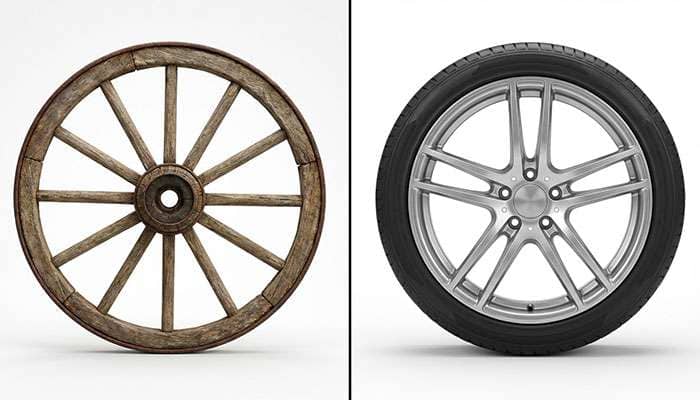
Solid rubber tires created a bone-jarring ride that limited vehicle speed and comfort. The shift to pneumatic design solved these fundamental problems while opening new possibilities for vehicle performance and passenger comfort.
Natural rubber seemed promising but had serious flaws - it became sticky mess in summer heat and cracked like glass in winter cold. Charles Goodyear spent years trying to solve these problems before accidentally dropping a rubber-sulfur mixture onto his hot stove in 1839. That accident created vulcanized rubber, the foundation material for every tire manufactured since.
The vulcanization process works by heating rubber with sulfur, creating cross-links between polymer chains that form a strong three-dimensional structure. This chemical transformation delivered crucial improvements:
Increased strength and elasticity across temperature ranges
Better resistance to solvents and chemicals
Improved stability in hot and cold conditions
Reduced stickiness and enhanced durability
Goodyear's discovery made millions for tire companies, but he died owing $200,000 despite creating the industry's foundation.
A Scottish veterinarian named John Boyd Dunlop watched his son struggle with the harsh ride of solid tires on his tricycle. Dunlop wrapped an inflated rubber tube in canvas and attached it to a wooden disk in October 1887. When he tested his creation, the pneumatic tire rolled across his entire yard while the solid tire version fell over immediately.
Dunlop patented this practical design on December 7, 1888. The air-filled tire eliminated vibration and dramatically reduced rider fatigue on long journeys. This simple but effective solution launched the pneumatic tire era.
André and Édouard Michelin tackled the next major problem - tires glued permanently to rims made repairs time-consuming and expensive. Their removable pneumatic tire design, patented for both bicycles and automobiles in 1895, allowed quick maintenance and easy repairs.
To prove their innovation worked, Michelin entered a car equipped with pneumatic tires in the 1895 Paris-Bordeaux race. They didn't win, but the demonstration clearly showed pneumatic tires' advantages over solid alternatives. This public test accelerated pneumatic tire adoption throughout the growing automobile industry.
Bias-ply tires ruled the automotive world for nearly seven decades. This construction method became the industry standard from the early 1900s until radial technology finally displaced it in the 1970s. Every vehicle rolling off production lines during this era relied on bias-ply engineering to connect with the road.
The secret to bias-ply construction lay in its crisscrossing fabric cords arranged diagonally from bead to bead at 30 to 45-degree angles. Each layer ran opposite to the previous one, creating a woven pattern that reinforced the entire structure. This design meant the sidewall and tread worked together as a single, unified unit.
This construction method delivered several key advantages:
Equal strength distribution across the entire tire surface
Robust sidewalls that resisted damage and punctures
Superior durability from overlapping fabric layers
Excellent grip and performance in off-road conditions
Manufacturers built these tires with even numbers of plies - typically 4, 6, 8, or even 10 layers for heavy-duty applications. More plies meant stronger tires capable of handling greater loads. The even number prevented the tire from pulling to one side during operation.
The same crisscrossing design that provided strength also created problems. When the tire flexed during operation, those overlapping plies rubbed against each other, generating heat that accelerated wear. At highway speeds, the rigid construction created additional rolling resistance that made the problem worse.
Bias-ply tires also developed flat spots when vehicles sat parked for extended periods. The design caused "squirming" on the road surface, especially when tire pressure dropped below recommended levels. This squirming led to unpredictable handling and faster tread deterioration.
Cooper Tire built its reputation during the bias-ply era. The company's 1930s truck and bus tires featured Egyptian cotton cord construction with a patented double breaker design that added two extra plies for enhanced durability.
When radial technology appeared, Cooper initially stayed with bias-ply construction. The company introduced bias-belted tires in the 1960s as a compromise, offering better performance while remaining compatible with existing vehicle suspensions. By 1977, however, the bias-ply market had collapsed by nearly 75% as radials took over.
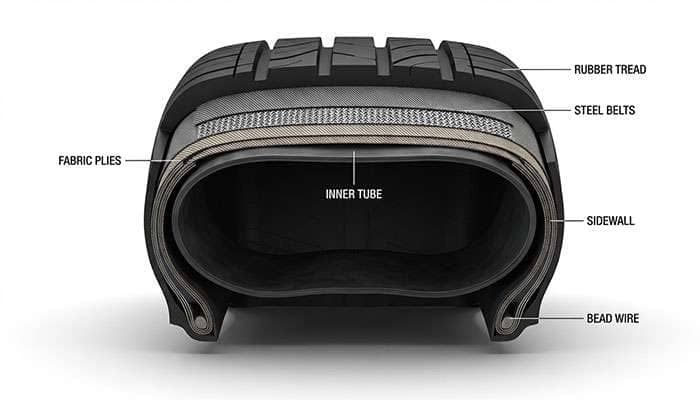
Radial tires represent one of the most important engineering advances in automotive history. The design fundamentally changed how tires function, moving away from construction methods that had dominated since the early 1900s.
Michelin filed their patent application on June 4, 1946, introducing the MICHELIN X tire. The revolutionary design positioned cords at 90-degree angles to the direction of travel. This construction approach solved multiple performance problems that had limited bias-ply designs for decades. Michelin expanded the concept to commercial vehicles by 1952, patenting the X-marked radial for truck applications.
The engineering advantage of radial construction comes from separating sidewall and tread functions. Picture the structure like a "peanut butter sandwich" with steel belts positioned between rubber compound layers. This creates two distinct performance zones:
Flexible sidewalls that absorb road impacts and improve ride comfort
Reinforced tread area with steel belts that maintains consistent ground contact
Multiple steel belt layers beneath the tread providing structural integrity
The sidewalls work like springs while the tread stays stable and flat against the road surface.
Radial design delivers measurable performance improvements. Rolling resistance accounts for 24-33% of total fuel consumption, and reducing rolling resistance by 20% can cut fuel use by 4.8-6.6%. Radial tires also run 15-20°F cooler than bias-ply designs, which extends service life significantly. The reduced heat buildup and energy loss essentially doubles tread life compared to bias-ply alternatives.
Cooper Tire adopted radial technology across their Evolution lines. The Evolution Tour features proprietary 3D Micro-Gage siping that extends through the entire tread depth for even wear. This all-season tire offers 60,000-mile warranties for H/V-rated versions and 65,000-mile coverage for T-rated models. The Evolution Sport uses asymmetric tread patterns that improve wet and dry traction with heat-resistant compounds designed for surface grip and high-speed durability.
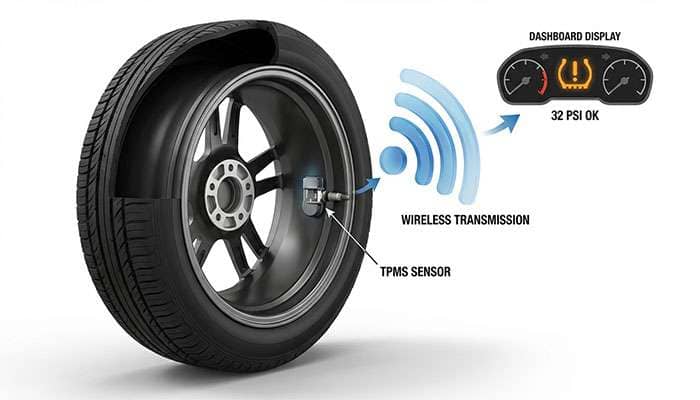
Modern tire technology has entered a new era where material science meets digital innovation. These advances deliver performance improvements that surpass what traditional tire construction could achieve.
Silica compounds now dominate modern tire construction, replacing carbon black as the primary reinforcing material. This switch delivers measurable performance gains: rolling resistance drops by 20-30%, which translates to 1.5-2% lower CO2 emissions. Silica-reinforced tires also provide better wet weather grip while extending overall tread life.
The science behind this improvement lies in how precipitated silica creates a reinforcing network throughout the rubber compound. This network increases tensile strength and abrasion resistance, allowing the tread to wear more slowly and evenly. The result is a tire that performs better and lasts longer.
Graphene represents the next frontier in tire reinforcement materials. This single-atom-thick carbon layer increases tensile strength by 30-40% and improves abrasion resistance by up to 500%. Real-world testing shows graphene-infused compounds deliver 19% better puncture resistance without compromising traction or flexibility.
Self-healing rubber technology uses microcapsule systems or reversible chemical bonds embedded in the polymer structure. When damage occurs, these bonds break and then automatically reform to repair the material. Heat can accelerate the healing process, with some systems achieving 99% repair efficiency within minutes.
Smart tires equipped with IoT sensors monitor tire pressure, temperature, tread depth, and road grip conditions. These systems transmit data every 4-5 seconds, providing real-time alerts about potential issues before they become dangerous. Since tire problems cause over 35% of vehicle accidents, this monitoring technology represents a significant safety advancement.
We believe these innovations will continue transforming tire performance and safety. The combination of advanced materials and intelligent monitoring creates tires that not only perform better but actively help prevent problems before they occur.
Tire technology represents more than just engineering progress - it demonstrates how persistent innovation solves real-world problems for drivers everywhere. Charles Goodyear's accidental vulcanization discovery started a chain reaction that continues today with smart tire monitoring systems.
Radial construction changed the game completely. When Michelin introduced steel-belted radials, they didn't just improve tire performance - they doubled tread life while cutting rolling resistance significantly. That single innovation has saved billions in fuel costs and reduced vehicle emissions worldwide.
Modern materials push performance even further. Silica compounds cut rolling resistance by 30% while improving wet grip. Graphene reinforcement creates puncture resistance that was impossible with traditional rubber compounds. Self-healing technologies point toward tires that maintain themselves automatically.
Today's smart tires represent the latest evolution. Real-time pressure monitoring, temperature tracking, and tread depth sensors turn tires into active safety systems. These technologies prevent over 35% of tire-related accidents by alerting drivers before problems become dangerous.
The progression from solid rubber wheels to intelligent monitoring systems shows how engineering advances accumulate over time. Each breakthrough solved specific limitations while creating new possibilities for vehicle performance, safety, and efficiency.
At Performance Plus Tire, we understand how these innovations benefit drivers. Our selection includes the latest radial designs with advanced compounds and construction techniques. Whether you need all-season performance or specialized applications, we carry tires that represent over 180 years of engineering advancement. Ready to upgrade your ride with the best modern tire technology? Our expert team can help you select tires that deliver the performance, safety, and value that generations of engineering innovation have made possible.
The evolution of tire technology reveals how incremental engineering improvements can create revolutionary changes in transportation safety, efficiency, and performance.
• Radial tires deliver 35-45% longer service life than bias-ply designs, fundamentally changing tire construction with steel belts and flexible sidewalls.
• Modern silica compounds reduce rolling resistance by 20-30%, cutting CO2 emissions while improving wet grip and extending tread life significantly.
• Smart tire technology with IoT sensors monitors pressure, temperature, and tread depth in real-time, preventing over 35% of vehicle accidents caused by tire issues.
• Graphene-enhanced rubber increases puncture resistance by 500% and tensile strength by 30-40%, creating ultra-durable yet flexible tire compounds.
• Self-healing rubber technologies use microcapsules and reversible bonds to automatically repair minor damage, achieving 99% healing efficiency within minutes.
The journey from Goodyear's 1839 vulcanization discovery to today's intelligent tires demonstrates how material science and engineering innovation continue transforming this critical automotive component into a sophisticated safety and performance system.
Radial tires offer several benefits, including a smoother ride, lower noise, better handling, and improved traction. They also provide better fuel efficiency due to lower rolling resistance and have a longer service life, typically lasting 35-45% longer than bias-ply tires.
Mixing bias-ply and radial tires can lead to handling issues and uneven wear. Radial tires run cooler than bias-ply tires, which can cause overheating problems on one side of the vehicle. Additionally, the different construction types can affect suspension and overall vehicle performance.
Recent advancements include silica compounds that reduce rolling resistance by 20-30%, graphene-enhanced rubber for improved durability, self-healing rubber technologies, and IoT-enabled smart tires with real-time monitoring capabilities for pressure, temperature, and tread wear.
Modern tire compounds, particularly those using silica instead of carbon black, can reduce rolling resistance by 20-30%, leading to lower fuel consumption and CO2 emissions. These compounds also improve wet grip and extend tread life, enhancing both safety and longevity of the tires.
Smart tires equipped with IoT sensors can monitor tire pressure, temperature, tread depth, and road surface grip in real-time. This technology helps prevent over 35% of vehicle-related accidents caused by tire issues by alerting drivers to potential problems before they become critical.



