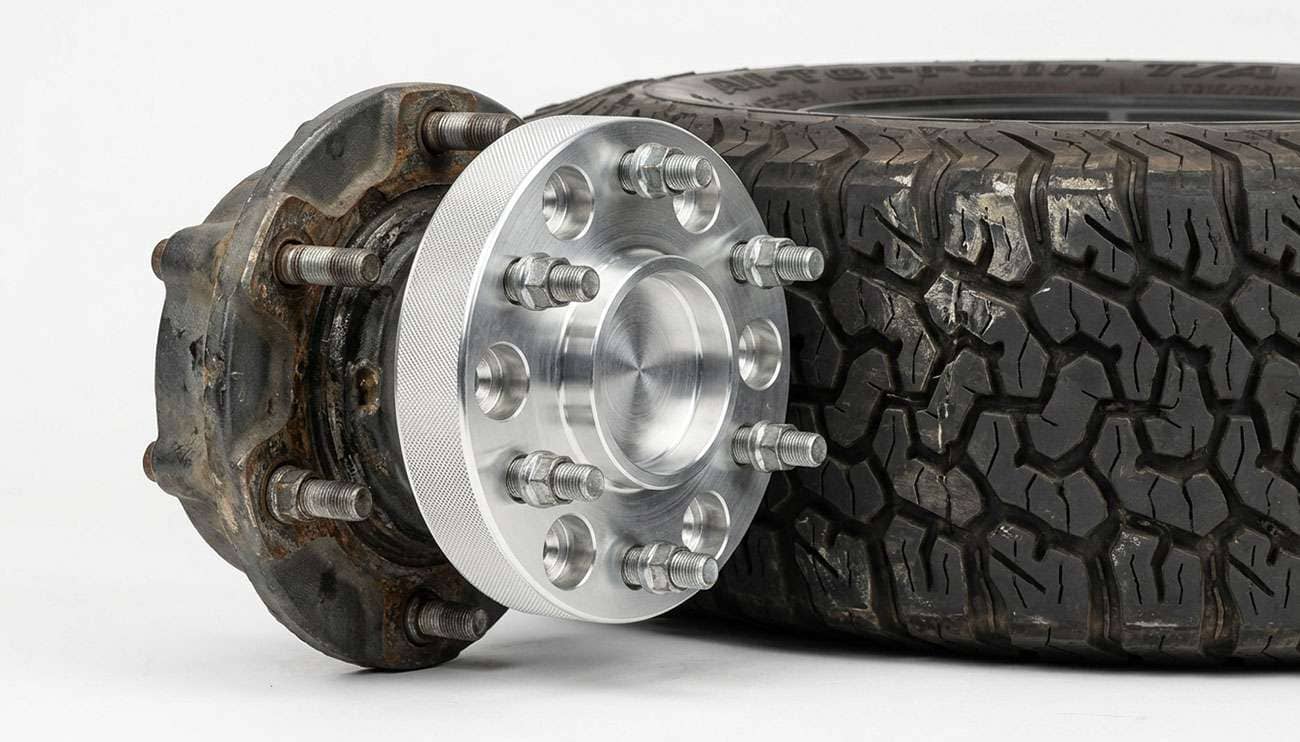
Sometimes, and the deciding variable is where the tire touches and whether the wheel is steered when it does. With the wheels straight, a spacer moves the tire outward by its full thickness, so it cures rub on struts, springs, and control arms and makes fender-lip rub worse. At full lock the push turns diagonal. At 35 degrees of steering, a 1.5-inch spacer moves the tire 1.23 inches outward and 0.86 inch forward or rearward, straight toward your bumper or the back of the wheel well.
If every answer you've found boils down to "it depends," that's what it depends on. Most guides split rub into inside versus outside and stop there. The part nobody puts in front of you is the fore-aft shift at full lock, which is how one spacer can clear a control arm and start chewing a bumper cover in the same turn. Let's run the numbers before you spend a dime.
Start with the witness mark, not the parts catalog. Polished plastic, a black rubber smear, or a bright spot on a control arm shows exactly where the tire makes contact. Match that location, and the moment it happens, to the table below.
Where the Tire Touches |
When It Touches |
Will a Spacer Stop It? |
Why |
|---|---|---|---|
Strut body, coil spring, or spring perch |
Wheels straight, over bumps |
Yes |
Moves the tire away by the spacer's full thickness |
Upper control arm (lifted IFS trucks) |
Full lock or full droop |
Usually |
Gains about 82 percent of the spacer's thickness at 35 degrees of lock |
Frame rail, sway bar end, or tie rod end |
Full lock |
Usually, but check the bumper side |
The tire moves outward, and also forward or rearward |
Fender lip or fender flare |
Over bumps or with a loaded vehicle |
No, it gets worse |
Pushes the sidewall further under or past the lip |
Front bumper, valance, or air dam |
Full lock, outside wheel of the turn |
No, it gets worse |
The tire moves forward about 57 percent of the spacer's thickness |
Mud flap or rear of the wheel well |
Full lock, inside wheel of the turn |
No, it gets worse |
The tire moves rearward about 57 percent of the spacer's thickness |
Front or rear of the liner, wheels straight |
Over bumps and dips |
No |
A height and diameter problem; a spacer only moves the tire sideways |
Inside and outside at the same time |
Full lock plus compression |
No |
The tire is too tall or too wide for the wheel well |
Brake caliper against spokes or barrel |
Constant scrape as the wheel turns |
Yes |
A thin spacer is the textbook fix for wheel-to-caliper contact |
Every "yes" is inboard contact. Every "no" is outboard, at the front or rear of the well, or a tire that's too big. The dividing line is inside versus outside, combined with whether the wheel is turned.
Contact on the tire's inner shoulder points inboard. Contact on the upper outer sidewall points to the fender. Scuffing only on the leading or trailing tread blocks points to the front or rear of the well. For full-lock rub, also note which wheel it is: on a left turn, the right front is the outside wheel and the left front is the inside wheel. If you haven't narrowed down the cause yet, our breakdown of why tires start rubbing covers the full list, then come back here with your contact point.
A wheel spacer is a machined disc, usually aluminum, that fits between the hub and the wheel. It reduces your effective offset by its own thickness: a 25 mm spacer under a +44 mm wheel puts that wheel where a +19 mm wheel would sit. Every clearance change follows from that.
With the wheels pointed straight, the spacer slides the wheel and tire outward along the axle line. Inboard clearance goes up by the spacer's thickness, outboard clearance goes down by the same amount, and nothing moves forward or back. On its own, that makes a spacer look like a simple trade of inside room for outside room.
The spacer pushes along the spindle axis, and the spindle axis rotates with the steering. Turn the wheel 35 degrees and the push splits in two. The cosine of 35 degrees, 0.82, goes outward. The sine, 0.57, goes fore-aft. The tire still moves exactly one spacer-thickness, just on a diagonal, which is why the two percentages add up to more than 100.
Because the steering axis sits inboard of the wheel, the outside wheel of a turn swings forward in the well and the inside wheel swings rearward. A spacer exaggerates both, pushing the outside tire toward the bumper and air dam and the inside tire toward the mud flap. Using 35 degrees as a working number (your exact full-lock angle differs, and the inside wheel turns a little tighter), a 1-inch spacer adds about 0.57 inch of fore-aft travel at full lock. A 2-inch spacer adds about 1.15 inches.
Veteran chassis engineer Huibert Mees, who led suspension work on the 2005 Ford GT and the 2012 Tesla Model S, puts normal kingpin offset (the distance from the steering axis to the wheel's centerline) at roughly 50 to 100 mm, and normal scrub radius within about 15 mm of zero. A spacer adds its full thickness to both. The tire's outer shoulder now swings on a longer arm through a wider arc, and steering effort, kickback, and wheel bearing load all climb with it. Before you move a wheel very far, read how much you can change wheel offset without creating new problems.
Yes. This is the job spacers do best. When the tire's inner shoulder or sidewall touches a strut body, coil spring, spring perch, or lower control arm with the wheels straight, a spacer adds clearance equal to its thickness. A 10 mm spacer buys 10 mm, with no geometry penalty on the inboard side.
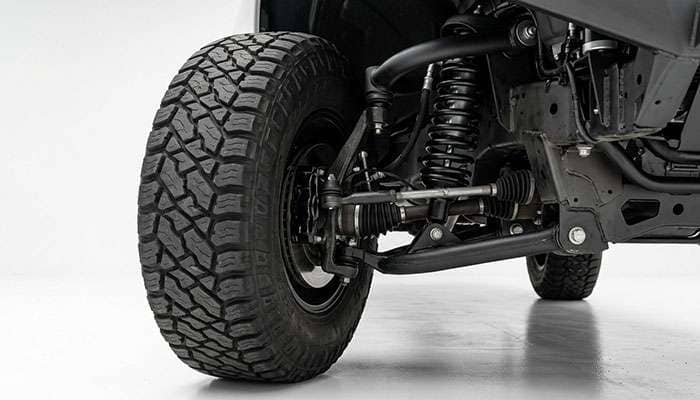
Inboard rub means the wheel sits too far in for the tire you're running. It usually follows a wider tire on the factory wheel, or an aftermarket wheel with more positive offset than the vehicle can use. Going from a 225 to a 255 section width on the same rim adds roughly 15 mm of reach on each side, and on many strut-type cars the inboard side has less room to give.
For strut and spring clearance on passenger cars, the gain needed is often just a few millimeters. Thin slip-on spacers ride on your factory studs, which makes thread engagement the limit. The common shop minimum is engagement at least equal to the stud's diameter. If a spacer eats into that, you need longer studs or a thicker bolt-on spacer with its own studs.
Rear wheels on vehicles without rear steering never turn, so a rear spacer only moves the tire straight out. Inboard rear rub responds exactly as the math predicts, and so does the fender lip above it: every millimeter gained inside comes out of the room outside.
No. A spacer makes fender rub worse every time, because it moves the tire toward the thing it's already hitting. If the tire contacts the fender lip, a flare, or the outer edge of the liner, a spacer pushes the sidewall further under that edge and turns an occasional brush into regular contact.
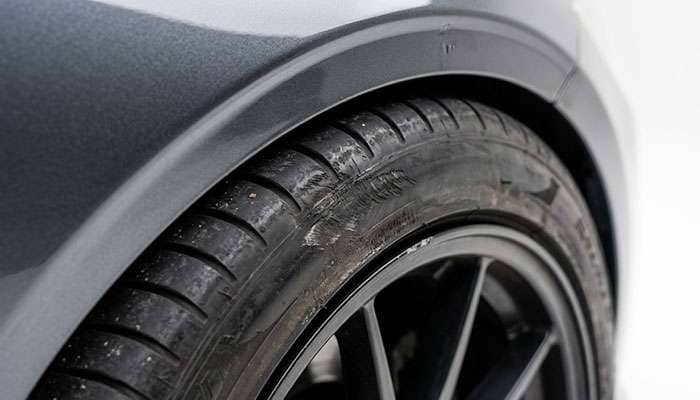
At ride height, most fender rub doesn't exist. Hit a dip, load the bed, or seat four adults in a lowered sedan, and the suspension compresses and raises the tire into the arch. Mees has noted that factory engineers deliberately leave a gap between sidewall and fender to cover suspension movement and car-to-car build variation. A spacer spends that gap before the suspension ever moves.
The fixes that work all run opposite to a spacer: rolling or trimming the lip, a little more negative camber to tilt the tire's top inward, a narrower tire, or a wheel with more offset. Fender rub often means the wheels already sit too far out.
Fender contact lands on the upper sidewall, the thinnest structural section of the tire, and a sharp lip wears through rubber fast. If you see scuffing, fraying, or exposed cords, check whether that sidewall damage is safe to drive on before your next trip.
It depends on which part of the tire is touching and which wheel it is. Full-lock rub comes in two versions that sound identical from the driver's seat, and they respond to a spacer in opposite ways.
If the tire's inboard shoulder hits the frame rail, a sway bar end, a tie rod end, or the inner liner at full lock, a spacer moves it away. You just don't get the whole thickness. At 35 degrees you get about 82 percent, so a 1-inch spacer buys roughly 0.82 inch at that contact point.
If the outside tire's leading edge hits the bumper cover or air dam, or the inside tire's trailing edge hits the mud flap, a spacer drives the tire deeper into that contact. Take a truck that clears its bumper by half an inch at full lock. Add a 1.5-inch spacer and that corner needs 0.86 inch of room, which creates a 0.36-inch interference that didn't exist before.
This is the scenario that fills fitment forums: a spacer cures an inboard rub at full lock and starts a new one at the bumper or mud flaps. One Land Cruiser owner who moved from +45 mm to +25 mm wheels, the same 20 mm move a 20 mm spacer makes, reported new mud flap rub whenever the front wheels were turned. Measure both sides of the problem before you buy.
On a solid front axle, adjustable steering stops limit how far the knuckle turns. Backing the tire off a small full-lock rub by a degree or two costs a little turning radius and nothing else, without adding a single fastener to the wheel end.
They fix the tire hitting an aftermarket upper control arm. They don't fix a taller tire hitting the bumper or mud flaps at full lock.
Lift kits for independent front suspension trucks often include tubular or boxed upper control arms that correct ball joint angle and caster. Those arms are bulkier than stock, and a larger tire's upper inboard shoulder can meet them at full lock or full droop. Spacers are the standard answer because they move the tire out without reducing steering angle. Size them with the 82 percent rule.
Lifting an IFS truck can tilt the knuckle forward and reduce caster, and aftermarket arms tilt it back. Either change moves the tire forward or rearward in the well, which is how a truck can start rubbing right after an alignment with no parts changed. Ask the shop what caster it set before you blame the tire.
A 35-inch tire has a full inch more radius than a 33, and that radius reaches forward and back at full lock, the same direction a spacer adds reach. If you're still planning the build, check which tire sizes each lift height clears and treat spacers as fine-tuning, not a way to squeeze in one more size.
Size a spacer from the gap you need, not the stance you want. The table shows where each common thickness actually moves the tire, plus the effective offset it creates on a +44 mm factory-style wheel.
Spacer Thickness |
Outboard Move, Wheels Straight |
Outboard Move at Full Lock |
Fore-Aft Move at Full Lock |
Effective Offset on a +44 mm Wheel |
|---|---|---|---|---|
1/4 in (6 mm) |
0.25 in |
0.20 in |
0.14 in |
+38 mm |
1/2 in (13 mm) |
0.50 in |
0.41 in |
0.29 in |
+31 mm |
1 in (25 mm) |
1.00 in |
0.82 in |
0.57 in |
+19 mm |
1.25 in (32 mm) |
1.25 in |
1.02 in |
0.72 in |
+12 mm |
1.5 in (38 mm) |
1.50 in |
1.23 in |
0.86 in |
+6 mm |
2 in (51 mm) |
2.00 in |
1.64 in |
1.15 in |
-7 mm |
Full-lock figures use a 35-degree steering angle and ignore the small tilt from caster and steering axis inclination. Fore-aft movement is forward on the outside wheel of a turn and rearward on the inside wheel.
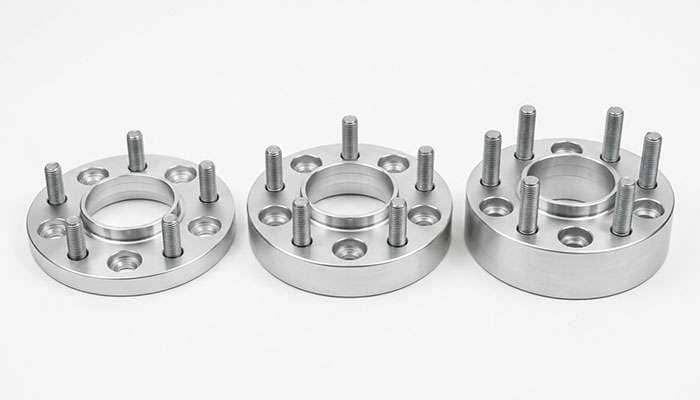
For inboard rub with the wheels straight, the clearance you need plus a working margin equals the spacer thickness. For inboard rub at full lock, divide that total by 0.82. Want half an inch of clearance at the upper control arm plus a quarter-inch margin? That's 0.75 divided by 0.82, or 0.91 inch, so a 1-inch spacer works and a 3/4-inch spacer comes up short.
Multiply your spacer thickness by 0.57 and compare it to the room ahead of the outside tire's leading edge and behind the inside tire's trailing edge at full lock. Then compress the suspension and subtract the full spacer thickness from your fender lip gap. If either number goes negative, that spacer trades one rub for another. And never stack two spacers to reach a number; use one thicker piece or a different wheel.
For tire clearance alone, a spacer and a wheel with the same net offset put the tire in the same place. As Mees put it when readers pressed him on this, what matters is where the wheel centerline ends up. The real difference is the hardware between hub and tire.
SAE J2530 is the recommended practice that sets performance tests and marking requirements for aftermarket passenger car and light truck wheels. A spacer adds a second bolted joint in front of that tested wheel, with its own studs, nuts, and torque sequence: spacer to hub first, wheel to spacer second. Choose hub-centric spacers so the wheel centers on a machined lip. Our guide to hub-centric vs. lug-centric wheels explains why that lip matters for vibration and stud loading.
Spacers make sense when you want to keep factory wheels, need a few millimeters of inboard clearance, or need to clear a big brake caliper. For hardware quality and bearing wear, read whether wheel spacers hurt your car before you order.
If you need an inch or more, you're buying tires anyway, or your state restricts spacers, a wheel built at the right offset is the cleaner fix. Pennsylvania's inspection regulations, for example, bar spacers thicker than 1/4 inch installed to widen wheel track under 67 Pa. Code Section 175.65(h). Availability works in your favor: across the aftermarket, 20x9 truck wheels are most commonly built at 0, +18, and +20 mm, so the roughly +19 mm position a 1-inch spacer creates on a +44 mm wheel is an ordinary off-the-shelf number. Most 20x10 wheels run negative offset, with -18 mm and -25 mm among the most common.
Rub never holds still. Every contact removes a little material, and the damage climbs a predictable ladder.
Work through these in order. The measuring in steps three and four is what keeps you from buying the wrong fix.
A wheel spacer moves the tire in one direction: outward. That makes it excellent for inboard rub on struts, springs, and control arms, and wrong for fender rub every time. The piece most owners don't see coming is full lock, where the outward push turns diagonal and shoves the tire forward on the outside wheel and rearward on the inside wheel by more than half the spacer's thickness.
Find the witness mark, note the wheel and the moment, and run the 0.82 and 0.57 numbers before you buy. If the math calls for an inch or more, or your state limits spacer thickness, you can browse wheels built at the offset your fitment needs and skip the extra joint entirely.
Here's what decides whether a spacer stops your rub or moves it.
They help when the tire rubs something inboard, like a strut, spring, or control arm, because they move the tire away by their full thickness. They make rub worse when the tire hits the fender lip, a flare, the bumper, or the mud flaps.
Yes. A spacer pushes the tire toward the fender, which can create lip rub over bumps. At full lock it also moves the outside tire toward the bumper and the inside tire toward the mud flap.
Only if the tire hits something inboard, like the frame, sway bar, or upper control arm, and you gain about 82 percent of the spacer's thickness there. If it hits the bumper, air dam, or mud flaps, a spacer makes that worse.
Add a margin to the clearance you need. For rub with the wheels straight, that total is your thickness; for full-lock rub, divide it by 0.82. Then confirm you have 0.57 times that thickness in fore-aft room.
For tire position, yes. A 25 mm spacer on a +44 mm wheel places the tire where a +19 mm wheel would. The difference is the second bolted joint a spacer adds.
It depends on your state. Pennsylvania's inspection regulations, for example, bar spacers thicker than 1/4 inch installed to increase wheel track. Check your state's rules before you buy.